
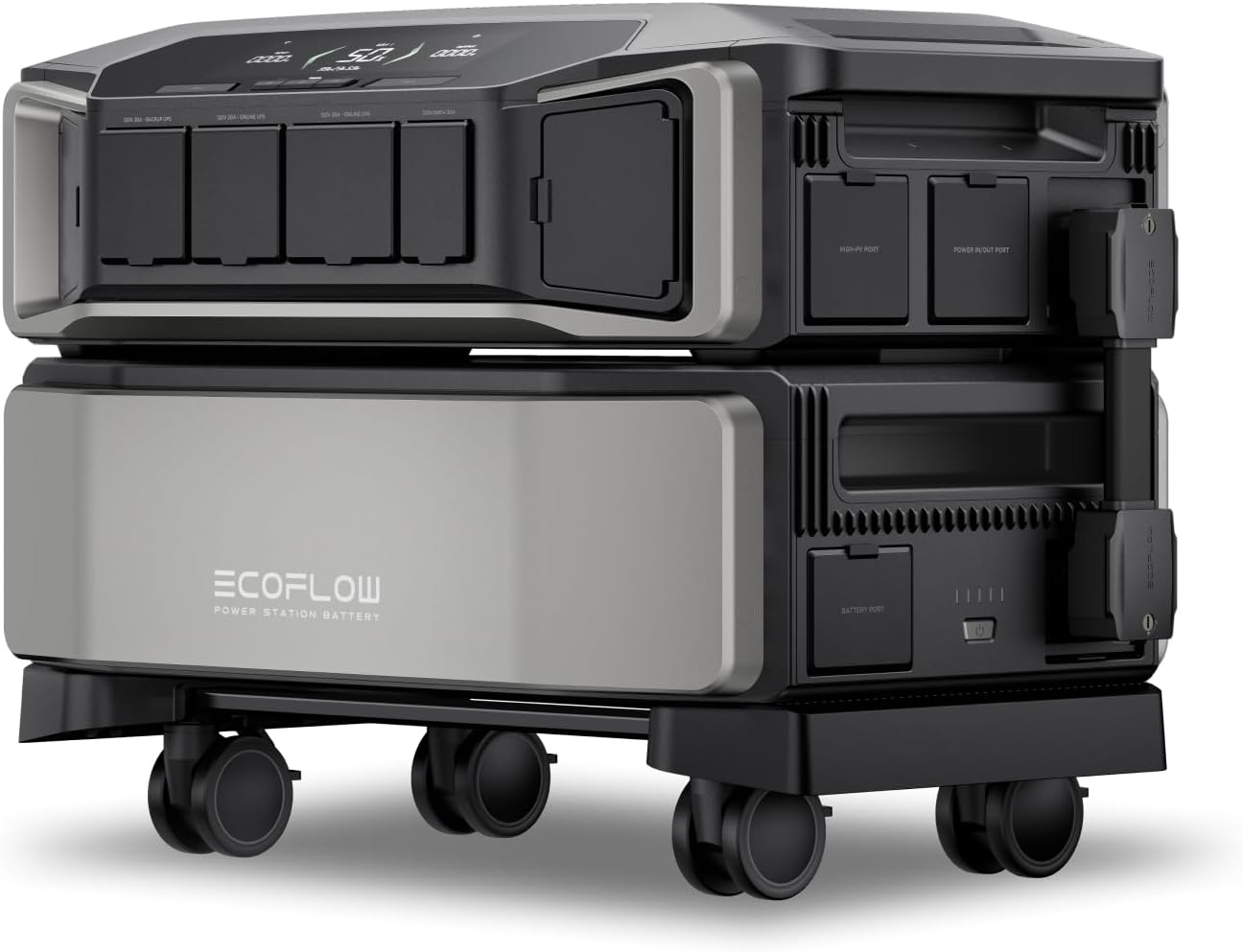
The third outage that year lasted four days. Four days. I stopped counting the cost of the spoiled food after the second day because the number was making me nauseous, and by the third day I was charging my phone in the car like a teenager and seriously pricing a hotel. That’s the outage that ended with me buying the EcoFlow DELTA Pro Ultra, and I want to be honest about the emotional state behind this purchase: it was not a rational comparison-shopping decision. It was a man who had been without hot water for 96 hours typing his credit card number with feeling.
6144 watt-hours. 7200 watts of output. 120 and 240 volts. Let me translate those numbers into the language of someone who has lived through a multi-day outage: this thing runs my entire house. Not the “essential circuits” version of my house that the smaller stations offer, where you pick three appliances and say goodbye to the rest. The whole house. The 240V output means the well pump runs. It means the electric dryer runs. It means the mini-split runs. During the ice storm last February, eleven days after I bought it, the grid died for 52 hours and my house was the only one on the street with lights, heat, and a working washing machine. My neighbor asked if he could run an extension cord over. I said yes. I am still dining out on that story.
Here’s the part where my grudge against the industry gets complicated, because EcoFlow’s marketing for this thing is actually restrained compared to what it can do. The spec sheet says 6144Wh expandable to 90kWh with extra batteries, which is a number so large it stops meaning anything. Ninety kilowatt-hours is three days of my entire house. Nobody needs that. But 6144Wh, the base unit, is the first capacity number I’ve owned that covers a full day of normal life, not survival-mode life, and then some.
The 7200 watts that actually matters
Most power stations top out at 3600W, which handles most things but draws a hard line at 240V appliances. The DELTA Pro Ultra’s 7200W with dual voltage erases that line. My central air’s startup surge is around 5000W. The Ultra didn’t flinch. I tested this in August, deliberately, AC blasting, dryer running, because I needed to know before the next storm, and the unit just sat there humming quietly while my electric meter spun backward in my imagination.
The 2-hour full recharge from the wall is real, I timed it, 1 hour 58 minutes from 5% to full, and that speed changes the strategy completely. With slower stations, you nurse the battery, you ration, you do outage math in your head all day. With a 2-hour recharge, the moment the grid flickers back for even a few hours, you’re full again. During the February storm we got four hours of grid power on day two, and by the time it died again I was back to 100%. That’s not a battery. That’s a time machine.
What they don’t tell you about 186 pounds
This site contains affiliate links. We may earn a commission on qualifying purchases.
It weighs 186 pounds. Let that number sit next to the word “portable” in the product name and watch them fight. This is not portable. This is furniture. It arrived on a pallet, and the delivery driver and I looked at each other with the shared understanding of two men about to hurt themselves. We got it into the garage. It has not moved since. It will never move again. When I sell this house, the DELTA Pro Ultra is staying, and I’ll mention it in the listing.
And honestly? That’s fine. The whole “portable power station” framing breaks down at this size, and EcoFlow knows it, which is why they also sell it as a home backup system with a smart panel. The wheels are a courtesy, not a feature. If you’re buying this, you’re buying home infrastructure. Plan the install location like you’d plan a water heater: near the panel, on concrete, where 186 pounds can live forever.
My tangent, because the template demands one and because it’s true: during the four-day outage, the thing I missed most wasn’t the lights or the heat. It was the garage door opener. Such a stupid, small thing. I came home the first night, pressed the button out of pure muscle memory, nothing happened, and I sat in my driveway in the dark feeling profoundly betrayed by a button. The DELTA Pro Ultra now backs up the garage door opener circuit, specifically, spitefully, because I never want to feel that particular betrayal again. Twelve watts. The smallest load in the house. The most important one.
The money question
This is the most expensive single purchase in my backup-power journey, by a lot, and I did the payback math the way I do everything now: with a grudge and a spreadsheet. A whole-house Generac with auto-transfer runs $12,000 installed, needs gas, needs maintenance, and sounds like a truck idling in your yard. The Ultra plus one expansion battery was less than half that, silent, no fuel, no maintenance beyond wiping dust off it. Against the cost of four days in a hotel plus spoiled food plus the sheer misery, it paid for itself in the first real outage.
Would I buy it again? I get asked this by everyone who sees it, and my answer is always the same: if your outages are measured in hours, this is overkill, buy something smaller. If your outages are measured in days, if you’ve ever charged your phone in a cold car at midnight, if you’ve ever thrown away a freezer full of food, then yes. A thousand times yes. The only thing I regret is the two smaller stations I bought first. Add up what I spent on those plus this, and I could have bought the Ultra twice.
Actually, no. That’s not right either. The smaller ones taught me what I actually needed. Without the adverb incident and the dead freezer, I’d never have understood why 6144Wh matters. So I don’t regret them. I just wish someone had handed me the Ultra first and saved me the tuition.


