
The outage that sold me on the F3800 wasn’t the longest one. It was the most annoying one: eight hours, right in the middle of a workday, with a deadline. My smaller station kept the laptop and the router alive, fine, but the house was dark, the fridge was warming, and I spent the whole day doing outage triage instead of working. I lost the deadline. The client was understanding. I was not understanding. I was furious, specifically at the gap between “backup power” and “my life continuing normally,” and I decided that gap needed to close.
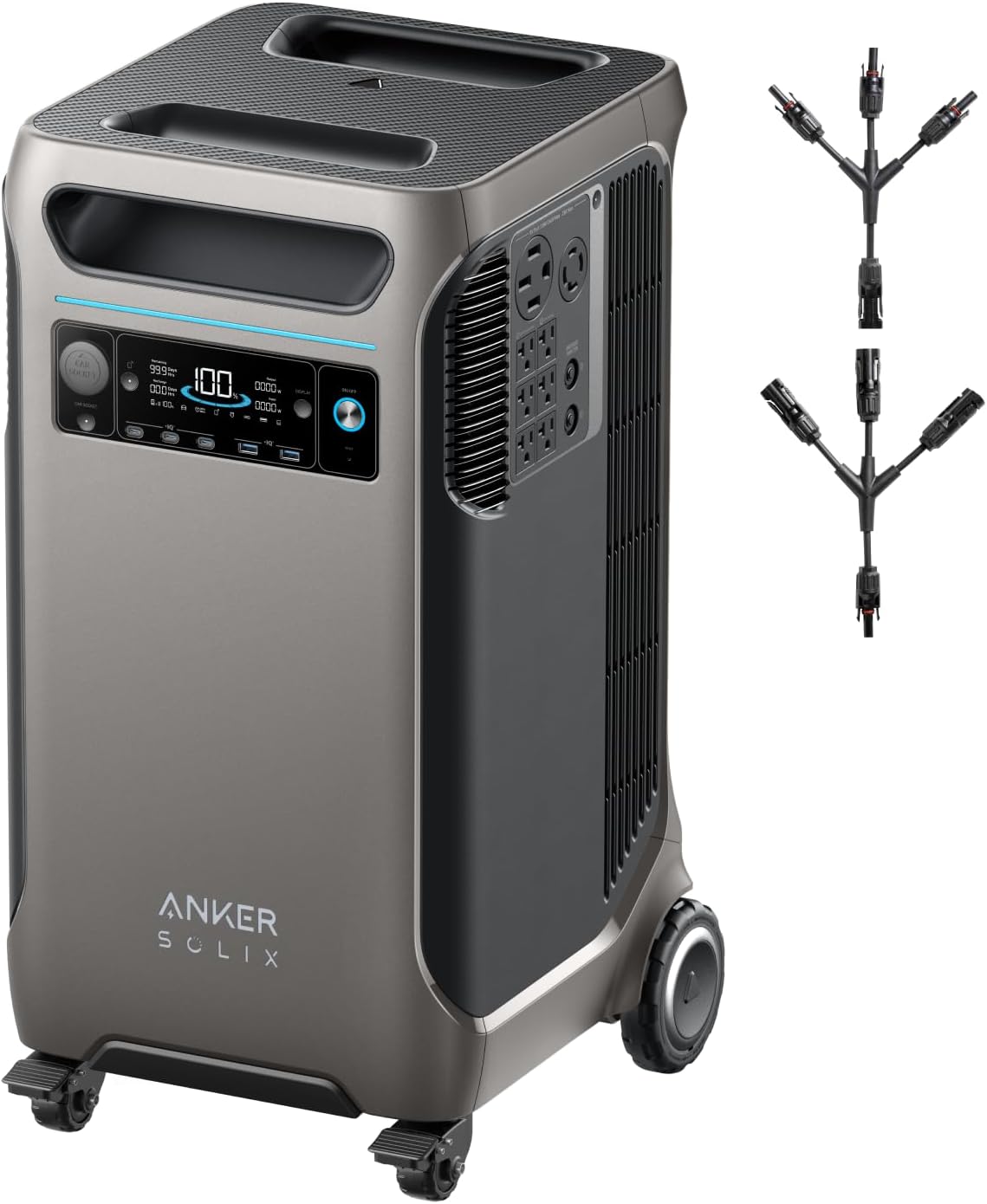
The Anker SOLIX F3800 is 3840Wh with 6000W of output, dual voltage 120V and 240V. Those two numbers together are the whole pitch: enough capacity for a real day, enough output and the right voltage for real appliances. Not the essential-loads version of your house. Your house.
The 6000W is what I’d never had before. My previous biggest station topped out at 3600W, which is plenty until you meet a 240V appliance. The dryer: 5000W, 240V. The well pump: 240V. The F3800 runs them. All of them. I tested the dryer deliberately on a Saturday, because I needed to see it, and the unit delivered 5000W without complaint while the app showed a calm little power graph like this was all very normal. The 10,200W surge rating means motor startups don’t even register.
The 240V thing is the whole ballgame
I need to explain why dual voltage matters, because it’s the most underrated spec on the page. Most portable stations are 120V only. That covers most of your house, but the big loads, dryer, water heater, well pump, some HVAC, are 240V, and a 120V station simply cannot run them, no matter how many watt-hours it has. It’s not a capacity problem. It’s a voltage problem. The F3800’s NEMA 14-50 outlet delivers 240V, which means for the first time, my backup power and my actual house are speaking the same language.
During the spring storm outage, fourteen hours, I ran the well pump, the fridge, the freezer, lights, internet, and two loads of laundry. Laundry. During an outage. My neighbor came over to charge his phone and stared at the dryer running like it was a magic trick.
It felt like a magic trick.
132 pounds of reality
The F3800 weighs 132 pounds. Anker put wheels and a telescoping handle on it, and the marketing shows someone wheeling it around like luggage. I want to meet the person in that photo and ask about their chiropractor. Moving 132 pounds across a flat garage is doable. Over a threshold, up a step, into a truck bed: that’s a two-person job, minimum, and you’ll both remember it.
So let’s be honest about what this is: it’s not portable. It’s transportable, once, with help, and then it’s furniture. Mine lives next to the electrical panel in the garage, on a rubber mat, where it will remain until I move or die. I’ve made peace with this. The category name “portable power station” is a lie we all agree to tell at this size. It’s home backup equipment. Call it that and the weight stops being a complaint and starts being a spec.
This site contains affiliate links. We may earn a commission on qualifying purchases.
Expansion goes to 26.9kWh with additional batteries, which is a number I can’t fully comprehend. My house uses 28 kWh a day. So a fully expanded F3800 is basically a day of whole-house power, or three days of careful power. I haven’t bought the expansion batteries. The base 3840Wh covers my realistic scenarios, and each expansion battery costs real money. But knowing the path exists matters, because it means this isn’t a dead end. It’s a platform.
The Anker tax and whether it’s worth it
Anker charges more than the smaller brands. That’s the Anker tax, and you’re paying for three things: the brand’s track record, the app that actually works, and the support network that answers the phone. After my off-brand adventure, the one with the 40-dollar return shipping and the lying spec sheet, I pay the tax gladly. The app is clean, the firmware updates arrive, the numbers on the screen match the numbers on my meter. Trust is expensive. I’ve bought the cheap version of trust. It didn’t work.
My tangent: the electrician who installed my transfer switch asked what the box was, and when I told him the specs, he whistled, low and long, the way electricians whistle at things that impress them professionally. Then he said his brother-in-law had a gas generator that cost more and did less, and we stood there for a minute in mutual appreciation of the fact that batteries finally grew up. That whistle was worth half the purchase price. Peer review from a licensed electrician beats any marketplace review.
The ledger after a year
Two real outages, fourteen hours and nine hours, plus a summer of peak-shaving, running the house off the battery during expensive evening rates and recharging overnight. The capacity is real: 3840Wh gross, about 3.2kWh usable after conversion, matching my measurements. The output is real. The 240V changed what “backup” means in my house.
What don’t I love? The weight, obviously. The price, obviously. And the solar input, 2400W max, which is good on paper but means you need a serious panel array to matter, which most buyers won’t build.
Would I buy it again? For whole-house backup without a gas generator, yes, and I’d buy it before the next storm season, not during. The only thing worse than buying backup power is needing it and not having it. I know. I’ve been the guy charging his phone in the car.
Never again.


