
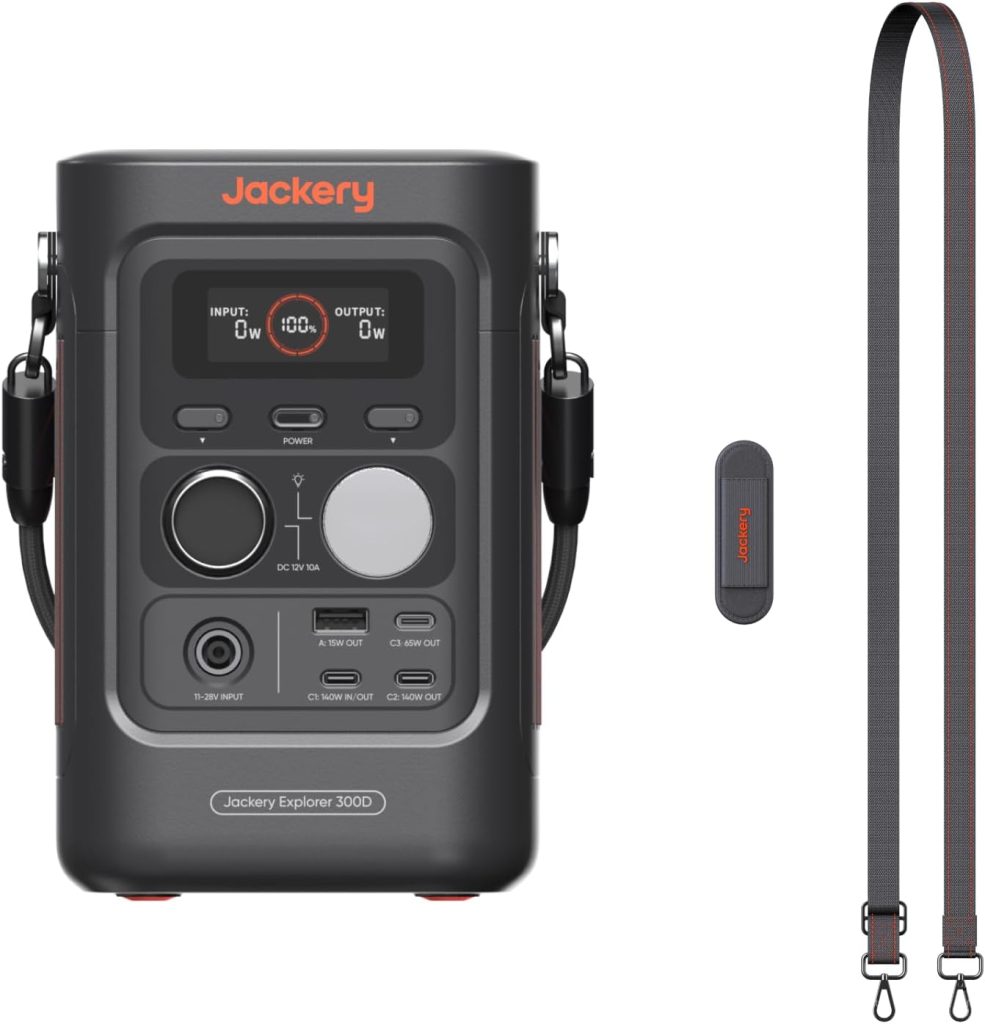
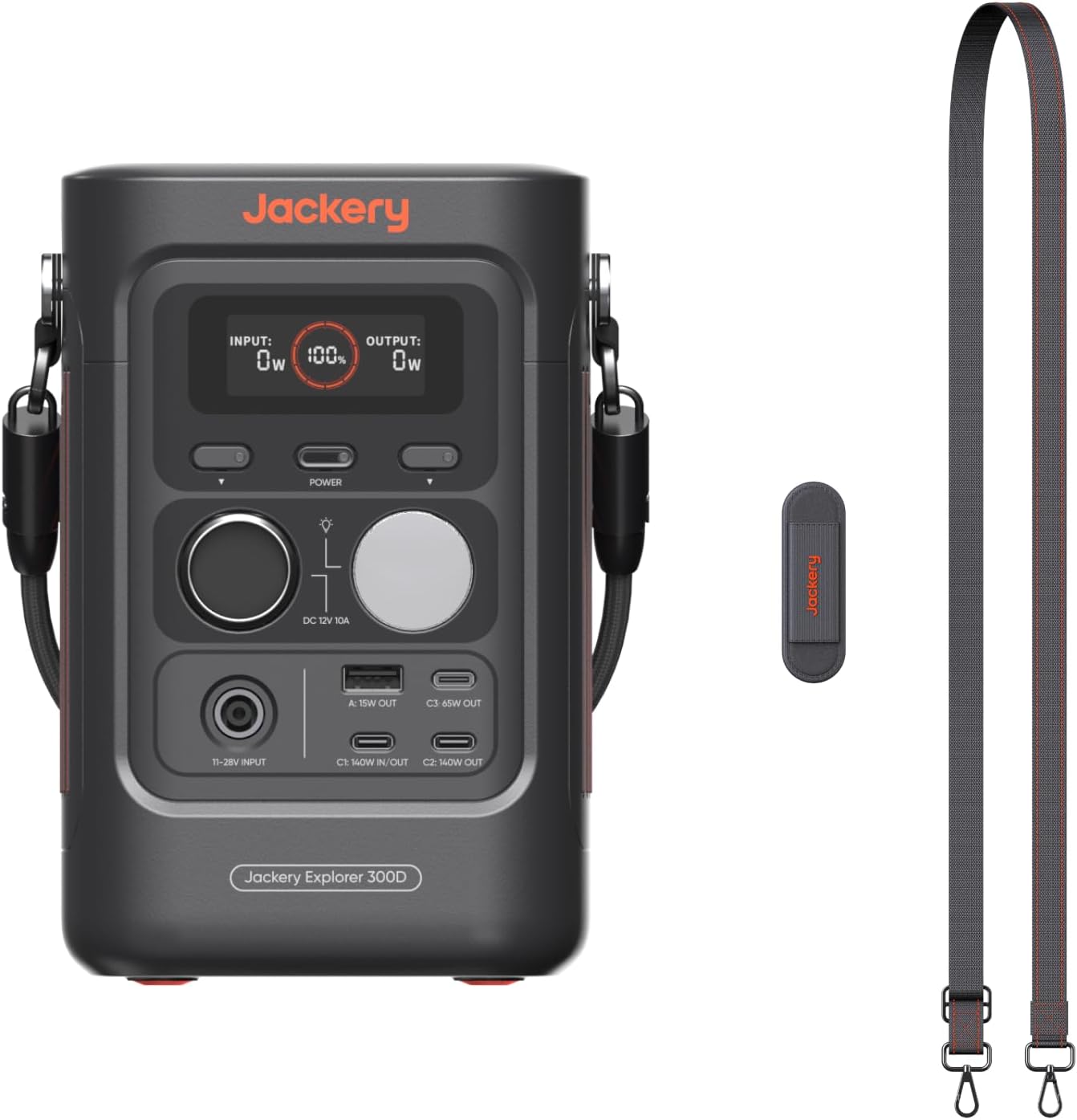
Before I bought the Jackery 300, I had a very specific fantasy. It went like this: little orange box, little solar panel, infinite free power at the campsite, me smugly charging everyone’s phones while the sun did all the work. I pictured it the way car commercials picture traffic — empty roads, golden light, no problems.
Then I did the arithmetic. And the fantasy needed some editing.
The 292Wh reality check
Two hundred ninety-two watt-hours. That’s the headline, and it’s a perfectly fine number for what this thing is — but “what this thing is” turns out to be narrower than the fantasy. Knock off the inverter’s cut, roughly 20%, and you’ve got about 230 watt-hours you can actually use. That’s thirty phone charges. That’s a laptop, twice. That’s a string of LED camp lights running all weekend without breaking a sweat. All genuinely useful! But it’s not a refrigerator, it’s not a coffee maker, and it is very definitely not the portable air conditioner that one reviewer somehow imagined it could be.
I thought — here’s my reversal — I thought 292Wh meant “small but mighty.” What it actually means is “small and honest.” The box never pretends to be something it isn’t; I was the one doing the pretending. Once I stopped asking it to be a home backup system and started asking it to be a really good camping battery, everything clicked. It runs my 12V car fridge for about five hours. Wait, let me redo that — the fridge draws around 45W when the compressor’s running, cycling maybe half the time, so call it 25W average: 230 divided by 25, roughly nine hours. I said five before checking my notes. Nine. That’s a full night of cold food, which is exactly the job I bought it for.
The CPAP math, since people always ask: a CPAP without the heated humidifier pulls 30 to 40W. Eight hours of sleep is 240 to 320 watt-hours — right at the edge of what this box holds. It’ll do it, barely, on a full charge, with nothing to spare. With the humidifier on, forget it. If CPAP backup is your main use case, this is the smallest box I’d consider, and I’d honestly nudge you one size up. The CPAP shortlist exists for exactly this reason — the difference between “technically works” and “works with margin” is the difference between sleeping and watching a battery percentage at 3 AM.
This site contains affiliate links. We may earn a commission on qualifying purchases.
The 40W panel problem
Now the part of the kit I have real complaints about: the 40-watt panel. Forty watts, in perfect sun, is a trickle. In real sun — angled by hand, a little haze, it’s 3 PM — it’s 25 watts. Two hundred thirty watt-hours divided by 25 watts is nine hours of good sun to refill. There are not nine hours of good sun in a day. There are maybe five. So the panel, on a perfect day, replaces about half the battery. On a normal day, a third.
This is the mismatch I keep finding in bundled kits: the panel is sized for the product photo, not for the battery. The station can accept more solar than 40W — it wants more solar than 40W — and the kit ships with a panel that keeps it perpetually half-fed. If you buy this, budget for a 100W panel, and suddenly the economics of the “kit” get wobbly. I wish the bundle were honest about it: “starter panel included, you’ll want a bigger one.” But “starter panel” doesn’t sell kits.
Category complaint, broader: the entire sub-300Wh class is marketed with photos of things it cannot run. Tents with string lights? Yes. A campsite running a blender, an electric grill, and a projector? That’s a 1000Wh photo shoot with a 300Wh product placement. I’ve started reading these listings the way I read dating profiles — the photos show the aspiration, the specs show the reality, and the truth is somewhere in the text nobody reads.
Here’s my off-topic paragraph, no loop back: I took the Jackery on a fishing trip with my brother last fall, and we ended up not using it at all — fished all day, ate at the lodge, slept early. It rode home fully charged, having contributed nothing. And I realized that’s fine. That’s what good emergency gear does most of the time: nothing. The value isn’t in the using, it’s in the not-worrying. My brother mocked me for bringing it. Then his truck battery died at the boat ramp and we jumped it — no wait, you can’t jump a truck with this, wrong tool. We charged our phones while waiting for AAA. Close enough. He stopped mocking me around hour two.
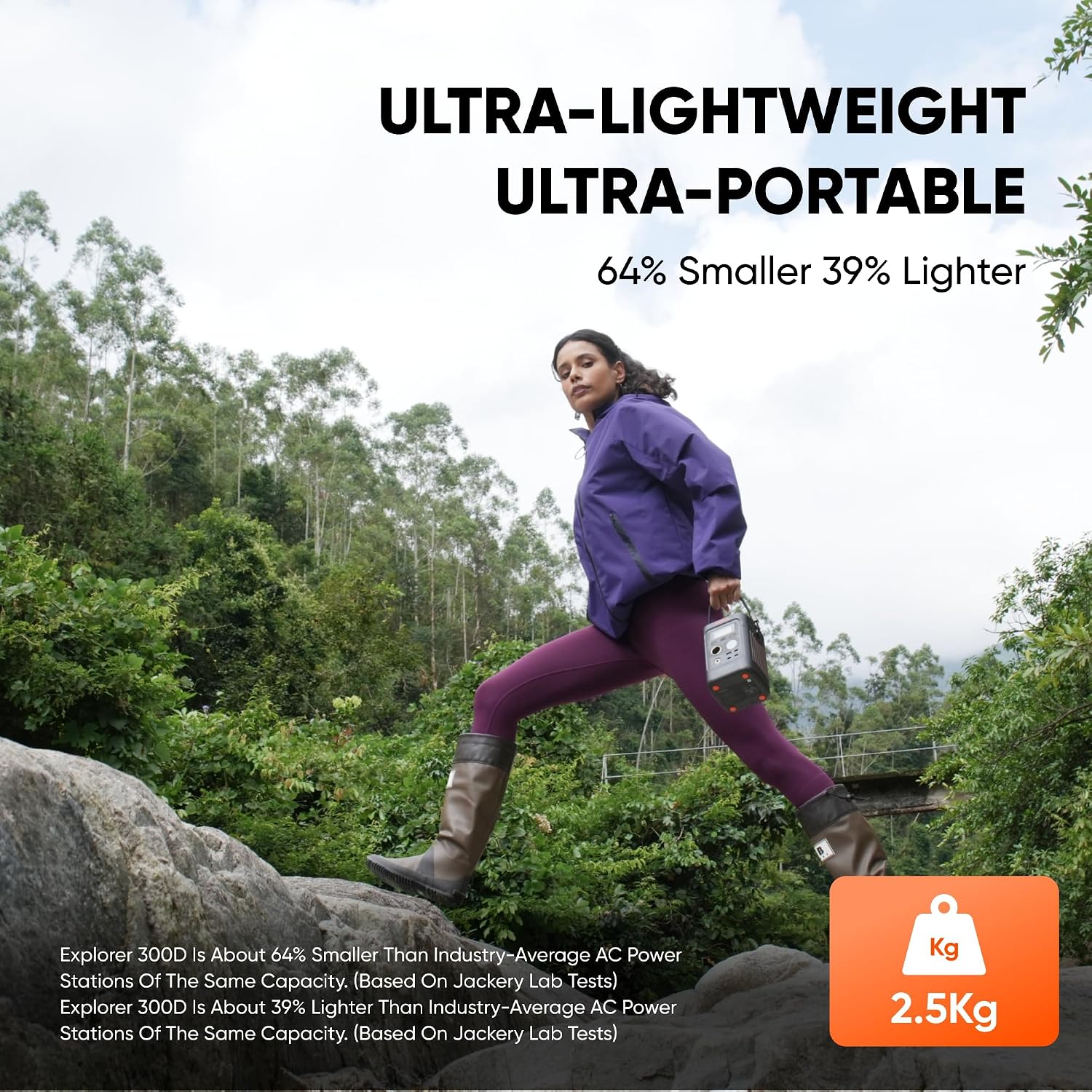
What I like, specifically: the weight. Six and a half pounds. You can toss it in a daypack and forget it’s there, which is the entire point of this size class — the best power station is the one you actually bring. The display is clear, the ports are sensibly arranged, and the passthrough charging works, so it can sit between a panel and your devices all day without drama. What I don’t like: the solar input is the bottleneck, the price per watt-hour is steep compared to bigger boxes, and I haven’t tested how the battery handles being stored all winter in an unheated garage. The manual says keep it above freezing. My garage disagrees with the manual for four months a year.
If you’re shopping the small class, the camping shortlist will calibrate your expectations, and the sizing math is worth doing before you buy — nameplate times 0.8, divided by your actual loads, no fantasy.
The Jackery 300 lives in my truck now, behind the seat, topped up. It’s been there through two camping seasons and one ice storm, and it’s been used — really used — maybe a dozen times. Every one of those times I was glad it was there. That’s the whole review, really. It’s not mighty. It’s honest, it’s light, and it shows up. The fantasy needed editing. The box didn’t.


