
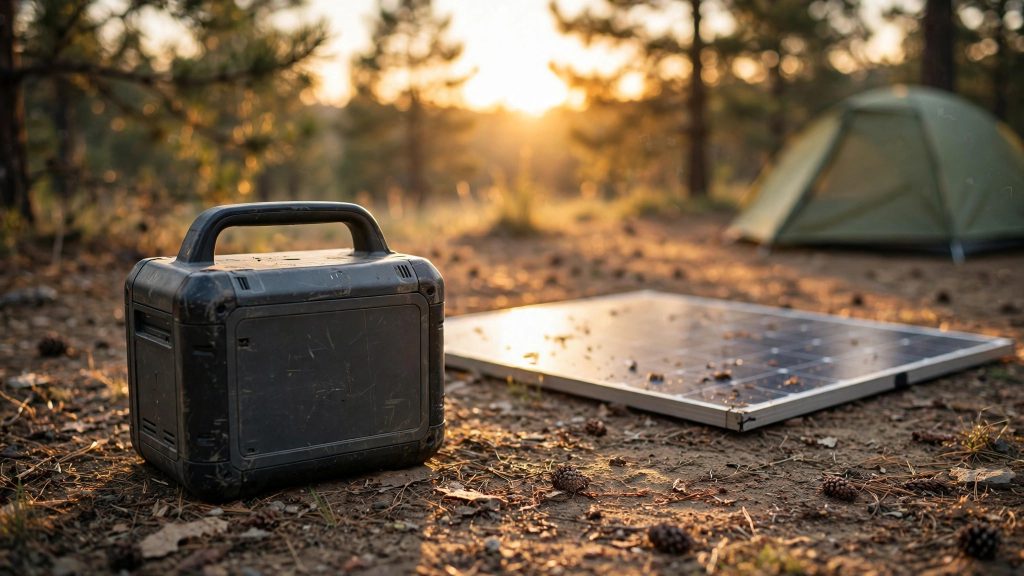
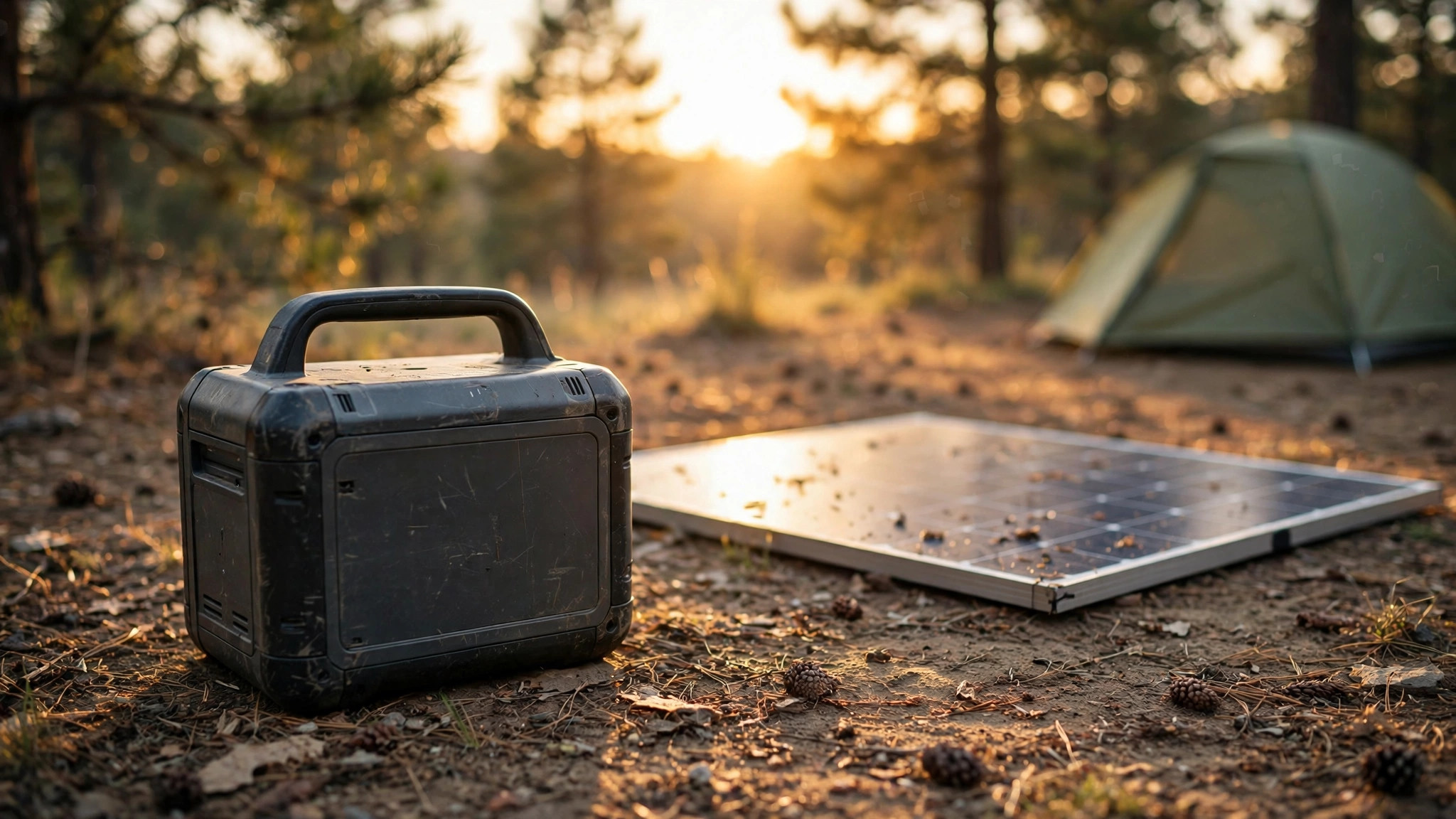
Short answer: Add up the watts of everything you want to run, multiply by the hours you’ll run them, then buy a portable power station with at least 20–30% more watt-hours than that number. Most campers land in the 256–500Wh range; home backup for a fridge and a few essentials usually needs 1,000–2,000Wh.
Picking the right size is the single most important decision when buying a portable power station. Too small and it dies halfway through the night; too big and you’ve overpaid for capacity you’ll never use. This guide walks you through the exact math — no guesswork — so you can size your station like a pro.
The 30-second sizing rule
size by watt-hours (Wh) for runtime, and by watts (W) for what it can actually turn on.
These are two different numbers and beginners mix them up constantly:
- Watt-hours (Wh) = the size of the “fuel tank.” A 1,000Wh station holds roughly twice the energy of a 500Wh station.
- Watts (W) = the maximum power it can deliver at once. A 1,000Wh station with only 600W output cannot run a 1,500W appliance, no matter how big the battery is.
You need both numbers to be big enough. The sections below show you how to check each one.
Step 1: List everything you’ll power
write down each device and its running watts — the nameplate or manual lists it, and the highest-wattage item sets your minimum output.
Walk through a typical day (or a typical outage) and note each device. Here are realistic running wattages for common gear:
| Device | Typical running watts | Notes |
|---|---|---|
| Smartphone (charging) | 10–20W | ~10–15Wh per full charge |
| Laptop | 45–90W | Check the charger brick |
| LED camp light / lantern | 5–15W | Tiny load, runs for days |
| 12V portable fridge (45L) | 35–60W | Cycles on and off |
| Full-size home refrigerator | 100–200W | Surge can hit 800–1,200W at startup |
| CPAP machine | 30–90W | Heated humidifier adds a lot |
| TV (43–55″) | 60–150W | LED/LCD models |
| Power tools (drill, saw) | 500–1,800W | Big surge on startup |
| Microwave | 800–1,200W | Needs a large station |
If you plan to run several things at once, add their watts together. That total must be under the station’s rated output — and under its surge rating for motor-driven appliances like fridges and power tools, which briefly draw 2–3× their running watts when they start.
Step 2: Do the watt-hour math
required Wh = (total watts × hours of use) × 1.25, and then round up to the next standard size.
The formula is simple:
Runtime (hours) ≈ Battery Wh × 0.85 ÷ Device watts
The 0.85 factor accounts for inverter losses — converting the battery’s DC power to household AC wastes roughly 10–15% as heat. The extra 1.25 multiplier (a 25% buffer) covers the fact that you rarely want to drain a battery to absolute zero, and that real-world loads fluctuate.
Worked example — keeping a fridge cold overnight: A full-size fridge draws about 150W while the compressor runs, and let’s say it cycles enough to average 150W over 8 hours. That’s 150 × 8 = 1,200Wh of energy. Add the 25% buffer: 1,200 × 1.25 = 1,500Wh. So you’d want a station in the 1,500–2,000Wh class — for instance, a 2,042Wh unit like the Jackery Explorer 2000 Plus covers this with room to spare.
Worked example — weekend camping: Phone charges (15Wh × 4), a laptop for 3 hours (65W × 3 = 195Wh), and LED lights for 6 hours (10W × 6 = 60Wh) total about 315Wh. With the buffer: 315 × 1.25 ≈ 394Wh. A 256–500Wh station handles this comfortably.
Step 3: Check the output wattage (not just capacity)
the station’s rated AC output must exceed your highest single device’s running watts — and its surge rating must cover motor startup spikes.
This is where most sizing mistakes happen. A 500Wh station with 300W output will happily charge phones all weekend but will shut down the instant you plug in a 700W coffee maker. Always compare the output spec against your biggest load:
- Phones, lights, cameras, drones → 300–600W output is plenty
- Laptops, 12V fridges, TVs, CPAP → 600–1,000W output
- Full-size fridge, power tools, microwave → 1,500–3,000W output
For anything with a motor or compressor, check the surge/peak rating too. A fridge that runs at 150W might need 1,000W for the split second its compressor kicks on — if the station can’t supply that spike, it trips.
Quick size chart: which capacity fits which job
100–300Wh for personal electronics, 500–800Wh for car camping and CPAP, 1,000–1,500Wh for a fridge or home essentials, 2,000Wh+ for whole-weekend off-grid or multi-appliance backup.
| Capacity | Best for | Example pick |
|---|---|---|
| 100–300Wh | Phones, tablets, cameras, LED lights, short laptop sessions | 256Wh class |
| 500–800Wh | 12V car fridge for a weekend, CPAP overnight, drone batteries | 500–800Wh class |
| 1,000–1,500Wh | Full-size fridge for hours, home office during outages, power tools | ~1,024Wh class |
| 2,000Wh+ | Multi-day off-grid, several large appliances, serious home backup | ~2,042Wh class |
Three proven sizes worth buying
if the math above points you at a size class, these are solid, widely-reviewed examples of each — small, medium, and large.
Every pick below is a real, current product with published specifications (capacity and output figures are the manufacturers’ rated specs). Choose the size class your calculation pointed to, not the biggest one by default.
Small (256Wh): EF ECOFLOW RIVER 2
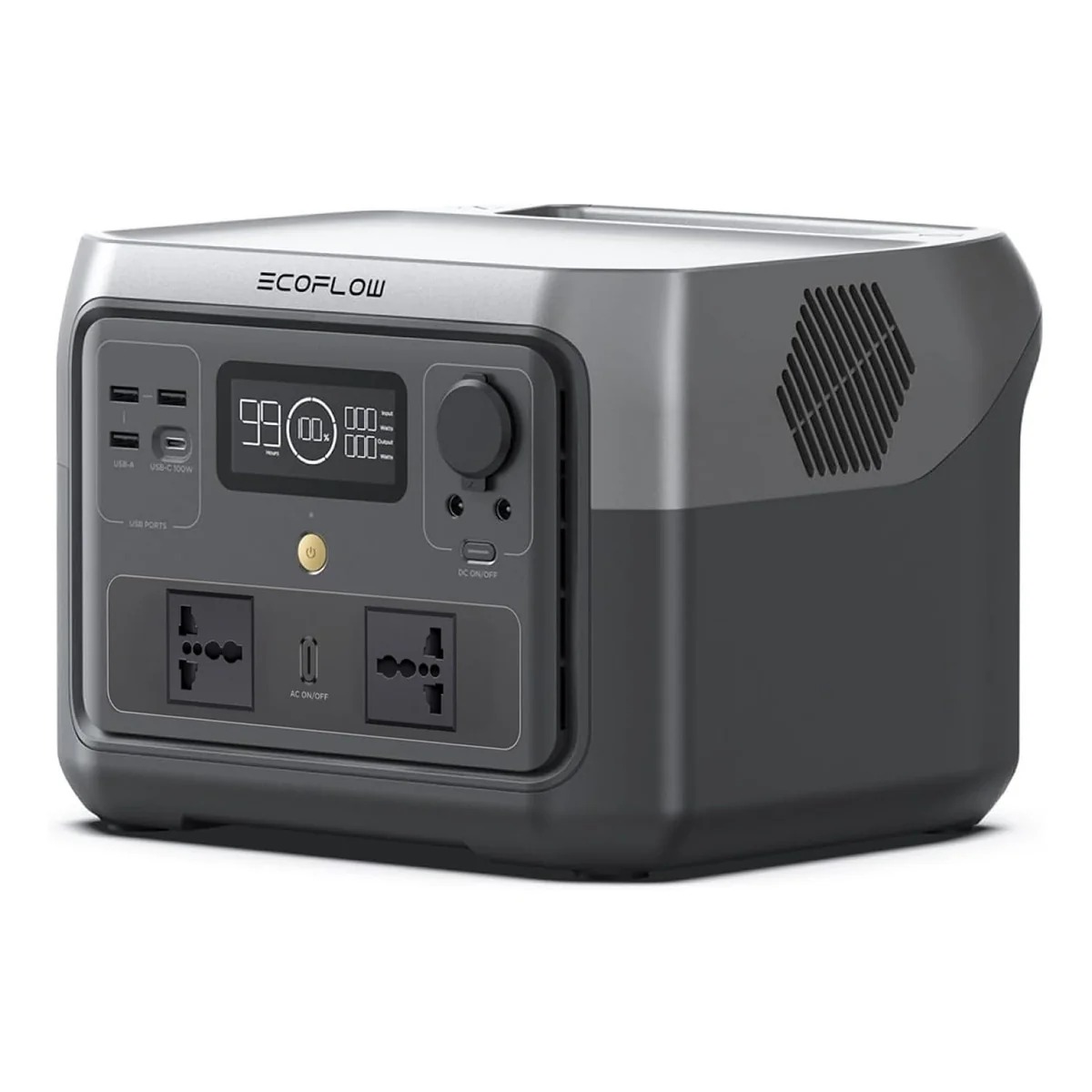
EF ECOFLOW RIVER 2 — 256Wh / 600W
A 7.7 lb LiFePO4 unit for phones, laptops, cameras and lights on weekend trips; recharges from a wall outlet in about an hour and accepts solar input for off-grid top-ups.
Medium (1,024Wh): EF ECOFLOW DELTA 2
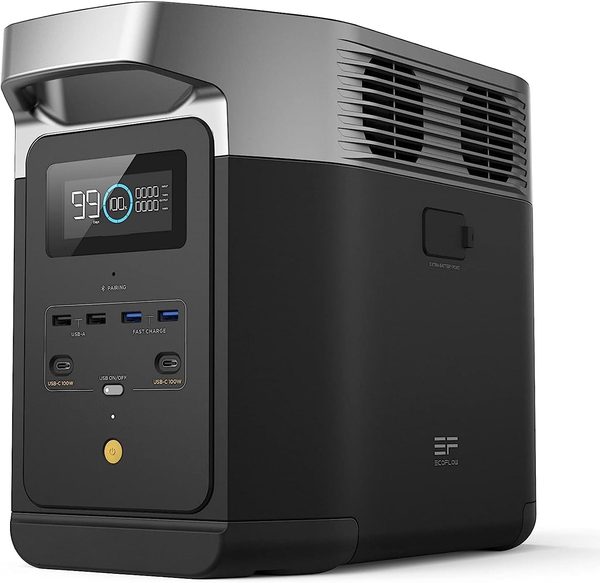
EF ECOFLOW DELTA 2 — 1,024Wh / 1,800W
The mid-size workhorse: 1,800W output covers a full-size fridge, power tools or a home office setup, with enough capacity for several hours of real backup. See our 1,152Wh-class comparison for how this size performs.
Large (2,042Wh): Jackery Explorer 2000 Plus bundle
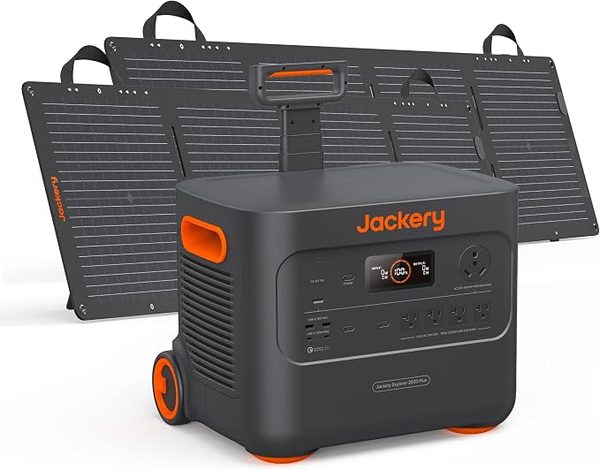
Jackery Explorer 2000 Plus — 2,042Wh / 3,000W
For multi-day off-grid trips or serious home backup: 3,000W output runs nearly anything short of central HVAC, and this bundle adds two 100W mini panels so it recharges from sunlight. Read our full review.
Don’t forget the solar panel
size your panel at roughly 1.5–2× the watts you expect to draw during the day if you want the station to hold its charge in sunlight.
A power station is only half of a solar generator — the panel is the other half. A rough rule: a 200W panel in good sun delivers about 140–160W in practice, so it replenishes roughly 140–160Wh per hour. That means a 1,024Wh station takes about 6–7 hours of solid sun to refill from empty on a single 200W panel. If you need faster refills, add a second panel or choose a station with a higher solar input limit.
Three sizing mistakes to avoid
the most expensive error is buying on capacity alone — output wattage, surge headroom, and chemistry matter just as much.
- Ignoring output watts. A huge battery with a small inverter can’t start a fridge compressor. Check both numbers.
- Forgetting the 25% buffer. Running a lithium battery to 0% every cycle shortens its life; size so your typical use lands around 70–80% depth of discharge.
- Overlooking battery chemistry. LiFePO4 (lithium iron phosphate) batteries typically last far longer than older NMC chemistries — for a station you’ll use weekly, chemistry affects lifetime cost more than the sticker price.
Frequently asked questions
What size portable power station do I need for a refrigerator?
A full-size home fridge (≈150W running, up to 1,000W surge) needs a station with at least 1,500–1,800W output and 1,000Wh+ capacity for several hours of backup; for overnight coverage, aim for 1,500–2,000Wh. A 12V camping fridge (≈45W) is far easier — a 500Wh station can run one for a full day or more.
How long will a 1,000Wh power station run a TV?
About 5–7 hours for a typical 100–150W LED TV: 1,000 × 0.85 ÷ 125 ≈ 6.8 hours. Add a streaming stick or soundbar (≈20–30W combined) and expect closer to 5 hours.
Is a 300W power station enough for camping?
Yes, for personal electronics — phones, tablets, cameras, LED lights and a laptop will all run fine on a 256–300Wh / 300–600W unit. It won’t run heating elements, a microwave, or a full-size fridge, so size up if those are on your list.
Can I run my CPAP on a portable power station?
Yes. Most CPAPs draw 30–90W (turn off the heated humidifier to stay at the low end). A 500Wh station delivers roughly 7–10 hours — enough for a full night’s sleep — and a 256Wh unit covers about 3–4 hours as an emergency backup.
What does “solar generator” mean — is it different from a power station?
A “solar generator” is simply a portable power station bundled with (or designed to pair with) solar panels. The station itself is the battery + inverter box; add panels and it becomes a solar generator that recharges from sunlight.
Should I buy a bigger station “just in case”?
Usually not more than one size up. Oversizing by 2–3× means paying for weight and capacity you never cycle — lithium batteries also degrade with age regardless of use. Buy for your real load plus the 25% buffer, and choose a model with expansion-battery support if you think needs may grow.
list your devices, multiply watts by hours, add 25%, and check the output rating against your biggest load. Do that and you’ll buy the right size the first time — whether that’s a 256Wh weekender or a 2,000Wh home-backup unit.
Common Questions About Sizing a Portable Power Station
Quick Answers
Straight answers to the questions people ask most about this topic.
What size portable power station do I need for camping?
For a typical weekend camping trip — phones, a laptop, LED lights — a 300 to 500Wh station is usually enough.
For a typical weekend camping trip — phones, a laptop, LED lights — a 300 to 500Wh station is usually enough. Add up each device’s watt-hours (watts × hours of use), then add about 25% headroom for inefficiency.
How many watt-hours do I need for home backup?
For essential home backup (a fridge, phones, a few lights, and a Wi-Fi router), most households need 1,000 to 2,000Wh.
For essential home backup (a fridge, phones, a few lights, and a Wi-Fi router), most households need 1,000 to 2,000Wh. A full-size refrigerator alone draws roughly 100–150Wh per hour while its compressor cycles.
What is the difference between Wh and W on a power station?
Watt-hours (Wh) measure stored energy — how long the station runs.
Watt-hours (Wh) measure stored energy — how long the station runs. Watts (W) measure output power — what it can turn on at once. Size the Wh for runtime, and the W rating for your hungriest single device.
Is a bigger portable power station always better?
Not necessarily.
Not necessarily. Oversized stations cost more, weigh more, and take longer to recharge. The most common buying mistake is paying for capacity you will never use — measure your actual loads first.
How do I calculate the right size?
List each device’s watts, multiply by daily hours of use, and sum the watt-hours.
List each device’s watts, multiply by daily hours of use, and sum the watt-hours. Multiply by 1.25 to cover conversion losses, then round up to the next standard size. That number is your target capacity.
Common Questions About Sizing a Portable Power Station
Quick Answers
Straight answers to the questions people ask most about this topic.
What size portable power station do I need for camping?
For a typical weekend camping trip — phones, a laptop, LED lights — a 300 to 500Wh station is usually enough.
For a typical weekend camping trip — phones, a laptop, LED lights — a 300 to 500Wh station is usually enough. Add up each device’s watt-hours (watts × hours of use), then add about 25% headroom for inefficiency.
How many watt-hours do I need for home backup?
For essential home backup (a fridge, phones, a few lights, and a Wi-Fi router), most households need 1,000 to 2,000Wh.
For essential home backup (a fridge, phones, a few lights, and a Wi-Fi router), most households need 1,000 to 2,000Wh. A full-size refrigerator alone draws roughly 100–150Wh per hour while its compressor cycles.
What is the difference between Wh and W on a power station?
Watt-hours (Wh) measure stored energy — how long the station runs.
Watt-hours (Wh) measure stored energy — how long the station runs. Watts (W) measure output power — what it can turn on at once. Size the Wh for runtime, and the W rating for your hungriest single device.
Is a bigger portable power station always better?
Not necessarily.
Not necessarily. Oversized stations cost more, weigh more, and take longer to recharge. The most common buying mistake is paying for capacity you will never use — measure your actual loads first.
How do I calculate the right size?
List each device’s watts, multiply by daily hours of use, and sum the watt-hours.
List each device’s watts, multiply by daily hours of use, and sum the watt-hours. Multiply by 1.25 to cover conversion losses, then round up to the next standard size. That number is your target capacity.

