
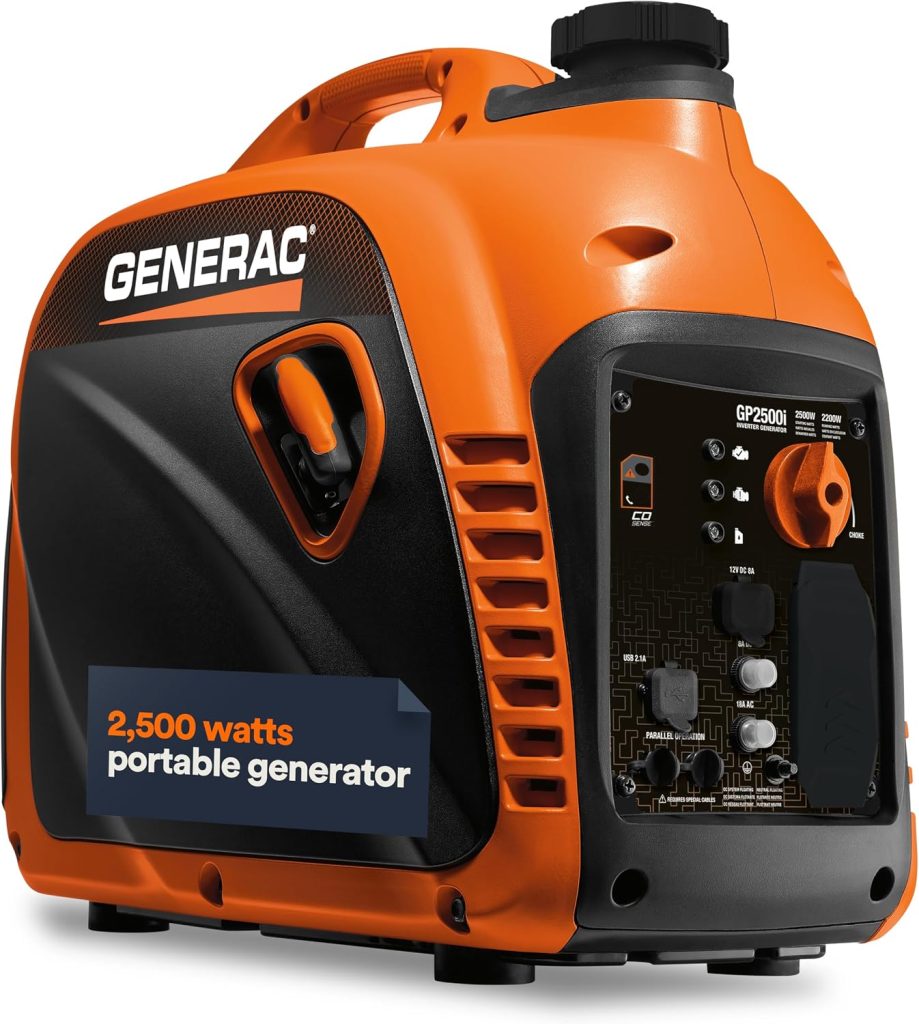
The box says 2500 watts. The spec sheet, three lines down, says 2200 watts running. Both numbers are true and the box is lying to you — welcome to generator marketing, where the biggest number wins and the fine print does the actual work.
Read the small number.
I spent a decade sizing backup power for small commercial sites, and the first thing I learned is that nobody’s loads match the brochure. The second thing I learned is that “portable” means 48 pounds until you’re carrying it up a hill, at which point it means something else entirely.
Quick Answer
The Generac GP2500i is a 2200W-running (2500W peak) inverter generator — quiet, clean power for RVs and essentials, sipping about a gallon over 8 hours at light load. Gas beats batteries on raw power per dollar; batteries win on silence and indoor safety. Pick by your actual loads, not the headline wattage.
Compare Top Portable Generators
Three proven picks side by side — choose the one that fits your needs.
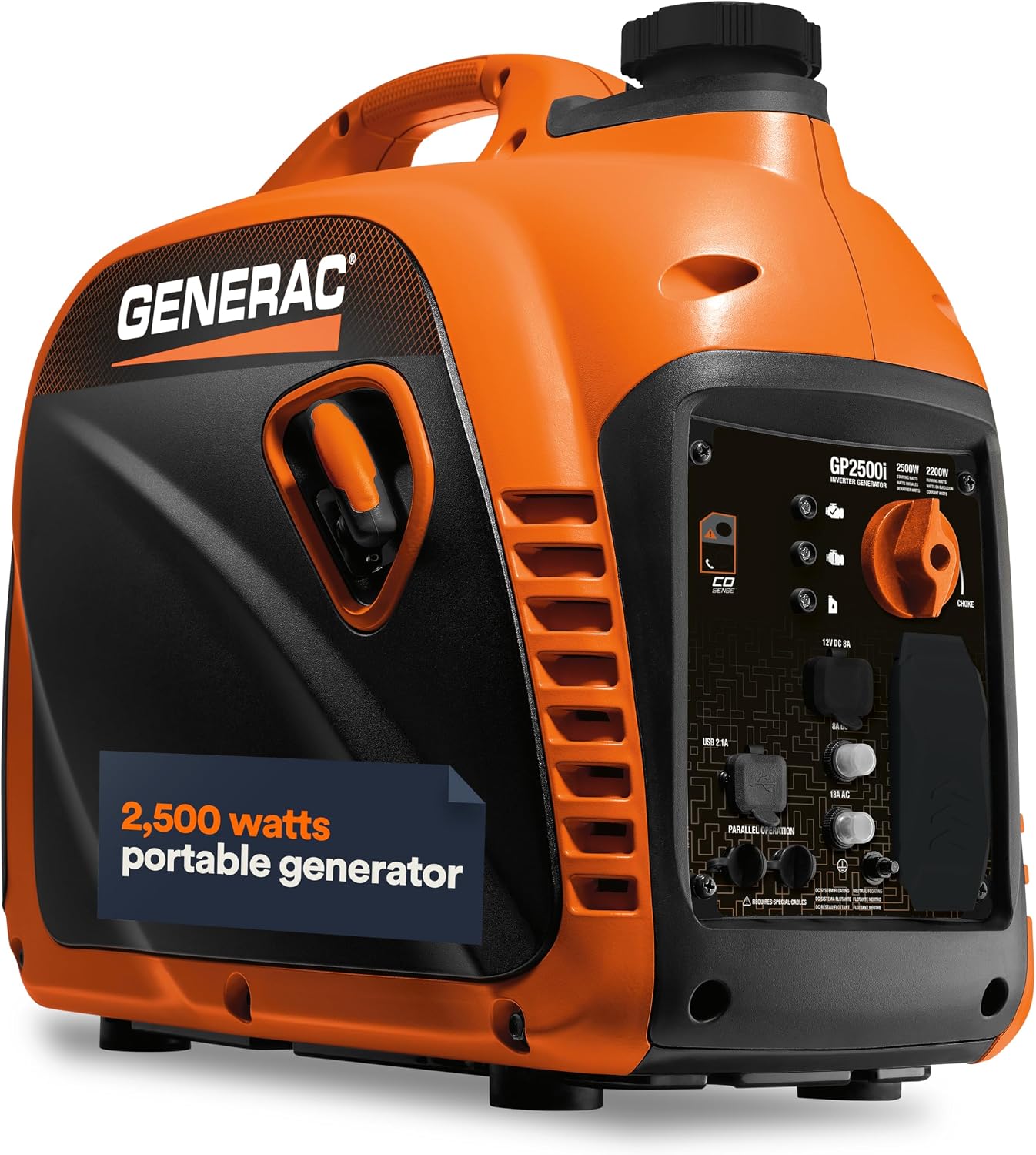
Prices and availability may vary — tap any product to check the current listing.
Let’s decode the numbers, because this is where people get burned. 2500W is the surge — what it can do for a few seconds when your fridge compressor kicks. 2200W is the continuous rating, what it can do all day without complaint. Every generator company leads with the big number. Every buyer should read the small one. I once watched a guy try to run a 2400W space heater off a “2500W” generator. It ran. For eleven minutes. Then the overload light came on and stayed on, like a tiny red monument to optimism.
The inverter part matters more than the wattage, honestly. A conventional generator’s engine speed wanders with the load, and the power quality wanders with it — fine for a circular saw, less fine for your laptop. An inverter generator holds total harmonic distortion under 3%, which is clean enough for anything with a circuit board. That’s the whole reason these cost more than the contractor-grade screamers. Space heaters are the classic trap — resistive loads don’t care about power quality, they just eat watts, and 1500W of heater is 1500W no matter how clean it is.
Gas vs. solar: the argument that never ends
Here’s my honest accounting. The GP2500i costs around $500-600. A comparable battery station — 2kWh, 2200W output — costs twice that. The generator runs 8 hours on a gallon of gas at quarter load; refuel in two minutes and go another 8. The battery runs out and then you’re waiting on the sun or the grid. On pure economics, gas wins going away.
But. The generator is 51 decibels at quarter load, which the brochure calls “quieter than a conversation.” It’s quieter than a conversation about generators, maybe. At full load it’s noticeably louder, and your neighbors at the campground will have opinions. It makes carbon monoxide — Generac’s COsense shuts it down if CO builds up, which is good, because people die from this every year running generators in garages. You cannot run it indoors. You cannot run it in the rain without cover. It needs oil changes, fresh gas, and a carburetor that won’t gum up if you ignore it for a year. Ask me about my first generator’s carburetor. Actually, don’t.
Solar stations: silent, indoor-safe, no maintenance beyond keeping them charged. Half the runtime per dollar. No contest on convenience, no contest on cost. Pick your religion.
I haven’t run a tri-fuel conversion myself — gasoline and propane only. The natural gas numbers are from manuals, not my meter.
Choose wisely.
The fuel math nobody does
A gallon of gas holds about 33kWh of energy. The generator turns maybe 15-20% of that into electricity. So your gallon gives you roughly 5-6kWh of actual power — at $3.50 a gallon, that’s about 60-70 cents per kWh. Grid power is 15 cents. Batteries charged from the grid are 15 cents plus the battery’s amortized cost. Nobody buys a generator to save money on electricity. You buy it for the hours when there is no grid.
Propane? The tri-fuel guys will tell you it’s cleaner and stores forever, which is true. It also makes about 10% less power than gasoline on the same engine. Fine. Just size for it.
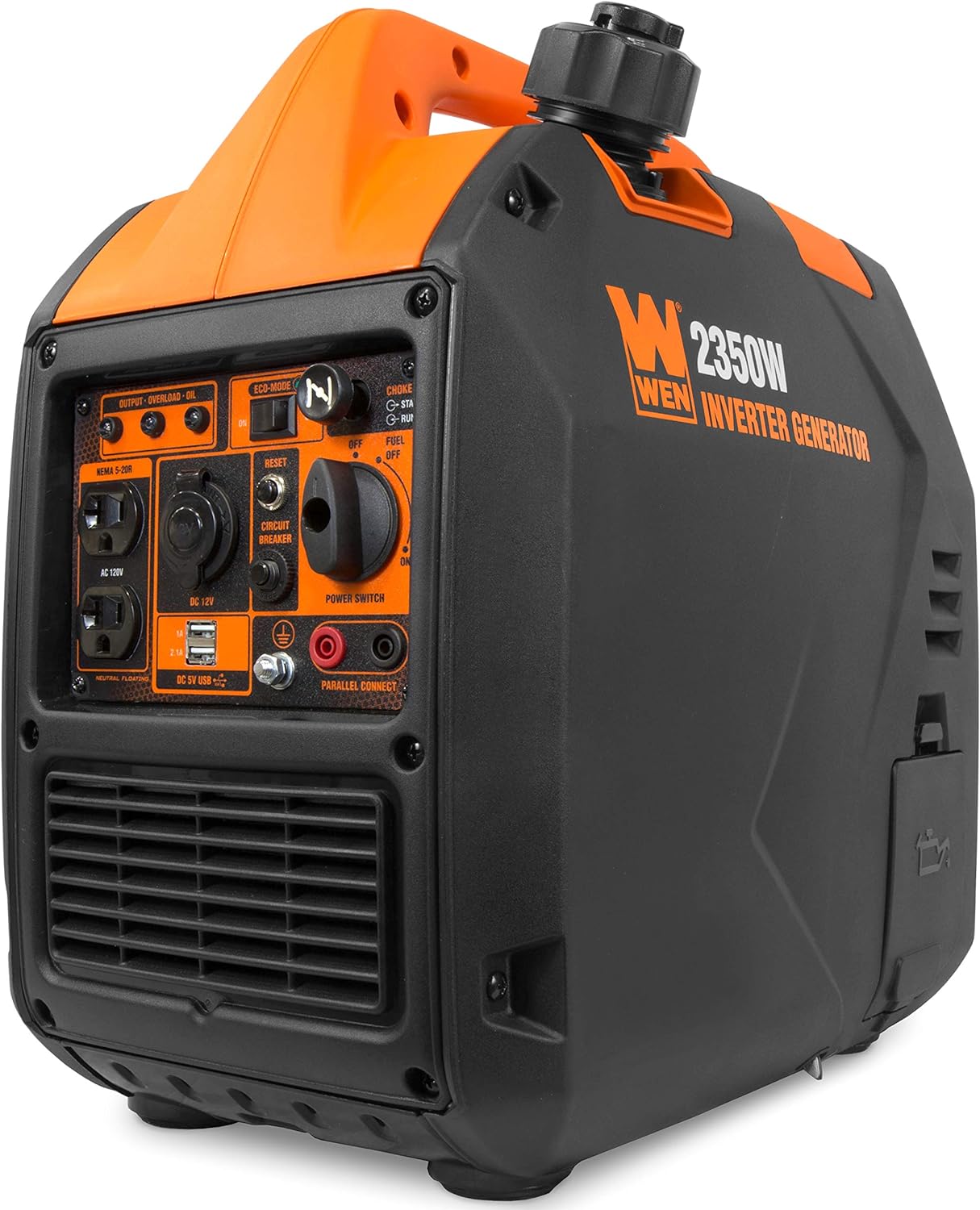
WEN 56235i — lighter, cheaper, and 51dB at quarter load
What I’d actually buy
For RV camping and tailgating: the GP2500i. It’s the right size — big enough for the AC’s startup surge (with a soft start kit, which is a whole other conversation), small enough to lift without a chiropractor. The COsense and the 3-year warranty are real differentiators; Generac’s service network actually exists, unlike some online-only brands where “warranty” means emailing a Gmail address.
For home backup of electronics and short outages: a battery station. The gas-vs-solar math flips when your loads are small and your tolerance for maintenance is zero. The Delta 3 in the comparison below is the crossover product — 1kWh, silent, and enough for a work-from-home setup through a workday outage.
For whole-house: neither of these. You’re in 14kW standby territory, permanently installed, automatic transfer switch. Different budget, different conversation. I haven’t installed one myself — residential standby is outside what I used to spec — so I’ll stop there.
The category’s favorite lie
“Clean, stable power.” Every inverter generator says it. And it’s true, as far as it goes — the THD numbers check out. But “stable” also implies the voltage never sags, and under a sudden heavy load, every small generator sags for a moment. The inverter recovers fast. Fast enough for electronics, not instant. The marketing photo shows a laptop and a string of patio lights. The reality is a fridge compressor and a well pump arguing about who gets the surge capacity. Size for the argument, not the photo.
Also: “8-hour runtime.” At 25% load. At 50% load you’re looking at 5-ish. At full load, half that. Everyone quotes the 25% number. Nobody runs at 25%.
Well, almost nobody. My neighbor does. He’s very particular.
A brief, unrelated memory
Hurricane season, 2022. My street lost power for three days. The guy across the street had a big portable — 7500W, open frame, loud enough to hear from inside my house with the windows closed. He ran extension cords to three neighbors’ fridges. Extension cords across wet lawns, in the rain. I thought about electrical code for about ten seconds and then thought about his neighbors’ ice cream. Sometimes the right answer is the one that keeps the food cold. The code can wait.
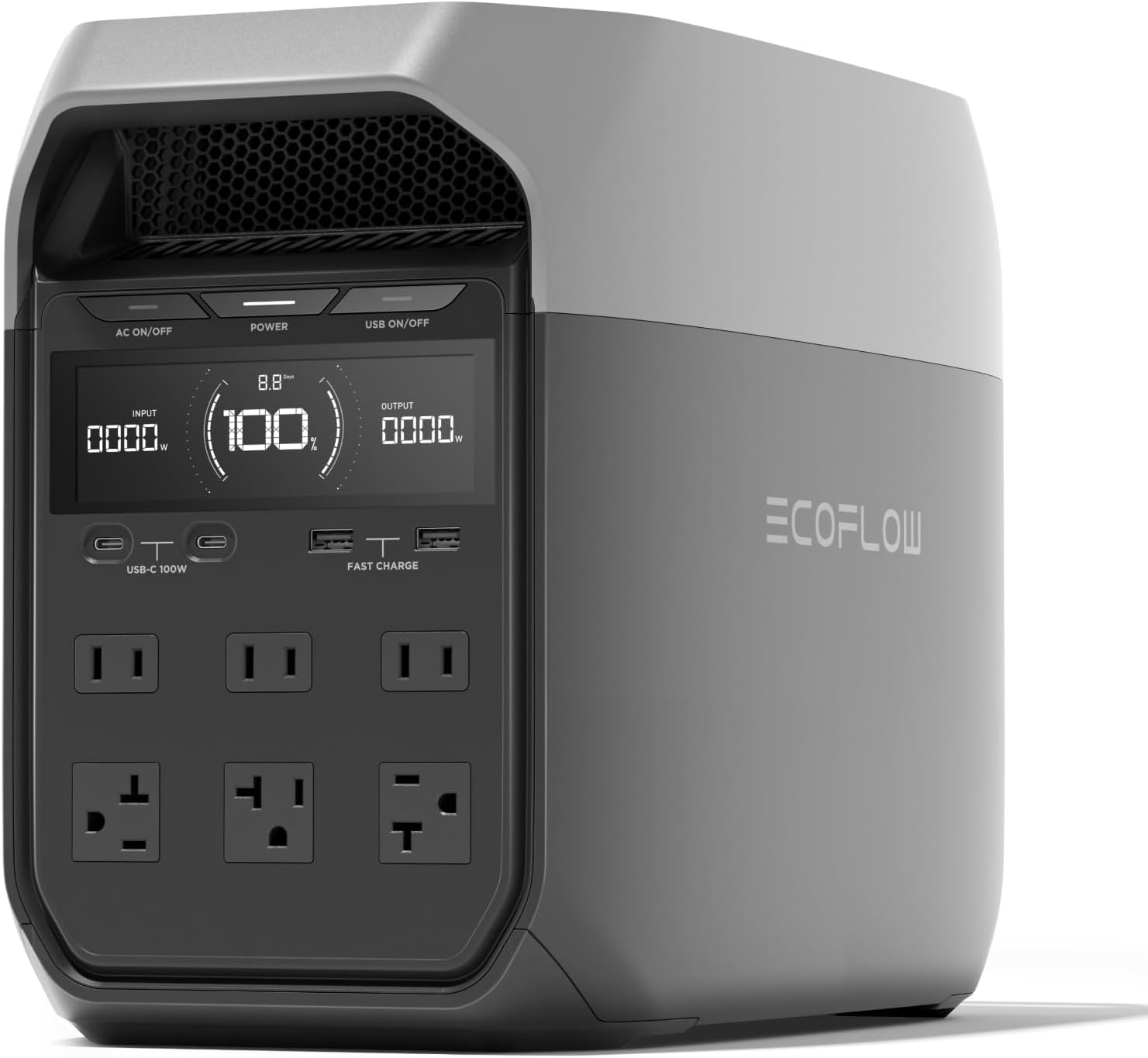
EF ECOFLOW Delta 3 — the battery alternative for light loads
The GP2500i sits in my shed now, which is where generators live 360 days a year. I run it every couple months — twenty minutes, a real load, fresh gas with stabilizer. The manual says monthly. I do bimonthly and feel guilty about it, which is the correct emotional relationship to have with a small engine. Last month it started on the second pull. The month before, the fourth. Small engines are like that. They remember when you neglect them, and they make you pay in pulls.
Frequently Asked Questions
What’s the difference between 2500W starting and 2200W running watts?
Starting (surge) watts is what the generator can deliver for a few seconds — enough to start a motor. Running watts is the continuous output. Always size your loads against the running number; the surge number just tells you whether motors will start.
Can I run the GP2500i indoors or in a garage?
No. Never. Carbon monoxide kills, and the COsense auto-shutoff is a backup, not permission. Minimum 20 feet from the house, exhaust pointed away, same as any gas generator.
How loud is it really?
About 51dB at quarter load — roughly a quiet conversation. It gets noticeably louder under heavy load. Quieter than open-frame generators by a wide margin, louder than any battery station.
Gas generator or battery station — which should I get?
Gas wins on power per dollar and runtime — refuel and keep going. Batteries win on silence, indoor use, and zero maintenance. For RVs and job sites, gas. For apartments, indoor backup, and light loads, batteries.
How does the WEN 56235i compare?
Similar class — 2350W surge, 1900W running, lighter at 39 pounds, usually cheaper. The Generac has COsense and a stronger service network; the WEN wins on price and weight. Both are solid.


