
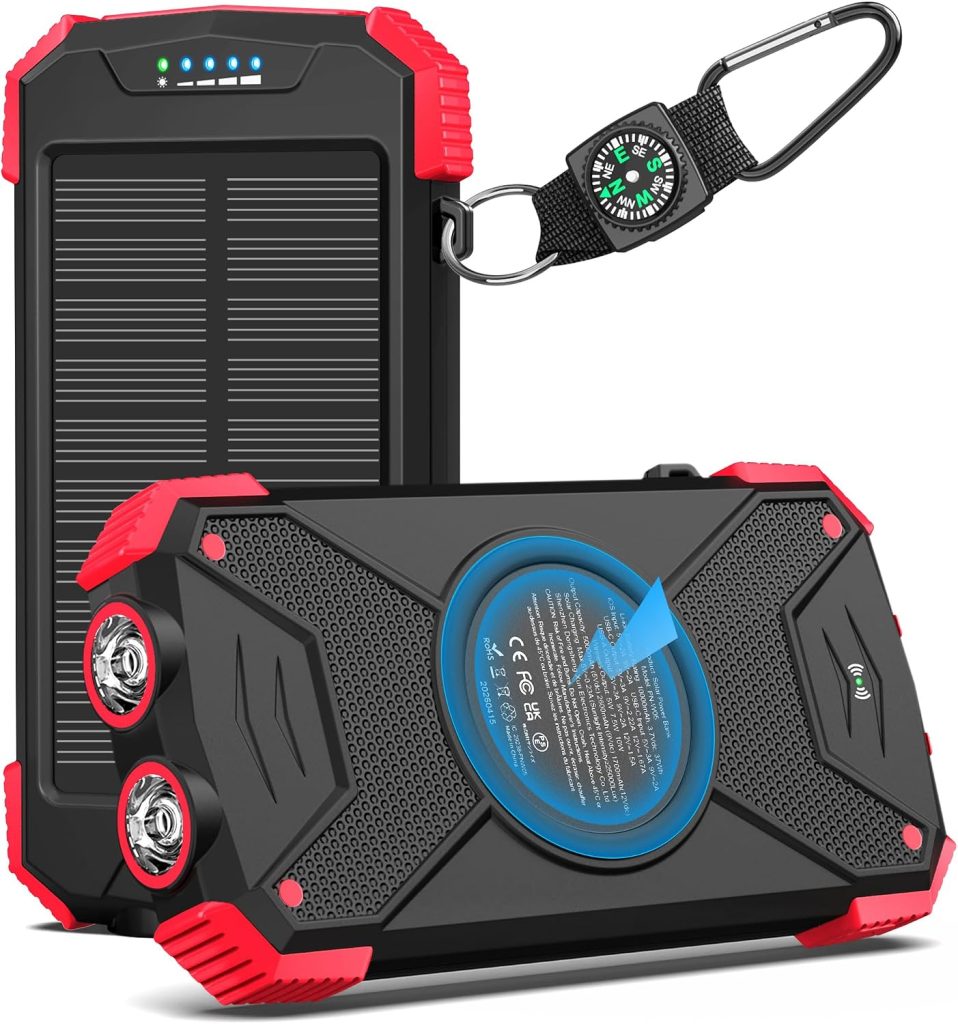
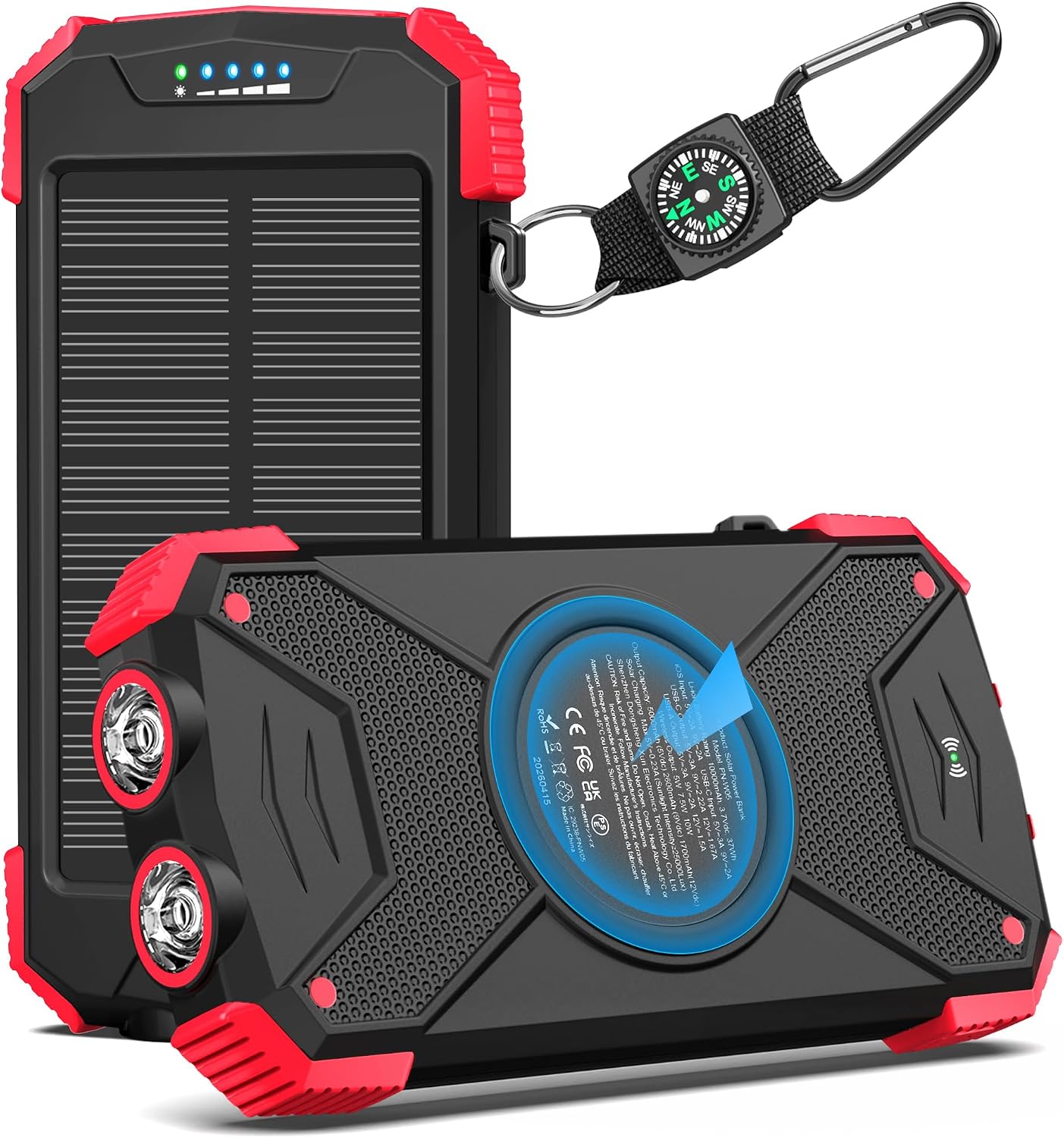
A solar power bank is the most misunderstood gadget in the camping-gear aisle. It promises phone power from sunshine — freedom from wall outlets. The reality is messier. This guide cuts through the hype around the BLAVOR 10,000mAh (model PN-W05), stacks it against the BLAVOR 20,000mAh and the Hiluckey 4-panel foldable, and tells you which — if any — earns a spot in your pack.
Quick Answer
The BLAVOR 10,000mAh is a legitimate pick for weekend campers — a pocketable power bank that earns its carry weight through fast wired charging and a tough shell, not through its solar panel. That panel is a trickle at best. Charge from a wall before you leave, treat sunshine as emergency backup, and it’s one of the smarter buys in the category. Need more capacity or Apple Watch charging built in? The 20,000mAh sibling exists for exactly that.
Top 3 Solar Power Banks for Camping
Same job — pocketable off-grid power — three capacities, one honest solar caveat.
BLAVOR 10,000mAh Solar Power Bank
20W USB-C + Qi wireless + IPX5 — the best-selling trail bank, 4.7 stars
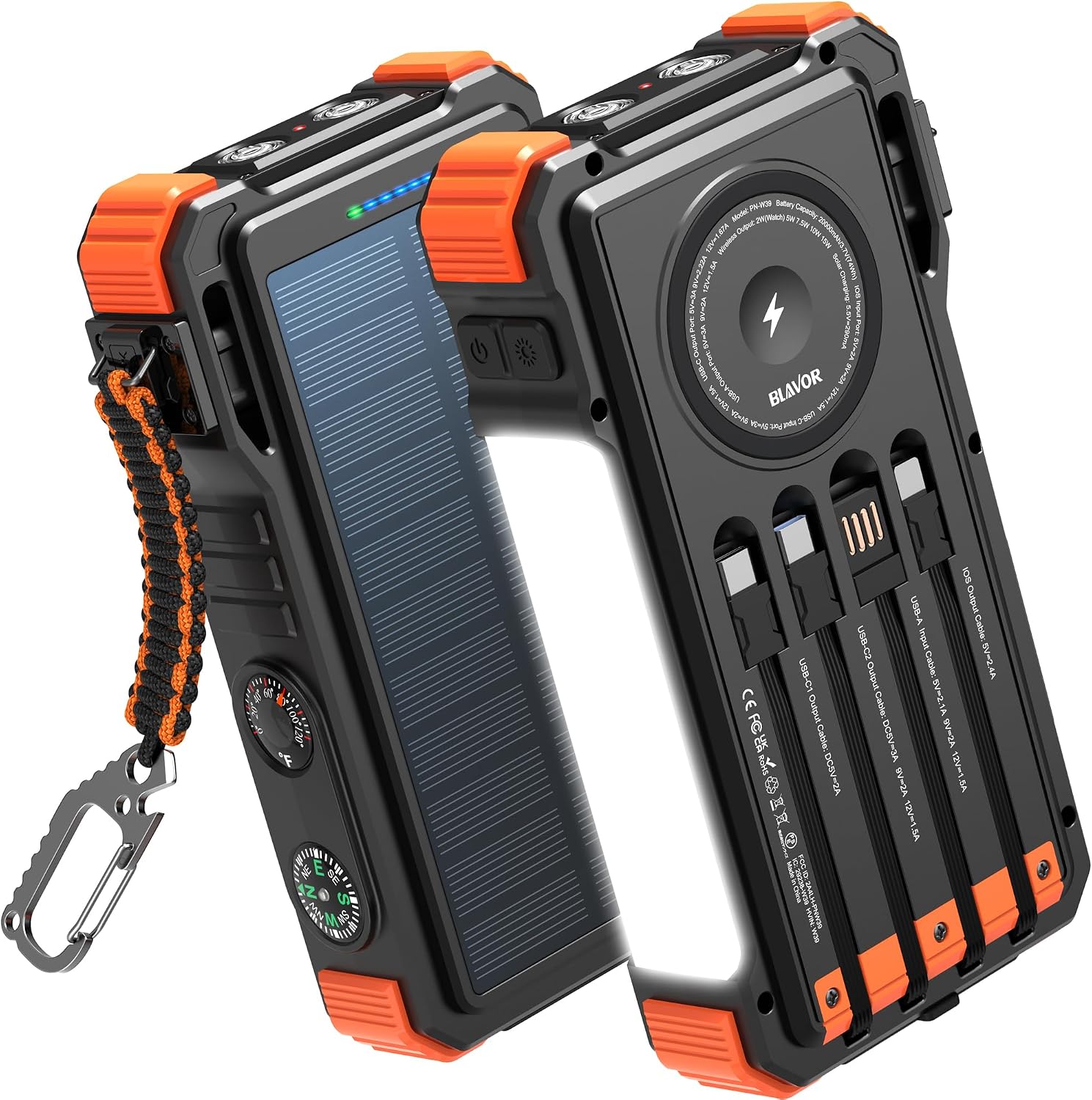
BLAVOR 20,000mAh Solar Power Bank
4 built-in cables + Apple Watch wireless charging — the capacity king
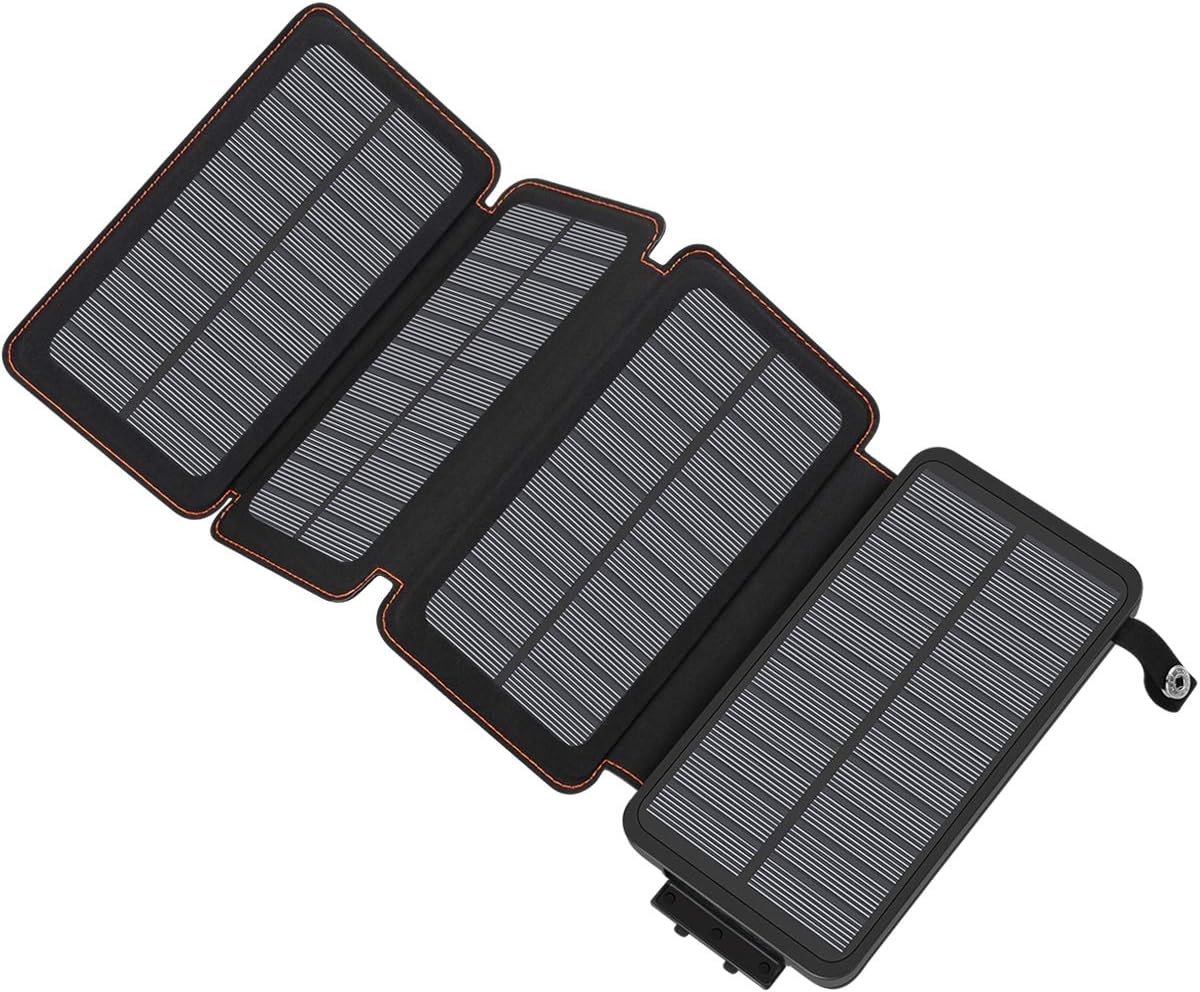
Hiluckey 4-Panel Solar Power Bank
4 foldable panels recharge it faster in sun — the off-grid stretch pick
Prices and availability may vary — tap any product to check the current listing.
What to Look For in a Solar Power Bank
Start here. Most of the confusion in this category comes from evaluating the wrong thing first.
Capacity — and what it really buys you. A 10,000mAh pack holds roughly two full smartphone charges in a perfect world, and the world is never perfect — conversion losses eat a real chunk. The BLAVOR 10K covers a long weekend of phone top-ups, but it won’t run a tablet through movie night and a phone through the morning. The 20,000mAh tier doubles your margin. First real trade-off: capacity tracks weight. The 10K sits around 9.3 oz — jacket-pocket territory. Double the cells and you’re in a different packing category.
The solar panel: trickle, not charger. This is the thing the box art lies about. The panel on the BLAVOR PN-W05 outputs something like 5V/0.3A in full sun — enough to add charge painfully slowly, or hold a level steady while you use the phone for navigation. It will not take the bank from dead to full in a day. Not even close. The 20K version has the same class of small panel; the Hiluckey HI-S025 is the honest exception — four folding panels that genuinely harvest more in direct sun — but even it wants hours of good light. Look, treat every integrated panel as an emergency slow-drip and you’ll never be disappointed.
Wired charging speed matters more than the panel. Sunshine is the side quest; the main event is how fast the bank refills your devices — and itself — from a cable. The BLAVOR 10K supports 20W two-way fast charging over USB-C: it fills itself from a wall in around four hours, and per the listing it can push an iPhone 15 to roughly 65% in 30 minutes. A bank that can’t fast-charge from the wall means leaving camp with a half-empty battery. Some. People forget.
Wireless charging — nice, not essential. The 10K includes a Qi pad (5W/7.5W/10W tiers); the 20K adds an Apple Watch spot. Wireless is slower and less efficient than cable — that’s physics — but it’s genuinely useful at 2 a.m. when you don’t want to fish for a cable. Don’t buy for wireless.
Durability and weather resistance. Camp gear gets rained on, dropped on rocks, and bounced around in duffel bags. The BLAVOR units carry an IPX5 rating — fine for dust and rain splash, not submersible. The shock-resistant shell survives the duffel better than sleek aluminum bricks.
The flashlight and the extras. The 10K packs dual LED flashlights (steady, strobe, SOS), a compass, and a carabiner — the 20K adds a camping lamp, a thermometer, and four built-in cables. The SOS strobe is the one feature that earns its space: an actual emergency signal. They don’t sell the product, but at this price tier they’re the difference between a commodity battery and camp gear.
How to Match the Power Bank to Your Situation
The weekend hiker. Friday night, Saturday on the trail, Sunday home. Your phone is your map, camera, and trail journal — it dies, your trip dies. Charge the BLAVOR 10K from the wall Thursday night, toss it in the daypack, and the 20W fast charging tops you up over lunch.
The family car camper. Base camp is a trunk. Devices multiply: two phones, a tablet for the kids, maybe a [rechargeable camping lantern](https://www.ecoswatt.com/goal-zero-lighthouse-600-camping-lantern-review/) at night. The 10K covers phones, but the family’s collective draw is a different problem — this is where the 20,000mAh BLAVOR earns its bulk, with built-in cables that end the “where’s the cord” scavenger hunt. And honestly? A setup like this is where a [portable power station](https://www.ecoswatt.com/ecoflow-river-2-portable-power-station-review/) starts making sense for bigger loads.
The off-grid weekender who actually believes the brochure. Three to four days, no car, real distance from outlets. This person bought a solar power bank *for the solar*. Cold truth: even the Hiluckey’s four folding panels — the strongest solar harvester of the three — won’t keep you topped up alone in patchy weather. Wall-charge before departure, sun as a supplement. If you want to run a fridge or serious lighting, [foldable solar panels](https://www.ecoswatt.com/jackery-solarsaga-100w-solar-panel-review/) feeding a station-class battery is the tier above.
Solar Power Bank Tiers Compared
| Type/Tier | Best For | Price Tier | Key Feature | Watch-Out |
|---|---|---|---|---|
| 10,000mAh all-rounder (BLAVOR PN-W05) | Weekend hikes, light travel | Budget-friendly | Fast 20W USB-C in/out, Qi pad, rugged shell | Panel is trickle-only; won’t fully recharge two phones twice |
| 20,000mAh high-capacity (BLAVOR PN-W39) | Families, multi-day trips | Mid-range | Built-in cables, Apple Watch charging, camp lamp | Heavier bulk; same small-class solar panel despite bigger battery |
| Foldable high-harvest (Hiluckey HI-S025) | Long sunny stretches | Mid-range | Four folding panels with genuinely faster solar refill | Bulkier folded shape; newer listing with a smaller review history |
The 10,000mAh tier is the sweet spot for trips of a couple of days — fast wall charging, light weight, friendly price. The 20,000mAh tier trades lightness for insurance: built-in cables and watch charging make it the family favorite, though its solar panel is no better than the 10K’s. The Hiluckey’s folding four-panel design is the only one here that takes solar harvesting semi-seriously — a real edge for long, sunny afternoons.
Scenario-by-Scenario: Where Does a Solar Power Bank Actually Shine?
Two-day hikes and backpacking weekends. Home turf of the 10K class. The bank starts full from the wall, the phone sips from it on the trail, and the panel dribbles enough during the day to keep you above panic levels. The BLAVOR’s weight — about 9.3 oz — is the argument here: it saves the trip when the battery turns red at mile twelve.
Base-camp camping with the family. Devices everywhere, one trunk, chaos. The 20,000mAh BLAVOR is the pick: built-in cables mean no one hunts for cords, the larger reserve stretches across two days of kid-tablet duty, and the camp lamp covers the tent. But don’t hand it solar duty alone — think of the panel as slowing the drain rather than refilling the tank.
Emergency kits and storm prep. A power bank earns its keep here even if you never touch it — until you need it. Stashed in a go-bag with a full charge, it rides out the storm season; the panel gives you a slow refill path when the grid’s down for days. One trade-off nobody mentions: lithium batteries self-discharge. Check the charge every few months, or your emergency bank is a paperweight with a flashlight.
Common Mistakes
Expecting the solar panel to do the charging. The single biggest disappointment in this category. Buyers imagine the panel refilling the bank daily; the physics says otherwise — 0.3A-class panels need days of good sun for a meaningful refill. Charge from the wall first. Every time.
Buying capacity for trips you don’t take. A 20,000mAh brick is reassuring on paper and annoying in a daypack. If your trips are one to two nights, the 10K’s lighter weight wins daily and its capacity covers you.
Forgetting the compass is decorative. Both BLAVOR models include a little compass on the shell. Novelty, not navigation. Bring a real compass. I keep saying this because people keep not doing it.
Why, How, and What
Why is the solar charging on power banks so slow? Physics and surface area. A phone-sized panel catches a phone-sized amount of sunlight, and that energy crosses a small panel, charge electronics, then a battery. Big dedicated panels harvest multiples more because they have multiples more surface. The small panel is engineered as a backup drip, not a primary charge path.
How should you actually use one of these on a trip? Charge it to 100% from a wall outlet before departure — the rule that makes everything else work. On the trail, strap it outside your pack or lay it panel-up during long stops so the trickle keeps working. Top up your phone in bursts rather than letting it drain to zero. Back at camp, plug in with a cable and let the wireless pad sleep.
What can a 10,000mAh bank realistically handle? A modern smartphone: roughly one and a half to two full charges in practice, after conversion losses. Earbuds, smartwatches, headlamps, action cameras, GPS units — the whole small-USB camp ecosystem. What it can’t do: run a portable fridge, charge a laptop at usable speed, or power station-class loads. Know the boundary and you’ll never be let down.
Questions People Ask Before Buying
Real buyer questions, straight answers
Can a solar power bank actually charge from sunlight alone?
It can top up from sunlight, but the integrated panel is a slow trickle — think days of good sun for a meaningful refill, not hours — so treat solar as an emergency supplement and always charge from a wall outlet before your trip. Neither replaces a wall charger.
BLAVOR 10,000mAh or 20,000mAh — which one should I pick?
Pick the 10,000mAh if your trips run one to two nights and you value low weight; pick the 20,000mAh if you’re charging a family’s worth of devices or want built-in cables and Apple Watch charging. The 20K isn’t simply “the better one” — it’s heavier, and its solar panel is no faster than the 10K’s.
How long does a 10,000mAh power bank take to recharge?
From a wall outlet, around four hours for the BLAVOR 10K thanks to 20W two-way fast charging — roughly half what slower banks take. From sunlight alone, plan on multiple days of good exposure. The wall number is the one that matters: plug it in at dinner, it’s full before bed. The solar number is weather-dependent and mostly theoretical.
Is the BLAVOR 10,000mAh worth it over a cheaper no-name solar bank?
Yes, for two concrete reasons: verified fast-charging circuitry (20W two-way, per the listing) and an unusually large review base — 47,695 global ratings on the product listing at a 4.7 average — which no-name competitors can’t match. The BLAVOR also holds a Best Seller badge in its marketplace solar-charger category and carries a 3-year warranty — signals that cost the manufacturer real money, which is exactly why they mean something.
Does the built-in flashlight drain the battery?
Barely. LEDs sip power — a flashlight running for an evening costs a few percent of capacity, a rounding error next to one phone charge. The SOS strobe uses a bit more because it’s brighter and intermittent, but even that is trivial compared to feeding a phone.
Key Takeaways
A solar power bank for camping is a battery first and a solar device a distant second — buy for capacity and fast wired charging, treat the panel as emergency backup.
The BLAVOR 10,000mAh (PN-W05) is the weight-conscious pick: 20W two-way fast charging, Qi pad, rugged shell, and 47,695 global ratings at 4.7 stars on the product listing.
The BLAVOR 20,000mAh trades lightness for insurance: double capacity, four built-in cables, Apple Watch charging, camp lamp — the family pick.
The Hiluckey HI-S025’s four folding panels are the only design here that takes solar harvesting semi-seriously; the trade-off is bulk and a newer, smaller review history.
Charge from the wall before every trip. The sun is plan B.
None of these replaces a power station for big loads — know the boundary between phone-class and station-class power.
Decision Tree: Which Solar Power Bank Fits Your Trip?
If your trips are one to two nights and every ounce counts → BLAVOR 10,000mAh; fast wall charging and light weight are the whole argument.
If you’re keeping a family or a group powered for days → BLAVOR 20,000mAh; capacity and built-in cables end the cable hunt.
If your trips have long, reliably sunny days and you want the panel to matter → Hiluckey HI-S025; four folding panels, fastest solar refill of the three.
If you own an Apple Watch and hate carrying its charger → the 20K BLAVOR has a watch spot built in.
If your loads include a fridge, laptop, or tent lighting beyond a flashlight → skip power banks; you’re in power-station territory.
If you want it as a storm-kit backup → any of the three — check the charge quarterly.
Frequently Asked Questions
How long does the BLAVOR 10,000mAh take to charge from a wall outlet?
Around four hours with a fast-charging adapter, thanks to its 20W two-way USB-C charging. That’s meaningfully quicker than budget banks that take eight-plus hours.
Can I bring a solar power bank on a plane?
Yes. A 10,000mAh bank is well under the standard 100Wh carry-on limit for lithium batteries; the 20,000mAh unit is under it too. Keep it in your carry-on, never in checked luggage.
Is a solar power bank waterproof?
Not waterproof — water-resistant. The BLAVOR units are rated IPX5, which covers rain and splashes but not submersion. The charging ports are the vulnerable part on every bank in this category.
What’s the difference between a solar power bank and a folding solar panel?
A power bank stores power in an internal battery and charges your devices anytime, including at night. A folding panel produces power only while the sun shines — no storage.
Can a 10,000mAh bank charge two phones at once?
It can — USB-C and USB-A ports plus wireless, so both phones get a slower share. Two full dead-to-full charges from one bank is realistic; three is pushing it.
Will the solar panel charge while the bank charges my phone?
Yes — pass-through works, though slowly. The panel dribbles power in while the phone draws power out, so the net effect is the bank draining a little slower. It’s not a perpetual-motion machine. It’s a slightly slower drain.
Final Recommendation
The BLAVOR 10,000mAh is the honest default in this category — a power bank that doesn’t pretend the sun is doing the work. Buy it for the 20W fast charging, the rugged shell, and the proven track record; use the panel for what it is, a slow emergency drip. If your device list runs bigger or your trips run longer, step up to the 20,000mAh version or the Hiluckey’s folding four-panel design instead. Wall-charge before you leave. Let the sun do the rest.
Top 3 Solar Power Banks for Camping
Same job — pocketable off-grid power — three capacities, one honest solar caveat.
BLAVOR 10,000mAh Solar Power Bank
20W USB-C + Qi wireless + IPX5 — the best-selling trail bank, 4.7 stars
BLAVOR 20,000mAh Solar Power Bank
4 built-in cables + Apple Watch wireless charging — the capacity king
Hiluckey 4-Panel Solar Power Bank
4 foldable panels recharge it faster in sun — the off-grid stretch pick
Prices and availability may vary — tap any product to check the current listing.


