
This site contains affiliate links. We may earn a commission on qualifying purchases.
I used to tell people a 200W solar panel kit puts 200 watts into the battery. Said it with a straight face, too. Then one slow afternoon I actually sat down with a panel spec sheet and a calculator, and the number that came out embarrassed me. It wasn’t 200. It was never going to be 200. The kit wasn’t lying, exactly. I just hadn’t done the division.
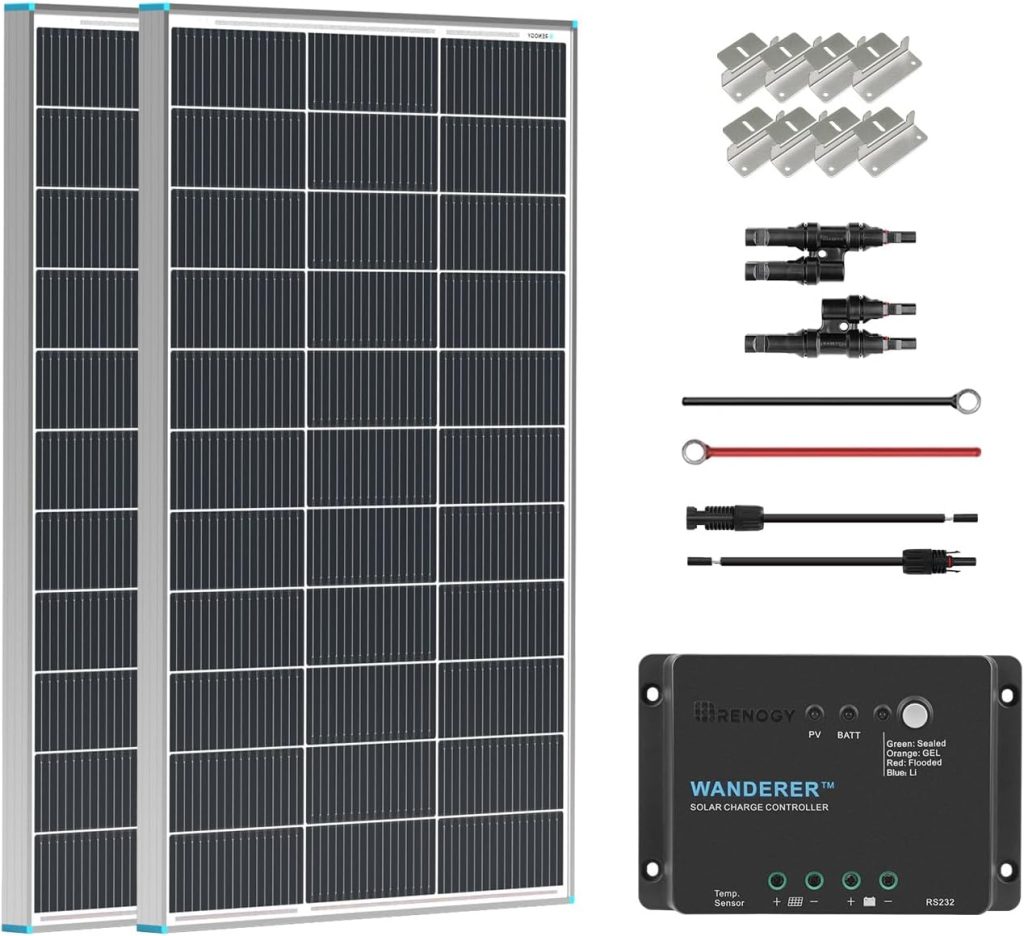
Here’s the part nobody puts in the headline. A 100W panel makes its 100 watts at about 18 volts — that’s the Vmp, the voltage where the panel actually produces. ECO-WORTHY prints it right on the listing for their 200W kit: 18V, 5.56A per panel, two of them. But your battery charges at around 13.8 volts, and a PWM controller — the Wanderer 30A in the Renogy 200W kit, the little LCD box in the ECO-WORTHY 200W kit — doesn’t convert voltage. It just connects the panel to the battery and lets the voltage fall. So the math becomes battery voltage times panel current: 13.8 × 11.12, which is about 153 watts. Roughly a quarter of the sticker number evaporates before a single electron reaches your battery. Not a defect. Physics. I ran the numbers three times because I didn’t want it to be true.
The math doesn’t care what the box says.
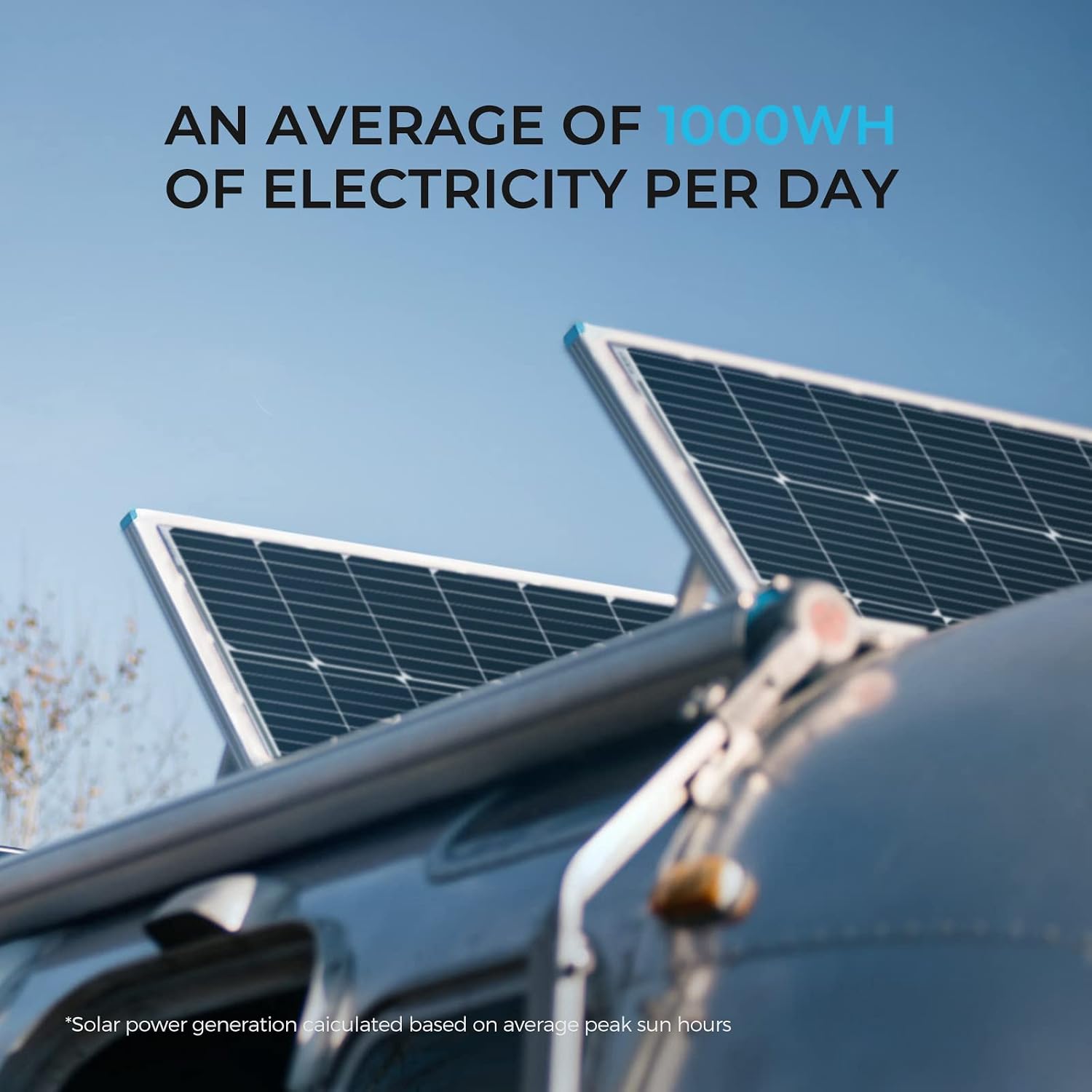
The listing photo for the Renogy kit shows two panels on a camper roof under the words “1000Wh per day.” I stared at that photo for a while. Five peak sun hours is a generous day in most of the US, and 150 real watts times five hours is 750 watt-hours. On a perfect day. Tilted right. No clouds, no dust, no bird deciding your panel is a toilet. A thousand is the kind of number a marketing department arrives at, not the kind a roof produces. This is the part where I’m supposed to be angry about it, but honestly every kit photo in this industry does the same thing. You just learn to do your own arithmetic and move on.
So what does 750 watt-hours actually run? This is the question everyone really asks, usually while pointing at a 12V fridge. A small compressor fridge draws maybe 35 watts while the compressor runs — but it doesn’t run all day. It cycles. A well-behaved fridge in mild weather cycles about a third of the time, which works out near 280 watt-hours a day. A 200W kit covers that with room to spare, and your battery stays happy. The same fridge in a heat wave, door opening every ten minutes, compressor barely resting — now you’re past 800 watt-hours and the kit is short. I used to say a 200W kit runs a 12V fridge. Actually, no. What I meant was it runs a fridge that cycles properly. The fridge’s duty cycle decides, not the sticker on the box.
Battery size is the other half nobody sizes. A 100Ah 12V lithium battery holds about 1,200 watt-hours, roughly 960 of it usable if you stop at 80% depth of discharge. That’s a bit more than one day of a 200W kit’s harvest. One cloudy day and you’re fine. Two in a row and you’re rationing the fridge and reading by headlamp. The kit is only the income; the battery is the savings account. People size the income and forget the account.
Now the number nobody checks: controller amps. Watts divided by battery voltage gives you the current the controller has to handle. For a 200W kit on a 12V system that’s 200 ÷ 12, about 16.7 amps, so the 30A Wanderer in the Renogy kit is honestly sized with real headroom. But 400 watts on the same 12V system is 33 amps, and I have seen kits ship a 30A controller next to 400W of panels. That controller clips at 30 amps and the extra panel becomes an expensive sunshade. The rule I use is 1.25× headroom — 33 × 1.25 is 41, so 40 amps minimum. Credit where it’s due: the ECO-WORTHY 400W kit ships a 40A MPPT controller. Somebody at that company did the division before the box got printed.
PWM versus MPPT, in watt-hours instead of adjectives. A PWM controller gives you battery voltage times panel current, and the rest becomes heat. An MPPT controller converts the extra voltage into extra current, which buys roughly 15 to 20 percent more daily yield in cool weather. Less on hot afternoons, because heat sags the panel’s Vmp closer to battery voltage and there’s less extra to convert. On a 200W kit that’s the difference between about 750 and about 870 watt-hours a day. Whether the MPPT premium is worth it mostly depends on your roof space. If you have room for one more panel, the panel is cheaper per watt-hour than the controller upgrade. Usually.
I once opened a combiner box on a two-year-old install and found an MC4 connector browned at the contact, the plastic gone that toasted color. Factory crimp was loose, and it had been arcing under load for who knows how long. The owner said it smelled like hot plastic for weeks before anyone looked inside. When your kit arrives, give every MC4 a firm tug. If it slides apart easy, it was never crimped right, and no amount of panel wattage fixes a bad connection. Connectors are the cheapest part of the system and the most common point of failure. Funny how that works.
Wiring the two panels: the kits ship Y connectors so you can run them in parallel, and on a real RV roof you should. Wire them in series and one panel half-shaded by the AC shroud drags the whole string down with it — series strings are only as strong as their weakest panel. Parallel keeps the sunny panel working at full current while the shaded one naps. Rooftops are cluttered places. Antennas, vents, a vent fan someone installed in 2009. Parallel forgives all of that.
Wire gauge matters less than people fear and more than kits admit. The ECO-WORTHY 200W kit includes 16.4 feet of 10AWG solar cable, which at 11 amps loses roughly 2% to resistance. Fine. The short tray cables that go from controller to battery are thinner, and they’re the weakest link in the chain — keep them as short as physically possible. Short as possible. Every foot of thin wire between the controller and the battery is a small tax on everything the panels earned that day.
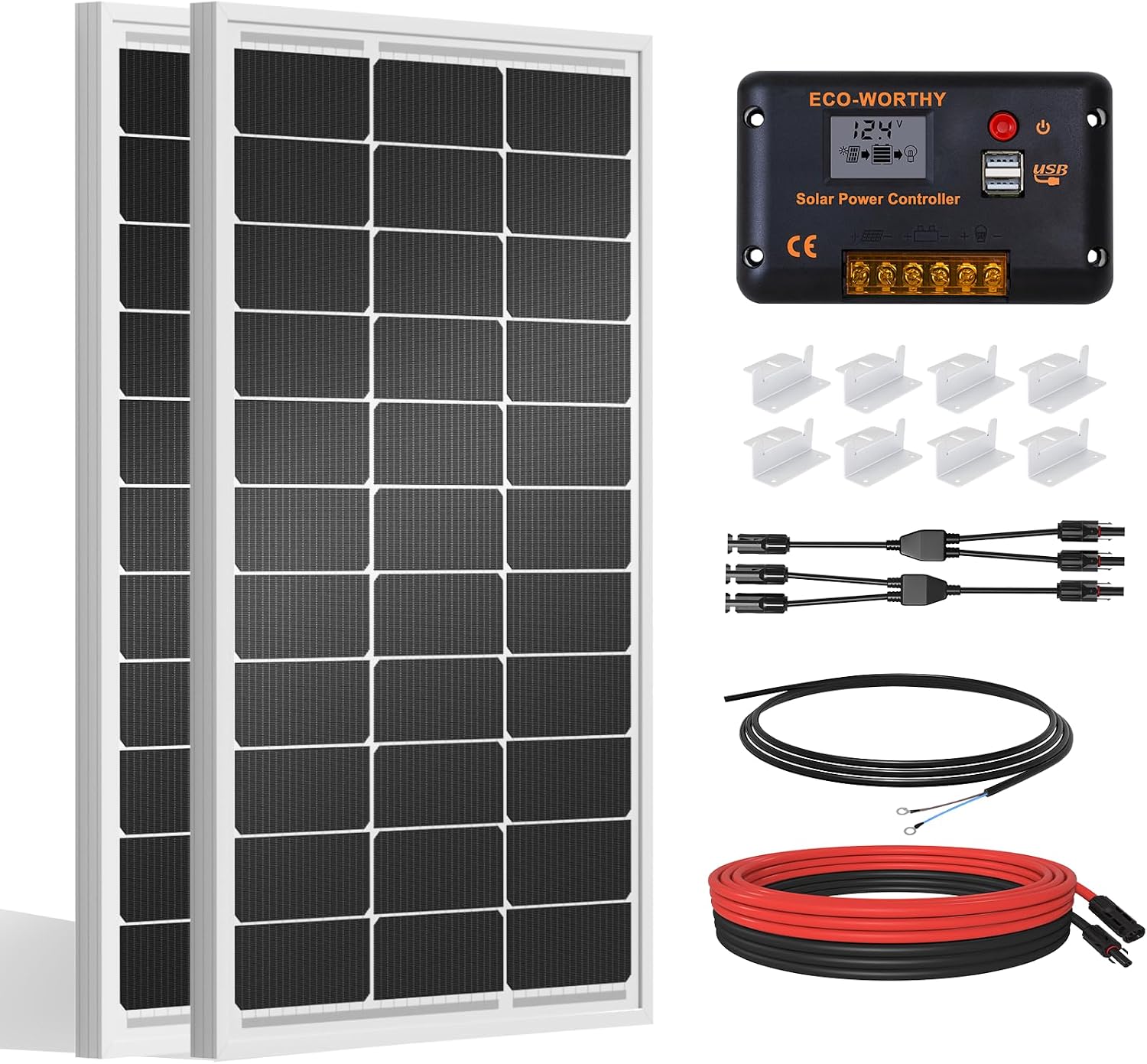
Cost per watt, because that’s the actual comparison and nobody lists it. The Renogy 200W kit runs about $230, which is $1.15 per watt. The ECO-WORTHY 200W kit is about $190, or $0.95 per watt. The ECO-WORTHY 400W kit is about $460 — $1.15 per watt, identical to the Renogy, except the money went into a 40A MPPT controller and a Bluetooth module instead of the brand name. Same dollars per watt, completely different places they got spent. Pick your religion.
Ratings, since people ask me. The Renogy 200W sits at 4.6 stars across 1,544 ratings, with 4% one-star. The ECO-WORTHY 200W is 4.6 across 1,181 ratings, 3% one-star. Add those together and across some 2,700 buyers, fewer than one in twenty hated their kit — about as good as this category gets. The 400W kit shows 4.4 stars with 8% one-star, but that’s 120 ratings. Actually, no — 120 ratings isn’t nothing. It’s just not 1,500, and early production runs always collect the angry reviews first. I’d want to see that number at 500 before drawing conclusions. The listing histograms are public; I checked them this week.
About expansion: the Renogy page says the kit supports up to 400W. True, electrically — you can bolt on two more 100W panels. But then the 30A Wanderer is staring at 33 amps, and we’re back to the clipping problem. You’d be buying a bigger controller too. Budget for it now rather than discovering it on a Saturday with the panels already on the roof. If you want to see the grown-up version done right, the Renogy 400W RV kit review covers a bigger roof system with the controller sized properly from the start. If the kit will feed an inverter for AC loads, that gets sized separately — there’s a whole separate piece on what size solar inverter you need, because inverter math is its own swamp. And if you’re thinking bigger than a cabin, house-scale math is a different animal entirely — start with how many panels a house needs before you extrapolate any of these numbers upward.
Buy the controller for the system you’ll have in two years.
Three Solar Panel Kits, Sized by Job
Same math as above — pick the wattage your loads actually need.
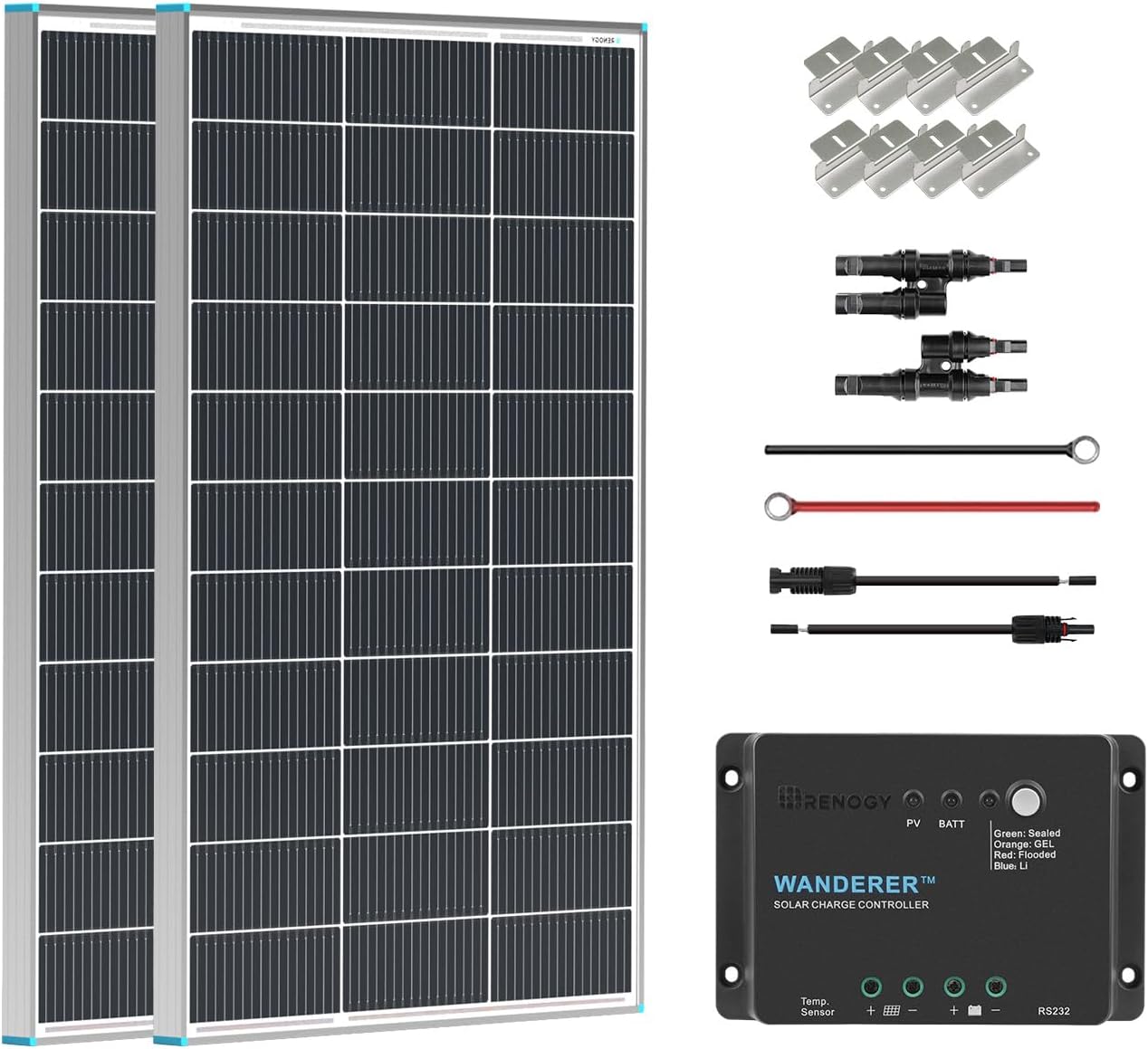
Renogy 200W 12V Solar Starter Kit
2x100W mono panels, 30A Wanderer PWM controller — the worked example above, honestly sized
ECO-WORTHY 200W Solar Panel Kit
Same 200W job for ~$0.95/W, 30A PWM with LCD, 10AWG cables in the box
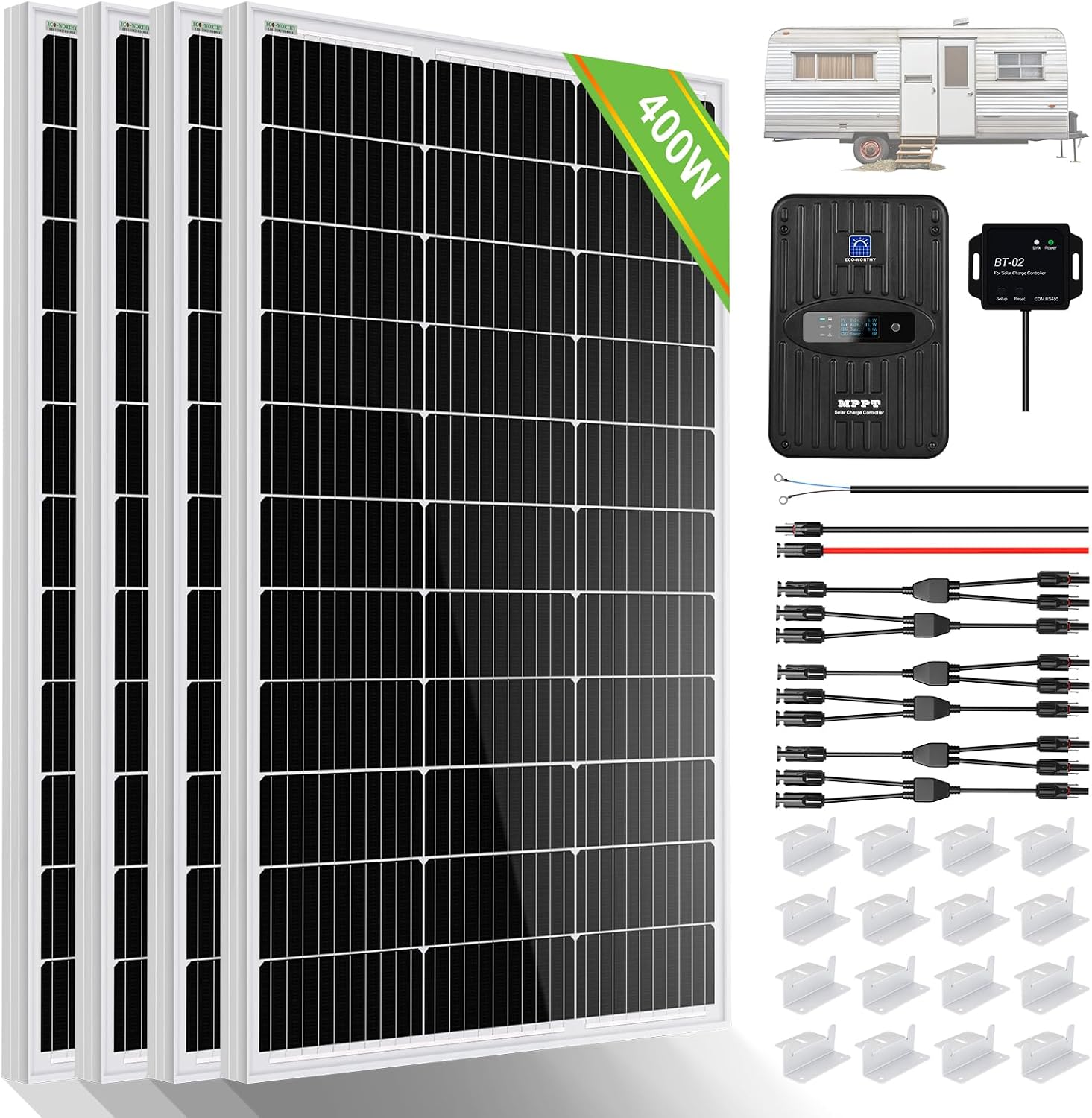
ECO-WORTHY 400W Solar Panel Kit
4x100W panels with 40A MPPT + Bluetooth — for the heat-wave fridge scenario
This site contains affiliate links. We may earn a commission on qualifying purchases.
My 200W kit only shows 140W at noon. Is something broken?
Almost certainly not. A 200W kit on a PWM controller maxes out around 150W into a 12V battery — that’s the 13.8 volts times 11 amps from the panel specs, not a malfunction. Subtract some heat, some wire loss, a little dust, and the 140s are exactly where the physics says you should be. If it shows 60W at noon under a clear sky, then start checking: a shaded panel, a loose MC4, the controller stuck in float mode on a full battery. But 140 at solar noon? I wouldn’t lose sleep over 140.
Can I add two more panels to my 200W kit later?
Electrically yes, practically budget for a controller too. Four 100W panels on a 12V system push about 33 amps, and your 30A controller becomes the bottleneck — it’ll clip the extra and run hot doing it. Either upgrade to a 40A or larger controller when you expand, or hang the second pair on its own small controller wired to the same battery bank. Controllers don’t mind sharing a battery; they each just do their own charging. People overthink this part. The panels don’t care how many controllers are in the room.
PWM or MPPT — does it change my daily watt-hours enough to matter?
On cool clear days, an MPPT controller harvests roughly 15 to 20 percent more than PWM from the same panels. On hot afternoons the advantage shrinks to single digits because heat drags panel voltage down toward battery voltage. On a 200W kit that’s maybe 120 extra watt-hours a day in spring, less in August. Worth it if your roof fits exactly two panels and no more. If you have space for a third panel, the panel usually buys more watt-hours per dollar than the controller upgrade. Usually — shade and winter tilt can flip that math.
Will a 200W kit run my 12V fridge?
If the fridge cycles normally, yes, comfortably. A small compressor fridge pulling 35 watts a third of the time uses under 300 watt-hours a day, and a 200W kit harvests around 750 on a decent day. The trouble starts in real heat with the door opening constantly — duty cycle climbs, daily draw can pass 800 watt-hours, and now the kit is short. So the honest answer is that the fridge decides, not the kit. Run the fridge for a day on a meter before you blame the panels. Most “my kit is too small” complaints I’ve heard were really “my fridge runs constantly” complaints wearing a disguise.
Why does my charge controller get warm? Should I worry?
Warm is the job description. A PWM controller burns off the extra panel voltage as heat — that warmth is literally where your missing 23% goes. It should feel warm through the case after a few hours of good sun. Hot is different. If you can’t keep your hand on it, or there’s a plastic smell, the controller is undersized for the array or it’s dying. Give it airspace when you mount it; screwed flat against a wall in a closed compartment is how controllers cook themselves. Mine runs warm enough to notice. Never measured it.
The Renogy 200W is still on my bench next to the Wanderer. I keep meaning to swap in an MPPT just to watch the numbers move on a cold morning. Haven’t gotten around to it. The loaner kit works, the math is settled, and there’s always another roof waiting.


