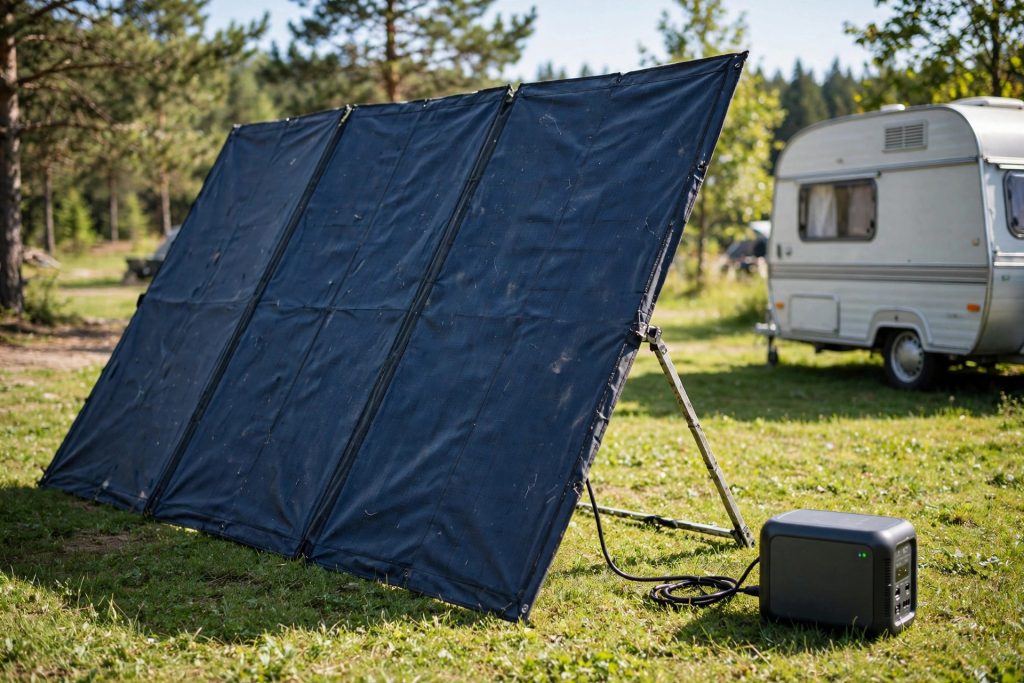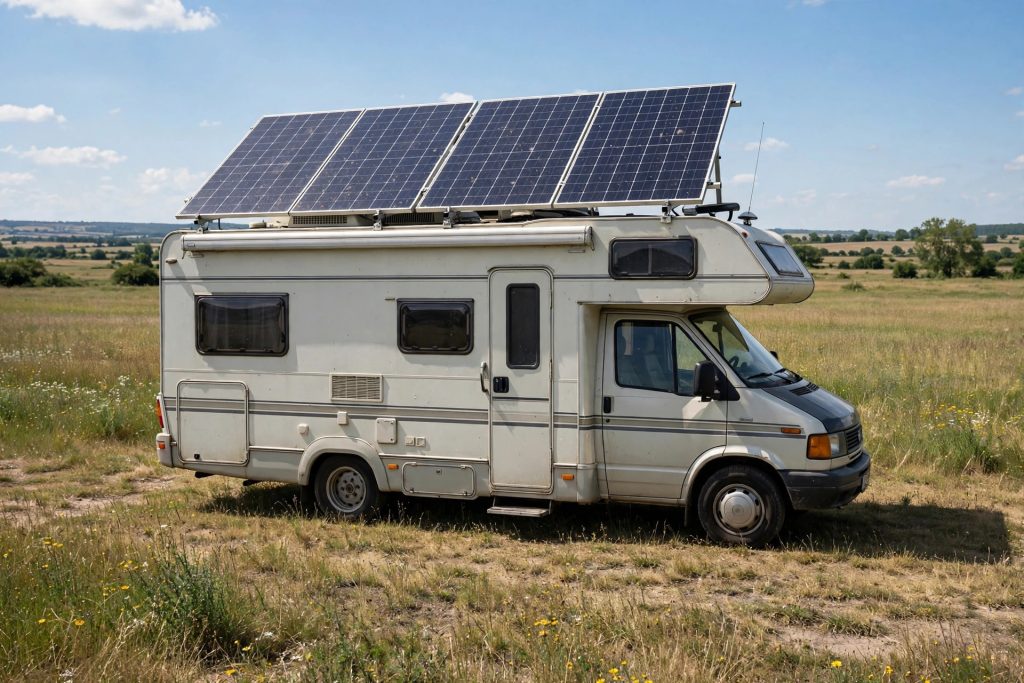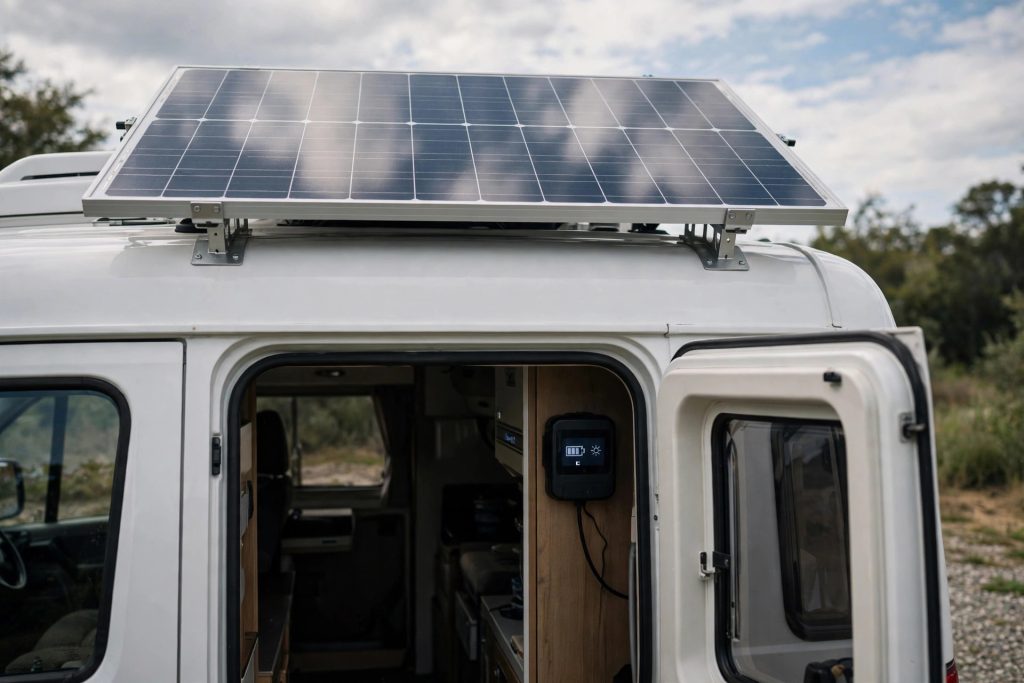
A flexible solar panel is what you buy when a normal panel won’t fit. That’s the whole reason this category exists. Rigid glass panels and folding suitcases are cheaper per watt and last longer, but neither will follow the curve of an Airstream shell, a pop-top camper roof, or a boat deck. A flexible panel bends, bonds down, and adds almost no height or weight. If your mounting surface is flat and strong, stop reading and go buy a rigid 400W roof kit from Renogy instead.
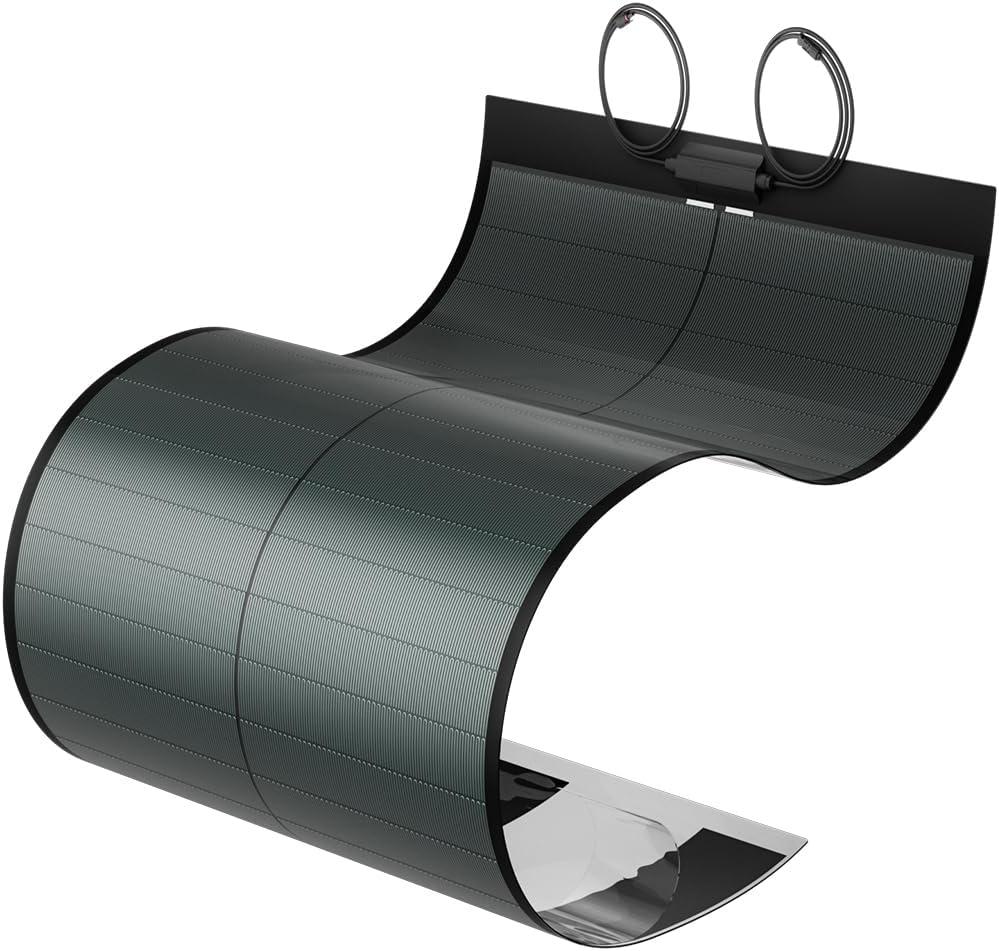
The BougeRV Yuma 100W is the most extreme flexible panel of the three we’re comparing here. It’s built on CIGS thin-film cells — copper indium gallium selenide on stainless steel foil — with no glass and no aluminium frame. BougeRV rates it bendable through a full 360 degrees, and it comes with adhesive tape backing so it sticks down without a single drill hole. That’s a genuinely different proposition from the semi-flexible monocrystalline panels most people picture. It’s also the panel with the most obvious costs: mid-teens efficiency, a premium price tier per watt, and an 18-month warranty. Fit versus value is the whole story here.
Quick Answer
The BougeRV Yuma 100W CIGS is the flexible solar panel to buy when the surface itself is the problem — a curved shell, a pop-top roof or a deck that defeats rigid panels — because nothing else here bends through a full turn, sticks down with no drill holes, or shrugs off partial shade as well. Read the costs first: mid-teens efficiency means more roof per watt, the warranty runs just 18 months, and the tape install is close to permanent. If your curve is gentle and your controller is a simple 12V unit, the Renogy below is the saner default; if your roof is flat and strong, skip flexible panels entirely and buy rigid or folding for less per watt.
Compare Flexible Solar Panels
Three ways to put 100W on a curved roof side by side — CIGS thin-film, mono flexible, or removable mono.
BougeRV Yuma 100W CIGS Flexible Solar Panel
CIGS thin-film that bends through a full turn and sticks down — the lightest here at about 4.4 lb, kindest to shade
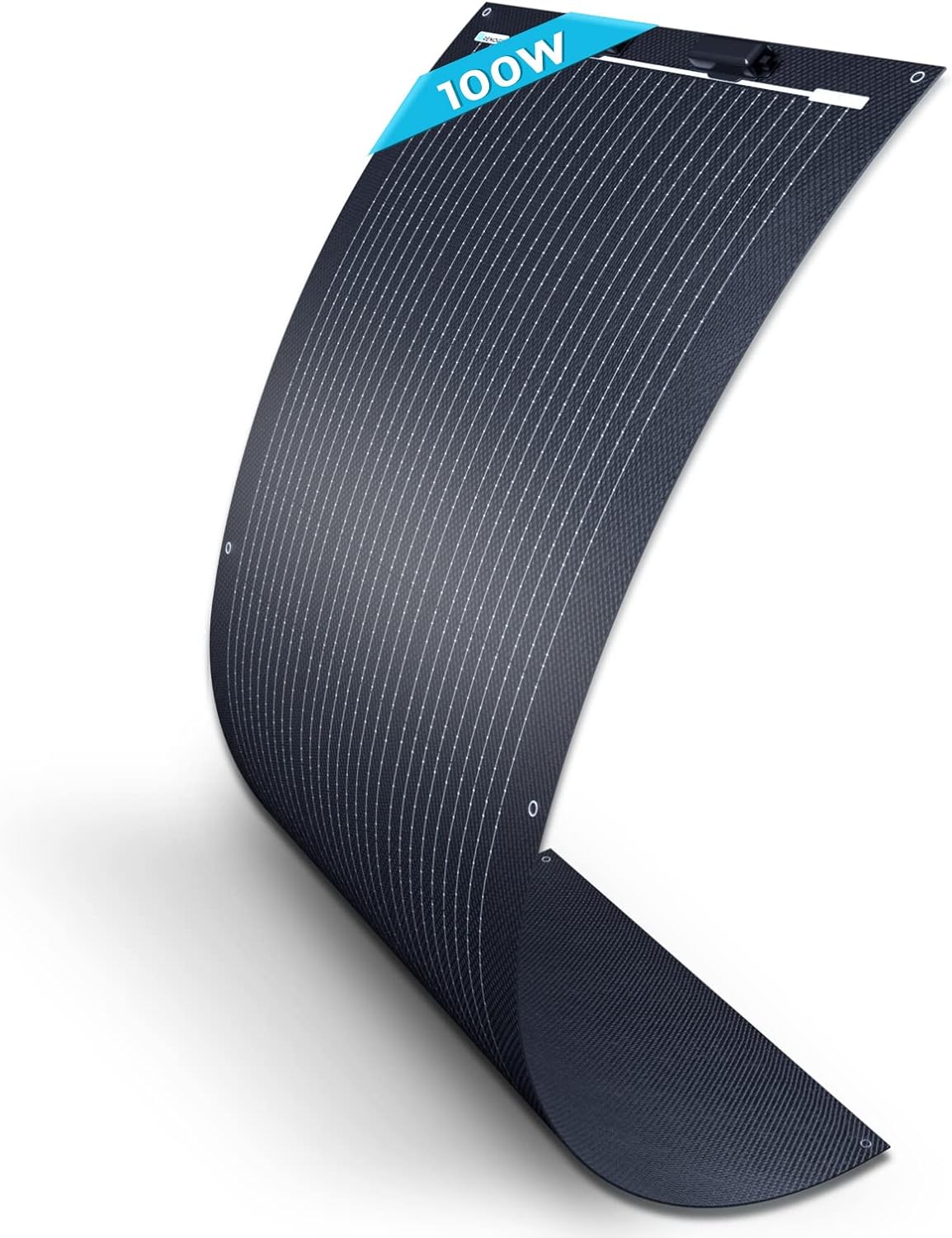
Renogy 100W Flexible Solar Panel (Black Division)
Monocrystalline efficiency around 22% with a 5-year warranty class — the sane default flexible panel
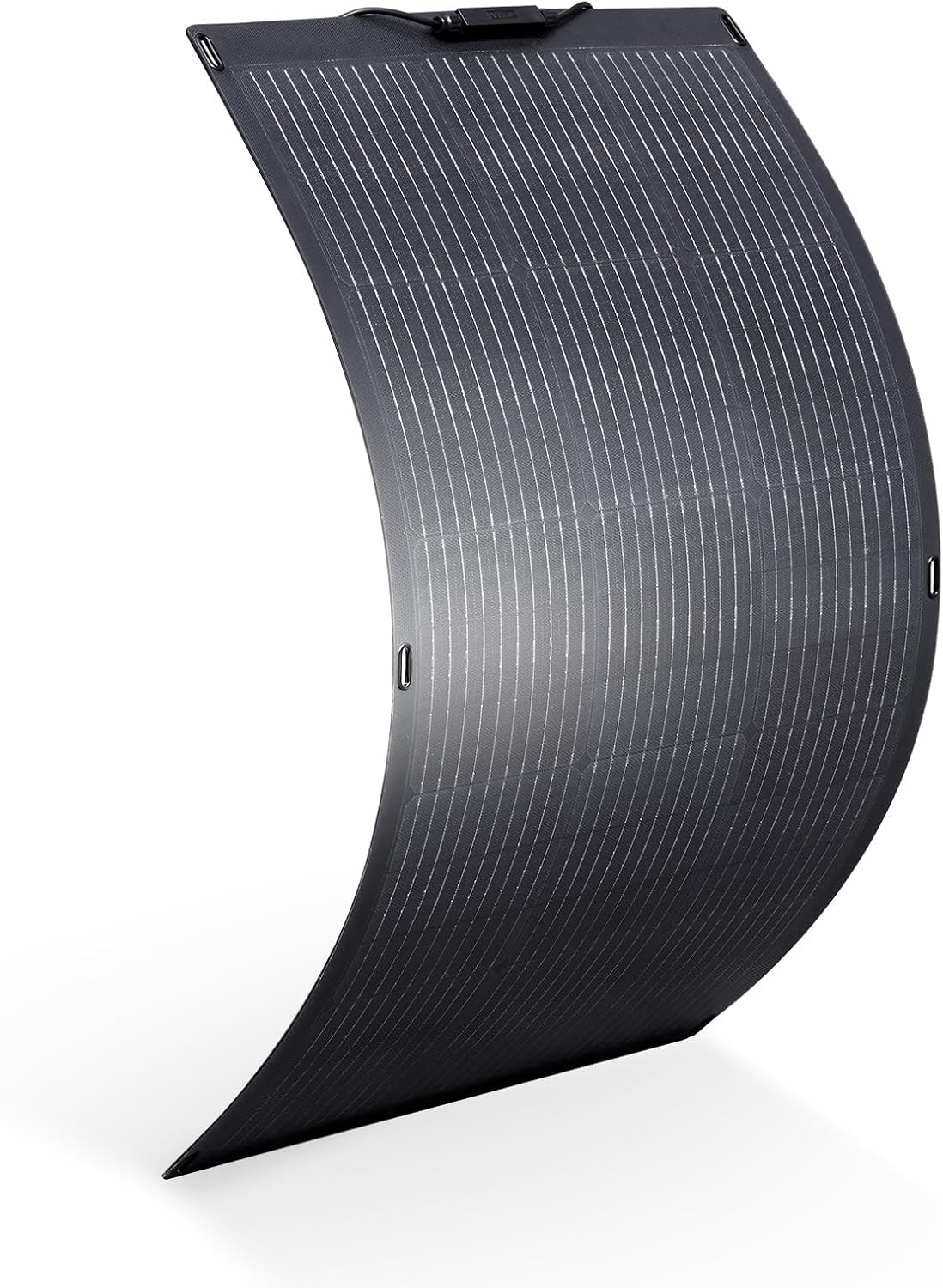
ALLPOWERS SF100 100W Flexible Solar Panel
Monocrystalline ETFE with metal grommets — the one you can unmount, move and tie down somewhere sunnier
Prices and availability may vary — tap any product to check the current listing.
What to Look For in a Flexible Solar Panel
Cell type: CIGS thin-film vs monocrystalline
This is the first fork in the road, and it decides everything else. CIGS thin-film, which is what the BougeRV Yuma uses, bends further and handles partial shade better than monocrystalline. The trade-off is efficiency: the Yuma’s cells sit in the mid-teens, roughly 16-17%, while a good monocrystalline flexible panel like the Renogy runs around 22%. That gap means you need more roof area for the same wattage with CIGS. If square footage is tight, monocrystalline wins. If your roof curves hard or shade keeps crossing the panel, thin-film’s advantages are worth the area penalty.
Bend limit and what your roof curve actually needs
Bend numbers get quoted like specs on a datasheet, but they map to real roof shapes. The BougeRV’s full 360-degree rating means it can wrap a tight radius — think a rounded pop-top edge or a heavily crowned shell. The Renogy bends to about 240 degrees, which covers gentle roof curves and nothing more. The ALLPOWERS is a semi-flexible laminate in the same ballpark as the Renogy. Be honest about your roof: most “curved” RV roofs are gentle arcs that a 240-degree panel handles fine. Only a genuinely tight curve justifies paying for the CIGS construction.
Voltage and controller match
Check the voltage class before you buy anything. The BougeRV Yuma runs a max power voltage around 25V and an open-circuit voltage around 31.5V — higher than a classic 12V panel. That’s not a problem, but it does mean it pairs with an MPPT controller or a power station’s solar input, not a bargain PWM controller. The ALLPOWERS SF100 is similar, around 25.5V max power and 30.6V open-circuit. The Renogy sits in the 24V class, so it plays nicely with simple 12V PWM and MPPT controllers alike. If you already own a cheap PWM controller, the Renogy is the path of least resistance.
Mounting method: tape, holes, or grommets
How a panel attaches decides whether you can ever take it off again. The BougeRV Yuma is tape-backed — it sticks down flat, no drilling, and it is close to permanent. Removal can damage the panel and mark the roof. The Renogy gives you both options: pre-drilled mounting holes or adhesive. The ALLPOWERS SF100 is the only genuinely removable one here, with metal grommets around the edges so you can tie or screw it down and lift it off later. If portability matters — chasing sun around a campsite — the grommet design is the reason to pick the ALLPOWERS.
Heat and the missing air gap
A panel bonded flat to a roof has no airflow underneath it. It runs hotter than a rack-mounted rigid panel, and on still, hot days it gives back some output. This is a physics problem, not a brand problem — every flexible panel in this group suffers from it. The workaround is mounting height: grommet-mounted panels that sit slightly off the surface run cooler than fully bonded ones. If you camp in serious heat and want every watt, that’s another small point for the removable ALLPOWERS or a rigid panel on standoffs.
Warranty and expected service life
Flexible laminates as a class carry shorter warranties and shorter expected service lives than rigid glass panels. The BougeRV Yuma’s warranty is 18 months — short even by flexible-panel standards. The Renogy covers about 5 years, which is far longer. The ALLPOWERS lands somewhere shorter than the Renogy. Treat the warranty as a rough proxy for how long the maker expects the panel to hold up, and price that risk into your decision. A cheap flexible panel that dies in year three is not cheap.
Who the BougeRV Yuma 100W Actually Fits
The curved-shell or pop-top owner. If you own an Airstream-style shell, a pop-top camper, or a van with a heavily crowned roof, rigid panels genuinely cannot do this job. The Yuma’s 360-degree bend and tape backing let it follow a curve that would leave a glass panel bridging air gaps. This is the buyer the panel was designed for.
The shade-dappled camper. If you park under trees and shade keeps crossing the roof, the Yuma’s anti-shading design means partial shade hurts it less than a mono panel. That’s a real advantage for forest campers who can’t chase open sky. You pay for it in efficiency and warranty length, but if shade is your daily reality, it’s the right trade.
The flat-roof owner should skip it. If your roof is flat and can take the weight, a rigid kit or a folding panel is the smarter buy. This whole category is optional for you. You’d pay more per watt, get less efficiency, accept a shorter warranty, and give up the ability to remove the panel cleanly — all to solve a fit problem you don’t have. Before you buy anything, work out how much solar an RV roof actually needs; a single 100W panel yields a few hundred watt-hours in decent sun, enough for lights, phones and a fan, not a fridge habit on its own.
Three Ways to Put 100W on a Curved Roof
| Panel | Cell Type | Bend | Voltage Class | Mounting | Weight Class | Best For | Watch-Out |
|---|---|---|---|---|---|---|---|
| BougeRV Yuma 100W CIGS | CIGS thin-film | Full 360° | ~25V max power / ~31.5V open-circuit (MPPT or power station) | Adhesive tape backing, permanent | Lightest, ~4.4 lb, under 1/16 inch thick | Tight curves and shaded roofs | Mid-teens efficiency, 18-month warranty, near-permanent install |
| Renogy 100W Flexible | Monocrystalline half-cut PERC | Up to 240° | 24V class (PWM or MPPT friendly) | Pre-drilled holes or adhesive | ~5.3 lb | The sane default flexible panel | Won’t wrap a tight radius |
| ALLPOWERS SF100 | Monocrystalline under ETFE | Semi-flexible | ~25.5V max power / ~30.6V open-circuit (MPPT or power station) | Metal grommets, removable | ~5.3 lb, about 3mm thick | Campers who want to unmount and move the panel | Warranty shorter than Renogy’s |
The BougeRV Yuma’s row is defined by that 360-degree bend and the tape. Nothing else here bends like it or sticks down like it, and the anti-shading design is a genuine edge under trees. The cost is the mid-teens efficiency — you need more roof area per watt — plus the 18-month warranty and an install you can’t undo cleanly.
The Renogy row is the balanced one. Around 22% efficiency means more watts per square foot, the 24V-class voltage works with simple controllers, and the roughly 5-year warranty is in a different league from the BougeRV’s. It bends to 240 degrees, which covers gentle roof curves but not a full roll. For most buyers, this is the flexible solar panel to beat.
The ALLPOWERS row is about the grommets. It’s the only genuinely removable option here — tie it down, screw it down, take it off and move it into the sun. The voltage class matches the BougeRV’s, so it wants an MPPT controller or a power station input, and the warranty is shorter than the Renogy’s. Buy it for the mounting flexibility, not the spec sheet.
Questions People Ask Before Buying
Real buyer questions, straight answers
Is a flexible solar panel worth it, or should I just buy a rigid one?
A flexible panel is worth it when the shape of your roof is the problem, and a waste of money when it isn’t. Rigid panels cost less per watt, run cooler, and last longer, so if you’ve got a flat roof with room to spare, buy rigid and don’t overthink it. Flexible earns its price on curved trailer roofs, pop-tops, van hoods, and boat decks where a rigid frame simply won’t sit. You’re paying a premium for conformability, lighter weight, and a low profile that doesn’t catch branches or wind. If none of that describes your setup, the premium buys you nothing.
BougeRV CIGS or a monocrystalline flexible panel — which is actually better?
Neither wins outright; they’re built for different installs. The Yuma’s CIGS cells bend through a full 360 degrees and its anti-shading design handles partial shade better than most, which matters on a curved, obstacle-strewn roof. A monocrystalline panel like the Renogy bends to about 240 degrees, converts more of the sun it catches (roughly 22% efficiency class versus the Yuma’s mid-teens), and typically carries a much longer warranty. So: extreme curves and shade tolerance point to CIGS, gentle curves and maximum output per square foot point to mono. Pick the cell type that matches your roof, not the spec sheet that looks best in isolation.
How much power will one 100W flexible panel really give me?
Expect a few hundred watt-hours on a decent sunny day, not 100W around the clock. A 100W panel only makes its rated power at ideal sun and temperature, and a bonded flexible panel runs hot with no air gap behind it, so real-world output sags on still, hot afternoons. Cloud, shade, and panel angle eat into it further. In practice that’s enough to top up a power station, keep a fridge battery honest, or run lights and devices — not enough to live off. Size your expectations at maybe half the nameplate on a mixed day and you’ll be pleasantly surprised instead of disappointed.
Can I stick a flexible panel down and take it off later?
You can, but assume the adhesive is close to permanent and plan accordingly. The Yuma mounts with tape backing, and peeling a bonded panel off a roof can damage the panel and lift paint or membrane with it. That’s why you test-fit and test-charge before you commit, and why you clean and prep the surface properly the first time. If removable mounting is a real requirement, buy a grommeted panel you can tie down instead. Treat tape-down as a decision you make once.
Will a 100W flexible panel charge my portable power station?
Yes, if the voltages match — and the Yuma’s do, with the right input. The Yuma runs around 25V max power and 31.5V open-circuit, which suits an MPPT controller or a power station’s solar input rated for that range. What it won’t do is play nicely with a cheap PWM controller expecting a 12V-class panel. Check your power station’s solar input window before buying, and remember one 100W panel charges slowly — fine for topping up, slow for refilling a big bank from empty.
Living With a Bonded Panel: Where Flexible Works and Where It Breaks
A curved trailer roof that finally gets solar. This is the Yuma’s home turf. A rigid panel would need a frame and standoffs that fight the curve and catch wind; the Yuma tapes down flat, follows the contour through its full 360-degree bend, and adds about 4.4 lb and under 1/16 inch of height. The honest limit: you get one shot at placement, because that adhesive isn’t coming back off cleanly.
A tree-shaded campsite where the anti-shading design earns its keep. CIGS handles partial shade better than most panel types, so a branch shadow across one corner doesn’t kill the whole array the way it can on a string of mono cells. It’s a real advantage on wooded sites. The limit is that “better” isn’t “immune” — heavy shade still crushes output, and no panel fixes a bad parking spot.
A hot, still roof at noon where the missing air gap costs output. Bonded flat means no airflow behind the panel, so it heat-soaks on a still summer day and loses some output exactly when the sun is strongest. Rigid panels on standoffs run cooler. You trade a bit of peak output for the low profile — a fair deal on a curved roof, a worse one on a flat roof where you had other options.
Common Mistakes Buyers Make With Flexible Solar Panels
Pairing a 31.5V-class panel with a cheap PWM controller. The Yuma’s open-circuit voltage is well above what a basic 12V PWM controller expects, so you lose power or cook the controller. Match it to an MPPT unit or a power station input rated for the voltage.
Taping a panel down before testing it and prepping the roof. Lay it out, confirm it charges, clean and prep the surface, then commit. Skip that and you’re stuck with a mispositioned panel you can’t remove without damage.
Expecting rigid-panel lifespan and output from a bonded laminate. Flexible panels as a class carry shorter warranties — 18 months on the Yuma versus about 5 years on the Renogy — and run hotter. Buy knowing that.
Buying one 100W panel to run loads it can’t feed. A fridge or an electric kettle will laugh at a few hundred watt-hours. Match the panel to realistic loads, or plan for two panels wired together if your controller’s voltage and current limits allow it.
Why, How, What
Why does CIGS bend further than monocrystalline?
CIGS cells are a thin-film chemistry deposited on a flexible substrate, so the whole laminate can flex through extreme curves — the Yuma handles a full 360 degrees. Monocrystalline cells are crystalline wafers, and crystals crack, so mono flexible panels use small cell divisions and stop at gentler bends, around 240 degrees on the Renogy. That’s the whole trade in one sentence: thin-film bends more, crystalline converts more.
How do you wire a flexible panel into a camper?
Run the panel’s leads to a charge controller sized for its voltage, then from the controller to your battery bank, with a fuse on the battery side. Keep cable runs short and use the right gauge so you don’t bleed voltage. If you add a second panel, wire it in parallel or series to suit your controller’s limits — check both voltage and current before you connect anything.
What size controller does a 100W flexible panel need?
For the Yuma, you need an MPPT controller rated for its roughly 31.5V open-circuit and 100W — a 10A MPPT unit covers a single panel comfortably. A basic 12V PWM controller won’t suit this panel’s voltage class. If you plan to add a second panel later, buy the controller for the eventual array, not just today’s single panel.
Frequently Asked Questions
Can a flexible solar panel be walked on?
Occasionally and carefully, not routinely. The Yuma is thin and bonded flat, so a light step won’t instantly destroy it, but repeated foot traffic stresses cells and the laminate. Keep traffic off it and you’ll get far more life out of it.
How long does a flexible solar panel last?
Shorter than rigid as a class, and the warranty reflects it — 18 months on the Yuma versus about 5 years on the Renogy. Heat, flexing, and UV all take a toll on bonded laminates. Treat it as a wear item with a realistic service life, not a permanent roof fixture.
Can I add a second flexible panel later?
Yes, if your controller can handle the extra voltage and current. Two 100W panels roughly double your harvest, which is the realistic fix for loads one panel can’t feed. Plan the controller for two panels from the start so you’re not rebuying it later.
Does a flexible panel work on a boat?
It can, and the low profile and light weight suit a deck or cabin top. The catch is heat and salt — a bonded panel with no air gap runs hot, and marine environments are hard on adhesives and laminates. Prep the surface well and accept a shorter service life.
Can I mount a flexible panel with screws instead of tape?
Only on panels built for it — the ALLPOWERS SF100 has metal grommets for tie-down mounting, while the Yuma is designed for its tape backing. Screwing through a tape-only laminate risks damaging cells and voiding the warranty. Match the mounting method to the panel.
What happens if part of the panel is shaded?
Output drops, but the Yuma’s anti-shading design limits the damage compared with a typical mono string, where one shaded cell can drag down a whole section. It’s a real edge on cluttered roofs and wooded sites. It won’t rescue you from heavy shade, though — reposition if you can.
Decision Tree: Which Flexible Panel Fits Your Roof?
Curved roof or pop-top that needs a panel to follow the contour → Yuma.
Gentle curve and a simple 12V PWM controller already installed → Renogy.
Need to unmount and move the panel between vehicles → ALLPOWERS.
Flat roof with room and no weight limit → skip flexible, go rigid or folding.
Mostly shaded parking → Yuma, and temper your output expectations.
Key Takeaways
The Yuma’s edge is conformability and shade tolerance, not raw efficiency.
Bonded means permanent — test and prep before the tape touches the roof.
One 100W panel is a top-up, not a power plant.
Match the controller to the panel’s ~31.5V open-circuit or lose output.
Flexible panels cost more per watt and carry shorter warranties. Know that going in.
Final Recommendation
Buy the Yuma if your roof is curved, your mounting spot is awkward, or shade is a constant nuisance and you want a panel that follows the surface and shrugs off partial shadowing. Buy the Renogy instead if your curve is gentle, you want more output per square foot and a longer warranty, and a plain 12V controller is already in place. Buy the ALLPOWERS if you need to take the panel off and move it around. Skip the whole category if your roof is flat with room to spare — rigid or folding panels will serve you better and cheaper.
Compare Flexible Solar Panels
Three ways to put 100W on a curved roof side by side — CIGS thin-film, mono flexible, or removable mono.
BougeRV Yuma 100W CIGS Flexible Solar Panel
CIGS thin-film that bends through a full turn and sticks down — the lightest here at about 4.4 lb, kindest to shade
Renogy 100W Flexible Solar Panel (Black Division)
Monocrystalline efficiency around 22% with a 5-year warranty class — the sane default flexible panel
ALLPOWERS SF100 100W Flexible Solar Panel
Monocrystalline ETFE with metal grommets — the one you can unmount, move and tie down somewhere sunnier
Prices and availability may vary — tap any product to check the current listing.
Affiliate Disclosure: This article contains affiliate links. If you buy through one of these links, we may earn a commission at no extra cost to you.