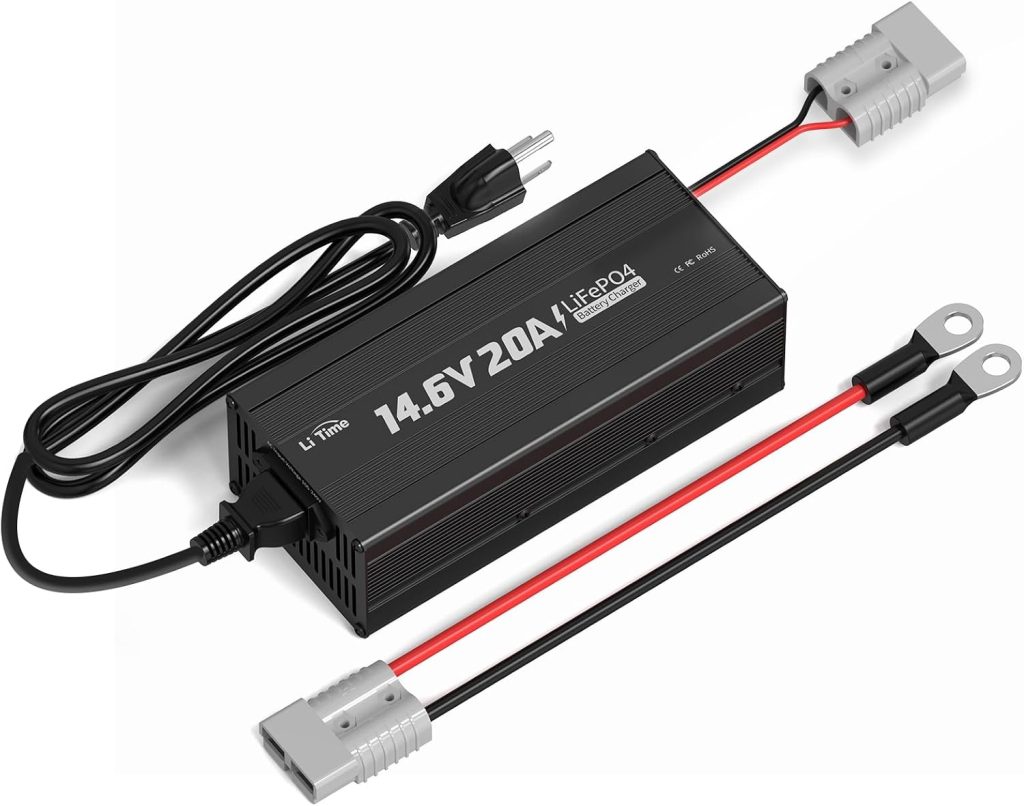
If your camper or travel trailer runs a LiFePO4 house bank, you already know the drill: solar keeps up on a good day, then a run of cloudy weather or a shady campsite leaves you short, and shore power is the only way to catch up before the next trip. The LiTime 12V 20A LiFePO4 Battery Charger is built for exactly that job. It’s a dedicated lithium battery charger that pushes 20A into a 12.8V LiFePO4 pack at 14.6V, and it does nothing else. That focus is the whole pitch, and it’s also the whole limitation. If you own lead-acid batteries, you’re in the wrong aisle here, and if you’re hoping this replaces a solar charge controller off-grid, it doesn’t.
Quick Answer
The LiTime 12V 20A is the lithium battery charger to buy when your camping or RV house bank is LiFePO4 and you want the fastest refill on shore power — a dedicated 14.6V profile at 20A, an Anderson connector for a fixed bank, and a 0V activation function that can attempt to wake a BMS-tripped pack. Read the limits first: it charges LiFePO4 only and cannot touch a lead-acid battery, it is not waterproof, and like every AC charger here it does nothing without a mains source. If your garage mixes chemistries, the NOCO GENIUS10 below covers both at half the current; if the charger will live somewhere damp, the Victron adds an IP65 housing and Bluetooth monitoring.
Compare Lithium Battery Chargers
Three charging philosophies side by side — dedicated speed, multi-chemistry flexibility, or waterproof smarts.
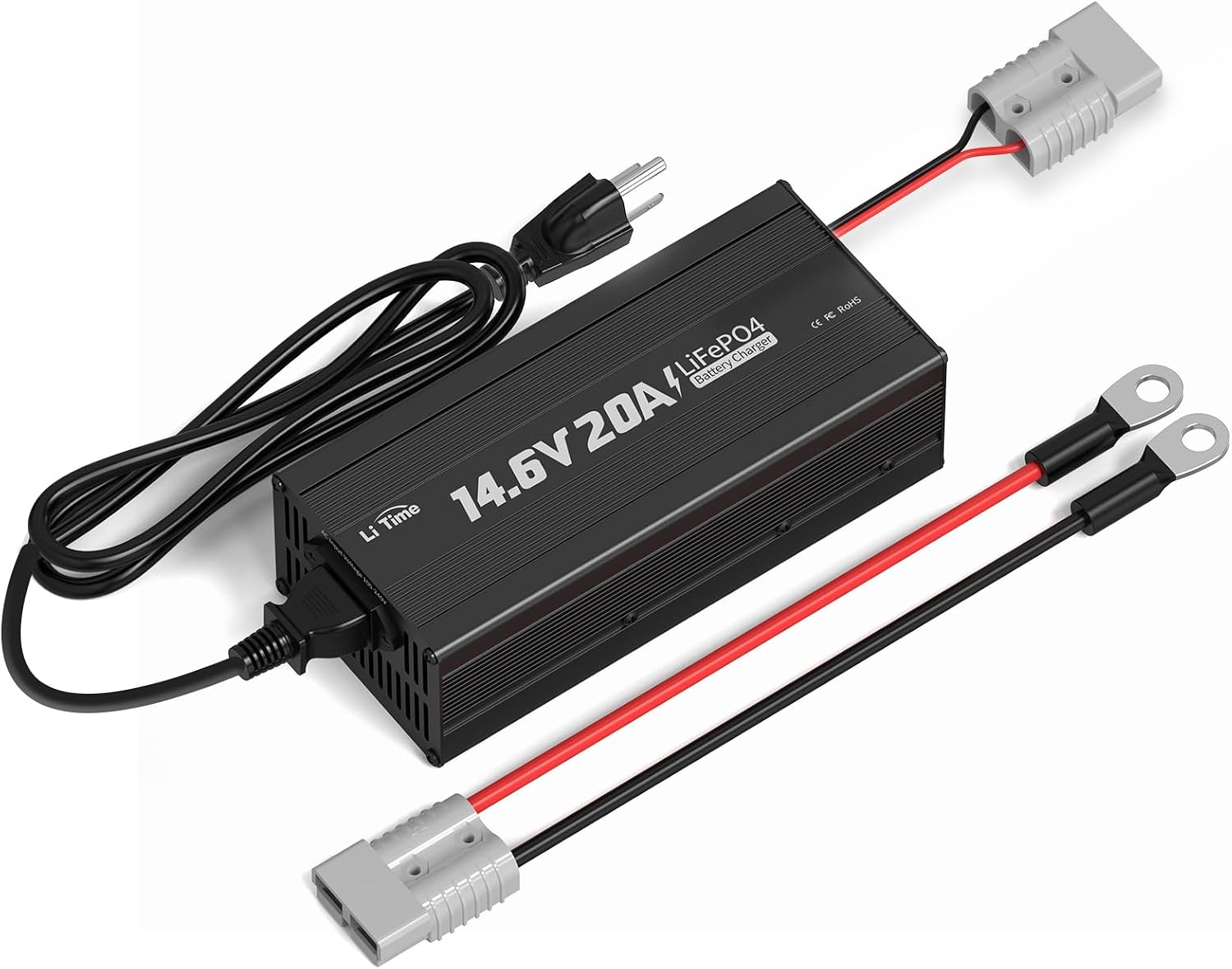
LiTime 12V 20A LiFePO4 Charger
Dedicated 14.6V at 20A for LiFePO4 only — the fastest shore refill here, but it cannot charge lead-acid and is not waterproof
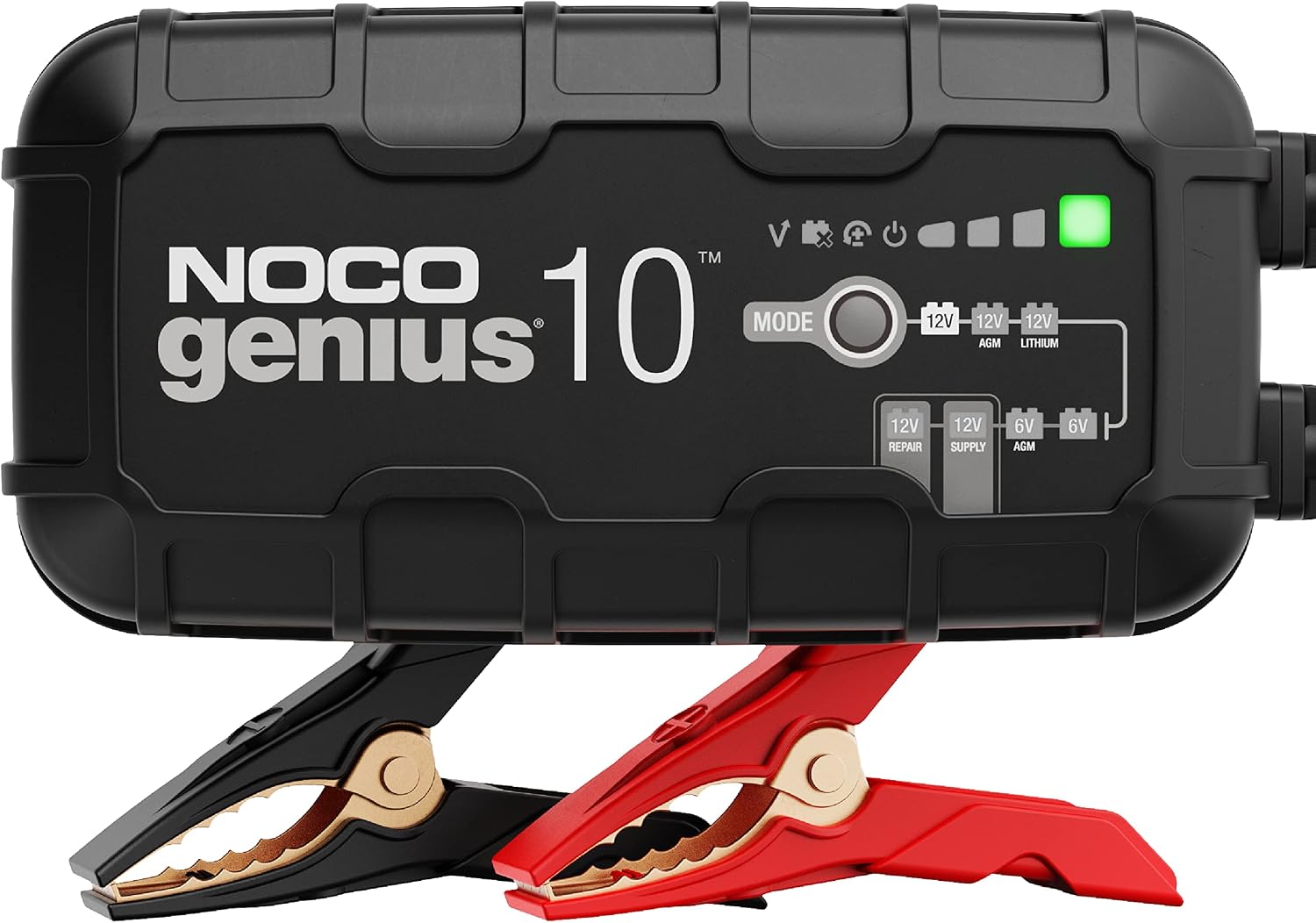
NOCO GENIUS10
10A multi-chemistry smart charger and maintainer — lead-acid plus a lithium mode you select yourself
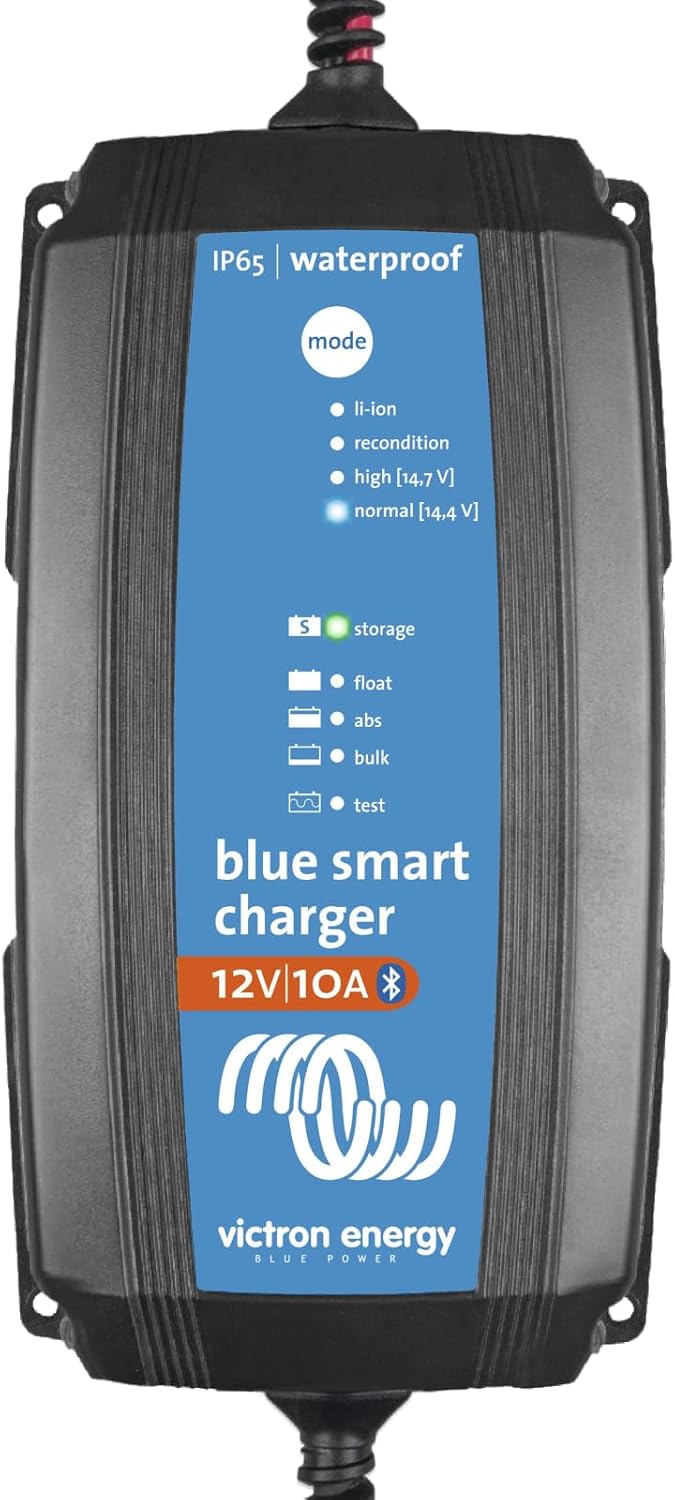
Victron Blue Smart IP65 12V 10A
10A with IP65 waterproofing and Bluetooth app monitoring — the pick for damp or exposed mounting
Prices and availability may vary — tap any product to check the current listing.
What to Look For in a Lithium Battery Charger
The charge profile matters more than the amp number. LiFePO4 cells want an absorption voltage around 14.4-14.6V, and they don’t appreciate being fed a plain lead-acid profile that never quite tops them off or that holds them at the wrong voltage for too long. A generic 12V battery charger built around flooded or AGM curves will typically undercharge a lithium pack, leaving capacity on the table, or stress it with a float stage it never asked for. The LiTime’s answer is simple: 14.6V at 20A, no lead-acid modes, no guessing. That’s the right call for a dedicated LiFePO4 charger, but it means the charger is only as good as your battery chemistry matching it.
Amps decide your refill time, and the math is honest but optimistic. A 100Ah LiFePO4 battery at 20A refills in roughly 5 hours from empty in theory. At 10A, roughly 10 hours. Double the bank to 200Ah and you’re looking at about 10 hours at 20A. Real times run longer because charging tapers near full, so treat those numbers as a floor, not a promise. Still, 20A is twice the current of the two rivals below, and on a hookup night before a trip that difference is real.
Dedicated vs multi-chemistry is a genuine trade-off, not a marketing line. A dedicated lithium battery charger can’t be set wrong. A multi-chemistry unit like the NOCO GENIUS10 covers flooded, AGM, gel, deep-cycle lead-acid and LiFePO4, but you have to select lithium mode yourself. Forget that step and you’re charging a lithium pack on a lead-acid profile, which is exactly the scenario the dedicated design eliminates. Flexibility cuts both ways.
0V activation is a rescue tool, not a miracle. The LiTime has a function that can attempt to wake a deeply discharged pack whose BMS has cut off. That’s genuinely useful if a battery sat too long or a parasitic draw flattened it. What it can’t promise is that every dead pack comes back. If cells are actually damaged, no charger fixes that.
Connectors should match how you’ll use it. The LiTime ships with an Anderson connector plus ring/M8 terminals. For a fixed RV or camping bank, ring terminals bolted to the battery posts are the clean answer, and the Anderson plug makes a quick disconnect easy. Clamps are fine for bench work but clumsy in a battery box. The NOCO includes clamps plus integrated eyelet terminals; the Victron leans on its own connection setup. Think about where the charger lives before you buy.
Weatherproofing decides where it can live. The LiTime is not waterproof and must be kept dry. That’s fine in a garage or a protected compartment, and a bad idea on an exposed wall in a damp shed. The Victron’s IP65 housing tolerates damp garages and exposed mounting far better. If your charger’s home is questionable, factor that in. And if you’re pairing this with a battery, see the LiTime 12V 100Ah LiFePO4 battery we reviewed for how the matching pack behaves.
Who the LiTime 20A Actually Fits
The RV or travel-trailer owner with a 100-200Ah LiFePO4 house bank. This is the core buyer. You pull into a campsite hookup with a depleted bank, plug in, and let 20A do the work. A 100Ah pack goes from empty to full in roughly 5 hours in theory; a 200Ah bank takes about twice that. It’s the fastest shore-power refill of the three chargers here, and it can’t be misconfigured for chemistry because it only does lithium.
The camper who stores a lithium bank at home between trips. If you want the pack full before you leave, 20A gets you there in half the time of a 10A unit. Batteries do lose charge sitting idle, so topping up before a trip is worth the effort; here’s why a stored lithium battery still loses charge between trips. The 0V activation function adds a little insurance if a pack sat longer than planned.
The solar owner whose panels fall short in winter. Shorter days and low sun mean your array may not refill the bank. An AC charger like this gives you a backup path when you have mains power: home, campsite hookup, generator or a large inverter. It doesn’t replace a solar charge controller off-grid, and it can’t charge below freezing safely unless the battery’s own BMS or heating allows it.
Who should skip it. If your garage mixes lead-acid and lithium, the LiTime is the wrong tool because it cannot charge lead-acid at all; the NOCO GENIUS10 covers both, at 10A and with a lithium mode you must select. If the charger will live somewhere damp or exposed, or you want app monitoring, the Victron Blue Smart IP65 is the better fit. And if you expect this to work without mains power, it won’t. It’s an AC charger, full stop.
| Type/Tier | Best For | Price Tier | Key Feature | Watch-Out |
|---|---|---|---|---|
| LiTime dedicated 20A | LiFePO4-only RV/camping banks wanting fast shore refill | Budget | 14.6V at 20A, 0V activation | Lithium only, not waterproof |
| NOCO GENIUS10 10A multi-chemistry | Mixed garages, winter maintenance | Mid | Lead-acid + selectable lithium mode, maintainer/desulfator | Slower 10A, manual lithium mode selection |
| Victron Blue Smart IP65 10A Bluetooth | Damp or exposed mounting, app monitoring | Premium | IP65 housing, Bluetooth app, storage mode | Highest tier, still 10A |
The tiers are clear: the LiTime buys speed and simplicity for a lithium-only setup at the budget end; the NOCO buys flexibility for a mixed garage in the middle; the Victron buys weatherproofing and monitoring at the top. Pick by what your garage and your battery bank actually look like, not by the amp number alone.
Questions People Ask Before Buying
Real buyer questions, straight answers
Is a dedicated LiFePO4 charger worth it, or will my old battery charger do?
If your old charger has a real lithium mode, it’ll do; if it’s a lead-acid-only unit, it won’t do the job properly. A lot of older chargers top out at 13.8–14.4V and never hold the 14.4–14.6V absorption window that LiFePO4 wants, so your pack ends up chronically undercharged and you blame the battery. Worse, some old units run desulfation or equalization cycles that are fine for a flooded battery and wrong for lithium. The LiTime 12V 20A skips all of that — it’s a one-trick pony that does the one trick correctly at 14.6V and 20A. If you already own a modern multi-chemistry charger with a lithium setting, keep your money. If your garage charger predates lithium batteries, it’s time.
How long does the LiTime 20A take to charge a 100Ah lithium battery?
Roughly five hours from empty in theory, longer in practice. The math is simple: 100Ah divided by 20A is five hours, and a 200Ah bank doubles that to about ten. But real charging tapers as the battery approaches full — the last stretch from around 90% to 100% crawls along at falling current, so budget an extra hour or so on a deeply drained pack. That’s normal behaviour, not a fault. Compare it to a 10A charger and you’re looking at roughly ten hours for the same 100Ah, which is the whole reason the 20A exists.
LiTime 20A or NOCO GENIUS10 — which one should I get?
Get the LiTime if everything you own is LiFePO4 and you want speed; get the NOCO if your garage is a mixed bag. The LiTime pushes 20A into a 12V lithium pack and nothing else — it physically can’t charge lead-acid, so a garage with a boat battery, a tractor battery and a lithium camper bank needs a second charger. The GENIUS10 is the opposite trade: half the current, but it handles flooded, AGM, gel and deep-cycle lead-acid plus a lithium mode you select manually, and it doubles as a maintainer with temperature compensation. One charger for everything, slower. One charger for lithium, faster. Pick based on what’s actually sitting on your shelf.
Can this charger bring back a lithium battery that went completely flat?
Sometimes, and only if the flatness is a BMS trip rather than a dead cell. The LiTime has 0V activation, which means it can attempt to wake a pack whose battery management system has shut itself off after a deep discharge. That’s a real feature and it saves batteries that would otherwise look dead. But it’s an attempt, not a guarantee — if the cells themselves are genuinely damaged or the BMS is faulty, no charger on the market fixes that. Treat it as a rescue tool for the common case, not a resurrection spell.
Can I use a lithium battery charger instead of solar panels?
No — these are AC chargers and they need mains power, full stop. Home, campsite hookup, generator, or a big inverter feeding off another bank: that’s the list. They do nothing in the middle of a field with no outlet, and they don’t replace a solar MPPT controller for off-grid charging. What they do pair beautifully with is solar — panels handle the long slow top-up while you’re parked, and the AC charger gives you a fast refill when you’ve got shore power. Plenty of campers run both, and it’s a sensible belt-and-braces setup rather than an either/or.
Charging a Camping Battery Bank at Home and On Hookups: Where It Works and Where It Breaks
Refilling the night before a trip at home. This is the LiTime’s home turf. Plug into a wall socket, clip or bolt to the bank, and a 100Ah pack goes from empty to full in an evening while you pack. The 100–240V input means it doesn’t care which country’s wall you’re standing at, and the LED indicator gives you a rough sense of progress without an app. If you make a habit of leaving the bank half-drained between trips, a 20A charger turns that from a weekend problem into a dinner-time problem.
A campsite hookup topping up a 200Ah bank across two nights. Here the math matters. A 200Ah bank at 20A is about ten hours idealized, and with the taper near full you’re realistically looking at more than one night’s charge if the bank is deeply drained. Two nights on hookup is comfortable; one night is optimistic. That’s not a knock on the charger — it’s just what 20A means against a big bank. If you routinely run 200Ah+ down to empty and expect a single overnight refill, you want more current than this unit offers.
Winter storage and the freezing-temperature caution. Do not charge a LiFePO4 battery below freezing unless its BMS or built-in heating explicitly allows it — charging cold lithium can damage the cells, and no charger feature overrides that physics. The LiTime doesn’t claim low-temp charging, so treat 0°C as your line. For winter, the better habit is to charge the bank to a partial storage level before the cold sets in, disconnect it, and leave it somewhere above freezing if you can. Then top it up in spring. A charger is a tool for the season, not a year-round babysitter for a frozen battery.
Common Mistakes Buyers Make With Lithium Battery Chargers
Leaving a multi-chemistry charger in lead-acid mode on a lithium bank. The NOCO GENIUS10 will charge LiFePO4, but only if you manually select the lithium mode. Leave it in lead-acid and you get the wrong voltage profile — the charger isn’t broken, the setting is. Multi-chemistry chargers put the chemistry decision on you, and plenty of people never make it.
Buying amps without doing the Ah math. A 20A charger on a 100Ah bank is a pleasant evening. The same charger on a 400Ah bank is an overnight-and-then-some job. Divide your bank’s Ah by the charger’s amps, then add an hour for the taper, and you’ll know whether the charger fits your life before you order it.
Charging a cold battery below freezing. Covered above, but it bears repeating because it’s the mistake that actually kills batteries. If it’s freezing where the battery lives, don’t plug in — move the battery somewhere warmer first, or wait.
Mounting a non-waterproof charger somewhere damp. The LiTime is not waterproof. A shed with a leaky roof, a damp locker, an open campsite box in the rain — none of those are places for it. If your mounting spot gets wet, the Victron Blue Smart IP65 is the one rated for it, and that’s exactly the kind of decision you should make before buying rather than after.
Expecting an AC charger to work off-grid without a mains source. No outlet, no charging. If your camping is dispersed and silent, the charger stays home and the solar does the work. Buying an AC charger for an off-grid setup with no generator or inverter is buying the wrong product.
Why, How, What
LiFePO4 changed the charger question because the chemistry has a narrow, specific absorption window around 14.4–14.6V and doesn’t want the equalization games lead-acid chargers play. Old chargers were built for a different battery, and the gap between “charges it” and “charges it correctly” is where packs quietly lose capacity.
The three designs answer it differently. The LiTime goes narrow and fast: one chemistry, 20A, nothing else. The NOCO goes broad and moderate: every common chemistry, 10A, with the lithium mode as one option among several. The Victron goes smart and weatherproof: 10A, Bluetooth monitoring, IP65 sealing, adaptive multi-step charging.
Before ordering, read your own battery’s label. Check the voltage (12V nominal, 12.8V LiFePO4), confirm the chemistry is actually LiFePO4 and not some other lithium flavor, and find the maximum charge current the manufacturer allows. If the label says 20A max, the LiTime sits right at the ceiling; if it says 50A, you’ve got headroom. Two minutes with the label beats a week with the wrong charger.
Frequently Asked Questions
Can the LiTime 20A charge a lead-acid or AGM battery?
No. It’s a dedicated 12V LiFePO4 charger and cannot charge lead-acid. If you need one unit for both chemistries, the NOCO GENIUS10 is the one that covers lead-acid, AGM, gel and lithium.
What size battery bank is the 20A charger right for?
It’s happiest on 100Ah-ish banks, where a full charge is an evening’s work. A 200Ah bank is workable but slow, and much beyond that you’re planning overnight sessions rather than quick top-ups. Do the Ah-divided-by-20 math before committing.
Does the NOCO GENIUS10 charge LiFePO4 properly?
Yes, provided you select the lithium mode yourself. It supports LiFePO4 up to 230Ah and adds maintainer and desulfator functions with temperature compensation. The catch is that it’s a manual chemistry choice, not automatic.
Is the Victron Blue Smart worth it over the other two?
Worth it if you need waterproofing or want app-based monitoring and settings — the IP65 rating and Bluetooth control are things neither rival offers. If you’re charging in a dry garage and don’t care about an app, the premium buys you features you won’t use.
Can I leave a lithium battery charger connected all winter?
Only if the charger has a proper storage or maintenance mode and the battery stays above freezing. The LiTime is a charger, not a maintainer, so it isn’t the tool for months-long connection. For winter, charge to a storage level, disconnect, and keep the battery warm.
Do I still need a solar charge controller if I own one of these?
Yes. These are AC chargers and have nothing to do with solar. A solar panel still needs an MPPT controller between it and the battery, and the AC charger simply complements that setup when you have mains power available.
Decision Tree: Which Lithium Battery Charger Fits Your Bank?
Everything you own is LiFePO4 and you charge on shore power → LiTime 12V 20A
Mixed garage: lead-acid, AGM and a lithium bank, one charger to rule them all → NOCO GENIUS10
Damp locker, boat, or outdoor mounting plus you want app monitoring → Victron Blue Smart IP65
Off-grid with no outlet, generator or inverter anywhere → none of these; put the money into solar
Big bank (300Ah+) and you expect single-night refills → none of these at 10–20A; look for more current
Key Takeaways
The LiTime 20A is lithium-only — it cannot charge lead-acid, AGM or gel, so a mixed garage needs a second charger.
It needs mains power: home, hookup, generator or inverter. It is not an off-grid solution and doesn’t replace a solar controller.
20A means roughly five hours for 100Ah and about ten for 200Ah, plus taper time near full.
It is not waterproof, so mount it somewhere dry or step up to the Victron IP65.
Never charge LiFePO4 below freezing unless the battery’s BMS or heating says otherwise.
Final Recommendation
Buy the LiTime 12V 20A if your bank is LiFePO4 and speed on shore power is what you’re after. It’s the fastest of the three into a lithium pack, it handles the 14.6V absorption window without you thinking about it, and the 0V activation gives you a fighting chance with a BMS-tripped battery. The trade-offs are honest ones: lithium only, not waterproof, and useless without an outlet.
Step sideways if your situation differs. A garage with lead-acid and lithium together points to the NOCO GENIUS10 — slower, but it speaks every chemistry. A damp mounting spot or a desire to watch charging from your phone points to the Victron Blue Smart IP65. Neither is a downgrade; they’re different answers to different questions.
And if there’s no mains source anywhere near where the battery lives, skip the whole category. An AC charger with nothing to plug into is a paperweight, and your money belongs in panels and a controller instead. Match the charger to the outlet, the chemistry and the bank size, and any of these three will serve you for years.
Compare Lithium Battery Chargers
Three charging philosophies side by side — dedicated speed, multi-chemistry flexibility, or waterproof smarts.
LiTime 12V 20A LiFePO4 Charger
Dedicated 14.6V at 20A for LiFePO4 only — the fastest shore refill here, but it cannot charge lead-acid and is not waterproof
NOCO GENIUS10
10A multi-chemistry smart charger and maintainer — lead-acid plus a lithium mode you select yourself
Victron Blue Smart IP65 12V 10A
10A with IP65 waterproofing and Bluetooth app monitoring — the pick for damp or exposed mounting
Prices and availability may vary — tap any product to check the current listing.
Affiliate Disclosure: This article contains affiliate links. If you buy through one of these links, we may earn a commission at no extra cost to you.