
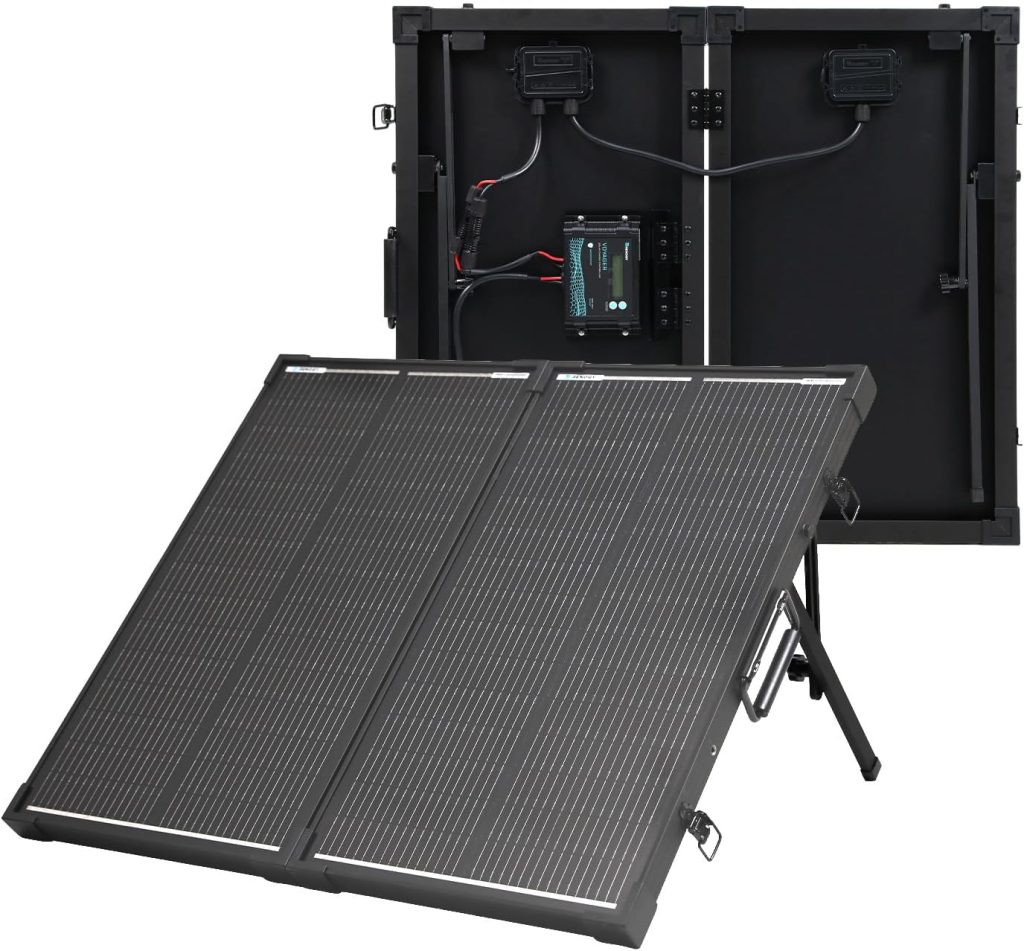
Drizzle. Not rain, exactly — the kind of mist that soaks you slowly while you insist it’s not really raining. My Renogy 100W suitcase sat open next to the RV, angled at a sky the color of old dishwater, pushing 22 watts into the house batteries.
Twenty-two watts. I watched it for a while, the way you watch a pot that won’t boil. The longer meditation on grey-sky output is at do solar generators work on cloudy days — spoiler: the panel’s fine, the sky’s the variable.
The Suitcase Concept, Explained
A solar suitcase is the whole starter system in a briefcase: two 50W panels hinged together, a charge controller mounted on the back, alligator-clip cables to your battery, folding legs to stand it up. Unfold, clip, done. No roof work, no wiring, no electrician.
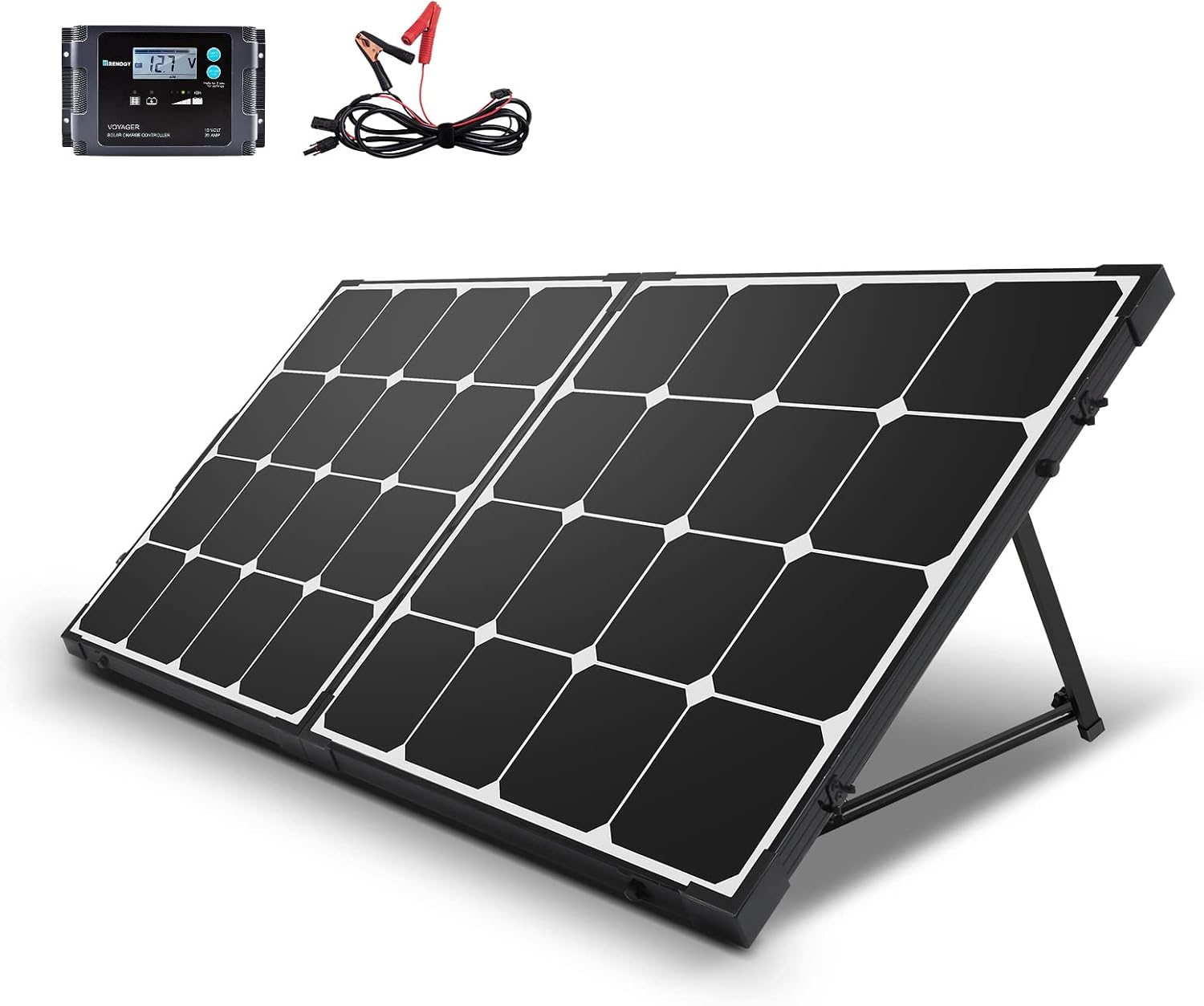
The Renogy 100W kit — N-type cells at 25 percent efficiency, 20A Voyager controller in the box — is the refined version of the idea. The controller is PWM, not MPPT, which the spec-sheet warriors will flag immediately. They’re right and it barely matters here: at 100W with a 12V battery, the MPPT advantage is a few percent on good days, more on marginal ones. Keep reading for the marginal-day part.
Who it’s for: RV owners with a house battery, van campers, anyone with a 12V system who doesn’t want a roof install. Who it’s not for: power station owners — the alligator clips and PWM controller are built for batteries, not for the DC input of a portable station. Wrong tool for that job.
What 100W Maintains vs What It Charges
Here’s the distinction that decides whether you’ll be happy. A 100W suitcase maintains a 12V battery bank beautifully — it offsets the daily drain of lights, water pump, vent fan, phone charging, and keeps the batteries topped through a week of camping. That’s the job it was born for.
What it doesn’t do is recharge a depleted bank quickly. A 100Ah 12V battery holds 1,200Wh; usable half of that on lead-acid, most of it on lithium. At 70 real watts for five hours — 350Wh a day — you’re refilling a half-depleted 100Ah lithium bank in about two days. Fine for maintenance. Slow for recovery.
I learned to think of it as a battery life-support system, not a generator. It keeps the bank healthy indefinitely under normal use. It won’t rescue a bank you drained running a microwave. Different expectations, different satisfaction.
PWM on a Drizzle Day
Back to the 22 watts. A PWM controller connects the panel directly to the battery — simple, reliable, cheap. An MPPT controller would have squeezed maybe 25 to 28W out of the same gloom by finding the panel’s optimal voltage point. The difference is real and also, on a 100W panel, worth a few dollars a year in harvested energy.
Where MPPT earns its keep is partial shade and low light — exactly the conditions where a portable suitcase lives, since you’re moving it around to dodge trees. I ran a PWM suitcase for two years before trying MPPT on the same setup, and the December numbers were better with MPPT. Noticeably, not dramatically. Maybe 15 percent more on grey weeks.
Would I pay double for the controller upgrade on a 100W suitcase? No. Would I spec MPPT on a 400W roof array? Instantly. Scale decides. The suitcase is small enough that simplicity wins.
Alligator Clips and the Art of the Temporary Install
The clips are the whole philosophy: nothing permanent. Clip to the battery terminals, unfold the panels, walk away. When you break camp, unclip, fold, stow. Fifteen seconds each way.
This temporariness is the suitcase’s superpower and its limitation. Superpower: no install, no roof penetrations, no commitment — renters, new RV owners, the solar-curious. Limitation: you have to remember to set it out, re-angle it, bring it in before the wind does. A roof panel works while you nap. A suitcase works while you tend it.
I forgot mine outside overnight once. Dew, not rain, but the controller housing isn’t fond of either. It survived. I bought a cheap plastic tub to throw over it on dewy nights. Ten dollars of tub protecting a two-hundred-dollar panel. The glamorous life of portable solar.
The Quartzsite Afternoon
Sideways story. Quartzsite, Arizona, January — the great gathering of the RV tribes. Thousands of rigs in the desert, and a solid fraction of them running portable solar. I walked the rows one afternoon counting suitcases like a birdwatcher. Renogy, Zamp, GoPower, a dozen marketplace brands.
An older couple had the Renogy 100W — same kit as this review — propped against their fifth wheel, angled with the kind of precision that comes from doing it daily for years. We talked. They’d been full-timing for six years. The suitcase was their only solar. “Keeps the batteries happy,” the husband said. “We don’t need more.”
Six years, one suitcase, no complaints. That’s the review that matters more than any spec sheet. The right-sized tool, used daily, in the right place — the Arizona desert, where the sun files that schedule I keep mentioning.
Suitcase Realities the Listings Skip
Reality one: the “25% efficiency” headline. High efficiency in a suitcase means smaller folded size, which matters when storage space is the constraint. It doesn’t mean more energy than any other 100W panel. I’ve said this about every panel review and I’ll keep saying it until the marketing stops implying otherwise.
Reality two: the legs. Suitcase legs are universally mediocre — flimsy in wind, sinking in sand, too short for good winter angles. Budget for a workaround: a rock, a stick, a purpose-built stand. The panel is good; the legs are a suggestion.
Reality three — mine: I bought the suitcase thinking I’d use it as my primary charging for everything, then discovered my power station couldn’t take the PWM controller’s output cleanly. The suitcase is for 12V battery banks. The power station wants its own panel with the right plug. Two systems, two panels, no shortcuts. I own both now. The redundancy annoys me and the reliability reassures me, in roughly equal measure.
What About the Competition?
Three portable solar options for the 12V battery job.
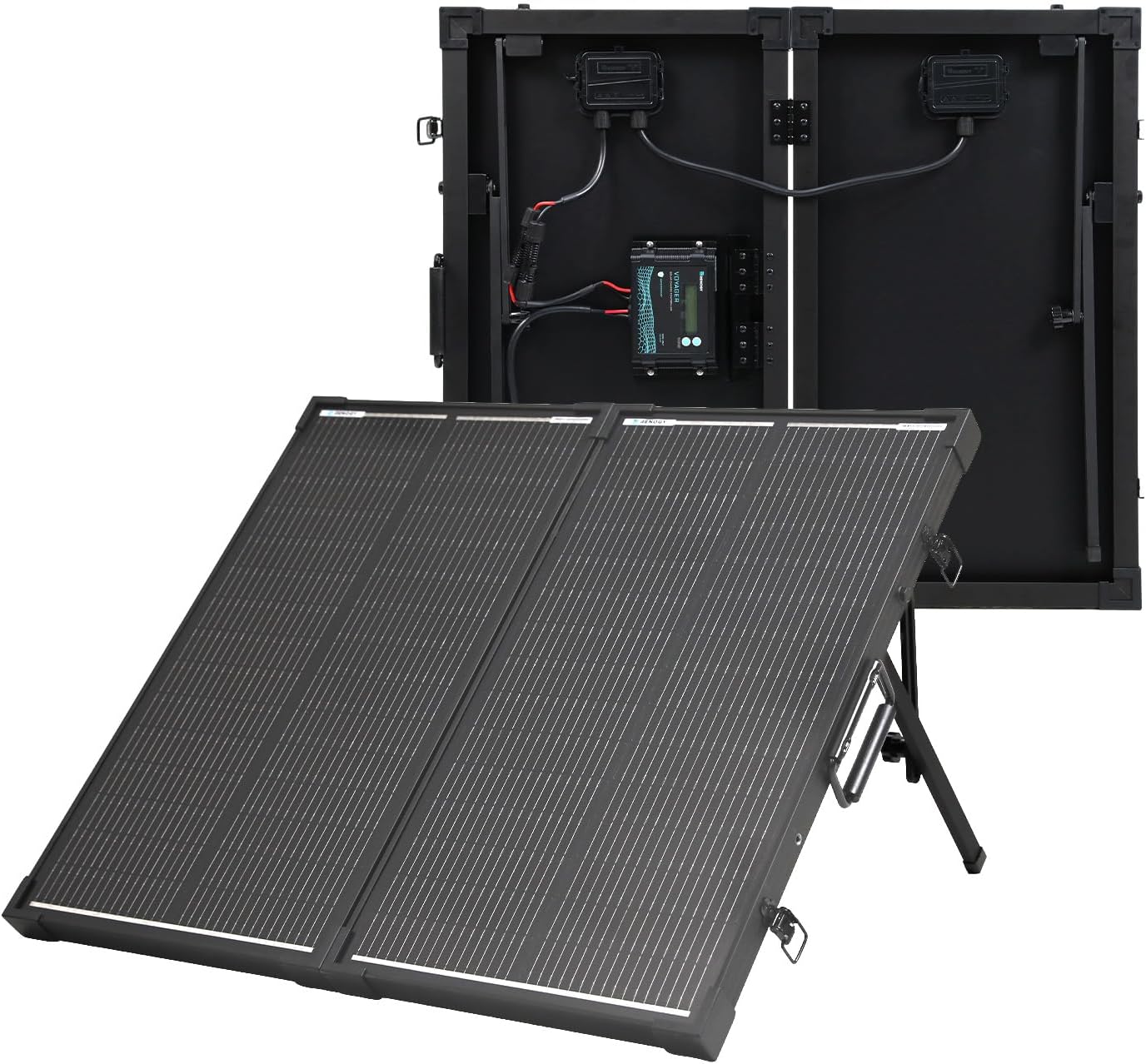
Renogy 100W N-Type Solar Panel Kit
100W N-type kit with 20A controller. A complete 12V charging system in a suitcase.
Renogy 100W Eclipse Solar Suitcase
100W Eclipse suitcase, Voyager controller. The long-track-record portable kit.
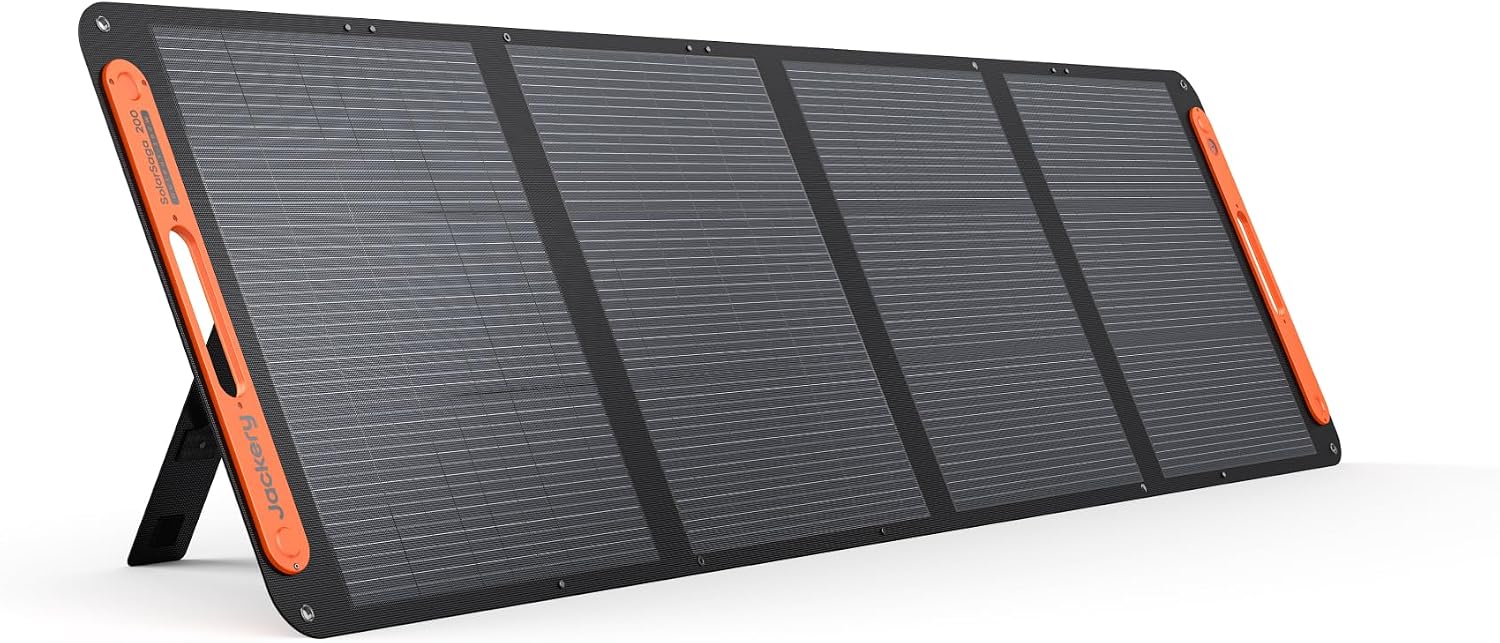
Jackery SolarSaga 200W
200W bifacial folding panel. Double the harvest for bigger stations.
Buy the Renogy 100W N-type kit if you want the complete suitcase system — panels, 20A controller, cables, the proven name in portable 12V solar. Buy the Renogy 100W Eclipse suitcase if you prefer the older SunPower-cell design with the long track record — the Renogy 200W suitcase review covers its bigger sibling if you need double the harvest in the same folding format. Buy the Jackery SolarSaga 200W if your load is a power station rather than a battery bank — double the watts, the right plug, no controller confusion.
Skip the suitcase if what you need is serious wattage. 100W maintains; it doesn’t power a lifestyle. That’s a roof array’s job.
The drizzle cleared by noon, by the way. By two the suitcase was pushing 81W and the batteries were back to float by four. Twenty-two watts at nine, eighty-one at two — same panel, same day, different sky. I keep the photo of the controller showing 22W on my phone, next to the one showing 81W. When someone asks me what portable solar “really” produces, I show them both. The answer is always both.
This site contains affiliate links. We may earn a commission on qualifying purchases.


