
“Runs a refrigerator for hours.” That’s what the listing for my first power station said, the one I bought before this Jackery. Hours. Plural. Technically true: it ran my fridge for one hour and forty minutes before dying, and one hour and forty minutes is, I suppose, hours if you round generously and don’t count the part where the freezer section never got below 40 degrees. I have never been so angry at an adverb.
So I came to the Jackery Explorer 2000 v2 with trust issues and a kill-a-watt meter, and I want to be clear about what I did: I plugged the meter into everything in my house for a week before the Jackery arrived, so I’d know the truth before the marketing got to me.
The headline numbers: 2042 watt-hours, 2200 watts continuous output. The fridge, measured: 148 watts running, compressor cycling about 35% of the time in a 72-degree kitchen, which works out to roughly 1.24 kWh per day. Add the inverter’s cut, call usable capacity 1.7 kWh, and the math says the Jackery runs my fridge for about 33 hours. I tested it during a planned outage, utility doing pole work, eight hours: fridge went from 100% to 76%. The math held. Twenty-four percent for eight hours of fridge. Finally, a power station whose arithmetic survives contact with my kitchen.
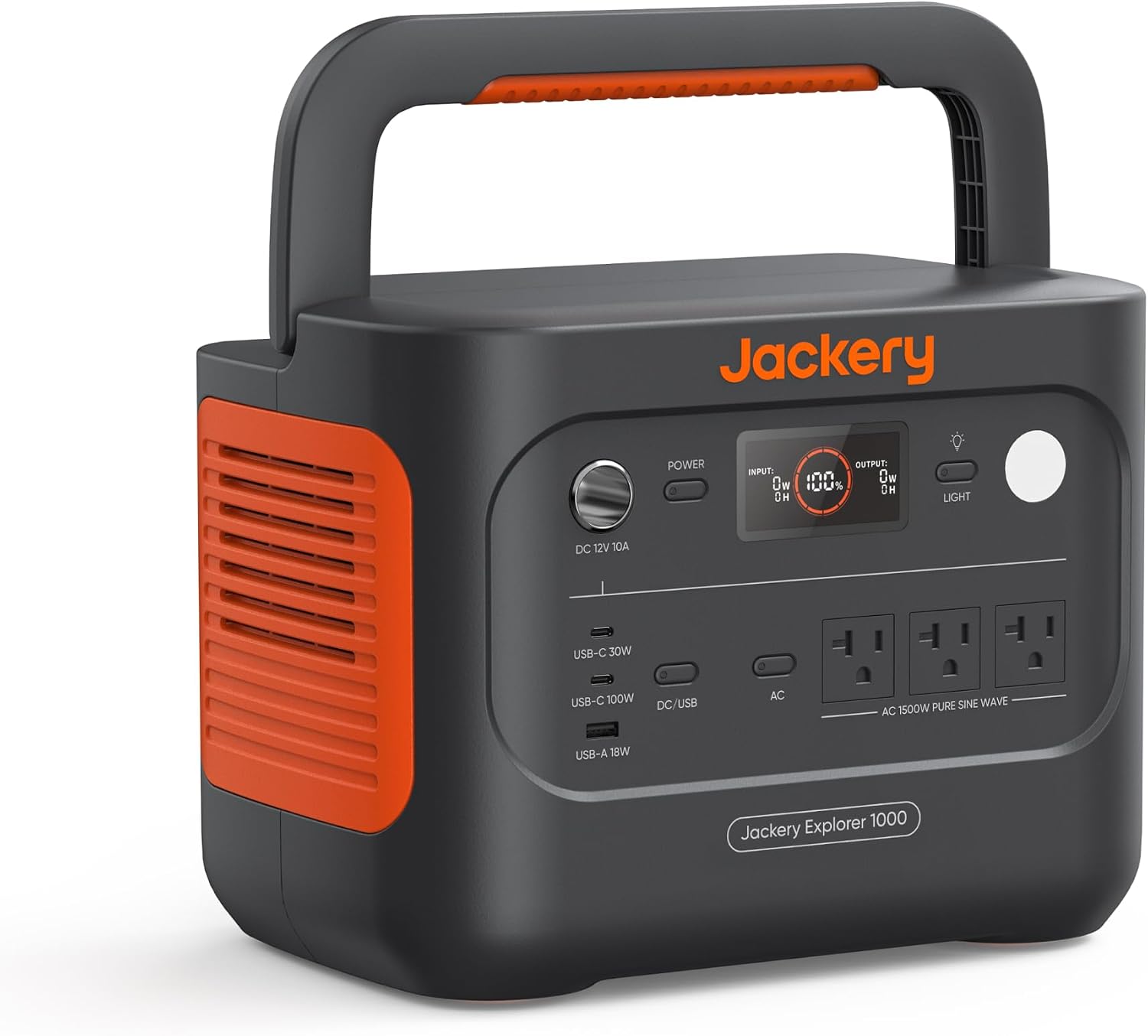
The 2200 watts is what separates this from the toy class. My sump pump pulls 1800 watts at startup. My old station would have folded. The Explorer 2000 v2 ran it without a hiccup, and then ran the fridge at the same time, and I stood in my basement feeling like I’d finally bought the right thing after buying the wrong thing twice.
The 400W panels: a reality check
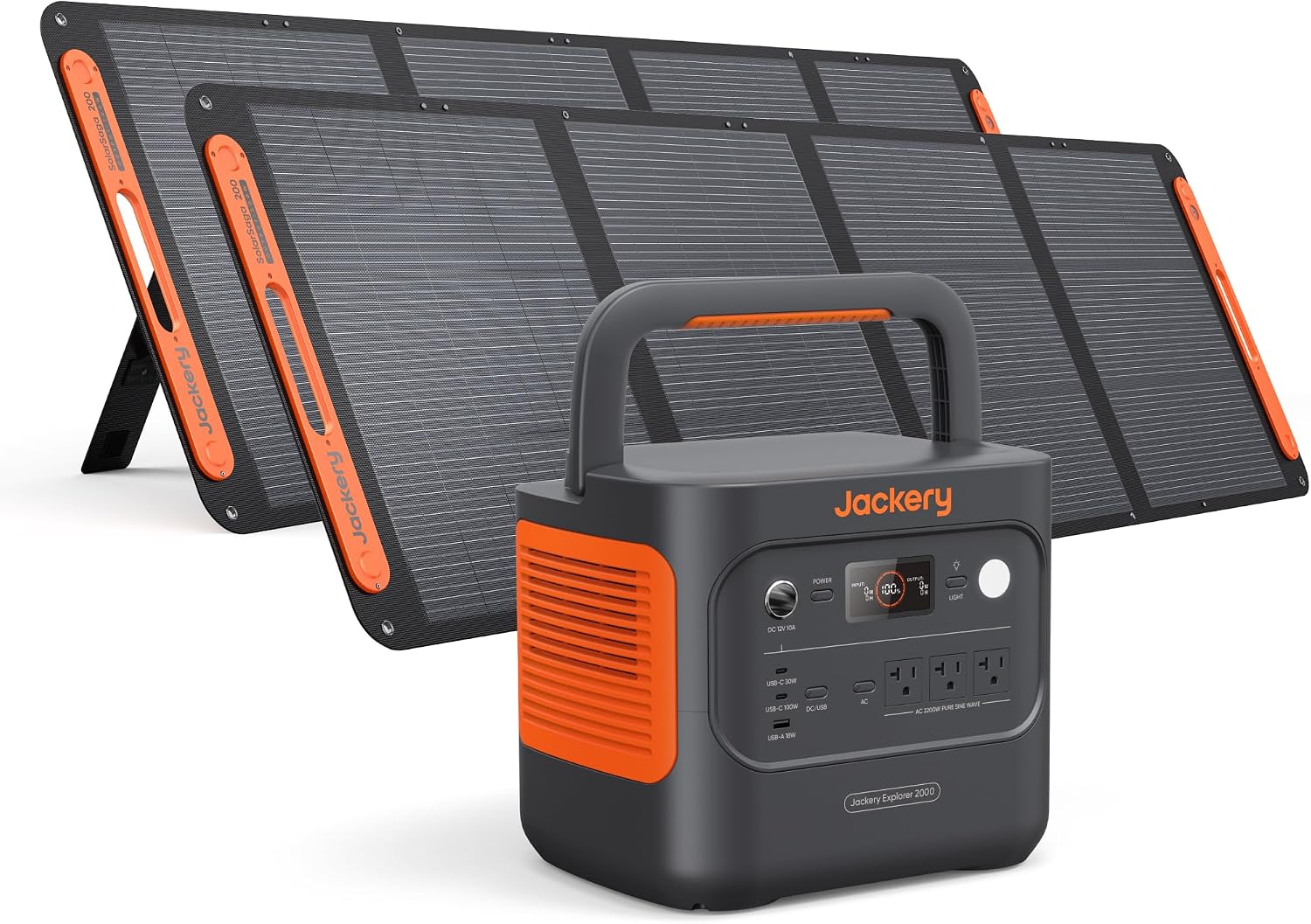
This review is of the bundle with two 200W SolarSaga panels, so let’s talk about them honestly. Four hundred watts of panels sounds like a lot. In June, angled properly, I measured 340 watts at solar noon, which is genuinely good, about 85% of rated, and over a full summer day they put roughly 2 kWh back into the battery. That’s the whole battery, basically, in one good day. In that scenario the bundle is magic: infinite fridge, as long as the sun cooperates.
In November, flat on the lawn because I was lazy, thin overcast: 90 watts. All day. Maybe 500Wh total. The battery holds 2042. You do the math, and then you do it again, because the first time feels like a mistake.
Not a mistake.
This site contains affiliate links. We may earn a commission on qualifying purchases.
This is the thing the solar-generator bundle photos never convey: the panels are a fair-weather friend. They’re fantastic in summer, decorative in winter. If your outage plan depends on winter solar recharging a 2kWh battery with 400W of panels, your plan is a hope, not a plan. Buy the bundle for summer resilience and grid-down afternoons. For winter, the wall charger is your plan, and it fills the thing in 1.7 hours, which I timed, twice, because I don’t trust anyone anymore, including me.
What 39.5 pounds feels like
The unit weighs just under 40 pounds, and unlike the 77-pound monsters in this category, you can actually carry it. I carried it from the garage to the kitchen during the outage, one trip, no drama. My wife carried it back. That matters more than any spec, because a power station you can’t move is a power station that lives in the wrong room when you need it.
Here’s my tangent, and it’s about the kill-a-watt meter, which cost twenty bucks and taught me more than every review I read. I measured my “efficient” LED TV: 85 watts. My cable box, the thing I never thought about: 28 watts, 24 hours a day, even when “off.” My phone charger: 12 watts. The meter turned my house into a spreadsheet, and the spreadsheet said my standby loads alone were eating 60 watts around the clock, which is 1.4 kWh a day doing absolutely nothing. I put half of them on power strips after that. The Jackery didn’t teach me this, but buying the Jackery is what made me measure, and measuring is what made me angry at the cable box. Everything is connected.
The honest verdict
After a year, the Explorer 2000 v2 is the thing I recommend when people ask, with one caveat I always add: the battery is the product, the panels are the accessory. The 2042Wh is real, the 2200W output handles real appliances, the 20-millisecond UPS switchover kept my computer alive through two flickers, and the whole thing is light enough to matter.
What I don’t love: the app is forgettable, the panels’ winter performance is what it is, and Jackery’s pricing means you pay for the name. But the name, in this case, bought me something the cheap brands didn’t: numbers that turned out to be true. After the adverb incident, that’s worth a premium.
Would I buy it again? I already did, in a sense. My brother lost power for two days last winter and I lent him mine, then bought myself a second one rather than wait for him to return it. That’s the review. I bought it twice.


