
The outage started at 6:40pm on a Thursday, which I know because the microwave clock died mid-beep and I have never in my life been so aware of what time it was. By 9pm the fridge was at 46 degrees and my wife was giving me the look, the one that says your expensive hobby was supposed to prevent exactly this. I had a power station at the time. A smaller one. 1kWh, bought during a sale, marketed as “whole-home peace of mind,” which turned out to mean it could run the fridge for about four hours and then peacefully watch the ice cream melt.
So when I say I did the math before buying the Jackery HomePower 3600 Plus, I mean I did the math with a thermometer in one hand and a grudge in the other.
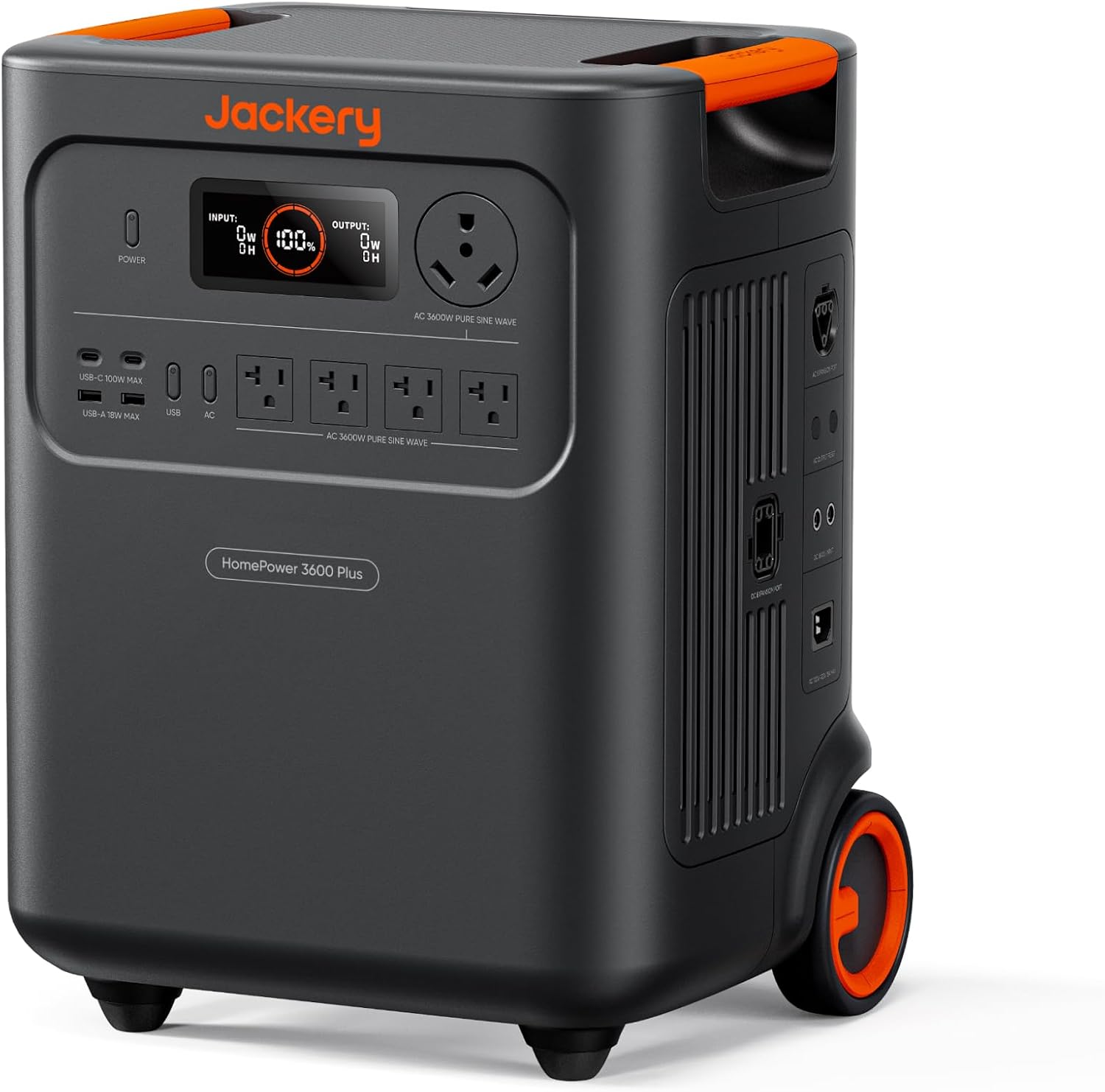
3584 watt-hours. That’s the headline number, and unlike the last unit I owned, this one actually behaves like it has that much in the tank. Here’s my real-world accounting from the ice storm in February, the one that took the grid down for 31 hours: fridge (about 150 watts running, cycling a third of the time, so roughly 1.2 kWh per day once you count the door openings from two kids), the gas furnace blower (800 watts when firing, but it cycles, call it 400 watts average in a cold snap), phones, the router, a few LED lights. I measured the whole circus at about 2.1 kWh for the first 24 hours, which means the Jackery covered the day with roughly a third of the battery left. The inverter eats about 15 to 20% in conversion losses, so usable is more like 2.9 kWh, and that matches what I saw. The numbers finally add up. I can’t tell you how rare that feels.
The 3600 watts of continuous output is the part that actually changed my life, though, because it’s the difference between “backup for the essentials” and “the house mostly works.” My well pump pulls 2000 watts at startup. The old 1kW station would have laughed at it. The Jackery didn’t blink. Surge is rated 7200 watts, and I believe it, because I have now run the well pump, the fridge compressor kicking on, and the microwave at the same time, and the only casualty was my own confidence that I understood electrical loads.
Why I stopped trusting “solar generator” bundles
This unit came with two 200W panels, and here’s where my grudge against the industry flares up again. The kit is sold as a “solar generator,” which implies the panels meaningfully recharge the thing during an outage. Let me do that math for you: 400 watts of panels, in February sun, through clouds, flat on my driveway because I was too cold to angle them properly. I got maybe 900 watt-hours in a full day. Nine hundred. The battery holds 3584. So a full day of winter sun replaced a quarter of the battery. In July it would be triple that, sure, but outages don’t schedule themselves for July.
The solar industry has a chronic honesty problem with bundles. They show you the station and the panels in one glossy photo and your brain files it under “infinite power.” It is not infinite. It is 400 watts times however many sun hours times however gray the sky is. I keep the panels, I use them, they trickle in and extend things by a few hours, but if you’re buying this thinking the panels make you grid-independent, you need to buy about six more panels and a very understanding spouse.
What the panels are good for is the slow days between outages. I leave the Jackery topped up from the wall, which takes about two and a half hours from empty, and the panels just maintain it. Fine. That’s honest work.
This site contains affiliate links. We may earn a commission on qualifying purchases.
The thing about weight nobody mentions in reviews
Seventy-seven pounds. That’s what this thing weighs, and every review says “has wheels and a telescoping handle, easy to move!” like it’s a suitcase. It is not a suitcase. It is a 77-pound box that you can, with effort, roll across a flat garage floor. Up a step? You’re lifting 77 pounds. Down the basement stairs? Pray. I positioned mine in the garage next to the panel and it has not moved since, and I consider that a permanent installation decision.
This is my tangent, and it’s only slightly about the product: I have started to think of home battery backup the way I think about a water heater. Nobody reviews a water heater for portability. You install it, it sits there, it does its job for a decade. The Jackery is a water heater that happens to have wheels. The whole “portable power station” framing is a category error for something this size. It’s home infrastructure. Treat it that way and you’ll be happy. Buy it thinking you’ll toss it in the truck for camping and you’ll throw your back out by June.
Expansion goes to 21kWh with the extra battery packs, which I haven’t bought because the base unit already covers my realistic outage scenarios and the expansion batteries cost real money. Maybe if the grid gets worse. Ask me in two years.
Would I actually recommend it
Here’s my honest accounting after one real outage and six months of ownership: the capacity is real, the output is real, the 10-millisecond UPS switchover kept my desktop and the router alive through three brownouts without a flicker, and the app is fine, forgettable, does what it says. The solar bundle math is optimistic to the point of fiction, the weight makes “portable” a stretch, and the price stings.
But. My fridge stayed at 38 degrees for 31 hours while the neighbors lost everything perishable. My kids did homework under real lights. The furnace ran. When the grid came back at 1am on Saturday, I walked through a warm house and felt something I hadn’t felt during an outage in years, which was nothing. No stress. No thermometer checks. Nothing.
That’s worth the money. I just wish the box had said “31 hours of not thinking about it” instead of whatever the marketing department wrote. That would have been the honest spec sheet.


