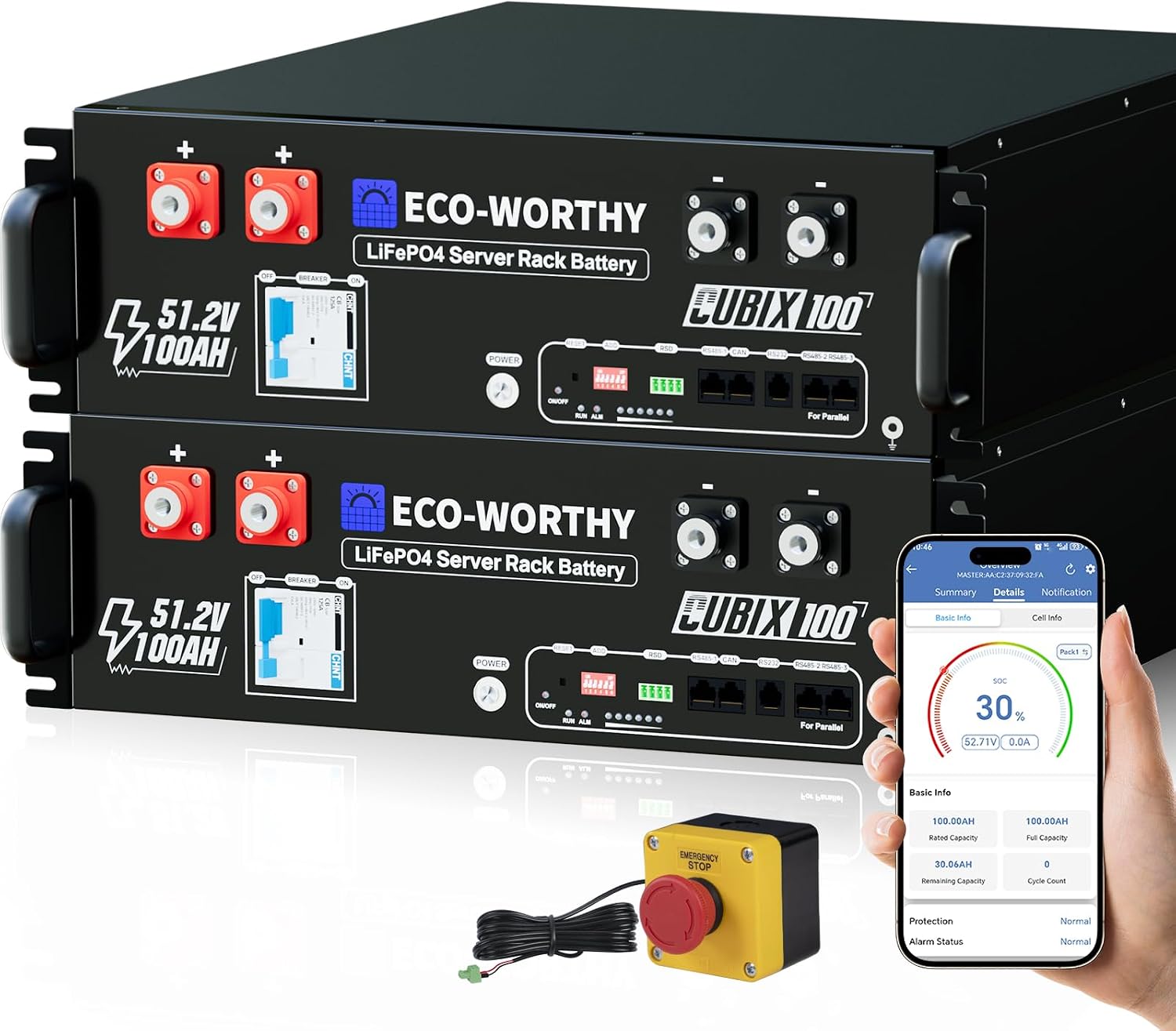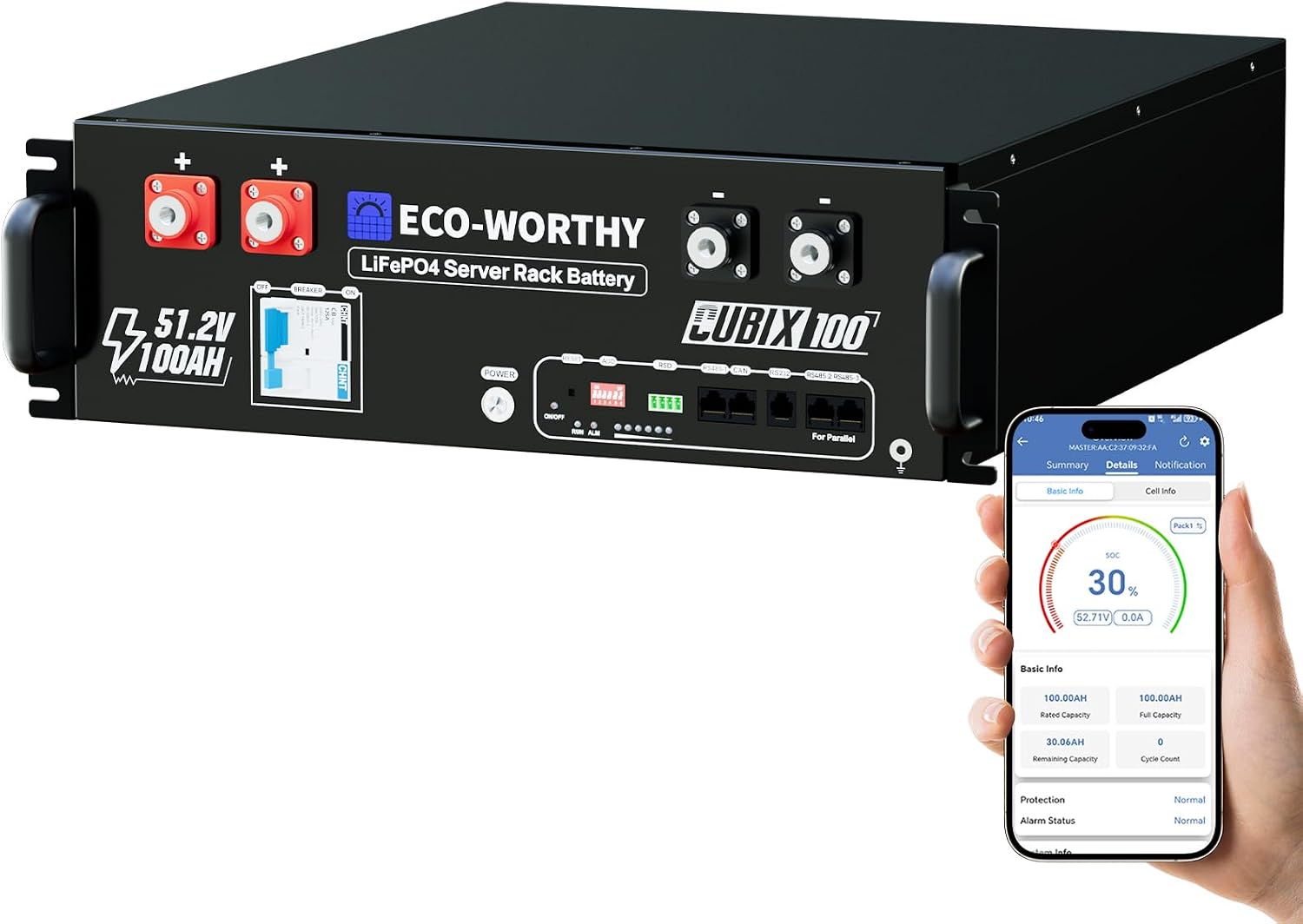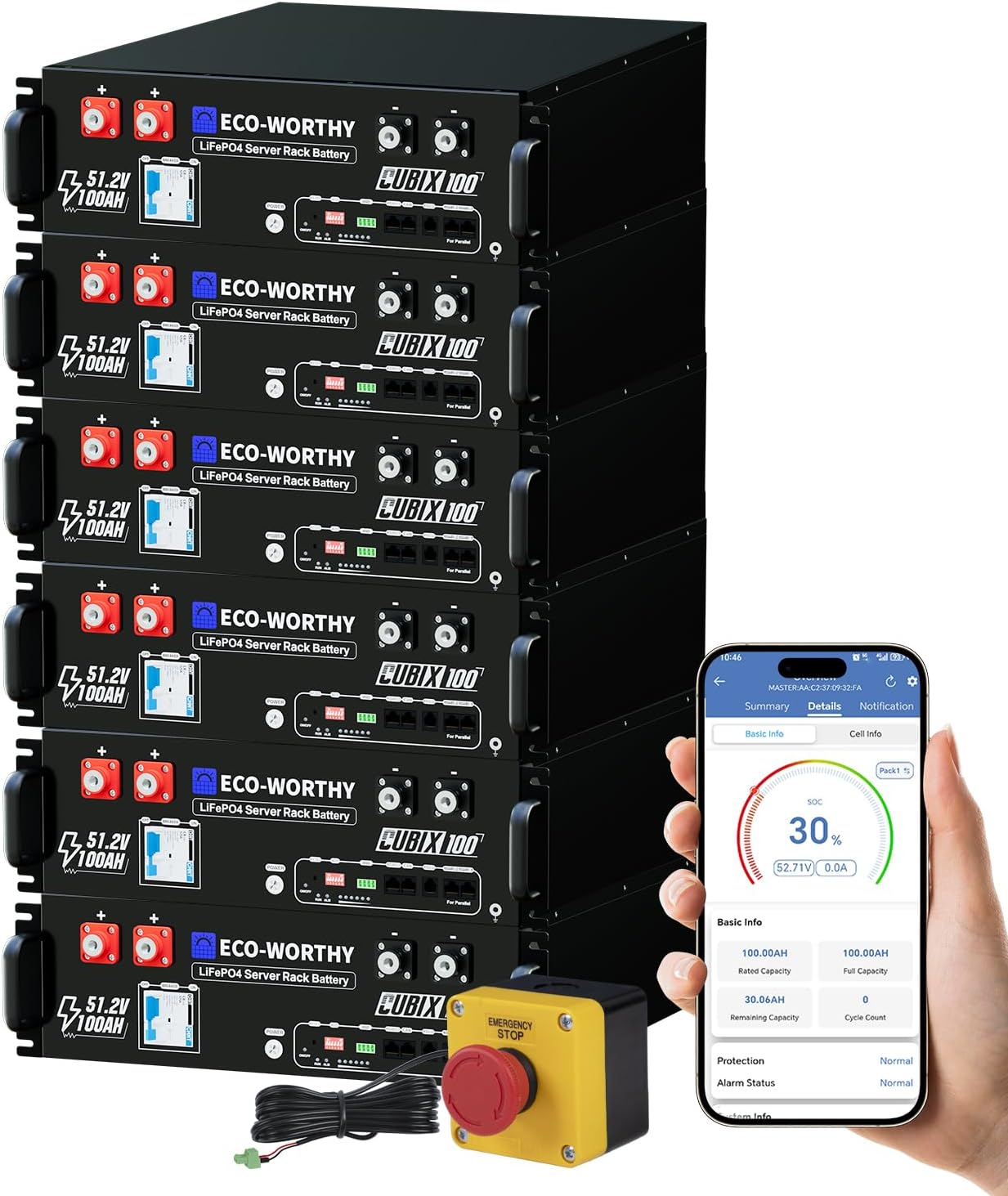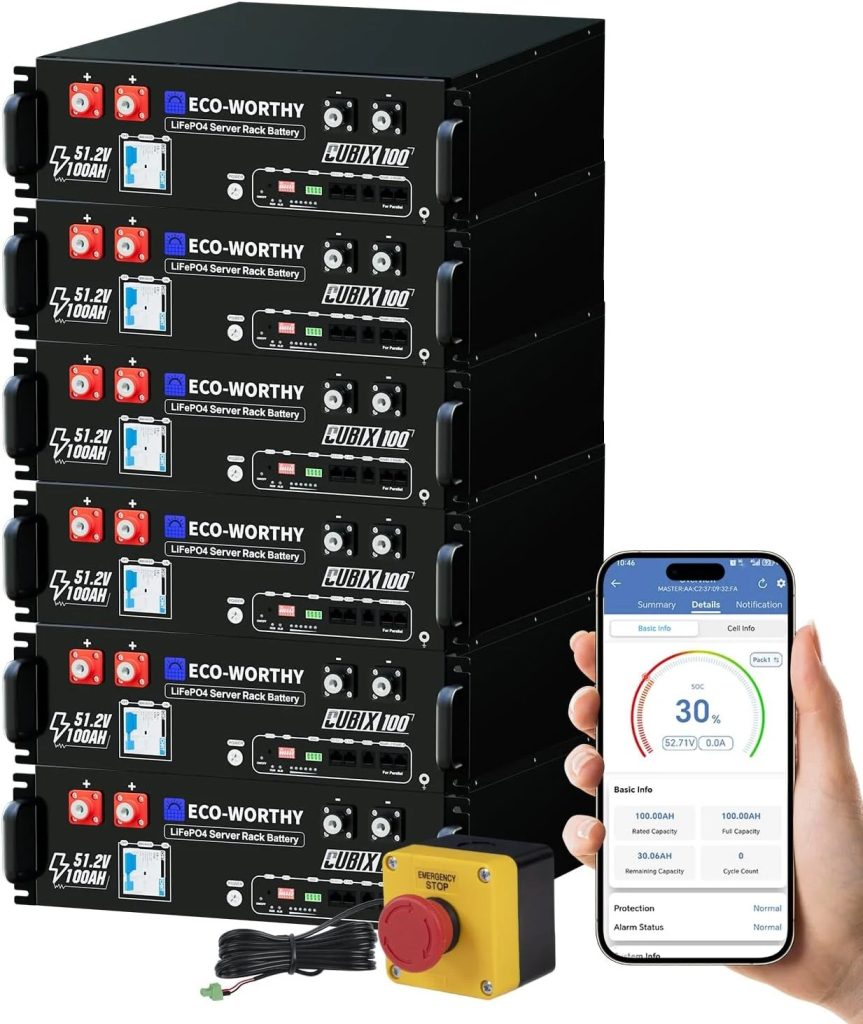
ECO-Worthy Cubix100: 48V 600Ah LiFePO4 Rack Battery for Solar Energy Storage

ECO-Worthy Cubix100 Review: Robust LiFePO4 Solar Battery Storage for Comprehensive Whole-Home Backup

As a veteran home energy storage consultant with over two decades of experience, I’ve seen the residential energy landscape evolve dramatically. It’s 2026, and the demand for reliable solar battery storage solutions has never been higher, driven by increasing grid instability and a desire for true energy independence. Homeowners are actively seeking robust home energy storage systems that can provide dependable whole home battery backup and optimize their renewable investments.

This review delves into the ECO-Worthy Cubix100 48V 600Ah Server Rack Battery LiFePO4, examining its real-world performance potential as a core component of a residential battery backup solution. While the Cubix100 is a battery module, not a complete integrated system, its specifications make it a compelling candidate for custom-designed backup battery for house applications, particularly for those building scalable off-grid battery systems or sophisticated grid-tied hybrid setups. My evaluation, from a home energy engineer’s perspective, focuses on how this battery integrates into a full energy storage solution, considering its chemistry, capacity, power delivery, and overall system viability.

Understanding the Core: Battery Chemistry (LiFePO4 vs. NCM)

The ECO-Worthy Cubix100 utilizes Lithium Iron Phosphate (LiFePO4 or LFP) chemistry. This is a critical distinction in the 2026 market for solar battery storage. My experience has consistently shown that LiFePO4 offers significant advantages for stationary residential applications compared to Nickel Manganese Cobalt (NCM) chemistries.

  • LiFePO4: Known for its inherent thermal stability, longer cycle life (often exceeding 6,000-10,000 cycles to 80% DoD), and improved safety profile, LiFePO4 is the chemistry of choice for long-term, reliable home energy storage. It’s less prone to thermal runaway and degradation from frequent deep cycling. For a home energy storage system, this translates directly into a safer installation and a battery that will perform reliably for many years, even under daily cycling for solar self-consumption or time-of-use (TOU) optimization.
  • NCM: While offering higher energy density (meaning smaller, lighter batteries for the same capacity), NCM batteries generally have a shorter cycle life and a higher risk of thermal events if damaged or improperly managed. While still present in some legacy systems, the industry trend, especially for whole-home backup, is firmly towards LiFePO4 due to its safety and longevity.

The ECO-Worthy Cubix100’s LiFePO4 chemistry provides a solid foundation for any durable backup power system.

Usable Battery Capacity and System Scalability

The Cubix100 boasts a nominal capacity of 600Ah at 48V, translating to a substantial 28.8 kWh per unit. For most LiFePO4 batteries, a Depth of Discharge (DoD) of 90-100% is common and safe, meaning nearly all of this capacity is usable. This single unit offers considerable reserve for a whole-house battery system.

What truly sets server rack batteries like the Cubix100 apart is their expandable battery capacity. These modules are designed for parallel connection, allowing homeowners to scale their energy storage precisely to their needs. Starting with a single 28.8 kWh unit, an owner could add multiple Cubix100 units to create a formidable solar battery bank of 57.6 kWh, 86.4 kWh, or even more, simply by integrating additional modules into the rack system. This scalability is crucial for future-proofing an energy storage solution as energy demands or solar generation capacity grows. For large homes or those aspiring to true energy independence, this modularity is invaluable.

Continuous Output Power & Peak Surge Capabilities

The output power of an energy storage system is primarily determined by the inverter it’s paired with, rather than the battery module itself, though the battery must be capable of supplying the necessary current. A 48V 600Ah battery like the Cubix100, properly managed by a robust Battery Management System (BMS) and connected to a high-quality hybrid inverter, can support significant continuous and peak loads.

  • Continuous Output Power: When paired with a suitable 10-15 kW hybrid inverter, the Cubix100 can sustain high power demands for extended periods, running essential and non-essential circuits. This is vital for whole home battery backup, where consistent power is needed for appliances like refrigerators, well pumps, or even smaller air conditioning units.
  • Peak Surge Output: Modern homes often have momentary high power draws, such as motor startup (refrigerators, washing machines, HVAC compressors). The ability to provide a strong peak surge is critical. A properly designed system featuring the Cubix100 and a quality inverter should be able to deliver 2-3 times its continuous rating for short durations, preventing brownouts or system shutdowns during these events. From an engineering standpoint, verifying the battery’s maximum discharge current rating against the inverter’s surge demand is a key design step.

Whole-Home Backup Capability and Automatic Transfer Switch (ATS)

For a truly effective whole-home battery backup system, the ECO-Worthy Cubix100 needs to be integrated into a well-engineered power architecture. This includes a smart inverter and an Automatic Transfer Switch (ATS).

  • ATS Functionality: In the event of a grid outage, the ATS instantaneously disconnects the home from the utility grid and transfers the electrical load to the inverter, which then draws power from the Cubix100 battery. This seamless transition is crucial. Without an ATS, grid-tied systems cannot legally and safely provide backup power during an outage.
  • UPS Switching Speed: A quality hybrid inverter paired with the Cubix100 should offer UPS (Uninterruptible Power Supply) switching speeds, typically under 20 milliseconds. This rapid response ensures that sensitive electronics, like computers, medical devices, and smart home hubs, experience no noticeable interruption during a blackout. From an engineering standpoint, ensuring compatibility between the battery, inverter, and ATS for this critical speed is paramount.

Solar Compatibility and Hybrid Inverter Performance

The ECO-Worthy Cubix100 is designed to be the backbone of a solar home battery system. Its 48V nominal voltage is standard for many hybrid inverters, making integration straightforward.

  • Solar Compatibility: The battery stores excess solar energy generated during the day, making it available for use at night or during peak demand periods. This optimizes self-consumption and reduces reliance on grid power.
  • Hybrid Inverter Performance: A high-quality hybrid inverter acts as the brain of the grid-tied battery system. It intelligently manages power flow between solar panels, the Cubix100 battery, the utility grid, and the home’s loads. Key performance indicators for the inverter include:
    • MPPT (Maximum Power Point Tracking) efficiency: How effectively it extracts power from solar panels.
    • Conversion efficiency: How much energy is lost when converting DC battery power to AC home power, and vice-versa.
    • Load balancing: Its ability to prioritize loads, optimize battery charging/discharging based on time-of-use rates, and seamlessly switch between power sources. A well-designed hybrid inverter system maximizes the value of your solar battery storage.

Battery Management System (BMS) and Grid-tied vs. Off-grid Operation

Every LiFePO4 battery module, including the Cubix100, relies heavily on its internal Battery Management System (BMS). This isn’t merely an accessory; it’s the core safety and performance guardian of the battery.

  • BMS Functions: The BMS monitors individual cell voltages, temperatures, and current flows. It protects against overcharging, over-discharging, over-current, short circuits, and extreme temperatures. It also balances cell voltages, ensuring uniform health and longevity across the entire battery pack. For a multi-module solar battery bank, the communication protocol between individual BMS units and the central inverter is critical for synchronous operation and optimal performance.
  • Grid-tied Operation: In a grid-tied setup, the Cubix100, managed by its BMS and a hybrid inverter, works in tandem with the utility grid. It can store solar energy, discharge during peak rates, and provide backup during outages.
  • Off-grid Operation: For off-grid battery systems, the Cubix100 becomes the primary power source. In this scenario, the robust capacity and cycle life are paramount. The system relies entirely on solar charging (and potentially a backup generator) to replenish the battery. The BMS ensures the battery’s health in this demanding environment, preventing critical failures far from utility support. This requires meticulous system sizing, as the battery must sustain all loads between charging cycles.

Installation Requirements and Safety Certifications

The ECO-Worthy Cubix100, being a server rack style battery, implies specific installation requirements.

  • Professional Installation: Due to its high voltage and energy density, professional installation by a certified electrician and solar installer is not just recommended, it’s mandatory. This ensures proper wiring, grounding, communication setup, and safety compliance.
  • Rack Mounting: These batteries typically require a dedicated server rack for stable mounting, proper ventilation, and easy access for maintenance. The physical footprint of multiple units in a rack can be substantial, requiring adequate space in a garage, utility room, or dedicated power shed.
  • Safety Certifications: Always verify that the battery, and the complete system it’s integrated into (inverter, ATS), carries relevant safety certifications such as UL 1973 (for battery safety), UL 9540 (for energy storage systems), and compliance with local electrical codes (e.g., NEC in the US). These certifications are non-negotiable for system reliability and homeowner safety.

Warranty and Long-Term Reliability

The warranty offered on the Cubix100 is a key indicator of the manufacturer’s confidence in their product. For LiFePO4 residential batteries, a standard warranty often ranges from 10 to 15 years, usually guaranteeing a certain percentage of original capacity (e.g., 70-80%) at the end of the warranty period or a specific number of cycles.

  • Warranty: Investigate the specifics of the ECO-Worthy warranty: what components it covers, how capacity degradation is addressed, and the procedure for claims. A robust warranty underpins the long-term reliability expectation.
  • Long-Term Reliability: Beyond the warranty, the LiFePO4 chemistry, coupled with a sophisticated BMS, provides inherent reliability. The absence of moving parts, robust construction, and passive cooling generally translate to a low maintenance requirement and a lifespan often exceeding 15-20 years for the battery cells themselves, provided they are operated within their design parameters by a competent inverter.

Cost per kWh

Analyzing the cost per kWh is crucial for evaluating the long-term value of any residential energy storage solution. This metric helps homeowners compare different systems on a level playing field.

For a battery module like the ECO-Worthy Cubix100, the “raw” cost per kWh for the battery itself is often more competitive than fully integrated, consumer-ready units. However, it’s essential to remember that this is only one part of the equation. The total installed cost per kWh must factor in:

  • The battery modules (Cubix100).
  • The compatible hybrid inverter.
  • The automatic transfer switch (ATS).
  • Wiring, conduits, safety disconnects.
  • The server rack.
  • Permitting and professional installation labor.

When all these components are considered, the overall installed cost per kWh for a complete whole-house battery backup system using server rack batteries can be very competitive, especially at larger capacities where the fixed costs of the inverter and installation are spread across more kWh.

Angle A: Home Energy Engineer – Core Evaluation Focus

From my perspective as a home energy engineer, the ECO-Worthy Cubix100, as a building block, offers significant potential.

  • Battery Chemistry (LiFePO4): Excellent choice for safety, longevity, and cycle life. It forms a reliable foundation.
  • Hybrid Inverter Integration: This is where the engineering comes in. The Cubix100’s performance hinges on being paired with a high-performance hybrid inverter. The inverter must be capable of seamless bidirectional power flow, efficient MPPT for solar charging, and sophisticated energy management algorithms to optimize storage and discharge. Its ability to intelligently manage multiple Cubix100 units in parallel is also vital.
  • Energy Management: A well-designed system leveraging the Cubix100 will incorporate advanced energy management software. This software allows for:
    • Time-of-Use (TOU) optimization: Charging the battery when electricity is cheap (e.g., off-peak solar, grid) and discharging during expensive peak hours, directly reducing electricity bills.
    • Self-consumption maximization: Prioritizing the use of self-generated solar power first, then drawing from the battery, and only then from the grid.
    • Load balancing: Intelligent distribution of power to various home circuits, ensuring critical loads are always met during outages, and non-critical loads are powered when capacity allows.
  • Whole-Home Backup: With adequate sizing (multiple Cubix100 units) and the right inverter/ATS combination, this battery system can undoubtedly provide comprehensive whole-home battery backup. The engineer’s role here is to perform a detailed load analysis to ensure the system can meet the specific energy demands of the household during prolonged grid failures.
  • Load Balancing: The ability of the hybrid inverter and its accompanying software to intelligently manage loads is paramount. During an outage, a truly engineered system can dynamically shed non-essential loads to extend the backup duration, or prioritize certain circuits (e.g., medical equipment, refrigerator) over others (e.g., clothes dryer).

Factory Insider Note

“Many home battery systems use the same battery cells, but inverter quality often determines overall reliability and system longevity. A premium LiFePO4 battery like the Cubix100 deserves a robust, intelligent hybrid inverter to truly maximize its potential.”


Real-World Scenario: The Solar Home Advantage

Consider a typical solar home in 2026, equipped with a 10kW solar array and a substantial solar battery storage system built around two ECO-Worthy Cubix100 units, totaling 57.6 kWh of usable capacity, managed by a 12kW hybrid inverter.

Daily Cycle:
As dawn breaks, the solar panels begin generating electricity. The home draws power directly from the PV array for morning routines. Any excess generation immediately begins charging the Cubix100 batteries. By mid-afternoon, with solar production peaking and household consumption relatively low, the batteries are typically fully charged. This is a critical point for peak shaving. Instead of exporting cheap midday solar power to the grid, it’s stored for later, more valuable use.

Come evening, as the sun sets and solar production drops to zero, the home seamlessly transitions to drawing electricity from the charged Cubix100 batteries. This is where the true value of solar battery storage shines. Instead of pulling expensive grid power during peak demand hours (typically 4 PM to 9 PM in many regions), the home uses its own stored, “free” solar energy. The energy management system within the hybrid inverter continually monitors consumption, battery state-of-charge, and grid conditions, intelligently dispatching power.

The family uses their kitchen appliances for dinner, watches TV, and charges their devices, all powered by the quiet, reliable energy from their battery bank. Even if time-of-use rates apply, their evening electricity consumption is essentially zeroed out from the utility, resulting in significant electricity bill savings. Around midnight, as demand dwindles, the battery may still have 50-70% charge remaining, ready to buffer the morning peak or provide several days of backup should the grid fail. This daily dance of solar charging and night-time electricity use makes the solar home truly resilient and cost-effective, turning a commodity like electricity into a managed, self-sufficient resource.

Who Is It Best For? Whole-Home Backup

The ECO-Worthy Cubix100 system is best suited for homeowners prioritizing comprehensive whole-home backup. Its large capacity potential, coupled with the inherent safety and longevity of LiFePO4 chemistry, makes it an excellent choice for:

  • Large residences: Capable of sustaining multiple circuits and high-draw appliances during extended outages.
  • Homes in areas with frequent or prolonged power outages: Provides peace of mind and continuity for daily life.
  • Families with critical medical equipment: Ensures uninterrupted power for essential devices.
  • Individuals seeking maximum energy independence: The ability to scale capacity means less reliance on the grid, even for prolonged periods.
  • Those looking for a customizable, robust solution: It’s not an all-in-one box, but a powerful component for a bespoke system.

Potential Drawbacks

While the ECO-Worthy Cubix100 offers compelling advantages, it’s important to acknowledge its realistic drawbacks:

  • High Installation Complexity and Cost: This is a battery module, not a plug-and-play system. It requires selection and integration with a separate hybrid inverter, an ATS, and potentially a dedicated server rack. This complexity inherently leads to higher professional installation costs compared to simpler, integrated battery units.
  • Professional Installation Required: Due to the system’s modular nature and high energy output, DIY installation is not feasible or safe. Qualified electricians and solar installers are essential.
  • Heavy Equipment and Space Requirements: Each 28.8 kWh unit is heavy, and multiple units mounted in a server rack can take up significant floor space. This needs careful planning for garage or utility room placement.
  • No Integrated Monitoring Software: Unlike some all-in-one solutions, the Cubix100 itself typically doesn’t come with its own app. Monitoring and energy management rely entirely on the chosen hybrid inverter’s software, which can vary in sophistication.
  • Higher System Design Learning Curve: Homeowners or installers need a good understanding of system architecture (battery, inverter, ATS communication) to properly size and configure a reliable whole-house battery backup solution around this module.

Value for Money

Evaluating the value for money of the ECO-Worthy Cubix100 requires a comprehensive view beyond the initial purchase price.

  • Cost per kWh (Installed): While the battery module itself may offer an attractive price per kWh, the overall installed cost will be influenced heavily by the chosen inverter, ATS, and labor. However, for larger systems (e.g., 50+ kWh), the modular nature often results in a lower average installed cost per kWh compared to proprietary integrated systems with smaller capacity increments.
  • Battery Lifespan & Cycle Life: With its LiFePO4 chemistry and robust BMS, the Cubix100 is designed for a very long cycle life (typically 6,000+ cycles to 80% DoD). This means potentially 15-20 years of daily use, offering exceptional longevity for the investment.
  • Electricity Savings (ROI): For homeowners on time-of-use (TOU) tariffs or those looking to maximize solar self-consumption, the ability of solar battery storage to shift expensive grid purchases to cheaper solar or off-peak periods can generate significant electricity bill savings. The larger the capacity, the greater the potential for savings and a faster ROI.
  • Warranty: A strong 10-15 year warranty for the battery is expected and contributes significantly to the perceived value, protecting the investment over the long term.
  • Long-term Ownership Cost: High cycle life and robust construction translate to minimal maintenance and low degradation over the years, reducing the long-term ownership cost. The modularity also allows for easier future upgrades or replacements of individual modules if needed, rather than having to replace an entire integrated unit.

Brand Comparison: ECO-Worthy Cubix100 vs. Leading Home Battery Systems

To provide context for the ECO-Worthy Cubix100, let’s compare it against some of the market’s prominent residential energy storage solutions in 2026. This comparison focuses on how these systems perform as comprehensive whole-house battery backup or home energy storage systems.

Feature ECO-Worthy Cubix100 (as part of a system) Tesla Powerwall 3 EcoFlow PowerOcean Pro Generac PWRcell
Battery Chemistry LiFePO4 LiFePOPO LiFePO4 LiFePO4
Battery Capacity 28.8 kWh per module (expandable) 13.5 kWh usable (fixed) 5 kWh per module (up to 45 kWh) 9 kWh per module (up to 36 kWh)
Continuous Output Varies by inverter (e.g., 10-15 kW) 11.5 kW 6 kW (single unit), 18 kW (multi-unit) 7.6 kW – 11.4 kW
Whole-Home Backup Yes (with compatible inverter/ATS) Yes Yes Yes
Solar Integration Excellent (via hybrid inverter) Integrated MPPT Integrated MPPT Integrated MPPT
Expandability Highly expandable (multiple modules) Limited (add more units) Highly modular Highly modular
Warranty Typically 10-15 years (battery) 10 years 10 years 10 years
Estimated Installed Cost $18,000 – $35,000+ (for 28-50 kWh system) $15,000 – $20,000 (13.5 kWh) $18,000 – $45,000+ (20-45 kWh) $20,000 – $40,000+ (27-36 kWh)

Note: Estimated Installed Costs are highly variable based on location, labor rates, permitting, specific inverter choices, and home electrical complexity. These are general ranges for 2026 for a complete system.

Who should buy ECO-Worthy Cubix100?

The ECO-Worthy Cubix100 is ideal for homeowners, energy enthusiasts, or those with very large energy demands who:

  • Seek maximum flexibility and scalability in their solar battery storage system design.
  • Are working with a knowledgeable installer to build a custom, robust whole-home battery backup solution.
  • Prioritize long-term reliability and deep cycle capability offered by LiFePO4 in a modular format.
  • Are building a comprehensive off-grid battery system where large capacity and customizability are paramount.

Who should buy Tesla Powerwall?

Tesla Powerwall is best for homeowners who:

  • Desire a fully integrated, sleek, and often visually appealing system with strong brand recognition.
  • Appreciate the simplicity of a single vendor for battery, inverter, and monitoring.
  • Are already within the Tesla energy ecosystem (solar roof, EV).
  • Prioritize a seamless, “set-it-and-forget-it” user experience, especially for backup battery for home functionality.

Who should buy EcoFlow PowerOcean?

EcoFlow PowerOcean (or similar modular “stackable” systems like EcoFlow Delta Pro Ultra) is a strong contender for those who:

  • Value modularity and expandable capacity, but prefer a more integrated, user-friendly design than server rack batteries.
  • Want easier installation and scalability with less complex wiring than component-based systems.
  • Are looking for a versatile hybrid energy storage solution that can easily adapt to changing energy needs.
  • Prioritize quick deployment and portable-style flexibility in an emergency backup power system.

Who should buy Generac PWRcell?

Generac PWRcell is well-suited for homeowners who:

  • Are looking for a robust, whole-home solution from a trusted name in backup power, especially if they already have or are considering a Generac generator.
  • Need reliable backup power system with robust continuous output for larger homes and demanding loads.
  • Want a cohesive ecosystem for both battery and potential generator backup, managed through a single platform.
  • Value integrated energy management for their renewable home energy system.

FAQ Section

Q: Why does battery chemistry matter for residential solar battery storage?

A: Battery chemistry is foundational to the safety, lifespan, and overall performance of your solar battery storage. LiFePO4 (Lithium Iron Phosphate), like that in the ECO-Worthy Cubix100, is the preferred choice for residential systems due to its superior thermal stability, significantly longer cycle life (meaning more charges and discharges before degradation), and enhanced safety profile compared to older chemistries like NCM. This translates directly to a more reliable, safer, and longer-lasting home energy storage system for your residence.

Q: How long can a system with the ECO-Worthy Cubix100 48V 600Ah Server Rack Battery LiFePO4 power an entire house?

A: The duration depends entirely on the home’s energy consumption and the number of Cubix100 units installed. A single 28.8 kWh Cubix100 could power a moderately efficient home (averaging 1-2 kW consumption) for 12-24 hours. However, for a true whole-home battery backup providing power for several days during an extended outage, especially for larger homes with AC, well pumps, or electric heating, multiple Cubix100 units would be necessary. For instance, two units (57.6 kWh) could sustain a typical energy-conscious family for 2-3 days without solar input, covering essentials and many non-essentials. A detailed load analysis is crucial for accurate sizing.

Q: What should homeowners consider before installing a home battery backup system with a unit like the ECO-Worthy Cubix100?

A: Before installing a home battery backup system centered around the ECO-Worthy Cubix100, homeowners must consider:

  1. Energy Needs Assessment: Conduct a thorough energy audit to determine average and peak daily consumption, especially for critical loads during an outage. This dictates the required battery capacity and inverter size.
  2. Inverter Compatibility: The Cubix100 needs to be paired with a high-quality, compatible 48V hybrid inverter and an Automatic Transfer Switch (ATS) to function as a complete residential energy storage solution. Research inverter features, warranty, and monitoring capabilities.
  3. Physical Space & Environment: Server rack batteries require dedicated space (often a garage or utility room) for the battery modules and inverter. Ensure adequate ventilation and stable temperatures for optimal performance and lifespan.
  4. Professional Installation: Due to the system’s complexity, high voltage, and safety requirements, engage a licensed, experienced solar and battery installer.
  5. Budget & ROI: Factor in the total installed cost (battery, inverter, ATS, rack, labor, permits) and evaluate the long-term ROI based on potential electricity bill savings (from solar self-consumption, TOU optimization) and the value of reliable backup power system.

Final Verdict: A Foundation for Robust Solar Battery Storage

The ECO-Worthy Cubix100 48V 600Ah Server Rack Battery LiFePO4 represents a compelling component for advanced solar battery storage solutions in 2026. Its LiFePO4 chemistry and substantial, expandable capacity make it an excellent choice for a whole-house battery system designed for long-term reliability and significant energy independence.

While it demands a custom-engineered approach with a high-quality hybrid inverter and professional installation, the payoff is a highly flexible, durable, and scalable home energy storage system. For homeowners looking to build a truly resilient backup battery for house scenarios, or those embracing a full off-grid battery system, the Cubix100 provides a robust, reliable, and cost-effective foundation, particularly when considering the long-term value and low cost per kWh at scale. My experience confirms that investing in a quality battery module like this, properly integrated, offers superior performance and peace of mind for decades to come.

#ECOWorthy #Cubix100 #48V #600Ah #Server #Rack #Battery #LiFePO4