BLUETTI Elite 30 V2 Review: Portable 288Wh/600W LFP Home Emergency Power Station

As a consultant with over two decades navigating the complexities of emergency power and off-grid energy, I’ve seen countless scenarios unfold. From sudden blackouts impacting entire cities to the quiet independence of remote cabins, reliable power is the bedrock of safety and comfort. Today, in 2026, the discussion around an emergency power supply for home isn’t a luxury; it’s a fundamental part of disaster preparedness. This guide cuts through the noise to deliver practical, experience-driven advice on selecting truly effective solutions for families, campers, RV owners, and homeowners alike. We’ll look at what actually works when the grid goes down, focusing on complete, resilient systems.

Why is an Emergency Power Supply for Your Home No Longer Optional, But Essential?

In my two decades in this field, I’ve observed a clear trend: grid reliability is facing increasing pressure from aging infrastructure, extreme weather events, and growing demand. An emergency power supply for home isn’t just about comfort; it’s about safeguarding food, maintaining critical medical equipment, and ensuring communication during blackouts, hurricanes, floods, winter storms, or wildfires. The peace of mind that comes from knowing you can weather an outage, maintain connectivity, and keep essentials running is invaluable. Renewable energy sources, particularly solar backup power, offer energy independence that traditional grid reliance cannot.

How Do You Calculate the Actual Power Needs for Your Home During an Extended Outage?

Calculating your power needs is the most crucial step in choosing an emergency power supply for home. It’s not about powering your entire house as usual; it’s about sustaining essential loads.

  1. Identify Critical Appliances: Start with what you absolutely cannot live without. This usually includes:

    • Refrigerator/Freezer (to preserve food)
    • Medical equipment (CPAP, oxygen concentrators, insulin refrigeration)
    • Communication devices (phones, laptops, internet modem/router)
    • Lighting (LED bulbs, flashlights)
    • Water pump (if on well water)
    • Furnace fan (for heat in winter)
    • Small kitchen appliances (coffee maker, microwave – sparingly)
  2. Determine Wattage and Run Time:

    • Wattage (W): Check the labels on your appliances for their running wattage (or average wattage for items like refrigerators that cycle on and off). Starting wattage (surge) is also important for motors.
    • Run Time (hours): How long do you need each appliance to run per day? A refrigerator might run 8 hours out of 24. A CPAP machine runs 8 hours overnight.
  3. Calculate Daily Watt-Hours (Wh): Multiply the wattage by the run time for each appliance, then sum them up for a total daily Wh requirement.

    • Example: Refrigerator (100W running) x 8 hours/day = 800 Wh/day.
    • CPAP (50W) x 8 hours/day = 400 Wh/day.
    • LED lights (10W total) x 6 hours/day = 60 Wh/day.
    • Phone charging (10W) x 2 hours/day = 20 Wh/day.
    • Total Daily Estimate: 1280 Wh.
  4. Consider Surge Power: Many appliances, especially those with motors (refrigerators, pumps), have a higher “starting” or “surge” wattage that lasts for a few seconds. Your chosen power solution must be able to handle this peak.

This granular approach ensures you invest in a system that genuinely meets your disaster preparedness needs without overspending on unnecessary capacity.

What Critical Appliances Should You Prioritize When Planning for Emergency Energy Storage?

Prioritization is key during a blackout. After several major storm seasons, homeowners consistently found that keeping refrigerators, internet equipment, and essential medical devices running mattered far more than powering every appliance in the house. Your priorities will dictate the type and size of your emergency energy storage system.

Here’s a general hierarchy:

  1. Life-Sustaining & Safety: Medical devices (CPAPs, oxygen concentrators, refrigerated medications), communication (charging phones, emergency radio), and basic lighting.
  2. Food & Water: Refrigerator/freezer to prevent spoilage, well pump for water supply.
  3. Comfort & Information: Internet modem/router, a small fan or heater (for specific zones), minimal charging for laptops/tablets, perhaps a small TV for news.
  4. Convenience: Coffee maker, microwave for quick meals (used sparingly due to high wattage).

Focusing on these essentials drastically reduces the required battery capacity and inverter output, making your emergency power solution more affordable and practical.

Understanding Your Emergency Power Options: From Portable to Whole-Home

Choosing the right emergency power supply for home or for your adventures requires understanding the different solutions available. Each has its strengths, suited for specific scenarios.

Portable Power Stations: Your Go-To for Flexible Emergency Power

Portable power stations are essentially large battery packs with built-in inverters and various output ports (AC outlets, USB, 12V DC). They are compact, quiet, and produce no emissions, making them safe for indoor use. They offer excellent portable emergency power for a range of situations.

  • Best for: Camping electricity, charging devices during short blackouts, running essential small appliances, off-grid camping, or as part of a layered disaster preparedness plan.
  • Capacity: Typically range from 200Wh to 3000Wh+.
  • Charging: Can be charged via wall outlet, car charger, or portable solar panels.

Spotlight: BLUETTI Elite 30 V2 Portable Power Station 288Wh 600W LFP

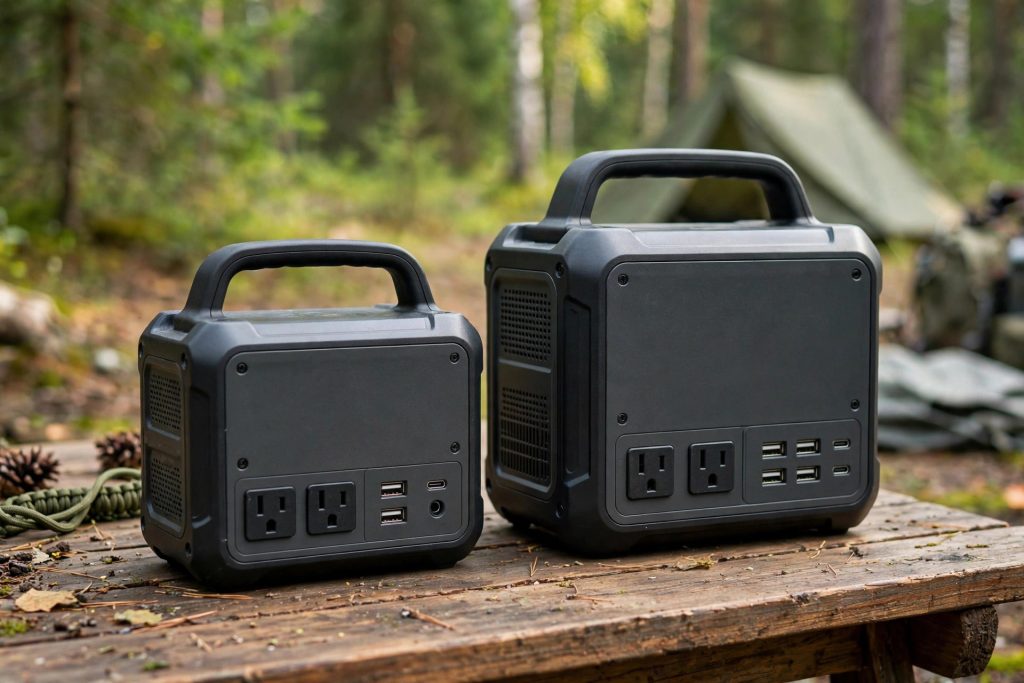
The BLUETTI Elite 30 V2, with its 288Wh capacity and 600W pure sine wave inverter (LFP battery chemistry), is an excellent example of a robust, entry-level portable battery generator.

  • For Home Emergency: It’s ideal for keeping critical communication devices charged (phones, tablets, laptops), running a small LED lighting setup, powering a fan, or even a small medical device like a CPAP machine for one night. Its LFP (LiFePO4) battery chemistry provides superior cycle life and safety compared to older lithium-ion chemistries. For short blackouts, it keeps you connected and lit.
  • For Camping: Absolutely a best power station for camping. It can power an electric cooler, charge cameras, headlamps, and phones for a weekend trip. Paired with a foldable solar panel, it becomes a self-sustaining solar camping system for extended stays.
  • Pros: Portable, silent, no emissions, versatile, durable LFP battery.
  • Cons: Limited capacity for larger home appliances, not designed for whole-home backup.

Solar Generators: Sustainable Backup Electricity for Extended Outages

A “solar generator” is essentially a portable power station bundled with portable solar panels. This combination allows for continuous recharging, making it a sustainable solar backup power solution, particularly for extended outages or off-grid camping.

  • Best for: Hurricane preparedness, multi-day blackouts, RV solar setup, remote work, or anyone seeking energy independence.
  • Capacity: Varies widely, often matching the higher-end portable power stations.
  • Charging: Primarily solar, but also AC wall charging.

Why Solar Generators are Essential for Hurricane Preparedness

For hurricane preparedness, a solar generator is invaluable. Unlike gas generators, they don’t rely on fuel, which can be scarce or impossible to acquire post-storm. The ability to harness the sun’s energy provides renewable emergency power as long as there’s daylight, keeping communication lines open, food cold, and essential medical equipment running during prolonged events.

Home Battery Backup Systems: Whole-Home Backup and Seamless Transition

These are larger, often stationary battery systems integrated directly with your home’s electrical panel. They store energy from the grid or dedicated solar panels and automatically kick in when grid power fails, providing whole-home backup or powering pre-selected circuits.

  • Best for: Homeowners seeking seamless, long-duration backup for critical circuits or entire homes, integration with rooftop solar for maximum energy independence.
  • Capacity: Ranges from 10 kWh to 50+ kWh.
  • Charging: Primarily from rooftop solar arrays, but can also be charged from the grid during off-peak hours.

RV Solar Systems: Powering Your Adventures Off the Grid

An RV solar setup provides the freedom to roam without relying on shore power. It involves rooftop solar panels, a charge controller, a battery bank (often deep cycle lead-acid or lithium), and an inverter to convert DC power to AC for household appliances.

  • Best for: RV camping, van life, overlanding, remote adventures, ensuring your RV battery system is always charged for comfort and convenience.
  • Components: Solar panels, charge controller, battery bank, inverter, energy monitoring system.
  • Benefits: Quiet, emissions-free power, extended stays in national parks or remote locations.

Practical Buying Guide: Choosing Your Emergency Power Supply

Selecting the right emergency power supply for home or adventure involves careful consideration of several technical aspects, directly related to your identified needs.

1. Battery Capacity (Wh or kWh)

  • What it is: The amount of energy the battery can store, measured in Watt-hours (Wh) or Kilowatt-hours (kWh).
  • How to choose: Refer back to your daily Watt-hour calculation. Aim for a battery capacity that can meet your essential needs for at least 1-3 days without recharging. For example, if your daily essential load is 1000 Wh, a 2000 Wh portable power station gives you two days of power.
  • Field Experience Note: I’ve seen campers bring oversized power stations that weighed more than their coolers. In reality, most weekend trips only require enough capacity to run a portable fridge, lights, and device chargers. For home use, balance capacity with portability and budget.

2. Power Output (Watts)

  • What it is: The maximum continuous power the inverter can deliver, measured in Watts (W). Also consider surge power, which is the peak output for a few seconds to start motor-driven appliances.
  • How to choose: Ensure the continuous output meets or exceeds the highest running wattage of any single appliance you plan to power. The surge rating must handle the starting load of your most demanding appliance (e.g., refrigerator, power tools). The BLUETTI Elite 30 V2’s 600W output can handle many common devices, but won’t run a full-size microwave or space heater.

3. Solar Input (Watts) & Charge Controller

  • What it is: The maximum wattage of solar panels the system can accept (for portable power stations/solar generators) or the efficiency of the charge controller (for RV/home systems).
  • How to choose: Higher solar input allows for faster recharging. For solar generators, match the portable solar panels to the unit’s maximum input. For larger RV or home systems, ensure an efficient MPPT (Maximum Power Point Tracking) charge controller is used to maximize solar harvest, especially important for renewable emergency power.

4. Charging Speed

  • What it is: How quickly the battery can recharge from various sources (AC wall outlet, solar, car charger).
  • How to choose: Faster AC charging is convenient for topping up before an anticipated outage. For solar charging, calculate how many hours of good sunlight you need to fully recharge your system based on its capacity and solar input.

5. Weight & Portability

  • What it is: The physical weight and ease of transport.
  • How to choose: For camping electricity or moving a unit around your home, portability is key. Heavier units (1000Wh+) often have wheels or sturdy handles. For permanent home battery backup, weight isn’t a factor. The BLUETTI Elite 30 V2, at its size, is highly portable.

6. Weather Resistance

  • What it is: The unit’s ability to withstand environmental elements like dust, moisture, and extreme temperatures.
  • How to choose: Important for outdoor use (camping, job sites). Check IP ratings if specified. For home backup, units are typically housed indoors or in protected enclosures.

7. Warranty

  • What it is: The manufacturer’s guarantee for defects and performance.
  • How to choose: A longer warranty (e.g., 5-10 years for LFP batteries, 10+ for home systems) indicates manufacturer confidence in durability and protects your investment in emergency energy storage.

8. Expandability

  • What it is: The ability to add more battery capacity or solar input later.
  • How to choose: Some portable power stations allow you to connect external battery packs. Home battery backup systems are often modular. This offers flexibility to grow your disaster survival setup as needs change or budget allows.

Scenario Guide: Home Power Outage

When the lights go out at home, whether for a few hours or several days, having a layered approach to your emergency power supply for home is paramount.

Immediate Response (First few hours)

  • Flashlights & Headlamps: Have multiple LED flashlights and headlamps with fresh batteries readily accessible. Forget candles; they’re a fire hazard.
  • Portable Power Station (e.g., BLUETTI Elite 30 V2): This is your first line of defense for charging phones, running a small radio for news, or powering a crucial medical device for a short period. The BLUETTI Elite 30 V2 is perfect here due to its quick deployment and quiet operation.

Sustained Outage (Beyond 12-24 hours)

  • Solar Generator (Portable Power Station + Solar Panels): For prolonged outages, you need to recharge. A solar generator solution (like a larger BLUETTI AC200MAX or EcoFlow Delta Pro paired with suitable panels) becomes essential. This powers your refrigerator intermittently to preserve food, keeps internet equipment running, and maintains critical lighting. This is crucial for maintaining communication equipment and monitoring news.
  • Communication Equipment: Ensure you have fully charged power banks for phones, and consider a hand-crank or solar-powered emergency radio. Two-way radios (walkie-talkies) can be useful for family communication on your property.
  • Food Preservation: An electric cooler (powered by your portable power station or solar generator) can supplement your refrigerator, especially for sensitive items. For your main fridge, minimize opening the door, and power it for an hour or two several times a day to maintain temperature.
  • Medical Equipment Backup: If you rely on medical devices, invest in dedicated backup batteries or a larger solar generator that can sustain them for the required duration. Always consult with your medical provider about specific power needs.
  • Water Storage: Have at least one gallon of water per person per day for drinking and basic hygiene. A filtration system is also a wise investment.

Long-Term Resilience (Multi-day/Week Outage)

  • Home Battery Backup System: For true long-term whole-home backup, a dedicated system like a Tesla Powerwall or a larger Bluetti EP900 with B500 batteries, integrated with rooftop solar, provides seamless, automatic power to critical circuits. This is the ultimate emergency power supply for home, offering significant energy independence.
  • Backup Generator (Gas/Propane): While this guide focuses on battery/solar, a traditional gas or propane generator can serve as a crucial last resort for very high-load items or extended outages when solar isn’t sufficient. Ensure proper ventilation and safety protocols are followed.
  • Emergency Kit: Beyond power, a well-stocked family emergency kit includes first-aid supplies, non-perishable food, blankets, cash, and important documents.

Comparison: Emergency Power Solution Types

To help you decide, here’s a comparison of common emergency energy storage solutions.

Feature Portable Power Station Solar Generator Home Battery Backup System Gas Generator
Best Use Case Camping, small home essentials, device charging Extended outages, off-grid camping, RV Whole-home/critical circuit backup High power needs, very long outages
Power Output 200W – 3000W 500W – 5000W 5kW – 20kW+ 3kW – 20kW+
Battery Capacity 200Wh – 3000Wh 500Wh – 5000Wh 10kWh – 50kWh+ N/A (fuel dependent)
Fuel Source Battery Battery (solar rechargeable) Battery (grid/solar rechargeable) Gasoline, Propane, Diesel, Natural Gas
Noise Level Silent Silent Silent Loud
Emissions None None None High (carbon monoxide risk)
Indoor Use Yes Yes Yes (indoor/outdoor rated) No (outdoor only, ventilation crucial)
Installation Plug & Play Plug & Play Professional electrical installation Set up outdoors, extension cords/transfer switch
Cost Low to Medium Medium to High High Low to Medium (plus fuel costs)
Maintenance Low Low Low Medium (oil changes, fuel stabilizers)
Expandability Some models (external batteries) Some models (external batteries) Often modular (add more batteries) Fuel capacity limited
Renewable Energy Yes (with solar panels) Yes (integrated solar charging) Yes (integrated solar charging) No
Example Brands Bluetti, Jackery, EcoFlow Bluetti, EcoFlow, Jackery Tesla, Generac, Bluetti, EcoFlow Honda, Generac, Champion

Recommended Brands and Systems (2026)

Based on my years of experience, these brands consistently deliver reliable, high-performance solutions for various emergency power needs.

Portable Power Stations & Solar Generators:

These are excellent choices for portable emergency power, whether for home use, camping electricity, or as part of an RV battery system.

  • Bluetti: Known for robust LFP (LiFePO4) batteries and high capacities. Models like the AC200MAX or EP500 are fantastic solar generators for more significant home backup needs, while the BLUETTI Elite 30 V2 remains a top pick for compact, reliable power.
  • EcoFlow: Offers fast charging speeds and innovative modular designs, such as the DELTA series, which can power a surprising range of appliances. Their ecosystem with smart home panels is also expanding.
  • Jackery: Renowned for user-friendly design and excellent portability, their Explorer series is popular for off-grid camping and shorter outages.
  • Anker SOLIX: A strong contender with durable builds and good performance, expanding their range significantly in recent years.

Portable Solar Panels:

Essential for transforming your portable power station into a solar backup power solution.

  • Renogy: Offers a wide range of monocrystalline panels, known for efficiency and durability, perfect for both portable and more permanent RV solar setup installations.
  • Jackery SolarSaga: Designed to seamlessly integrate with Jackery power stations, offering good portability and efficiency.
  • EcoFlow Solar Panels: Excellent quality and often foldable, optimized for their Delta and River series power stations.
  • ALLPOWERS: Provides competitive pricing and a good selection of foldable panels suitable for various portable power stations.

Home Battery Backup Systems:

For comprehensive whole-home backup and energy independence.

  • Tesla Powerwall: Still a benchmark for integrated home solar and battery storage, offering sleek design and robust performance.
  • EcoFlow PowerStream/Power Kits: Their modular Power Kits and PowerStream micro-inverter system offer flexible, scalable solutions for homeowners and RVs, bridging the gap between portable and whole-home.
  • Bluetti EP900/B500: Bluetti has entered the home backup space with powerful, modular systems designed for significant energy storage and integration.
  • Generac PWRcell: A strong player in the home energy storage market, often paired with their traditional standby generators for a hybrid approach.

Wind Turbines (for truly off-grid solutions):

While not primary for most emergency home backup, small wind turbines can supplement solar in remote, consistently windy locations, particularly for off-grid energy systems.

  • Pikasola: Offers small-scale wind turbines suitable for cabins or supplemental power.
  • Automaxx: Known for robust, smaller residential wind turbines.
  • Ista Breeze: Another reliable option for compact wind power generation.

Frequently Asked Questions about Emergency Power

Q: Why is a portable power station a reliable emergency power supply for home essentials?

A: A portable power station like the BLUETTI Elite 30 V2 is reliable for home essentials because it’s quiet, emission-free, and instantly provides AC and DC power for crucial devices. Unlike gas generators, it requires no fuel, making it safe for indoor use to power lights, charge phones, keep internet running, or back up critical medical equipment during a blackout.

Q: What is the difference between a portable power station and a solar generator?

A: A portable power station is a battery-powered unit with an inverter and outlets. A solar generator is a portable power station combined with solar panels, allowing it to recharge using sunlight. This makes it a self-sustaining solar backup power solution for extended outages, offering renewable emergency power.

Q: Can a portable power station power my refrigerator during a power outage?

A: Yes, many mid-to-large capacity portable power stations (typically 1000Wh and above, with sufficient wattage output) can power a standard refrigerator intermittently for several hours a day. Smaller units like the BLUETTI Elite 30 V2 (288Wh/600W) are generally not sufficient for a full-size refrigerator but could power a small electric cooler or mini-fridge. Always check your refrigerator’s wattage and the power station’s output.

Q: How much solar panel wattage do I need for my solar generator?

A: The ideal solar panel wattage depends on your portable power station’s maximum solar input and your desired recharge time. A good rule of thumb for disaster preparedness is to have enough panel wattage to fully recharge your battery within 6-8 hours of good sunlight, especially for emergency energy storage.

Q: Is a whole-home backup system worth the investment for my emergency power supply for home?

A: For homeowners seeking seamless power continuity for critical circuits or their entire house, particularly during frequent or long-duration outages, a whole-home backup system is absolutely worth the investment. It integrates directly with your electrical system, often with solar, providing automatic, silent power without the hassle of manual setup or fueling.

Final Recommendation: Build a Layered Emergency Power Strategy

In my 20-plus years of helping people prepare, the most resilient individuals and families are those who adopt a layered approach to their emergency power supply for home. Relying on a single solution often leaves gaps.

Start with the basics:

  1. Fundamental Portability: A reliable portable power station like the BLUETTI Elite 30 V2 Portable Power Station 288Wh 600W LFP is an excellent starting point for basic portable emergency power. It handles crucial device charging, lighting, and small medical devices for short outages or acts as your personal hub for camping essentials.
  2. Sustainable Recharge: Pair your portable power station with high-quality portable solar panels to create a self-sufficient solar generator. This provides solar backup power for extended blackouts, a must for hurricane preparedness.
  3. Expand as Needed: Depending on your lifestyle and location, consider expanding to a larger portable power station for more demanding appliances, or for RV owners, a comprehensive RV solar setup with an RV battery system. For the ultimate peace of mind, homeowners facing frequent outages should investigate a whole-home backup battery system integrated with rooftop solar.

No single product is a silver bullet for every scenario. The best emergency power supply for home is a well-thought-out system tailored to your specific needs, giving you the confidence and capability to face any power disruption, come what may.

#BLUETTI #Elite #Portable #Power #Station #288Wh #600W #LFP