The wind blew all night and my phone gained four percent. Four. I lay in the tent listening to the little turbine whirring on its pole outside — a cheerful, earnest sound — and watched the battery icon the way you watch a pot that won’t boil. By morning the turbine had harvested roughly enough energy to send a few texts. The experience taught me more about micro-wind than any spec sheet could, which is good, because the spec sheets in this category are works of speculative fiction.
A 5W USB wind turbine is a strange and lovely idea: a tiny propeller, a little generator, a USB port, all packed into something the size of a water bottle. Hang it from a tent pole or a tree branch, let the wind spin it, trickle-charge your phone. At night, when solar panels are decorative, the wind is still blowing. That’s the pitch, and it’s genuinely clever. The problem is the physics between the pitch and the phone.
Five watts is the rated output, and “rated” in micro-wind means “in a wind tunnel at the ideal wind speed,” which is typically 8 to 10 meters per second — a fresh breeze, the kind that makes flags snap. At that wind speed, the turbine makes its 5W, the USB port delivers 5V, and your phone charges slowly. Below that — and most campsite wind is below that — output falls off a cliff, because wind power scales with the cube of wind speed. Half the wind speed means one-eighth the power. One-eighth of 5W is 0.6W, which is not charging your phone, it’s warming it slightly. I did this math at 3am in the tent. Cubed. The wind was maybe 3 m/s. The turbine was making well under a watt. The whirring was the sound of hope, not power.
Wait, that’s not right — I said four percent like it was nothing. Four percent was two texts telling my wife I was fine. That’s not nothing. It’s just not charging.
This is the part where I admit the category charmed me anyway. There’s something deeply appealing about a device that makes electricity from nothing but moving air, no sun required, working the night shift while the solar panels sleep. On a windy ridge, with sustained 6-8 m/s wind, a 5W turbine genuinely trickles 2-4W into a power bank overnight — 15-25Wh by morning, which is a real phone charge. Not fast. Not impressive. But real, and earned while you slept. I just wish the listings led with “works great on windy ridges” instead of implying it works everywhere. It does not work everywhere. Most places, most nights, it’s a very small fan running in reverse.
The USB output is both the genius and the limitation. Genius, because USB is universal — no adapters, no controllers, just plug in the phone. Limitation, because 5W at USB voltages is the ceiling of usefulness: it charges phones, e-readers, headlamps, nothing bigger. And phones are picky — many won’t even register a charge below a watt or two, so in light wind the turbine spins, the LED blinks encouragingly, and the phone sits at its percentage, unimpressed. The LED blinks whenever the blades turn, implying productivity. The blades turn in a 2 m/s breeze. The productivity requires triple that.
Build quality in micro-wind is a lottery. The CYRENT 5W unit is representative: compact, light, simple. But tiny turbines live hard lives. The bearings spin at high RPM in dust and grit, the blades are thin plastic, and the whole thing hangs outdoors in weather. A micro turbine that survives two seasons of real use is a good one. Most reviews are written after a week, when everything still works. The reviews worth reading are the updates, the “six months later” edits, and they’re rare because nobody updates a review of a $30 gadget. I get it. But the absence of long-term data is itself data.
I haven’t tested the CYRENT unit itself — mine was a no-name with the same specs, so brand-specific claims I’ll leave alone.

Here’s the honest comparison the category needs: a 5W wind turbine versus a 20W solar panel. The solar panel costs about the same and in four hours of decent sun makes 60-80Wh — three times what the turbine makes on a good windy night. Solar wins on energy, every time, in every scenario except sustained wind with no sun. The turbine’s only real advantage is the night shift and the cloudy-week scenario. So the honest pitch for micro-wind is narrow: it’s a supplement for solar, not a substitute. A trickle for the hours the panels sleep. Anyone selling it as primary charging is selling weather they can’t guarantee.
That said, the step up from micro-wind to real wind is enormous and worth understanding, because it reframes what the 5W toy is. A VEVOR’s 500W wind kit is a different species — pole-mounted, 12V battery charging, hundreds of watts in real wind. An 800W VEVOR turbine bigger still. These are cabin-scale machines, not tent-scale toys, and they play by the same cubic law — which is why real wind people obsess over site wind speed the way solar people obsess over panel angle. The 5W turbine is a gesture toward that world. A charming, mostly decorative gesture, but a gesture.
The hybrid idea — a 400W hybrid wind-solar setup with a charge controller that takes both — is where small wind actually makes sense. Solar by day, wind by night, the controller blending them into one battery. At the 400W scale the energy is real, not gestural. The 5W USB turbine is what you buy to learn whether you like the idea of wind before committing to the pole in the backyard. I like the idea of wind. I just no longer pretend the toy version powers anything but patience.
Real wind you can actually buy
The 5W micro class has nearly vanished from shelves; these are the smallest real turbines currently sold.
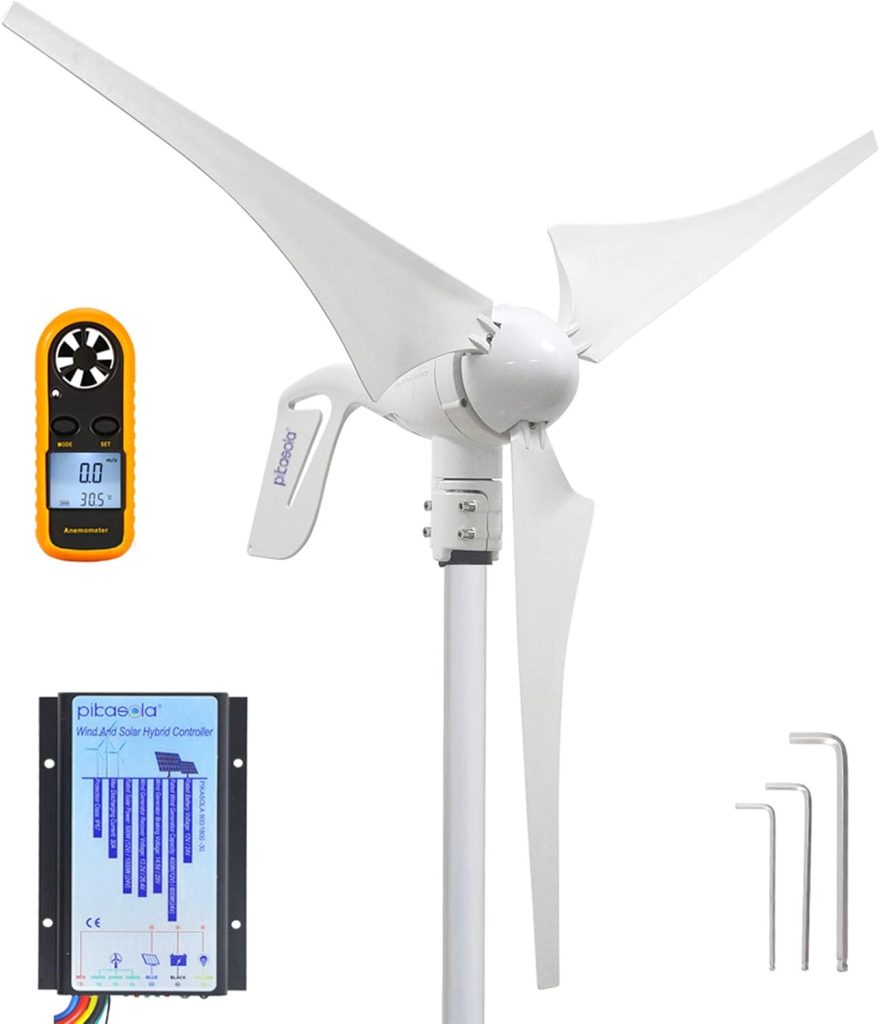
Pikasola 400W 12V Wind Turbine Generator
400W 12V three-blade turbine with low 2.5 m/s startup; the saner first turbine.
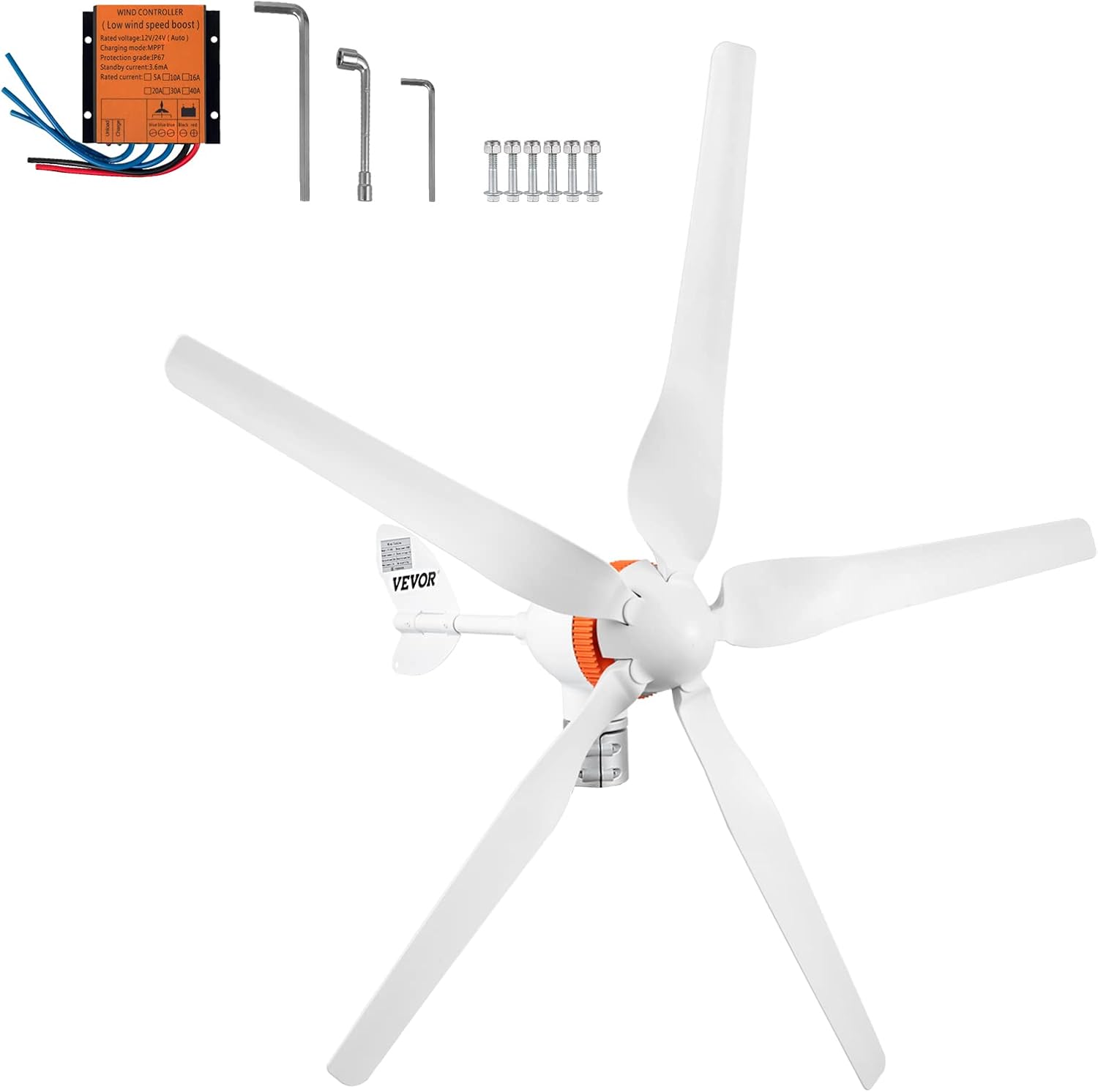
VEVOR 500W 12V Wind Turbine Kit
500W 12V five-blade kit with MPPT controller included; a complete small-wind starter.
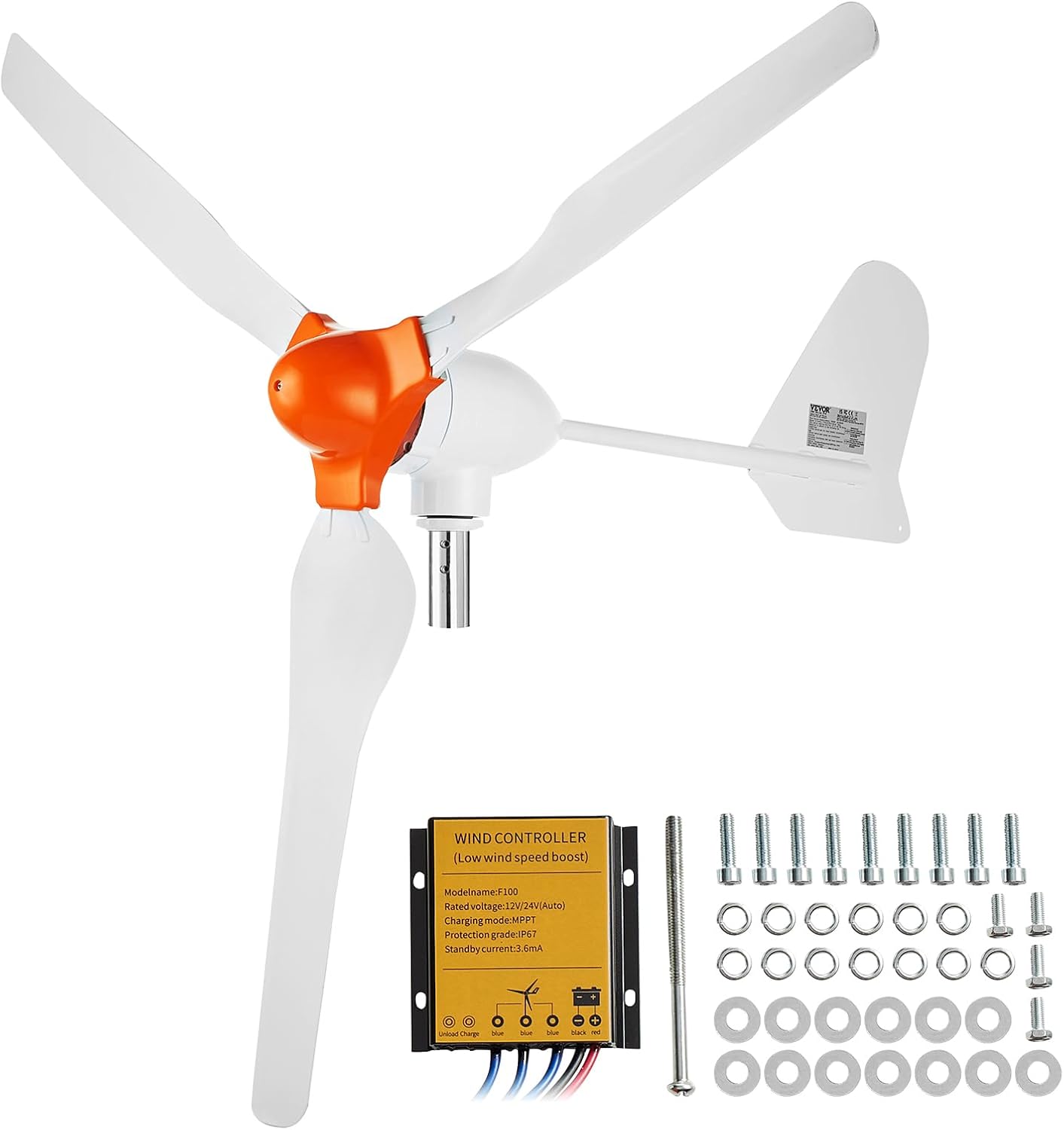
VEVOR 800W 12V Wind Turbine Generator
800W 12V three-blade turbine with MPPT controller; the step up for windy sites.
The category’s foundational exaggeration is the word “charger.” A 5W turbine is called a charger, and chargers — in the mind of every buyer — fill batteries. This one fills them at the speed of a dripping faucet, on windy nights only, and the name sets an expectation the physics can’t meet. If they called it a “wind trickler” or a “breeze harvester,” nobody would feel misled. But “charger” sells, so “charger” it is, and every buyer goes through the same 3am tent math I did. The industry could fix this with honest output curves — watts at 3, 5, 8, 10 m/s, printed on the box. Four numbers. They won’t, because three of the four numbers are embarrassing.
And yet. I still own mine. It hangs in my garage now, and on windy nights I sometimes plug in a dead headlamp just to watch it work — slowly, honestly, making real electricity from moving air. There’s a pleasure in it that has nothing to do with the watt-hours. It’s the same pleasure as a hand-crank radio or a wood stove: the machine asks something of the world and the world answers. Four percent overnight. A few texts. The whirring outside the tent, cheerful and earnest and almost entirely symbolic. I keep it for the symbolism. I charge my phone from the solar panel.