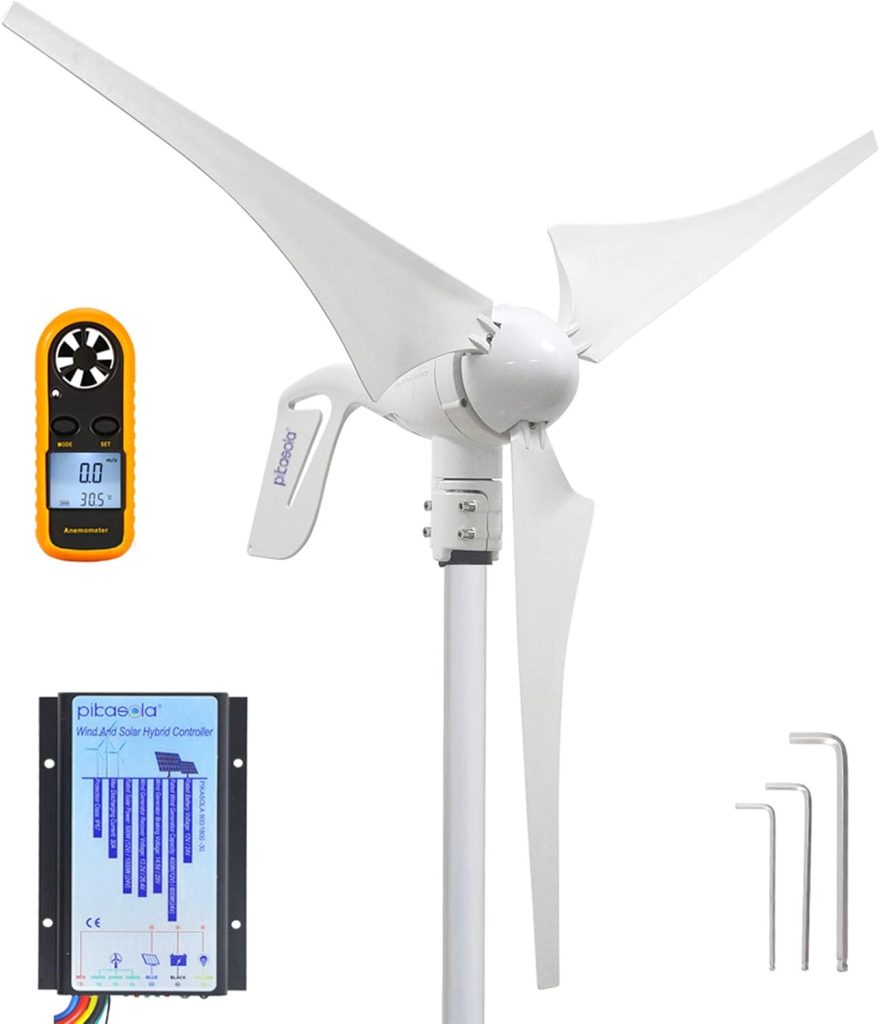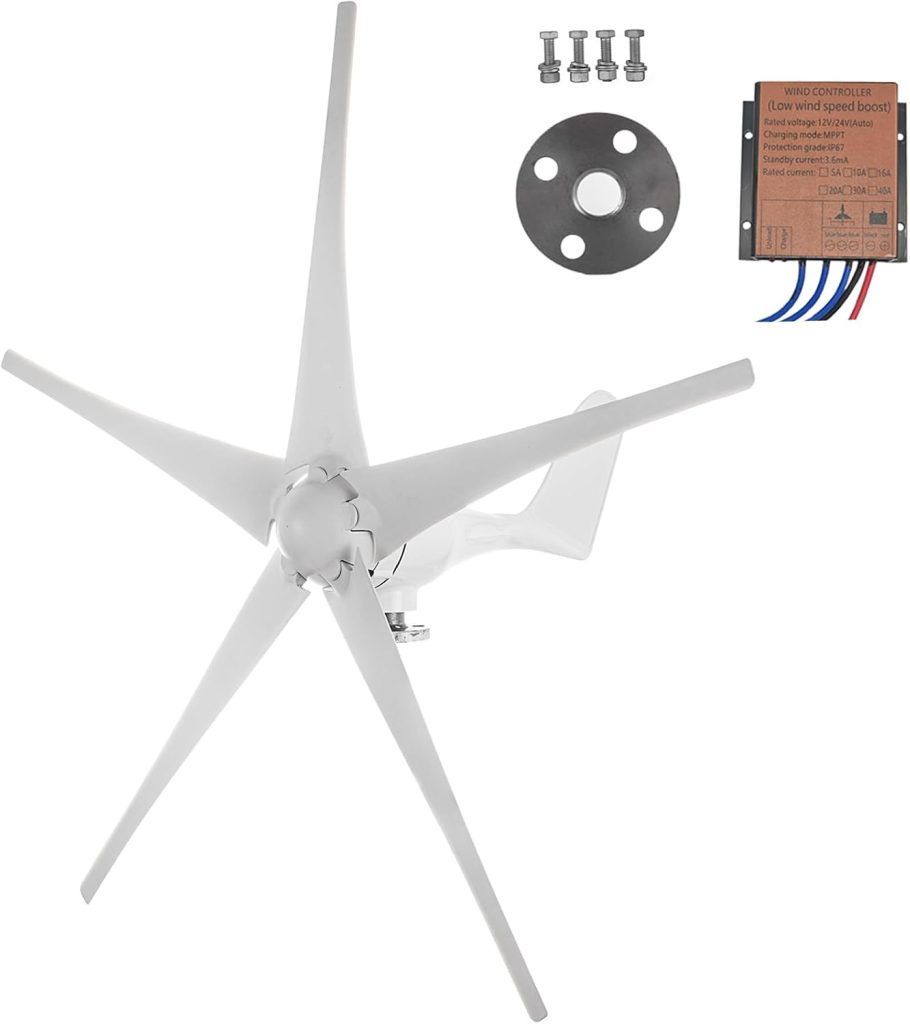
1200 watts. That’s what the listing says, big and confident, right under the photo of five white blades spinning against a blue sky.
Here’s the number the listing whispers: rated wind speed, 12 meters per second. That’s 27 miles per hour. A near-gale. The kind of wind that makes your patio furniture relocate. So the question isn’t whether the turbine can make 1200W. It’s how often your backyard sees a near-gale.
Mine sees it roughly never.
The Cubic Problem Nobody Mentions Up Front
Wind power follows a brutal rule: power rises with the cube of wind speed. Double the wind, eight times the power. Which also means halving the wind cuts power to one eighth. This one formula explains the entire small-wind industry, and it’s the formula the marketing photos hope you never learn.
Run it. Rated 1200W at 12 m/s. At 6 m/s — a breezy day, the kind that feels productive — output drops to roughly 150W. At 4 m/s, a normal afternoon, you’re looking at maybe 40 to 45W. At 3 m/s, the blades are turning and the meter is barely awake.
I did this math on a napkin after my solar array went up, back when I was still romantic about adding wind to the mix. The napkin said no. I didn’t listen to the napkin for six months. The napkin was right.
What 5 Blades Actually Buy You
The five-blade design isn’t decoration. More blades means better low-wind startup — this one claims 2.5 m/s cut-in, and I’ll grant that the blades do start turning early. PBT blades, decent balance, the MPPT controller in the kit actually tracks instead of just pretending to.
But starting to turn and making useful power are different sports. Between cut-in at 2.5 m/s and anything worth harvesting at 5 or 6 m/s, there’s a wide band of spinning-for-show. Five blades spin earlier and also cap your top end sooner — more drag at high wind. It’s a trade, not a win.
Three blades would be more efficient at speed. Five blades start easier and run quieter. Pick your disappointment.
My Roof, My Wind, My Disappointment
I put an anemometer on my roof for three months. Subdivision outside a mid-size city, two-story house, the kind of place where the brochure would show a turbine. Average wind speed at 30 feet: 3.8 m/s. Gusts to 9 on storm days. Hours per month above 8 m/s: eleven. Eleven hours.
That’s the thing about residential wind that the turbine listings can’t fix with a better controller. My solar panels sit in laminar sunshine. My roof sits in turbulent soup — trees, houses, fences chopping the wind into gusts and lulls. Turbines hate turbulence the way solar hates shade, except you can’t trim your neighbor’s house.
The honest use case for a 1200W small turbine: open farmland, a hilltop, a coastal bluff, a boat. Places where the wind has a long fetch and nothing to trip over. If your install site has a fence within fifty feet in any direction, do the anemometer test first. I wrote up the bigger end of this category in my 18kW wind turbine kit review and the same wind-measurement warning applies double there.
The Controller Question
Credit where it’s due: the kit’s MPPT controller matters more than most buyers realize. A cheap PWM dump controller on a wind turbine is a recipe for cooked batteries — when the wind gusts, voltage spikes, and something has to eat it. The MPPT unit here handles braking and load diversion without drama, at least on paper.
Paper. Right. I’ve bought exactly one small turbine in my life, a 400W unit years ago with a controller that failed in month four and took a battery with it. So when I say “on paper,” I mean I haven’t personally tortured this controller. The spec sheet reads right. That’s all I can honestly give it.
Brake function, though — check that any turbine you buy has one, manual or automatic. A runaway turbine in a 50 mph gust doesn’t just stop making power. It can throw a blade. This isn’t theoretical; there are videos.
The Electric Bill That Started All This
Totally sideways for a moment. My solar array’s payback math is what got me into this mess — 8.4 years at current rates, I calculated, then the utility changed the net metering rules and it became 11. That’s when the wind turbine idea showed up, like a rebound relationship. Something to make the numbers feel better.
It wouldn’t have. Even being generous — say the turbine averages 100W around the clock, which my wind data says is fantasy — that’s 2.4 kWh a day, maybe 30 cents. Eleven dollars a month against an $800 kit. The payback period has three digits. For comparison, sizing the solar side properly is far more predictable — I keep pointing people at how many solar panels do I need for my home because panels, unlike turbines, actually deliver their math.
I keep the napkin. It’s pinned to my office wall next to the solar production chart, as a reminder that wanting a thing to pencil out is not the same as it penciling out.
The Category’s Favorite Trick
Small wind’s signature move is the rated-power headline. 1200W! Then, buried in the manual: at 12 m/s. It’s technically true and practically a rumor. Solar does this too with STC ratings, but at least the sun hits its lab conditions daily. Nobody’s backyard hits 12 m/s daily.
The second trick is the “up to” language. “Up to 1200W” covers everything from 1200 down to zero, including the 40W you’ll actually see. Legally bulletproof. Informationally empty.
And buyers — me included, once — do the rest of the damage ourselves. We see 1200W, we think “that’s more than my 400W panel,” we forget that the panel makes its rated power on every sunny afternoon while the turbine makes its rated power during weather events. Different currencies. I compared them like they were the same money for an embarrassingly long time.
What About the Competition?
Three small turbines if you’re determined to try wind anyway. Same honest advice applies to all of them: measure your wind first.
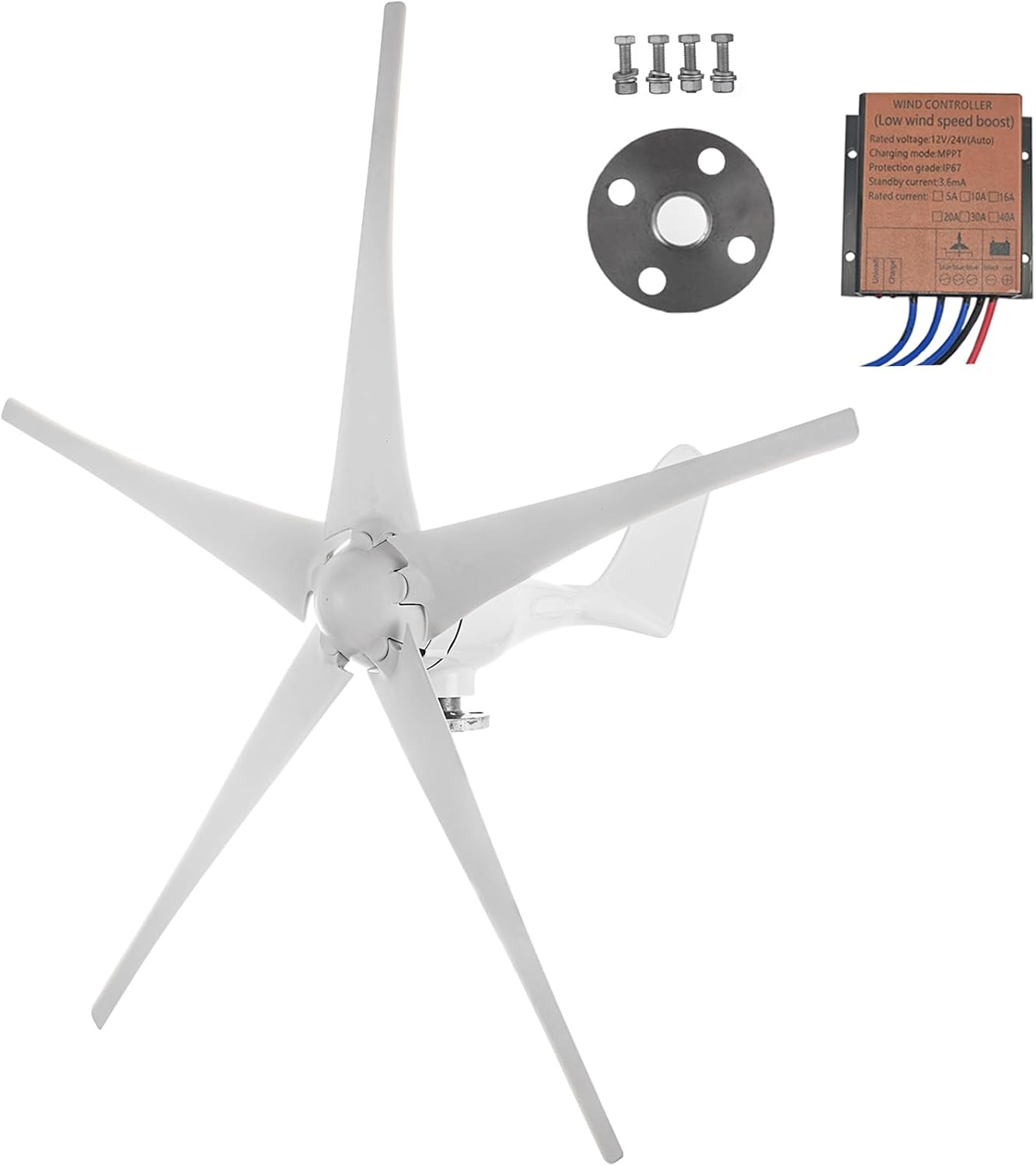
Enrienn 1200W Wind Turbine Generator
1200W, 5 blades, MPPT controller in the box. For genuinely windy, open sites.
Windmax HY1000-5 Wind Generator Kit
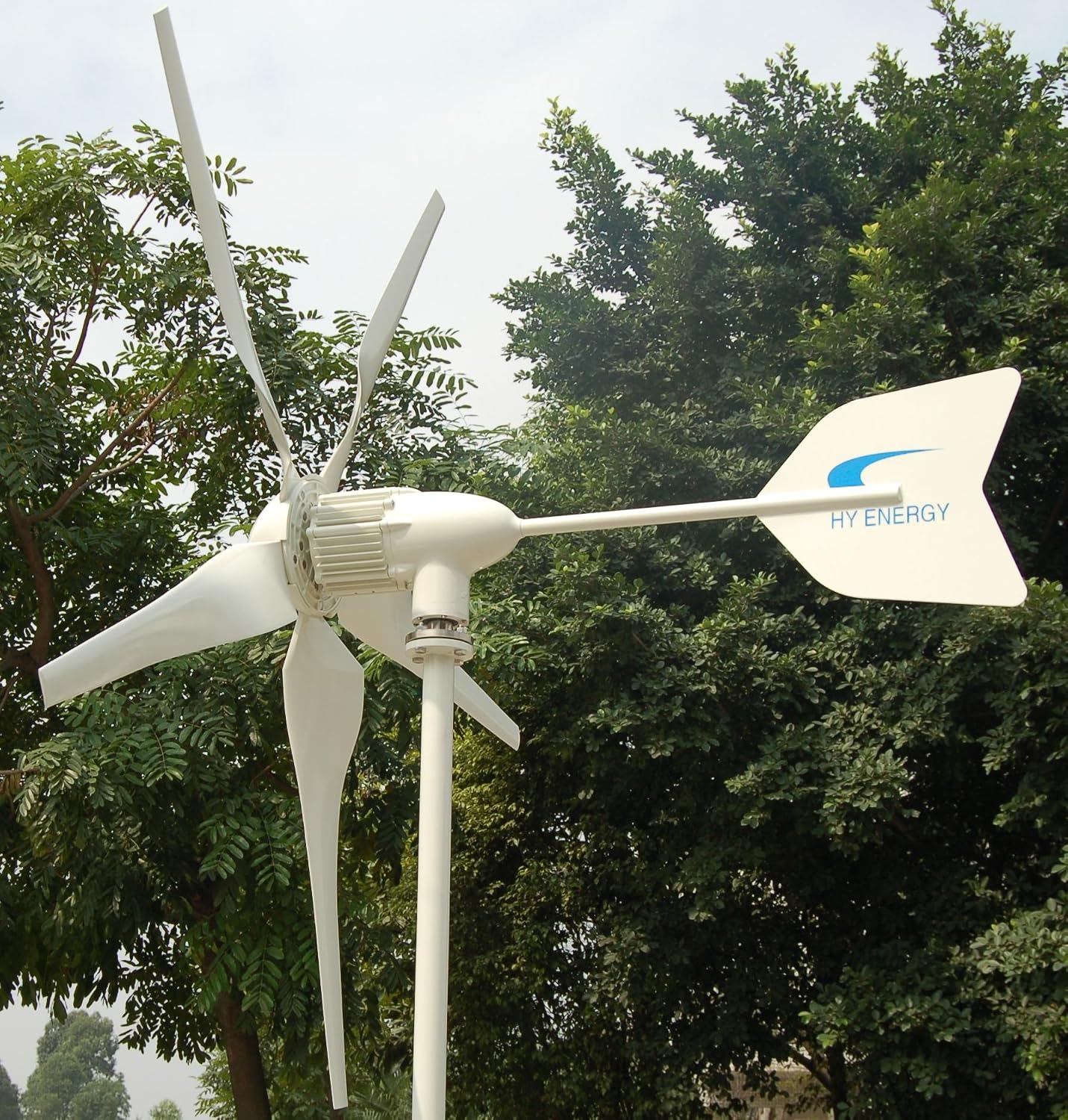
1000W 5-blade kit. The older documented design in small residential wind.
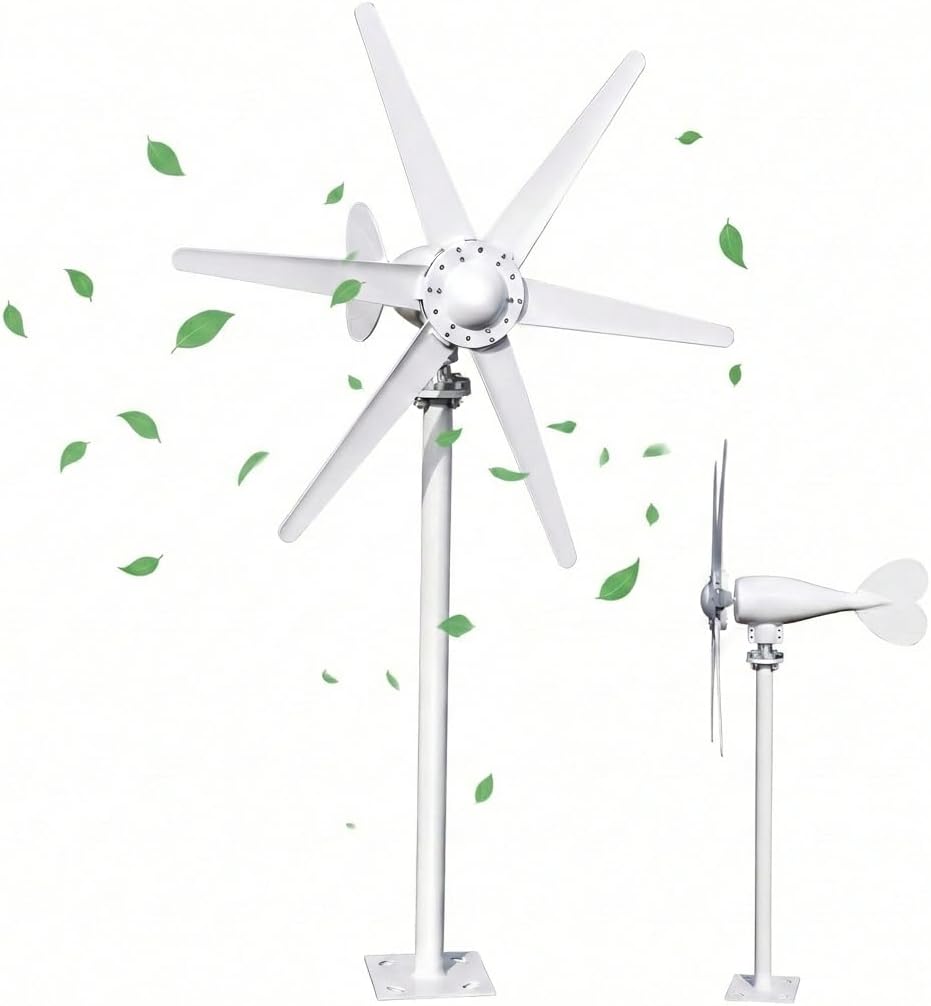
800W Horizontal Wind Turbine Generator
800W, 6 blades, 12V/24V with controller. Easy low-wind startup, accessible price.
Look at the Enrienn 1200W if your site is genuinely open and windy — five blades, MPPT controller in the box, the full kit. Look at the Windmax HY1000-5 if you want the older known quantity in this space; it’s been around long enough that the failure modes are documented. Look at the vertical-axis 1000W if low vibration matters more than peak output — verticals start easier in gusty air but give up efficiency at speed.
Skip all three if you live in a subdivision with trees. That’s not a turbine problem. That’s a wind problem, and no blade count fixes the air where you live.
The anemometer is still on my roof. It says 4.1 m/s right now, gusting to 6. The turbine listings are still in my bookmarks. Every few months I open one, run the cubic math again, and close the tab. The napkin stays pinned to the wall. Some lessons you just rent instead of owning.
This site contains affiliate links. We may earn a commission on qualifying purchases.