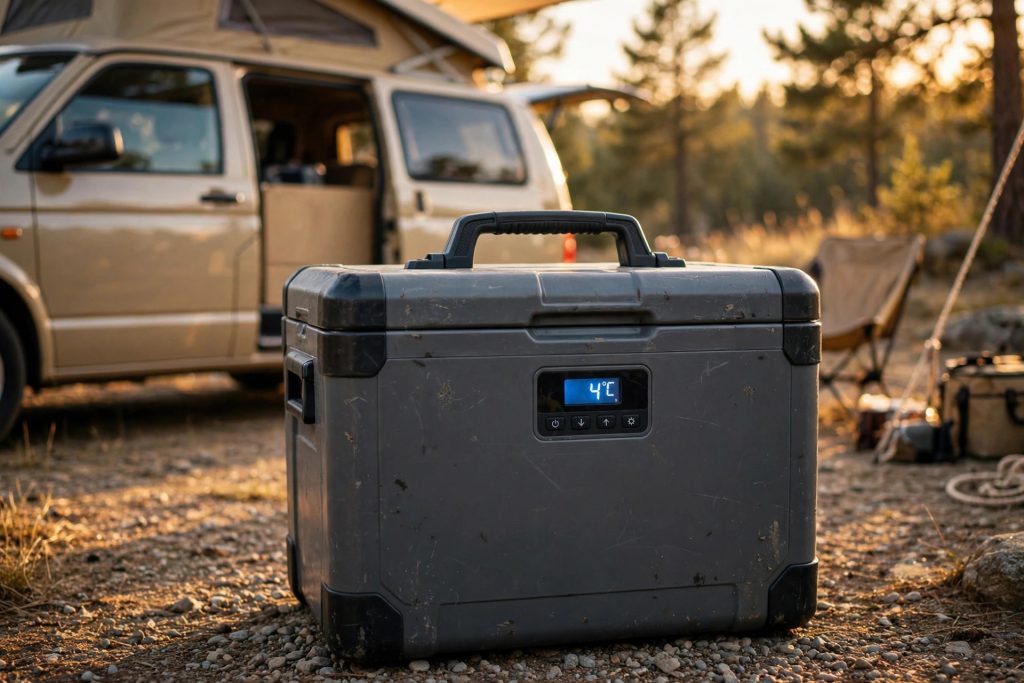
Alpicool C30 Review: 28-Quart 12V Portable Fridge Freezer for Camping
Buying ice gets old fast. Three days into a road trip, half your cooler is slush, the meat is questionable, and you’ve already spent more on ice than the food it’s supposed to save. The Alpicool C30 is built for people who are done with that cycle — a 28-quart compressor fridge freezer that runs off your car’s 12V outlet or a portable power station, with genuine freezing capability down to -4°F. This guide walks through how it fits real car-camping, overlanding, and RV routines, and what to check before any 12V fridge ends up riding in your trunk.
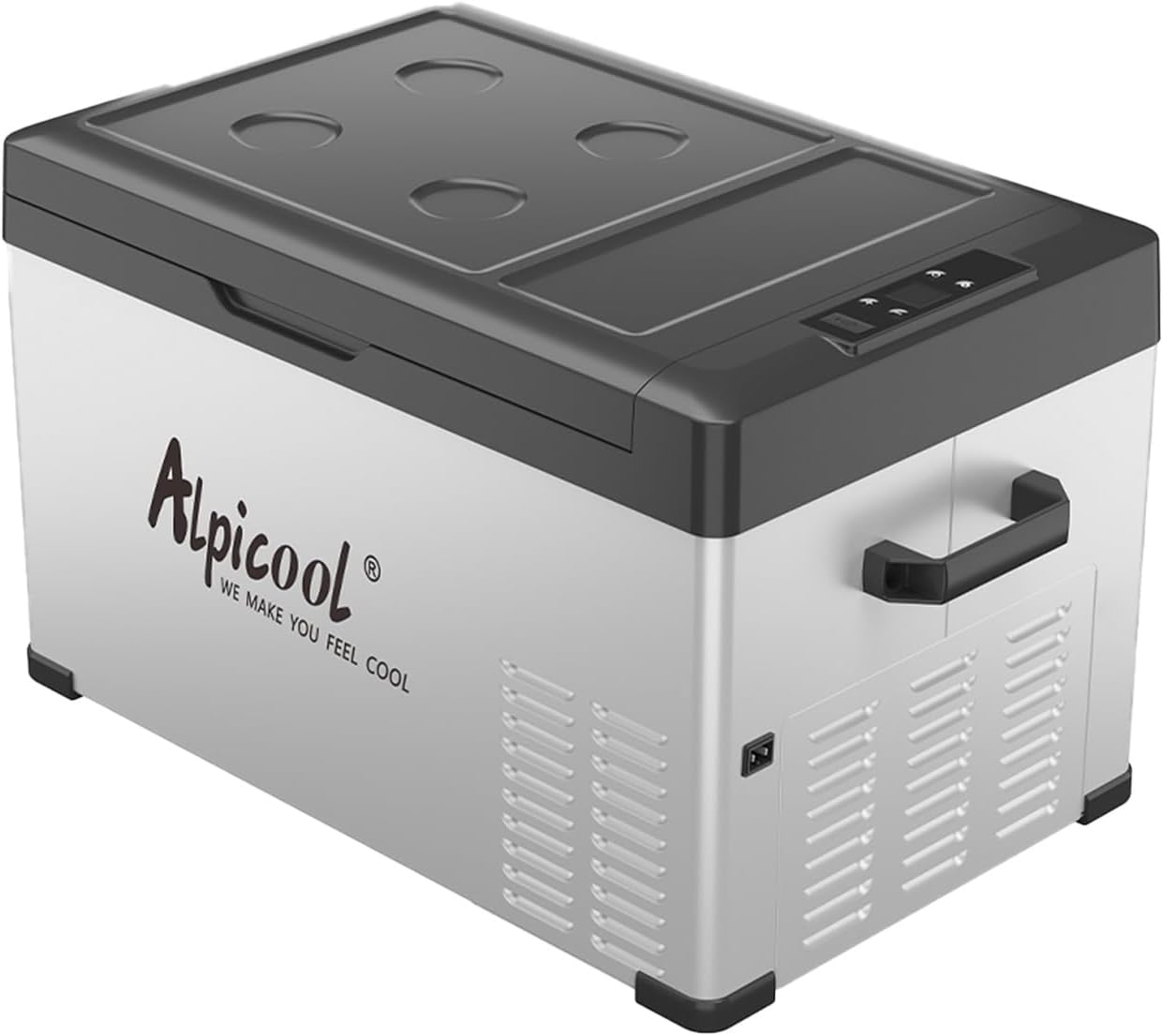
Quick Answer
The Alpicool C30 is a solid mid-range 12V fridge freezer for campers who want real freezing without the ice runs. Its 28-quart capacity suits couples or small families on 2–3 day trips, the modest power draw pairs easily with solar and power stations, and 3-stage battery protection keeps your car’s starter battery safe. The main trade-off is the single-zone interior — you pick one temperature, fridge or freezer, at a time.
Compare Top 12V Portable Fridge Freezers
Three proven picks side by side — choose the one that fits your needs.
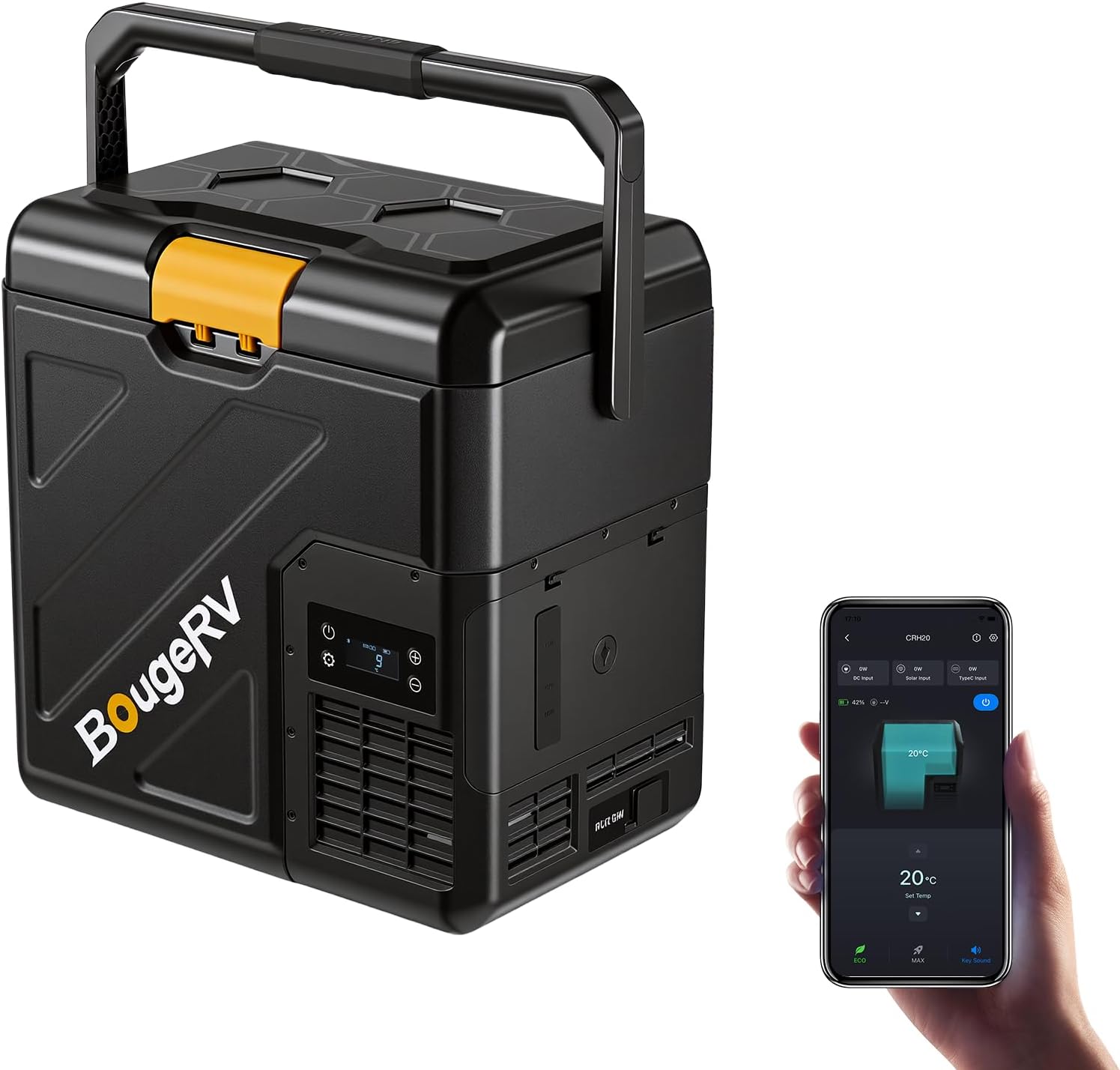
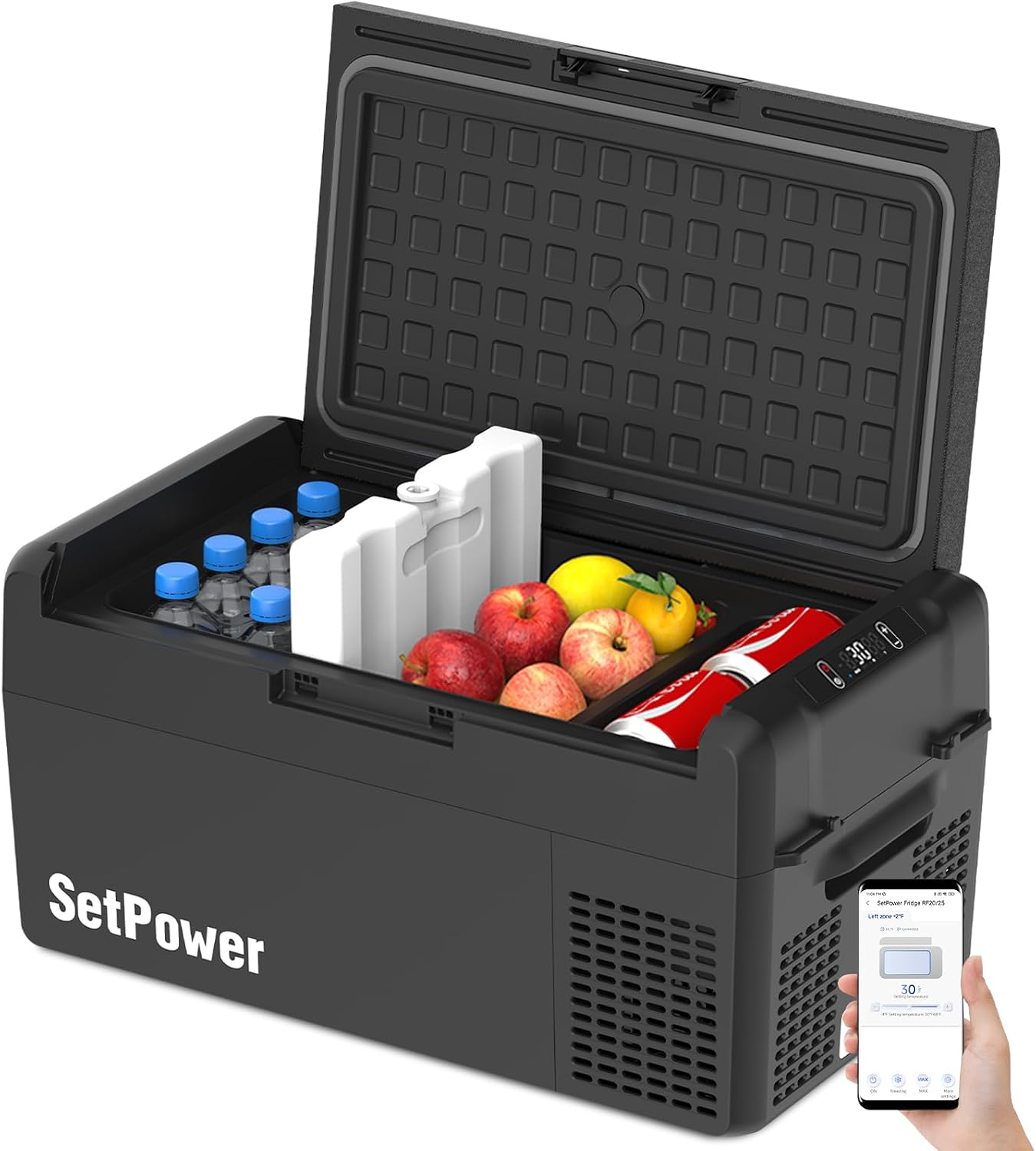
Prices and availability may vary — tap any product to check the current listing.
For context, we have reviewed the BougeRV CRH20 and the ICECO GO20 in the same portable-fridge category.
What to Look For in a 12V Car Fridge Freezer
Not all 12V “coolers” are fridges. The difference between a thermoelectric box that just makes things slightly less warm and a compressor unit that genuinely freezes food is the difference between a fun gadget and a tool you can trust with a week’s worth of groceries. Here’s what actually matters, and where the C30 lands on each.
Capacity and Interior Layout
28 quarts is the sweet spot for two people on a long weekend. Think a couple dozen cans plus real food — eggs, meat, dairy, the stuff that makes camp cooking actually good instead of sad trail mix. For solo travelers it’s generous; for a family of four on a week-long trip, you’ll be packing tight and restocking.
What catches people off guard: the C30 is a single-zone box. It holds one temperature setting at a time. Set it to freezing and everything inside freezes. Set it to fridge temps and nothing does. That sounds obvious written down, but I’ve seen people buy a single-zone fridge expecting a freezer compartment and a fridge compartment like the one in their kitchen. It isn’t that.
If your trips regularly need frozen meat and chilled drinks at the same time, that’s the signal to look at a dual-zone model instead.
Compressor Power and True Freezing
A compressor fridge works like the fridge in your kitchen — refrigerant cycle, real cold, the works. The C30 reaches true freezer temperatures down to around -4°F, which means ice cream stays ice cream and frozen meat stays frozen for days. A thermoelectric cooler, by contrast, typically only cools a fixed amount below ambient air, so on a hot day your “cold” drinks are merely lukewarm. Not comparable.
The trade-off is that compressor fridges cycle. The compressor kicks on, cools the box down, shuts off, repeats. That cycling is normal, efficient even — but it’s worth knowing about before you park the fridge inside your tent and wonder what that hum is at 2 a.m.
One more thing: cool-down takes time. The C30 pulls from room temperature down to fridge temps noticeably fast, usually well within an hour in MAX mode. But a hot car trunk in July is a different story. Pre-cool at home if you can. Your food will thank you.
Power Draw and Solar Compatibility
The C30’s rated draw is a modest 45W, which is the number that makes everything else work. Why? Because a draw that small plays nicely with the gear campers already carry. A typical 256Wh portable power station runs it for hours of actual cycling (it doesn’t pull 45W continuously — the compressor idles between cycles). A 100W solar panel on a sunny day can essentially keep it fed indefinitely.
This is where the practical-use angle really matters. If your fridge pulled 200W, you’d need a serious power station and a big panel array, and suddenly your weekend trip has the electrical budget of a small cabin. At this draw, a modest station plus a panel covers you.
The catch: MAX mode pulls harder than ECO. MAX is for the initial cool-down and for holding temperature on scorching days. ECO is the mode you’ll actually live in. Don’t set MAX and forget it — your battery won’t love that.
Battery Protection for Your Vehicle
The classic fear with 12V fridges is the dead starter battery. You park, the fridge keeps running overnight, and in the morning the car won’t turn over. The C30 addresses this with 3-stage battery protection — low, medium, and high cutoffs that shut the fridge down before your vehicle battery drains to the danger zone.
It’s a genuinely useful feature, and honestly it’s table stakes for any 12V fridge worth buying. Set it to high protection if your car battery is older or if you’re parking for a long time. Set it lower only if you know your battery is healthy and you want maximum cooling time.
Limitation worth naming: battery protection saves the car, not the food. When the fridge cuts off, the box starts warming. Insulation buys you time — hours, not days — so this is a “keep the trip going” feature, not an excuse to leave the fridge in a parked car for a weekend.
Noise Level
The C30 runs under 45dB, which is roughly the level of a quiet library conversation. While driving, you won’t hear it at all — road noise swallows it completely, and the unit is built vibration-resistant for exactly this use case.
Overnight is the real question. Inside a small tent, next to a light sleeper? You’ll hear the compressor cycle. It’s not loud, but it’s there. Van lifers and RV folks usually park the fridge in the cargo area or an outside compartment and never think about it again. Tent campers should do the same if noise bothers them — outside the sleeping area, under a tarp if rain threatens.
Weight and Portability
At about 33 pounds before you put anything in it, the C30 is a genuine two-person lift when fully loaded with food and drinks. Empty, one person can manage it — the handles help — but don’t kid yourself about hauling a full one up a hill to a walk-in campsite.
This is the quiet trade-off of the whole category. Compressor fridges are heavy by nature. Lighter fridges exist, but they’re smaller or thermoelectric (and then they don’t freeze). If portability is the priority, size down to the 21-quart class instead of expecting a 28-quart box to feel light.
Match the Fridge to Your Trip
Different trips, different demands. Here’s how to tell whether the C30’s particular mix of size, power, and features lines up with how you actually travel.
The Weekend Road-Tripper
You drive somewhere Friday evening, camp through Sunday, drive home. Your routine: load the fridge at home (pre-cooled, ideally), run it on the car’s 12V outlet during the drive, and at camp either plug it into shore power at a powered site or let the battery protection do its thing overnight while parked.
For this person, the C30 is close to ideal. 28 quarts covers a couple’s food for three days without restocking, the 45W draw won’t stress a healthy car battery between drives, and the freeze capability means you can bring frozen meat on Friday and cook it Sunday. That’s the whole point of a compressor fridge: eating real food on day three.
The single zone rarely bites weekenders. Freeze everything Friday, switch to fridge temps Saturday, eat through it. Simple.
The Off-Grid Overlander
You measure trips in weeks, not days. Your rig probably already has a dual-battery setup or a sizable power station, solar panels live on the roof, and the fridge runs 24/7 for the entire trip.
Here the C30 works as a solid single-purpose unit, but think about your system. It’ll need a power source that can feed it continuously — a large power station recharged by panels, or a vehicle dual-battery setup. And the single zone becomes a real planning question on long trips: are you running it as a freezer for a meat stash, or as a fridge for fresh food? Some overlanders run a C30-class box as a dedicated freezer alongside a bigger fridge. That combination is genuinely popular, and it makes sense once you’ve tried keeping frozen goods frozen for a week.
If you’re just starting to build an overland setup, though, a dual-zone box might serve you better as the one and only fridge. One box, two compartments, fewer decisions.
How the Tiers Compare
12V cooling comes in distinct tiers, and each one is the right answer for somebody. Knowing which tier you’re in saves you from buying too much fridge — or too little.
| Type / Tier | Best For | Price Tier | Key Feature | Watch Out |
|---|---|---|---|---|
| Thermoelectric cooler | Day trips, keeping drinks cool for hours | Budget | Light and cheap | Only cools below ambient; can’t freeze |
| Budget compressor (small) | Solo campers, tight trunks | Budget | Real compressor cooling, compact | Small capacity; basic battery protection |
| Mid-range single-zone (Alpicool C30) | Couples, weekend and week-long trips | Mid-range | True freezing, 3-stage battery protection, ECO mode | One temperature at a time; ~33 lbs loaded |
| Dual-zone premium | Families, overlanders, long off-grid runs | Premium | Fridge and freezer simultaneously, app control | Bigger, heavier, needs more power |
A thermoelectric cooler is fine for a beach day and useless for a camping trip — it can’t freeze, and on a hot afternoon it barely chills.
A budget compressor fridge gets you real refrigeration in a small package, which is great until you need to feed more than one person.
The mid-range single-zone, where the C30 sits, is the category’s sweet spot for most campers: genuine freezing, sensible power draw, enough room for a couple’s long weekend.
Dual-zone premium boxes are the endgame for serious overlanders, but you’re paying for capacity and complexity most weekenders will never use.
Powering It on the Road: The Practical Setup
Here’s how the C30 actually lives in a vehicle. While driving, plug it into the 12V cigarette-lighter outlet — the fridge draws its power there and your alternator keeps up without breaking a sweat. Most people run MAX mode during the drive to pull the temperature down fast, then switch to ECO when they arrive.
At camp without shore power, you have two options. Option one: leave it plugged into the car and rely on the 3-stage battery protection to cut it off before the battery gets low. This works for overnight stops with a healthy battery, especially if you set the protection to high.
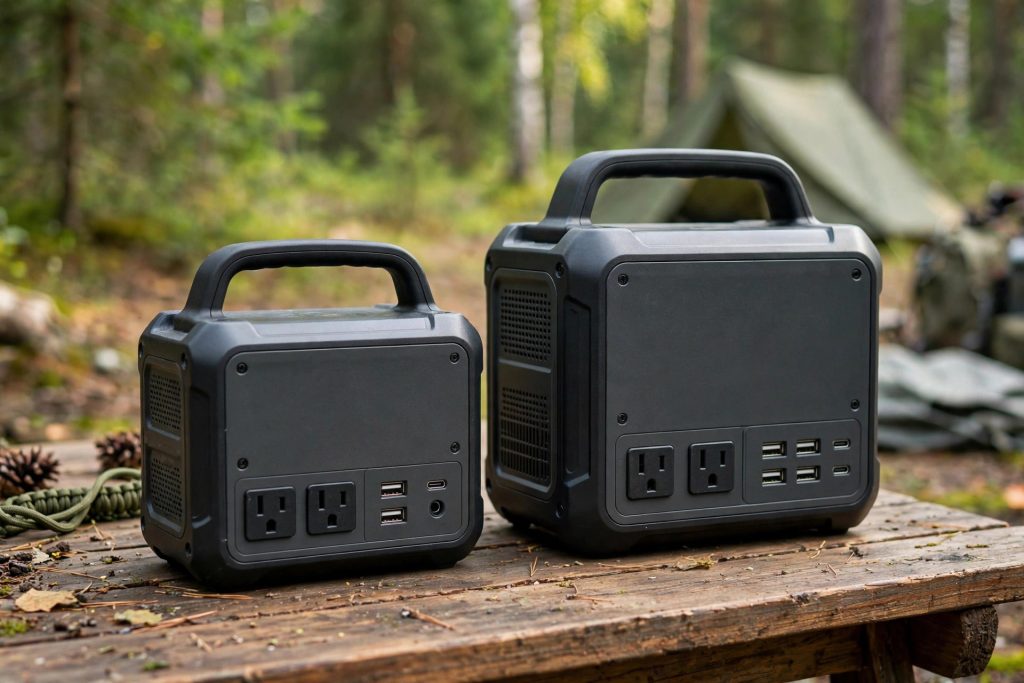
Option two: a portable power station. This is the setup that pairs best with solar. A few-hundred-Wh station runs the C30’s cycling compressor through the night, and a panel tops the station back up during the day. In good sun, this loop runs indefinitely. In bad weather, you’re burning through stored capacity — plan accordingly.
What doesn’t work: running it off the car battery for days straight with the engine off. Battery protection will eventually cut the fridge to save the car, and then your food is on its own. Ask me how I know. Actually, don’t. Just don’t.
Multi-Day Trips: Freezing That Actually Holds
The reason to buy a compressor fridge instead of a cooler is days three through seven. Ice can’t do this. A bag of ice in a cooler is gone in a day or two in summer; the C30 holding -4°F keeps frozen goods frozen as long as it has power.
The trick is the initial freeze. Load the fridge with already-frozen food, run MAX mode until the box is deep-frozen, then drop to ECO and let it hold. A full, frozen box holds temperature far better than a half-empty one — thermal mass is your friend. Pack it full, even if that means adding frozen water bottles as filler.
And manage the lid. Every open is a blast of warm air. Organize so you’re not digging. Fridge discipline sounds silly until you’re on day five and the ice cream is still ice cream.
Common Mistakes Buyers Make
Buying on capacity alone. Quarts are easy to compare, so people compare quarts. But 28 quarts with a single zone behaves very differently from 28 quarts split into two zones. Think about how you’ll use the temperature range, not just the volume.
Skipping the power plan. The fridge is only as good as its power source. A shocking number of people buy the fridge, then discover at the campsite that they have no way to run it overnight. Sort out the car outlet, the power station, or the dual-battery setup before the trip, not during it.
Running MAX mode all the time. MAX is for cool-down and heat waves. Living in MAX mode drains batteries faster for marginal benefit once the box is at temperature. ECO is the default. Let it be.
Forgetting about weight. 33 pounds empty is manageable. Add twenty pounds of food and drinks and it isn’t. Plan where the fridge lives in the vehicle and how it gets in and out — before you’re trying to muscle it across a muddy campsite.
Questions People Ask Before Buying
These are the questions shoppers actually type into search and AI assistants when they’re close to buying. Straight answers, no fluff.
Is the Alpicool C30 worth it for car camping?
Yes, if you’re camping often enough to be annoyed by ice — roughly five or more trips a year, or any trip longer than two days. The C30 replaces the ice-buying routine entirely, freezes food for real, and draws little enough power to run off a modest power station or your car’s outlet. For one annual trip, a cooler is cheaper and simpler. For regular campers, the fridge pays for itself in convenience within a season.
The math is simple: ice runs cost money and time on every trip, and coolers can’t keep frozen food frozen past a day or two. The C30 eliminates both problems at once.
Alpicool C30 vs BougeRV CRH20: which is better?
It depends on what you value more — capacity or convenience features. The C30 gives you 28 quarts of single-zone space, a solid choice for couples who need room for a few days of food. The BougeRV CRH20 is smaller at 21 quarts but adds app control, so you can adjust temperature from your phone without walking to the trunk. Both are compressor fridges with real freezing ability, and both sip power modestly.
Pick the C30 if capacity is the priority. Pick the CRH20 if you’d rather have a smaller box with smarter controls. Neither is the wrong answer; they’re just built for different trip styles.
What size 12V fridge do I need — is 28 quarts enough?
For two people on a 2–3 day trip, 28 quarts is plenty — it holds several days of real food plus drinks without creative packing. Solo travelers can go smaller without missing anything. Families of four or trips longer than four days are where 28 quarts starts to feel tight, and that’s when larger or dual-zone boxes earn their keep. When in doubt, err on the side of slightly bigger than you think you need.
A fridge that’s too small gets opened constantly and packed inefficiently, which wastes more energy than carrying a slightly larger box.
Can a 12V car fridge run on solar?
Yes, with a portable power station in between. The C30’s modest 45W draw means a few-hundred-Wh power station handles it through the night, and a 100W solar panel replenishes the station during the day. In steady sun, this loop runs indefinitely. In overcast stretches, you’re spending stored capacity, so a bigger station buys you more cloudy-day margin.
Don’t wire the fridge directly to a bare panel — panels don’t produce steady power, and the fridge wants steady power. The station is the buffer that makes solar work.
Does the Alpicool C30 work as a freezer?
Yes, genuinely. It cools down to around -4°F, which is true freezer territory — frozen meat, ice cream, and frozen meals all stay frozen for as long as the fridge has power. This is the key difference from thermoelectric coolers, which only cool below ambient temperature and can never freeze anything. Just remember it’s one temperature at a time, so when it’s in freezer mode, everything inside is frozen.
If you need frozen and chilled simultaneously on the same trip, you need either a dual-zone fridge or two single-zone boxes.
Why, How, What: Quick Answers
Why does a compressor fridge beat a cooler on long trips?
Because ice is a consumable and electricity isn’t. A cooler starts losing the moment you close the lid — the ice melts, the meltwater warms, and by day two or three you’re buying more ice or eating warm food. A compressor fridge holds a set temperature indefinitely as long as it has power, and on a road trip power is easy: the car’s alternator while driving, a power station at camp. The upfront cost is higher, but the per-trip hassle drops to nearly zero.
How do you keep food frozen for three days off-grid?
Start frozen, stay frozen. Load already-frozen food into a pre-cooled box, run MAX mode until everything is deep-frozen, then switch to ECO to hold it. Keep the fridge full — frozen water bottles fill gaps and add thermal mass that resists temperature swings. Limit lid openings, and keep the box out of direct sun. With a power station and panel backing it, three days is routine; the fridge doesn’t care how long the trip is, only whether it has power.
What size power station pairs well with the C30?
A station in the few-hundred-Wh range covers overnight use comfortably, since the compressor cycles rather than pulling its full rated draw continuously. Pair that with a 100W-class solar panel and you’ve got a self-sustaining loop in decent sun. Bigger stations buy cloudy-day margin, not capability — the fridge runs the same either way. Don’t oversize the station hoping the fridge will run “better.” It won’t. It’ll just run longer between charges.
Frequently Asked Questions
Will the C30 drain my car battery?
Not if you use the battery protection as intended. The 3-stage cutoff (low/medium/high) shuts the fridge down before the vehicle battery drops to a level that risks a no-start. Set it to high protection with an older battery or long parking stops. For multi-day parking, though, switch to a power station — protection saves the car, but the food warms up once the fridge cuts off.
Can it run on a portable power station?
Yes, and this is one of the best ways to use it. The modest power draw means a typical few-hundred-Wh station runs the cycling compressor for hours, and a 100W solar panel keeps the station topped up in daylight. Use the station as the buffer between panel and fridge — don’t connect the fridge to a bare panel.
How fast does it cool down?
From room temperature to fridge temps, noticeably fast — well within an hour in MAX mode for a pre-cooled box. Starting from a hot car trunk in summer takes longer, which is why pre-cooling at home on AC power before loading is the move experienced campers swear by. A full box of already-cold food holds temperature far better than an empty box cooling down.
Is it too loud to sleep near?
Under 45dB is quiet — roughly a hushed conversation. In a vehicle you won’t hear it over road noise. In a tent next to a light sleeper, the compressor cycling will be noticeable, so park it outside the sleeping area (under a tarp if rain is possible). Van and RV owners typically keep it in the cargo area and never think about it.
Can it be a fridge and freezer at the same time?
No — it’s a single-zone box with one temperature setting. Everything inside is either refrigerated or frozen, your choice. This is the C30’s main limitation versus dual-zone models. If your trips regularly need both at once, size up to a dual-zone fridge rather than fighting a single-zone box.
What won’t fit in 28 quarts?
A week’s groceries for four people, tall bottles standing upright in every corner, and a frozen turkey. What does fit: several days of food for two, a couple dozen cans with room for real meals, or a solid stash of frozen meat for a long weekend. If you’re feeding a crowd or going a full week, plan on a bigger box — or a second one.
Final Recommendation
The Alpicool C30 is the fridge for campers who are done buying ice. If you camp regularly, cook real food at camp, and want frozen goods to survive the whole trip, its 28-quart single-zone box, true freezing, modest power draw, and 3-stage battery protection cover everything that matters. The single-zone limit and the loaded weight are the honest trade-offs — and for most couples and small crews, neither is a dealbreaker.
Want app control and a smaller footprint? Look at the BougeRV CRH20. Need frozen and chilled at the same time? That’s dual-zone territory. But for the classic car-camping use case — drive somewhere, eat well, drive home — the C30 is hard to argue with.
Decision Tree: Which Fridge Fits Your Trip?
Mostly day trips and tailgates? → A thermoelectric cooler is enough. Don’t pay for a compressor.
Weekend camping for two, real food, no ice runs? → The Alpicool C30. This is exactly its lane.
Want phone control and a smaller box? → The BougeRV CRH20 trades capacity for app convenience.
Need frozen meat AND cold drinks at once? → Dual-zone premium. Single-zone boxes can’t do both.
Key Takeaways
• The Alpicool C30 is a 28-quart compressor fridge freezer with true -4°F freezing, a modest 45W draw, and 3-stage car battery protection.
• Single-zone means one temperature at a time — fridge or freezer, your call per trip.
• Pairs naturally with a portable power station and solar panel for off-grid multi-day trips.
• Under 45dB and vibration-resistant, but keep it outside the sleeping area if you’re noise-sensitive.
• About 33 lbs before food — plan the lift, don’t improvise it.