
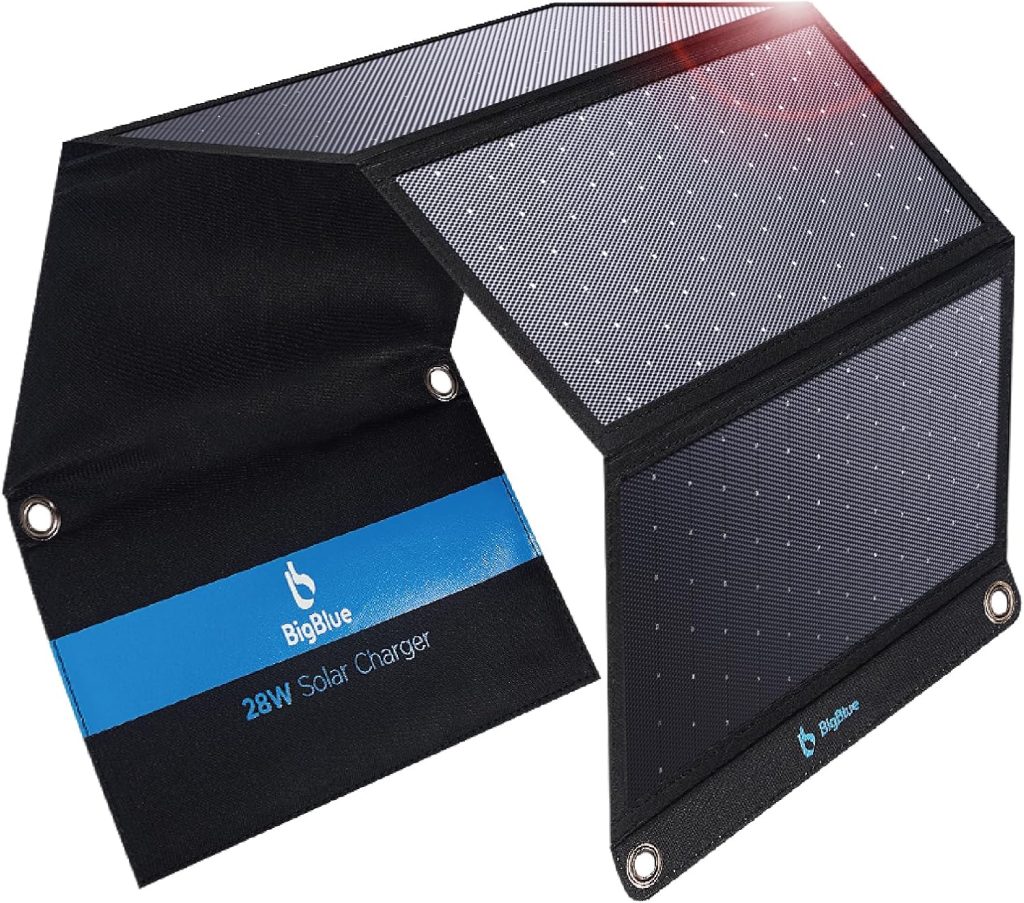
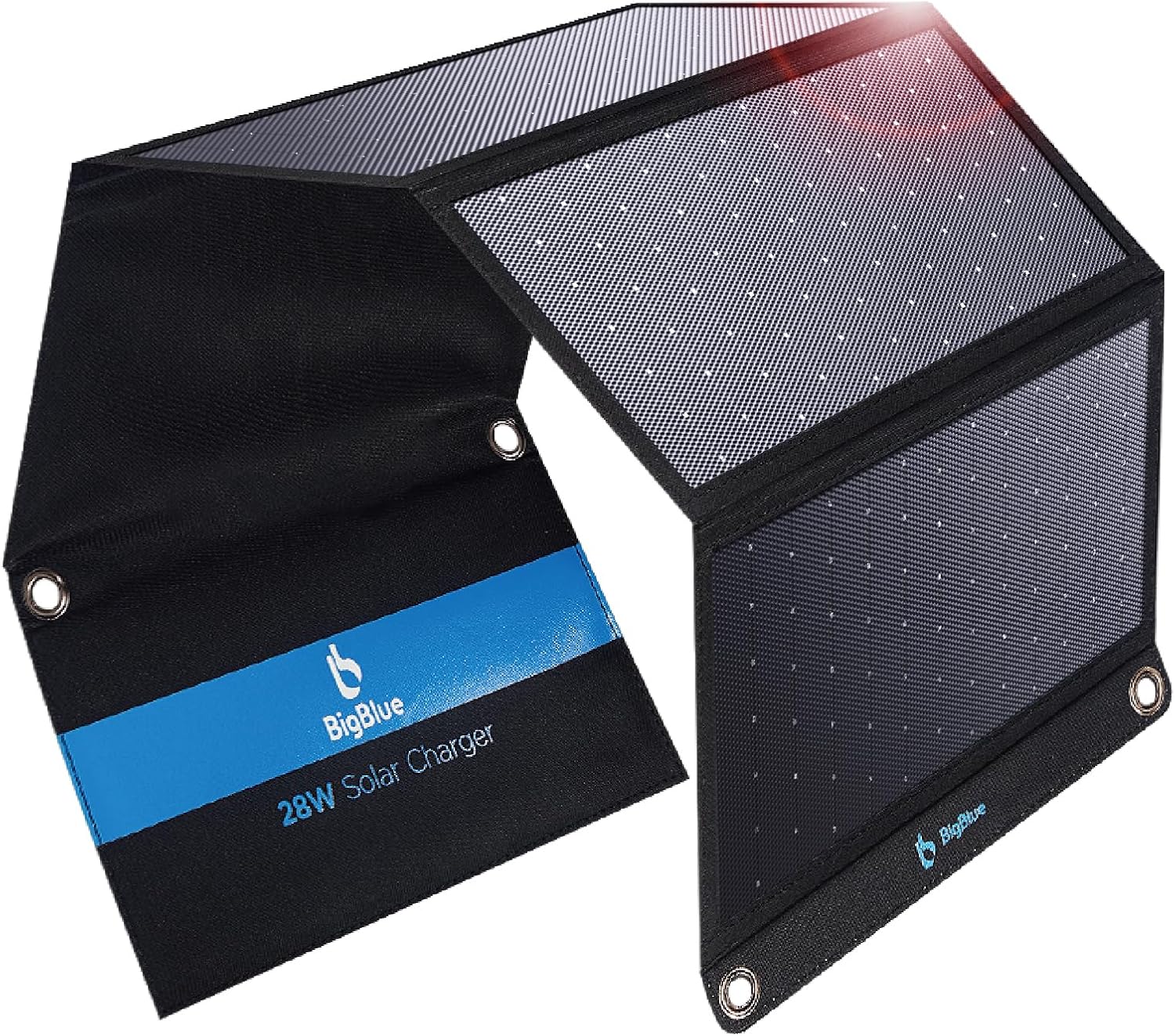
A solar charger for camping lives in a strange middle ground. It’s not a gadget charger, and it’s not a generator — it’s the thing that keeps your phone alive on day three of a trip, when the battery icon starts feeling like a threat. This guide breaks down whether the BigBlue 28W, one of the most widely known portable solar panel charger models, earns a spot in your pack, how it compares to the FlexSolar 40W and Nekteck 28W, and when to size up. Written for weekend campers and thru-hikers.
Quick Answer
The BigBlue 28W is a solid phone-and-small-device foldable solar charger — light, packable, and simple. It won’t fast-charge a laptop or refill a power station, and overcast skies cut its output hard. If your camp setup is phones, a headlamp, and a [rechargeable camping lantern](https://www.ecoswatt.com/goal-zero-lighthouse-600-camping-lantern-review/), it’s about right. Run bigger loads and you need a bigger tier.
Top 3 Portable Solar Chargers for Camping
Same job — keep your devices alive — three different sizes and price tiers.
BigBlue 28W Solar Panel Charger
Dual USB-C + USB-A, foldable with pack straps — the field-tested sweet spot
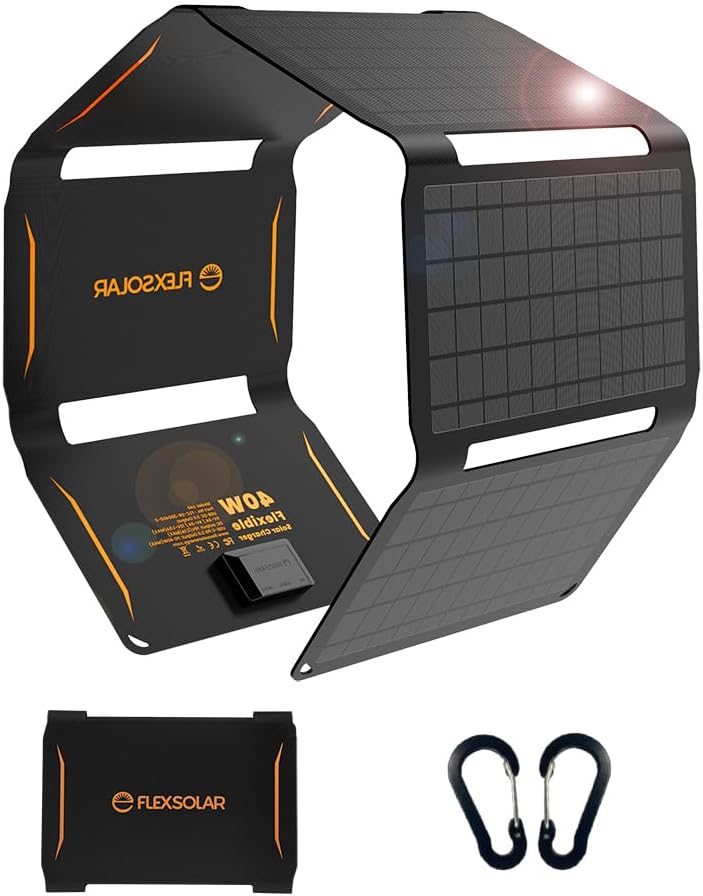
FlexSolar 40W Foldable Charger
More watts with PD fast charging — runs two devices at once
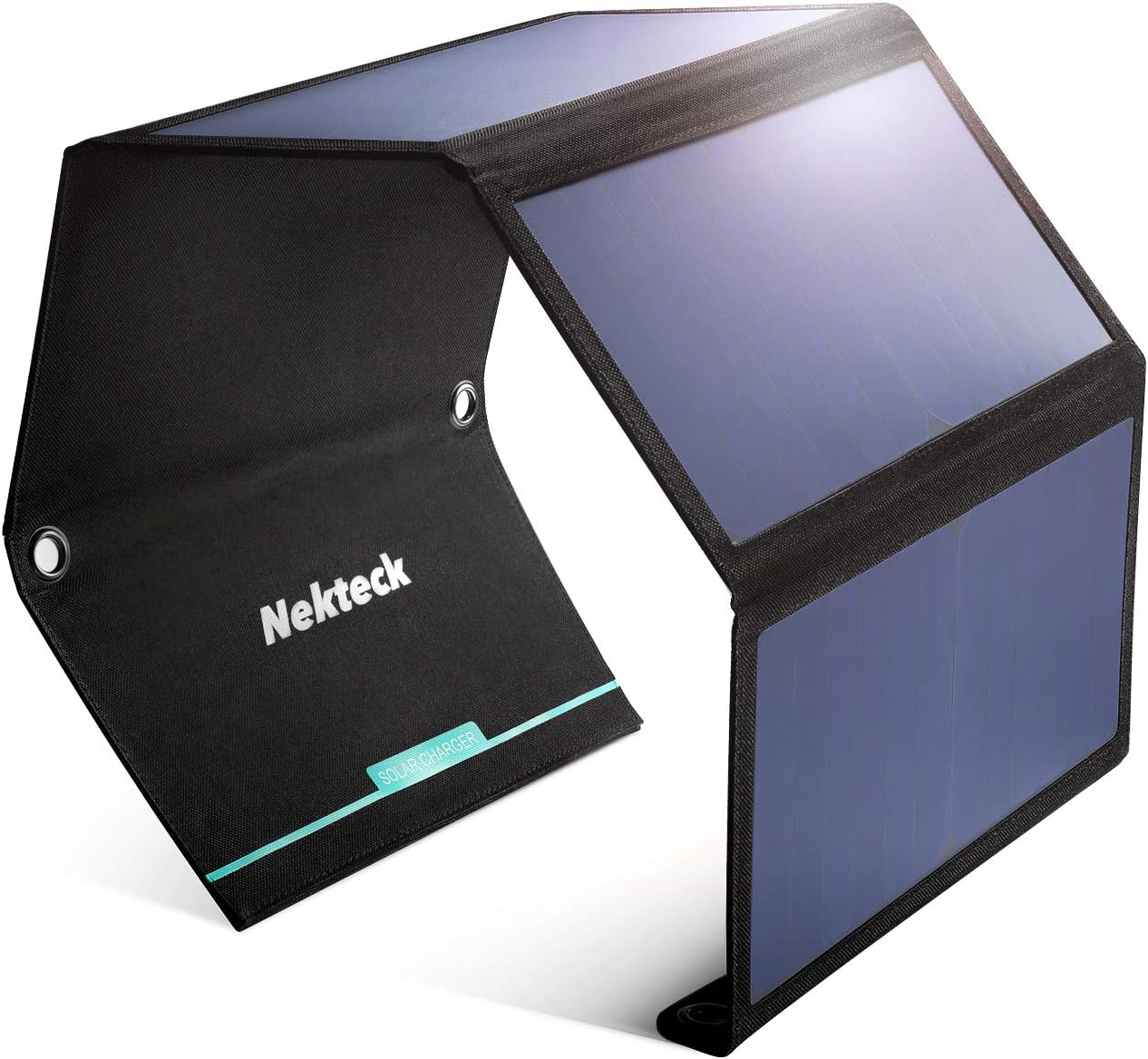
Nekteck 28W Solar Charger
The budget 28W pick — USB-A only, but the basics are solid
Prices and availability may vary — tap any product to check the current listing.
What to Look For in a Solar Charger for Camping
Most buyers go wrong here.
Rated wattage vs. real output. A “28W” solar panel charger almost never delivers 28 watts in the field; midday sun typically yields around half. Compare in tiers: 28W trickle-charges phones and small USB gadgets, 40W has headroom for hungrier devices in imperfect light, and 100W-plus folding panels flirt with power-station territory. The gap between tiers matters more than the gap within one.
USB-C versus USB-A. This decides what your charger is actually good for. USB-C handles modern phones and negotiates faster charging on better panels. USB-A-only panels (like the Nekteck 28W) still charge anything, just slower. The “better” port buys you nothing if every cable you own ends in an A plug — check your cable kit before you buy.
No battery inside — know what that means. Most folding panels, including the BigBlue 28W, have no battery: sunlight hits, current flows, your phone charges. A cloud passes, charging stalls. That keeps weight and price down, but your phone only charges when the sun behaves. Built-in-buffer panels cost and weigh more, yet suit hikers under tree cover. For campers who lay the panel flat for hours? The buffer barely matters.
Weatherproofing, honestly assessed. Sellers love throwing around IPX4 — splash resistance from any direction, fine for drizzle, not a downpour. What matters is whether the control box and ports sit behind a cover — that’s where failures start. Tuck it under a tarp overhang if the sky turns ugly.
Mounting and portability. This separates panels people use from panels that live in a drawer. The BigBlue 28W has loops that strap to a pack with a carabiner, so it charges while you walk — a feature that gets real use on long trails. Heavier 40W panels technically offer the same loops, but they’re bulky enough that most owners just set them up at camp. Weight tracks wattage: 28W folds to roughly hardcover-book size, 40W is noticeably chunkier, 100W larger still.
Shade behavior. One quirk: on multi-panel folding chargers, shade on one section drags down the whole output, not just the shaded slice. A strap shadow or a leaf can cut charging to a fraction. Lay panels fully in the open and rotate them with the sun. It’s also why 40W buys resilience: even hobbled by partial shade, a bigger panel still feeds a phone.
How to Match the Charger to Your Situation
The weekend camper. Drive in Friday, camp Saturday, drive home Sunday. Phones, maybe a speaker, a headlamp — your power problem is small and brief. A 28W foldable solar charger covers this cleanly: unfold it on a camp table, rotate it after lunch, done. Anything bigger is dead weight you’d never use.
The multi-day trekker. Three to seven days out, moving daily. Your phone is also your map, camera, and emergency beacon, and you can’t count on sitting in full sun because you’re walking. You want a panel that straps to your pack — the BigBlue 28W’s mounting loops fit that style. If your phone is critical and you also feed a satellite communicator, a 40W panel buys margin. Hate babysitting gear? Pair the panel with a [portable power station](https://www.ecoswatt.com/ecoflow-river-2-portable-power-station-review/) at base camp.
The car camper. You’ve got space, weight barely matters, and your loads run bigger — phones, tablets, maybe a small fridge or a lantern battery. A 28W phone-level charger will feel underpowered here. Because it is. Look at 100W folding panels feeding a power station instead.
Foldable Solar Charger Tiers Compared
| Type/Tier | Best For | Price Tier | Key Feature | Watch-Out |
|---|---|---|---|---|
| 28W foldable (phone-class) | Weekend campers, hikers | Budget-friendly | Packs to book size, straps to a backpack | Too small for tablets or stations; shade kills output |
| 40W foldable (mid-tier) | Multi-day trips, hungrier devices | Mid-range | Extra headroom; USB-C PD plus USB-A on most models | Heavier and bulkier; overkill for a two-day trip |
| 100W+ foldable (station-class) | Base camp, power-station charging | Premium | Actually refills power stations in a day of sun | Heavy; wasted if your loads are phone-level |
The 28W tier is the sweet spot for minimalists and a false economy for power-hungry campers — buy it for what it is, not what the number implies. The 40W tier costs and weighs more, but it keeps working when conditions aren’t ideal. The 100W-plus tier is a different animal entirely — generator-adjacent gear.
Scenario-by-Scenario: Where Does a 28W Solar Charger for Camping Actually Shine?
Day hikes and short overnighters. Here the 28W class is genuinely hard to beat. The panel folds flat, weighs almost nothing, and a few hours of trail sun meaningfully charges a phone. Strapped to a pack, it turns idle walking hours into passive charging.
Multi-day camping with a fixed camp. At a fixed camp you can play to the panel’s strengths: lay it flat, tilt toward the sun, rotate it through the day. Two hours of attentive placement beats six of half-shaded neglect. Given good placement, a 28W panel keeps two phones and a few small devices healthy indefinitely — just don’t expect it to run [foldable solar panels for bigger loads](https://www.ecoswatt.com/jackery-solarsaga-100w-solar-panel-review/) like laptops or a fridge.
Emergency backup and storm prep. A foldable panel is a decent emergency layer: no fuel, no moving parts, works as long as the sun rises. But “emergency” usually means overcast weather, when panels perform worst. Treat a 28W charger as one layer of resilience alongside a pre-charged power bank.
Common Mistakes
Buying for the number on the box. The most common error: treating “28W” like guaranteed output. It isn’t. Plan around roughly half the rating on a good day.
Daisy-chaining wrong. Panel → power bank → phone loses energy at each hop. When the sun is strong, charge the phone directly from the panel — it’s faster. Save the bank for overnight refills while you hike.
Ignoring cable quality. A thin, cheap cable can throttle charging harder than a cloud. Use short, decent-gauge cables — the ones that came with your devices are usually fine.
Leaving it in partial shade, then blaming the gear. A strap shadow across one panel section can tank the whole output. I’ve watched people research panels for a week and then lay theirs under a tree branch. Check placement before you blame the hardware.
Why, How, and What
Why does a 28W panel charge so much slower than its rating suggests? Three stacked reasons. The rating assumes lab conditions — perfect perpendicular sunlight — which the trail never delivers. USB charging involves conversion losses between the panel’s DC output and your device’s battery. And phones throttle charging speed based on heat and battery level.
How should you position a folding panel at camp? Face it toward the sun — angled roughly where the sun sits, not just “toward the sky” — and rotate it every couple of hours. Keep every section fully unshaded, including the seams. Charging while hiking? Strap it outside your pack facing up — hours of suboptimal sun still add up.
What can a 28W solar charger for camping realistically power? Phones, smartwatches, earbuds, headlamps, action cameras, GPS units, satellite communicators — the whole small-USB ecosystem of slow, low-draw devices. What it can’t do: charge laptops at usable speed, refill power stations, or run a portable fridge.
Questions People Ask Before Buying
Real buyer questions, straight answers
Is the BigBlue 28W solar charger enough to keep a phone charged on a camping trip?
The BigBlue 28W handles phone-level charging well in decent sun, topping up a modern phone within a few hours of direct light, though heavy cloud cover or deep tree shade slows it to a trickle. Plan around slow-but-steady trickle charging and it delivers reliably. It folds to roughly book size, so it earns its pack space on weekend trips. Where it struggles: reviving a dead phone quickly during a short lunch stop under patchy clouds.
Which is better for camping, the BigBlue 28W or the FlexSolar 40W?
The FlexSolar 40W delivers noticeably more output and a more flexible port mix, but it’s heavier, bulkier, and pricier — the better pick for longer trips, and overkill for a simple weekend. Choose it when your device list outgrows phone-level charging. Its higher wattage gives it headroom in imperfect light, and its port mix — USB-C fast charging plus USB-A plus DC output — feeds more device types. The BigBlue counters with packability: lighter, slimmer, with mounting loops for strap-to-a-pack charging. Short trips with phone-level loads? BigBlue.
Can a portable solar panel charger charge a power bank?
Yes — and pairing a folding panel with a power bank is arguably the smartest setup in this category, since the bank absorbs the sun’s inconsistency and charges your devices after dark. The panel harvests by day, the bank delivers by night — simple and effective. The panel feeds the bank all day; you charge devices from the bank at night. A 28W panel refills a phone-sized bank in a solid day of good sun.
Does a foldable solar charger work on cloudy days?
A foldable solar charger still produces power under clouds, but output drops sharply — expect a fraction of sunny-day performance, and heavy overcast may barely register on your phone’s battery icon. Thin high clouds cost you a third or so; thick gray skies reduce charging to a trickle. If your region is chronically cloudy, size up one tier: a 40W panel on an overcast day can still feed a phone, while a 28W panel might just hold it steady.
Do I need a solar charger with a built-in battery?
Most campers don’t need a built-in battery — a separate power bank does the same job better, costs less than integrated-battery panels, and charges from a wall outlet at home. Splitting the jobs gives you a bigger buffer and a lighter panel. Built-in-battery panels sound convenient, but the integrated cells are usually small, add weight, and cost a premium.
Key Takeaways
A 28W portable solar panel charger is a phone-class tool: good for phones, earbuds, headlamps, and GPS devices; wrong for laptops, power stations, and fridges.
Real-world output runs well below the rated wattage — plan around roughly half.
BigBlue 28W wins on packability and pack-strapping simplicity; FlexSolar 40W wins on output margin and port flexibility; Nekteck 28W is the budget USB-A-only pick.
Partial shade on one panel section drags down the whole panel — placement discipline matters more than brand.
Pair any folding panel with a power bank: the bank absorbs the sun’s inconsistency, and devices charge at night regardless of weather.
Size up one tier if your trips are long, cloudy, or involve devices hungrier than a phone.
Decision Tree: Which Solar Charger Fits Your Trip?
If your whole camp power problem is a phone and earbuds on a weekend trip → BigBlue 28W; light, simple, exactly enough.
If you’re out for a week or your region loves clouds → FlexSolar 40W for the output margin; the extra weight pays off on day four.
If your budget is tight and you only carry USB-A-era gear → Nekteck 28W: the cheaper 28W alternative with simpler ports.
If you need to charge a power station, run a fridge, or top up a laptop → skip phone-class panels entirely; look at 100W folding panels or a station setup.
If you hike under tree cover most of the day → pair any panel with a power bank, and charge devices from the bank.
If you mostly car camp and weight doesn’t matter → the bigger tier is the better value; you’d notice the output, not the weight.
Frequently Asked Questions
How long does a 28W solar panel take to charge a phone?
In direct midday sun, a 28W panel can put a meaningful charge into a typical phone within a couple of hours — enough for the rest of the day.
Are foldable solar chargers waterproof?
Most aren’t waterproof — they’re splash-resistant at best. An IPX4 rating covers rain splash and drizzle, not sustained storms — and the port box is the vulnerable part. If rain sets in, tuck the panel under a tarp overhang.
Can I leave a solar charger charging my phone unattended at camp?
Physically, yes — the phone manages its own charge rate. Two caveats: you can’t rotate an unattended panel, and gear left out in busy campgrounds can walk away.
What’s the difference between a solar charger and a solar generator?
A solar charger produces power directly from sunlight in real time — no storage, no AC. A “solar generator” is really a power station (a big battery with an inverter) plus the panels that refill it — it stores power and can run AC devices like laptops.
Will a 28W panel charge two phones at once?
It can, though each gets a slower share. In strong sun both phones trickle along; in weak light, the split can drop each device below the threshold where charging feels productive.
Is it better to buy a bigger panel or a second power bank?
Depends on your bottleneck. If your bank runs out and you can’t refill it, a bigger panel solves it; if you need power at night and in bad weather, a bigger bank solves it. Most multi-day campers want both.
Final Recommendation
The BigBlue 28W earns its reputation, with one important asterisk. For weekend campers and hikers whose power needs stay firmly in the small-USB world — phones, earbuds, headlamps, a GPS — it’s one of the most sensible buys in the category: light enough to forget and effective enough when given decent sun.
If your trips run longer, your skies cloudier, or your device list includes anything hungrier than a phone, step up rather than stretching the 28W class past its limits. The FlexSolar 40W is the natural next rung. Buy the tier your trips demand — not the one that sounds impressive in a spec list.


