
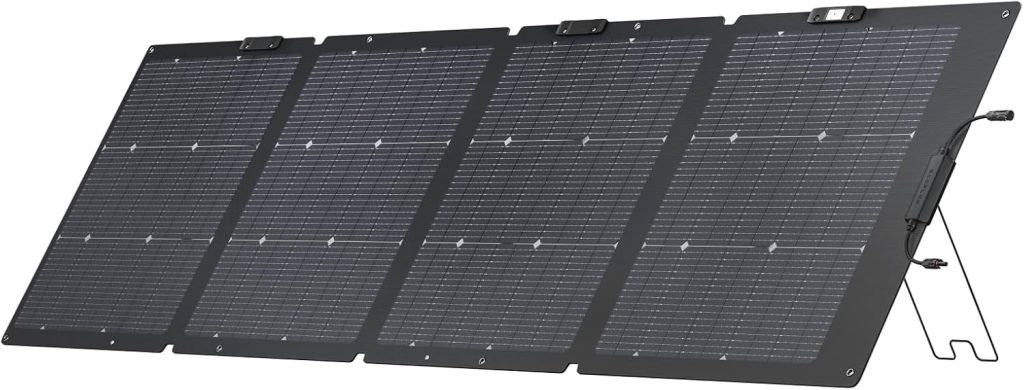
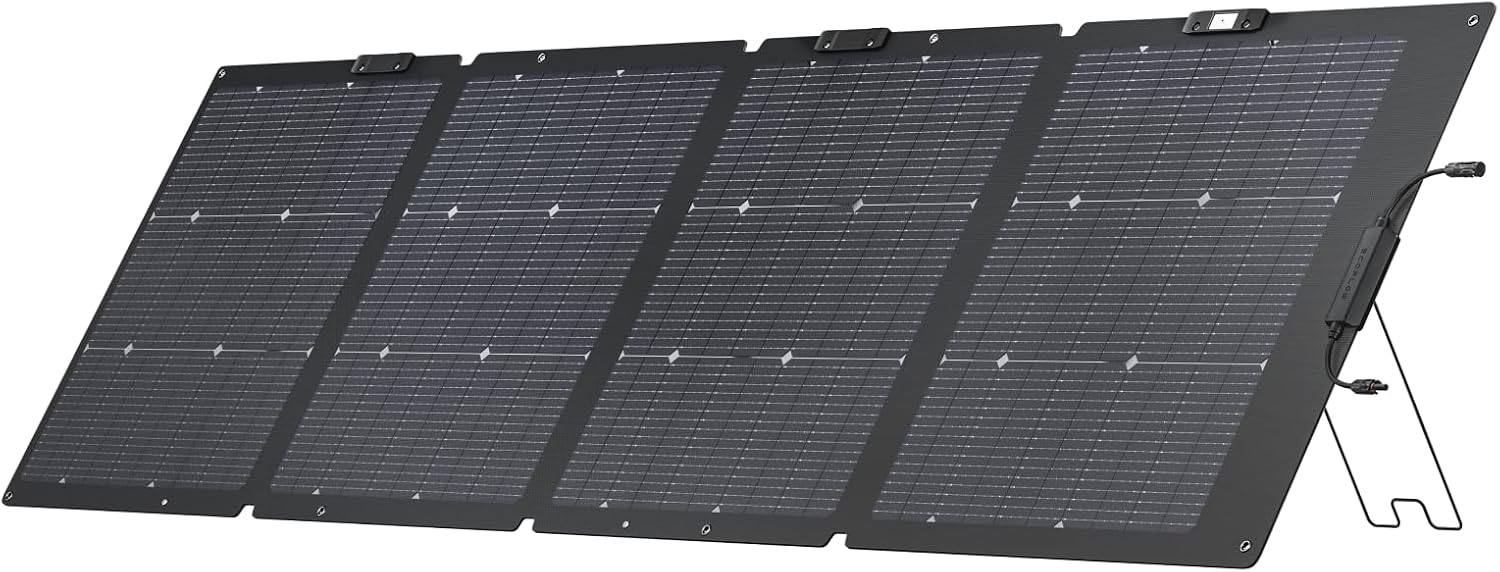
A portable solar panel kit is one of those purchases that looks simple until you’re staring at wattage numbers, cell types, and connectors wondering what’s actually worth paying for. This guide takes a hard look at the EcoFlow 220W bifacial portable panel — a 220-watt foldable aimed squarely at campers, RV owners, and off-grid setups — and asks the question every shopper should ask: is the bifacial premium worth it, or does a cheaper 200W mono foldable do the job just as well?
Quick Answer
The EcoFlow 220W bifacial is a strong mid-to-upper-tier choice for campers and RVers who want solid output from a single foldable unit and camp in bright, open sites. If you mostly camp in shaded woods and just need weekend top-ups, a cheaper 200W mono foldable gets you nearly the same practical result. Buy the bifacial when your terrain actually feeds its rear side.
Top 3 200W-Class Portable Solar Panels for Camping
Same wattage class, three different designs — pick by how you camp.
EcoFlow 220W Bifacial Portable Solar Panel
Bifacial 220W with IP68 sealing — the best watts-per-kilo in the foldable class
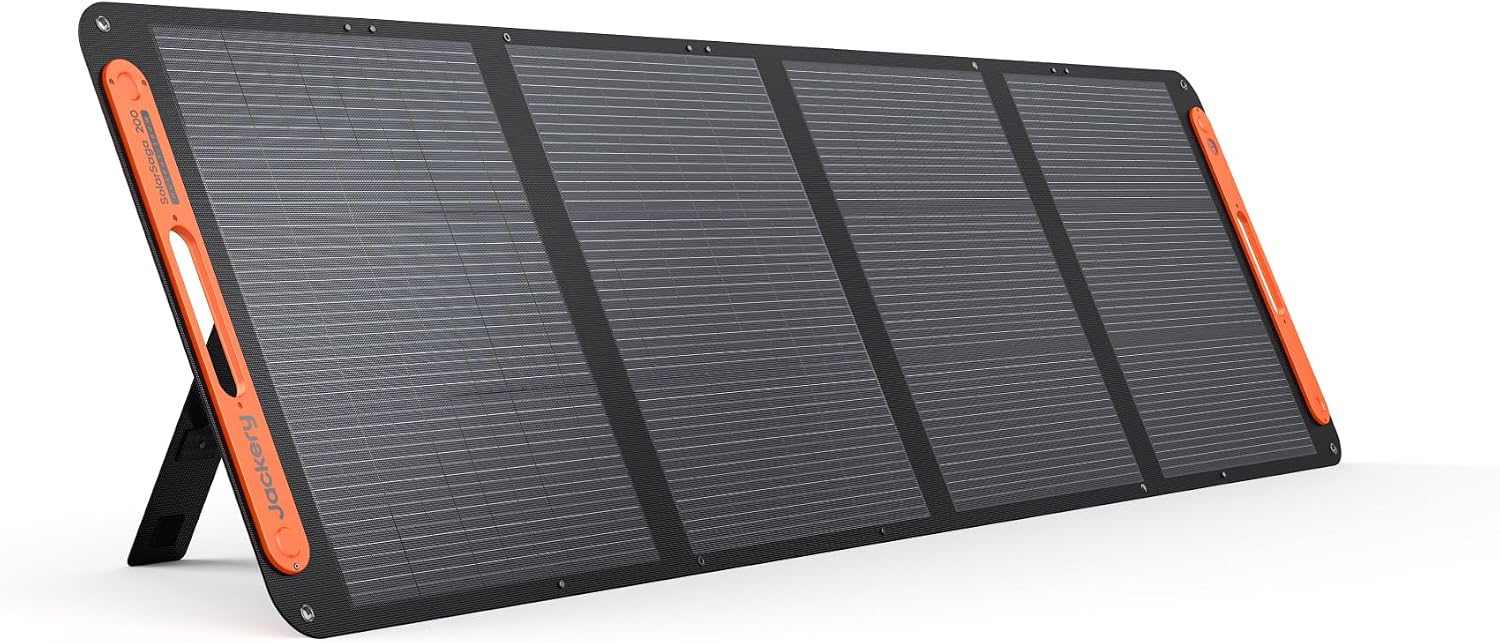
Jackery SolarSaga 200W
Bifacial too, and pairs natively with Jackery power stations
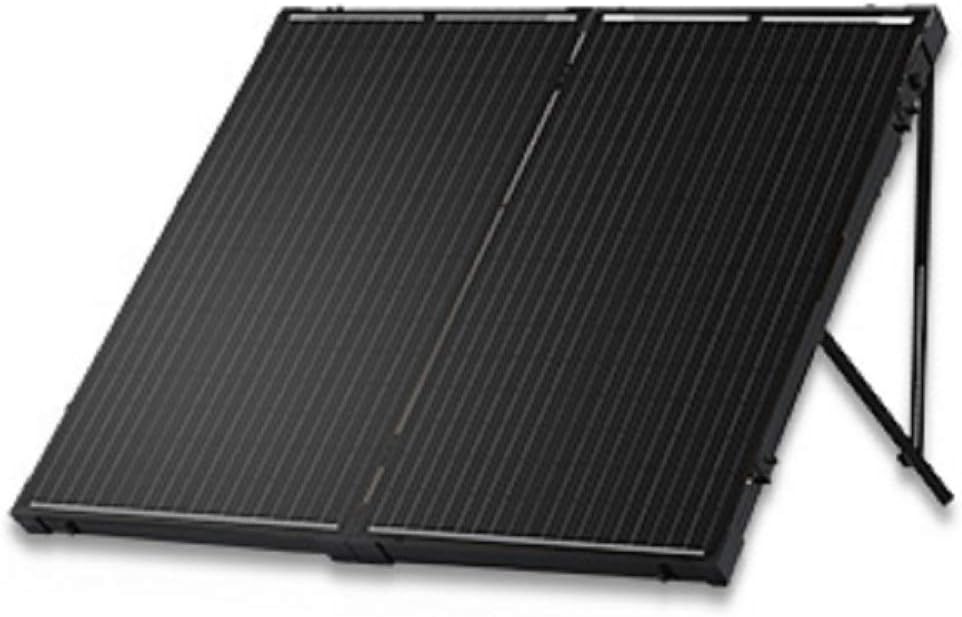
Renogy 200W Portable Solar Suitcase
Suitcase form with built-in charge controller — best for 12V battery setups
Prices and availability may vary — tap any product to check the current listing.
Shopping around? We have also tested the EcoFlow 160W NextGen and the Jackery SolarSaga 200W — both worth a look before you decide.
What to Look For in a Portable Solar Panel Kit: The Buying Criteria
Real wattage vs. nameplate wattage. The “220W” on the box is a lab number — panels rarely hit their full rating in the field. Heat, angle, haze, and cell quality all eat into output. What matters for a solar panel kit is the share of that rating you can realistically capture, so don’t shop by the biggest number; shop by how much of it survives the real world.
Bifacial vs. monofacial — the honest math. A bifacial panel’s bonus comes from its back side catching reflected light, and the manufacturer of this EcoFlow panel claims up to 25% conversion efficiency from its N-type monocrystalline cells. That “up to” does a lot of heavy lifting. On bright sand, snow, or light gravel, the rear side contributes meaningfully. On dark soil or forest duff? Almost nothing.
Weight and pack size. Portable panels live a double life: power source and luggage. This EcoFlow unit weighs roughly 15–16 lb and folds into its included carry bag — reasonable for the 220W class, but not something you’ll enjoy hauling to a walk-in site. Compare weight per watt, not weight alone — heavier is fine if it produces proportionally more.
Build quality and weatherproofing. Outdoor gear dies two ways: water and vibration. An IP68 waterproof and dustproof rating — which this panel carries — is genuinely reassuring for something that sits outside in rain and dust all day. Also check the hinges, corner stitching, and cable strain relief: panels fold and unfold dozens of times a season, and flimsy hinges are the number-one failure point on cheap units.
Stand design. A foldable panel with a bad kickstand is a kite with ambitions. The adjustable stand on this model lets you angle toward the sun instead of laying the panel flat — flat is the enemy of output. Wide, stiff stands hold in wind; flimsy wire props flip over in a gust. For a camping solar panel kit, this detail separates “works” from “works and stays put.”
Connectors and what’s in the box. The EcoFlow 220W uses an MC4 connector and ships with a solar-to-XT60i charging cable plus the carry bag — everything needed to hook straight into an EcoFlow power station. The catch for mixed-brand setups: other brands’ stations need their own adapter cables. Check connector types before buying, or your camping weekend dies before it starts.
How to Match the Panel to Your Situation
The weekend car camper. You drive in, pitch a tent or sleep in the SUV, and need to recharge a mid-size portable power station during the day — lights, phones, a fan, maybe a small cooler. Honestly? You don’t need bifacial. A 200W monofacial foldable costs less and covers your needs. The 220W EcoFlow is overkill here — nice overkill, but overkill.
The RVer or vanlifer. You’re off-grid for days or weeks, roof space is limited, and every watt counts because the station runs the fridge, lights, laptops, and a fan overnight. Here the 220W bifacial makes a real case: more watts from a single footprint, IP68 sealing against weather you can’t dodge, and reflective surfaces feeding the rear side. For a solar panel kit that has to earn its keep daily, the premium starts looking reasonable.
The home backup planner. You want a panel to stretch a portable power station through an outage — phones, a router, a CPAP, LED lanterns. Outage skies are often gray, and in diffuse light a bifacial’s rear-side capture is proportionally more relevant. But stay realistic — one 220W panel won’t run a refrigerator for long. It’s a supplement, not a generator replacement.
Portable Solar Panel Tiers Compared
| Type/Tier | Best For | Price Tier | Key Feature | Watch-Out |
|---|---|---|---|---|
| Budget 100–160W mono foldable | Phone/light charging, beginners | Budget-friendly | Light and compact | Too weak to recharge a power station in a day |
| Mid-range 200W mono foldable | Weekend camping, casual RV use | Mid-range | Good watts-per-dollar | Rear side collects nothing; angle it right or lose output |
| 220W bifacial (EcoFlow class) | RV/vanlife, serious off-grid | Upper mid-range | Rear-side bonus in bright environments | Pays off only if the rear side actually sees light |
| 300–400W rigid or heavy bifacial | Semi-permanent RV roof setups | Premium | Serious charging speed | Heavy, bulky, not truly portable |
A 100–160W foldable trickle-charges small devices fine, but pairing it with a 1kWh-class station is like filling a pool with a garden hose. The 200W mono foldable is the sweet spot for most campers: enough wattage to move the needle in a day of decent sun at a price that doesn’t sting. The 220W bifacial tier buys more headroom per footprint — but only pays off where reflected light exists. The 300–400W class belongs on RV roofs, not in your trunk.
Weekend Camping: Does One Panel Get You Through?
Picture it: you arrive Friday evening, deploy the panel Saturday morning, and run lights, phones, a fan, and maybe a 12V fridge off your station all weekend. One 220W panel in decent sun can meaningfully recharge a mid-size station during the day — enough that by Sunday you’re not rationing. The adjustable stand matters more here than the bifacial magic, because you’ll re-angle as the sun moves. For pure weekend camping, this panel is arguably more than you need. Fine problem to have.
RV Road Life: Watts Per Square Foot Rules
RVers can’t spread out four panels. Roof space, storage, and weight budgets are all finite. That’s exactly where a 220W bifacial earns its price: one panel, more watts per packed size, plus a rear-side bonus on concrete, sand, or light gravel. Plug it into your station via the included MC4-to-XT60i cable — no roof install needed. At roughly 15–16 lb it’s a manageable portable add-on, and it doubles as a ground-deployed booster if you already have roof panels.
Home Outage Backup: A Supplement, Not a Savior
Let’s be blunt: a single 220W panel won’t run your house through a blackout. It will keep the small essentials alive — phones, a hotspot, a CPAP, lanterns — if you’ve got a portable power station to store the energy. Outage skies are often gray, and bifacial panels pick up relatively more from diffuse light than monofacial ones. But manage the fantasy: this is a “keep essentials alive for a day or two” tool. Two panels and a bigger station change the equation; one panel is a lifeline, not a lifestyle.
Common Mistakes
Buying watts you can’t store. A 220W panel feeding a tiny 300Wh station is wasted potential — the station fills and the rest of the day’s sun goes nowhere. Size the battery first, then the panel. There’s a reason serious off-grid folks pick the station before the panels.
Forgetting the panel needs babysitting. Foldable panels don’t track the sun. Lay one flat at noon, walk away, and by 4 p.m. it’s producing a fraction of what it could. People who get great results re-angle two or three times a day. The adjustable stand makes that easy — but only if you actually do it. Set a phone reminder. Seriously.
Ignoring connector reality. MC4 is an industry standard, which is good news — but “standard” doesn’t mean every station accepts it without an adapter. The included solar-to-XT60i cable covers EcoFlow stations natively. Anything else: check your station’s input port and order the right adapter before the trip, not during it.
Expecting the bifacial back side to work everywhere. The big one. Bifacial pays off only where light reaches the back: bright ground, elevated mounting, reflective surroundings. Flat on dark asphalt or forest floor? The rear side contributes almost nothing, and you’ve paid a premium for a feature doing zero work. Know your terrain before paying for the technology.
Why/How/What
Why do portable panels cost so much more per watt than rooftop panels?
It’s the packaging, honestly. A rooftop panel is a flat slab bolted down once and left alone for decades — cheap materials at scale. A portable panel has to fold, survive trunks and tailgates, hinge open hundreds of times, carry an IP68 rating, and ship with stands, bags, and cables. You’re paying for mobility, durability, and convenience — not just watts.
How long does a 220W panel take to charge a power station?
Take the station’s watt-hour capacity, divide by realistic panel output (roughly 60–80% of the 220W rating in good sun, less when cloudy), and add a couple of hours for real-world losses. A roughly 1kWh station in solid sun might fill in a long day; a 2kWh unit needs two days or a second panel. People consistently underestimate this — “one full sunny day per kilowatt-hour” is a rough, honest rule of thumb.
What separates one portable panel from another in the same watt class?
Three things, in order of real-world impact: cell efficiency (how much sunlight becomes electricity), the stand and hinges (a panel that can’t stay angled underperforms all day), and honest weatherproofing (IP68 vs. vague “weather resistant” claims). Brand track record matters too — solar is a long game. Paper specs are the least reliable differentiator; build is what you’re buying.
Questions People Ask Before Buying
Real buyer questions, straight answers
Is the EcoFlow 220W worth it?
The EcoFlow 220W is worth it if you camp or travel in bright, open environments and pair it with a mid-to-large power station — the extra watts plus the bifacial rear-side bonus meaningfully shorten charging time versus a standard 200W mono foldable. In shaded forest sites, or if you’re only topping up phones and lanterns, a cheaper 200W panel delivers nearly the same practical result and the premium is hard to justify. Match the panel to your terrain and battery, not the spec sheet.
Can it charge a power station in a day?
In genuinely good sun, yes — a 220W panel puts a serious dent in a mid-size station over a full day and can fully recharge smaller ones; large 2kWh-class units typically need a second day or a second panel. Real output runs below the 220W nameplate — heat, angle, and haze take their cut — so treat roughly three-quarters of rated watts as your working number.
Bifacial vs regular — does the back side matter?
The back side matters when the ground or surroundings reflect light onto it — snow, white sand, light concrete, a pale van roof — and matters little to not at all on dark soil, asphalt, or forest floor. Think of bifacial as a bonus ranging from “noticeable” to “near zero” depending entirely on where you camp. It shouldn’t be the reason you buy if your sites are shaded.
What size panel do I need for camping?
For keeping a mid-size portable power station healthy through a weekend — lights, phones, a small fan, maybe a 12V fridge — 200 watts is the practical floor, and this 220W panel sits right in the sweet spot. Below 200W you’ll struggle to meaningfully recharge anything bigger than a small station in a day. Above 300W, panels get heavy and awkward for car camping.
EcoFlow 220W vs Jackery SolarSaga 200W — which one?
Pick the EcoFlow 220W for more headroom per footprint, tougher weatherproofing (IP68), and campsites bright enough for the bifacial rear side to contribute; pick the Jackery SolarSaga 200W if you’re already in the Jackery ecosystem or find it at a meaningfully lower price tier. This isn’t good-versus-bad — the Jackery is a proven 200W bifacial foldable in its own right. Same-brand pairing (panel to station) is the usual tiebreaker, since native cables just work.
Key Takeaways
The EcoFlow 220W bifacial is a strong upper-mid-tier portable solar panel kit for campers, RVers, and outage backup — extra watts plus a bifacial bonus in bright conditions.
Bifacial earns its premium only on reflective terrain (sand, snow, light concrete); on dark or shaded ground the rear side contributes almost nothing.
200W is the practical floor for recharging a mid-size power station in a camping day; below that, temper expectations.
IP68 sealing and a sturdy adjustable stand determine real-world output more than the wattage number alone.
Match the panel to your station’s capacity and connector first; the included MC4-to-XT60i cable covers EcoFlow stations natively.
Versus the Jackery SolarSaga 200W it offers more watts and tougher sealing; versus the Renogy 200W suitcase it’s lighter and more portable but lacks a built-in charge controller.
Decision Tree: Which 200W-Class Solar Panel Kit Fits You?
If you camp mostly in shaded forests and just need weekend top-ups → a 200W monofacial foldable; bifacial buys you nothing under trees.
If you RV, vanlife, or camp on beaches and deserts with a 1kWh+ station → the EcoFlow 220W bifacial; the rear side actually works here.
If you want a grab-and-go panel for a 12V battery setup without a separate controller → the Renogy 200W solar suitcase with built-in charge controller.
If you’re already invested in another brand’s station → buy that brand’s panel; native cables and matched inputs beat 20 extra watts.
Frequently Asked Questions
Is the EcoFlow 220W solar panel worth the money?
For RVers, vanlifers, and campers in bright open sites with a mid-to-large station, yes — the extra watts and bifacial bonus shorten charge times in a way you’ll feel. For shaded weekend camping or small-device charging, a cheaper 200W mono foldable does the job and the premium is hard to defend. Buy for your use case, not the spec sheet.
Is bifacial worth it on a portable solar panel?
Only if the back sees light. On snow, sand, white gravel, or light concrete, the rear side adds meaningful output. On dark soil, grass, or asphalt, almost nothing — and you’ve paid extra for a feature sitting idle. Elevate the panel slightly and park it over bright ground to get your money’s worth.
How fast can the 220W panel charge my power station?
Roughly a full day of good sun per kilowatt-hour of battery is a realistic rule of thumb. A mid-size station can fill in one long sunny day; a large 2kWh-class station typically needs two days or a second panel. Re-angle the panel a few times through the day — it matters more than people think.
Can the EcoFlow 220W handle rain?
Yes — it carries an IP68 waterproof and dustproof rating, among the strongest weatherproofing on a portable foldable. Rain, dust, and splashes are non-issues. IP68 doesn’t mean storm-proof against hail or flying debris, so fold it away when weather turns violent. Folded and bagged, it travels fine.
Will it work with non-EcoFlow power stations?
Generally yes, with the right cable. The panel uses an industry-standard MC4 connector and ships with a solar-to-XT60i cable for EcoFlow stations. Other brands need their own input adapters — check your station’s solar input port and connector type before ordering, and confirm its voltage input range accepts the panel’s output.
Should I buy the panel alone or a full solar panel kit?
A full kit (panel + station + cables matched by the manufacturer) is the painless route — everything plugs together and compatibility is guaranteed. Buying the panel alone makes sense if you already own a station and just need more charging capacity. Own nothing yet? Size the station to your needs first, then add panels. The panel is the easy part; the battery is the decision.
Not sure what fits your setup? Our Renogy 200W portable solar suitcase walks through the real-world math.
Final Recommendation
For most campers shopping a portable solar panel kit, the EcoFlow 220W bifacial is the buy-it-once option in the 200W class — provided your campsites are bright and your power station is mid-size or larger. The IP68 sealing, solid stand, and bifacial bonus make it a panel that holds up over seasons, not just spec sheets.
But don’t buy technology your terrain can’t use. Shaded forest camper with a small station? Pocket the savings with a 200W monofacial. Loyal to another brand’s ecosystem? Stay in it. The right solar panel kit matches your ground, your battery, and your habits — and on those terms, the EcoFlow 220W earns its place for open-sky travelers who need every watt they can carry.


