
The listing said “runs a refrigerator.” So I ran the numbers, because I’ve been burned by that sentence before. 1,024Wh on the label. Usable AC output, after the inverter takes its 15-20%: about 820Wh. A full-size fridge averages 75-100W once you account for compressor cycling — let’s say 90W to be unkind. 820 divided by 90 is nine hours. Nine hours of refrigerator. Not “runs a refrigerator” in the way the sentence wants you to hear it — indefinitely, confidently, through the storm. Nine hours, and then the ice cream phase of the outage begins. The sentence wasn’t a lie. It was a sentence with the second half missing.
The 1,024Wh class is the most competitive, most reviewed, most argued-about size in portable power, and the reason is simple: it’s the smallest size that feels like “real” backup. Below it, you’re charging gadgets. At 1,024Wh, you’re running a fridge overnight, working a full day from a home office, keeping a CPAP alive with room to spare. It’s the threshold size. And because it’s the threshold, every brand fights here, the prices are the sharpest, and the marketing is the most aggressive. The aggression is what you have to filter. The threshold itself is real.
A thousand watts of output — the “1000W” in the title — is the number that determines what plugs in. 1,000W continuous runs a fridge (150W running, 600W surge), a TV and a game console, a home office, power tools up to a circular saw (briefly, and you’ll feel the battery drop). It doesn’t run a microwave (1,500W+ draw), a space heater (1,500W of pure disappointment), or anything with a big heating element. The 1,000W line is honest about most real loads and dishonest about the ones people most want — heat and cooking. I keep a little card on my station listing what it can and can’t run, because during an outage, nobody does division. The card does the division in advance.
LiFePO4 is the chemistry, and at this point it’s the only chemistry worth buying in this class. The cycle life — 3,000+ cycles to 80% capacity — means the station outlives its useful relevance. You’ll replace it because something better exists, not because the battery died. The older NMC stations faded after a few hundred deep cycles, and I watched it happen to a friend’s unit: year three, the capacity meter lied, the runtime shrank, the complaints started. LiFePO4 doesn’t do that. It degrades so slowly you stop thinking about it. Which is the point of a battery: to be unthought about, until the lights go out, when it just works.
Solar input limits are the spec that determines whether “solar generator” is a description or a fantasy. A 1,024Wh station with a 200W solar input cap takes all day to refill from panels — 200W real-world is more like 150W, so seven-plus hours of good sun. With a 400W+ input, it’s a half-day job. With 800W, it’s a few hours. The input number matters more than the panel you own, because the station caps what the panel can deliver. Check the input before buying the panel. I own a 400W panel and a station with a 200W input, and half my panel is decorative. The mismatch is my fault. The manual listed the input clearly. I read the output section twice and the input section never.
Weight: a 1,024Wh LiFePO4 station is 25-30 pounds. Portable in the sense that one person can carry it. Not portable in the sense that you’ll want to. It lives where it lives — garage, closet, car trunk — and moves for outages and trips. The product photos show people carrying them one-handed with a smile. The smile is real for the first fifty feet. Then it’s a two-hand carry, and then it’s on a hand truck. I don’t mind the weight. Weight is cells, and cells are the product. But the photos lie, and the lie is so consistent across brands that it must test well. Nobody smiles carrying 28 pounds. They grimace efficiently.
Wait — 28 pounds with a smile for fifty feet is optimistic. It was more like twenty feet. Then the hand truck. I’m revising my own anecdote.

The three units that define this class are the ones everyone’s choosing between. EcoFlow’s DELTA 2 is the reference — 1,024Wh, 1,800W output (which is generous for the class, and genuinely useful), the fast wall charging that refills to 80% in under an hour. It’s the safe pick, the one with the field history, the one whose quirks are documented instead of discovered. BLUETTI’s AC180 brings 1,152Wh — the extra 128Wh is real, not rounding — with 1,800W output to match. Anker’s SOLIX C1000 Gen 2 is the newer challenger, compact, fast-charging, from the brand that made its name on batteries before batteries were cool. Between the three, the differences are interface, app quality, and price on the day you buy. The electrons are the same. Buy the deal, not the brand. Actually — buy the deal from a brand with a service address. The service address matters more than the discount.
The generic 1,024Wh units — the ones with alphabet-soup brand names and prices 30% below the big three — are the gamble in this class. And it’s a real gamble with real upside: the cells inside are often the same LiFePO4, the inverter often adequate, the savings substantial. The downside is everything around the cells: the BMS quality, the thermal design, the app (if it exists), the warranty (if it’s honored), the company’s existence in three years. I’ve watched value brands become beloved mainstays and watched them vanish with the warranty inbox. The difference is unknowable at purchase. That’s what makes it a gamble, not a mistake. Some gambles pay. Just know you’re gambling.
I haven’t bought a generic alphabet-soup unit myself — everything I own is from the big three, so the gamble assessment is from forums, not my garage.
The 1,024Wh shortlist
The three units that define the threshold class. Buy the deal from a brand with a service address.
EF ECOFLOW Delta 3 Portable Power Station, 1024Wh
1,024Wh LiFePO4 with 1,800W output and sub-hour fast charging; the class reference.

BLUETTI AC180 Portable Power Station, 1152Wh
1,152Wh LiFePO4, 1,800W output, 0-80% in 45 minutes; the stretch pick above 1kWh.
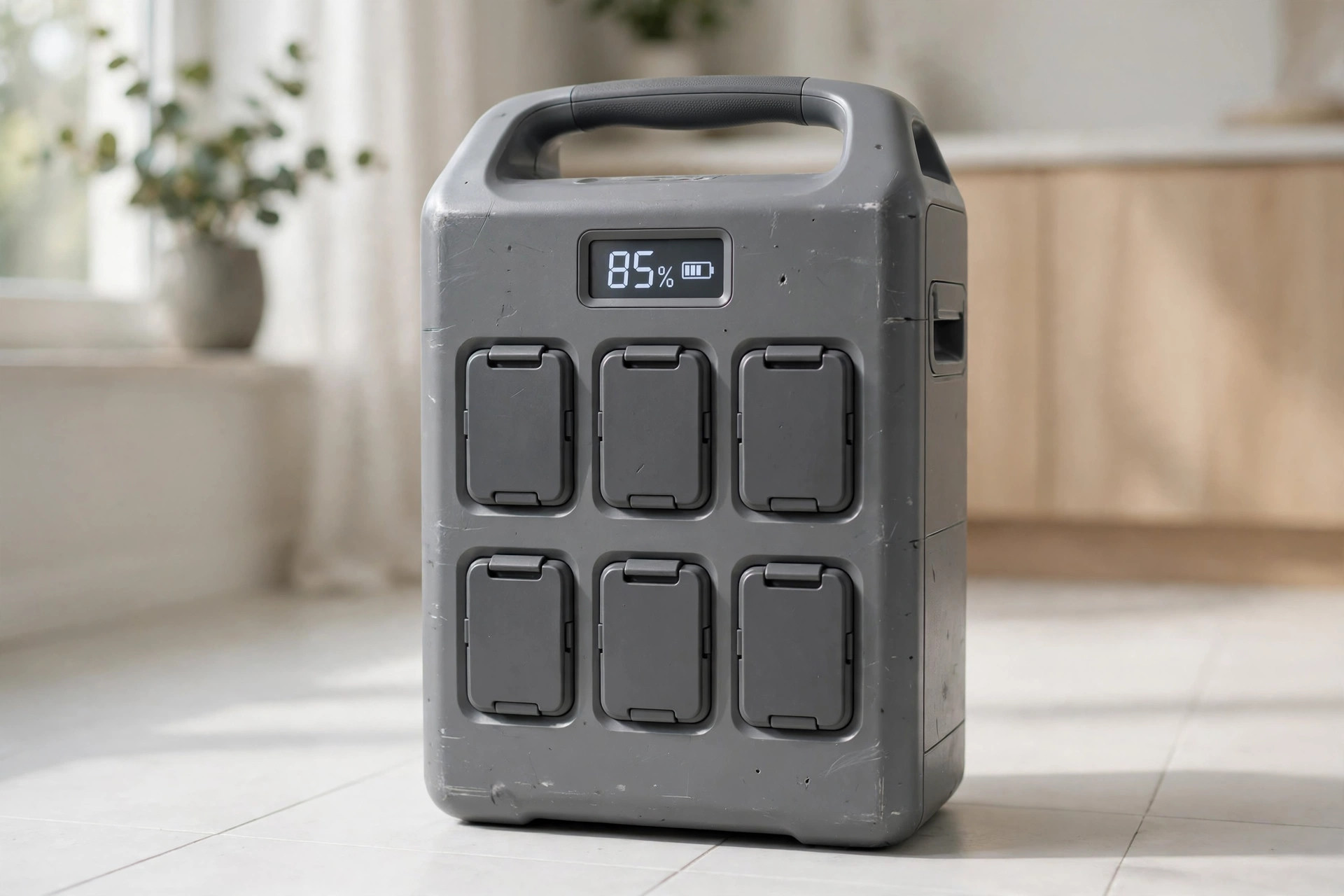
Anker SOLIX C1000 Gen 2 Portable Power Station, 1024Wh
1,024Wh LiFePO4, 2,000W output, full recharge in 49 minutes; the newer challenger.
The category complaint that never gets old: “1,024Wh” is printed bigger than “820Wh usable,” and the gap between them is never explained. Every buyer discovers inverter losses on their own, usually during the first outage, usually while doing math by flashlight. The industry could print both numbers — “1,024Wh cell capacity, ~820Wh usable AC output” — and it would cost nothing. It would even build trust. But the bigger number sells, so the bigger number is the headline, and the usable number is a secret you learn from experience. I learned it. Now you know it. Tell the next person.
My 1,024Wh station sits in the garage, charged, with the little card taped to it: what it runs, what it doesn’t, how long. The card is the most valuable accessory I own. The station is second. During the last outage — eight hours, a fallen tree, the usual — the fridge stayed cold, the office stayed up, the phones stayed alive, and at hour seven the station was at 20%, right where the card said it would be. The card was right. The card is always right. Do the math before the storm, write it on a card, and the outage becomes an errand instead of an emergency. Nine hours of refrigerator. That’s the product. That’s enough.

