Short answer: a smart plug is a relay and, on the models worth buying, a watt meter that sits between the wall outlet and one device, switching it on a schedule and reporting exactly what that device draws — including while it pretends to be off. The remote control from the couch is the toy part. The meter is the tool. Used right, one plug pays for itself by finding the loads in your house that bill you 24 hours a day for doing nothing.
The U.S. Department of Energy puts standby power at 5 to 10 percent of residential electricity use, roughly $100 a year for an average household. That is not one greedy appliance. It is forty small ones — a watt here, three watts there — stacked across every room, every hour, all year. You cannot fix a load you have never measured That same week of readings is also the sizing sheet for plug in solar panels, sized to the baseload you just measured instead of to the roof., and your utility bill will never itemize it for you. A prepaid meter pushes the same idea to its limit — you watch a money balance instead of a monthly total — and what a prepaid meter is, and what it really costs per kWh, is worth knowing before you envy that visibility.
What is a smart plug actually measuring?
An energy-monitoring smart plug measures real-time watts, cumulative kilowatt-hours and, in the app, an estimated running cost for whatever is plugged through it. Plain smart plugs only switch. Monitoring models — the Kasa KP125M, the Tapo P115 and the Emporia plug below — add a metering chip, and that chip is the entire reason to buy one. A plug that switches without metering is a timer with Wi-Fi.
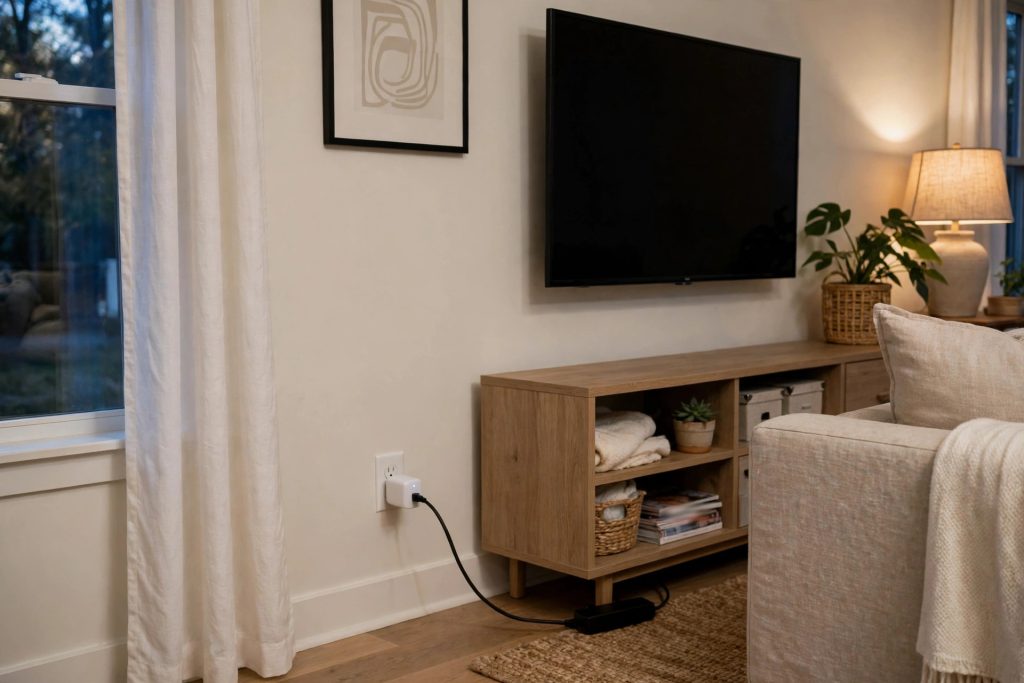
Feed it the entertainment strip first. Retailer and lab write-ups of standby loads keep landing in the same range: cable boxes, game consoles and streaming hardware pulling 15 to 40 watts combined while nobody is watching anything. Run the numbers on 30 idle watts cut for 16 hours a day and you get about 175 kWh a year — near $30 at average U.S. residential rates. One strip. One plug. That is the honest scale of the win, and it repeats at the desk, the spare TV and the charger drawer.
The app connected on the third try. When it finally paired, the reported draw differed from the wall display on my watt meter by about 4 percent. Which one is right? For hunting standby loads, it barely matters — you are ranking loads against each other, not certifying a lab instrument — but write the offset down before you start quoting your own figures.
Do smart plugs save money, or just move the load?
A smart plug saves money only when the standby draw it kills is bigger than the roughly 1 watt the plug itself eats to stay connected. Emporia lists its own plug at about 1W of energy use, and that figure is typical for the category. Put one on a phone charger that idles at 0.3W and you have built a tiny net loss with an app. Put one on a 25W entertainment strip and schedule it off from midnight to 6 p.m., and the plug’s own watt is a rounding error.
Do the arithmetic before the purchase, not after. Standby watts × idle hours per day × 365 ÷ 1000 = kilowatt-hours per year. Multiply by your rate. If the answer is under about $5 a year, that outlet does not need a plug — it needs you to ignore it. If it is $20 or more, the plug pays back inside a year and keeps paying. This is also the measurement habit that makes every later purchase smarter: once you know your real device watts, guides like how many watts a house draws, peak and average stop being abstract, and sizing exercises like what size portable power station you need get built on your numbers instead of a marketing table.
There is a second job these plugs do well. Leave one on a single suspect appliance for a week — the old fridge in the garage, the window air conditioner, the gaming PC — and the cumulative kWh tells you what that device really costs per month. Owners consistently rate the monitoring itself as the feature they keep using after the novelty of voice switching fades; in retailer feedback for the Tapo line, energy monitoring is the most praised function, while the recurring complaints are about lifespan, not accuracy.
The rating on the box that can hurt you
Read the continuous amp rating, not the headline peak — a plug marketed at 15A may only be cleared for 10A continuous. Emporia states it plainly in its own spec sheet: 15A max peak load for up to one hour per day, 10A max continuous, 1800W at 120V on paper. A 1500W space heater draws about 12.5A. That is over the continuous line, all evening, every evening. The Kasa KP125M and Tapo P115 carry a full 15A / 1800W rating, which is exactly why the heater question separates the three picks below.
Retailer review roundups for the Emporia plug tell the same story from the other side: the angry one-star reviews cluster around units failing inside the first year and around that 15A-versus-10A gap, with owners running sustained computer or air-conditioner loads the plug was never cleared to hold. The metering gets praised. The headline rating gets people in trouble. Match the plug to the load class — electronics and strips for the 10A-continuous plug, anything with a heating element only on a true 15A unit, and nothing with a big motor surge on any of them.
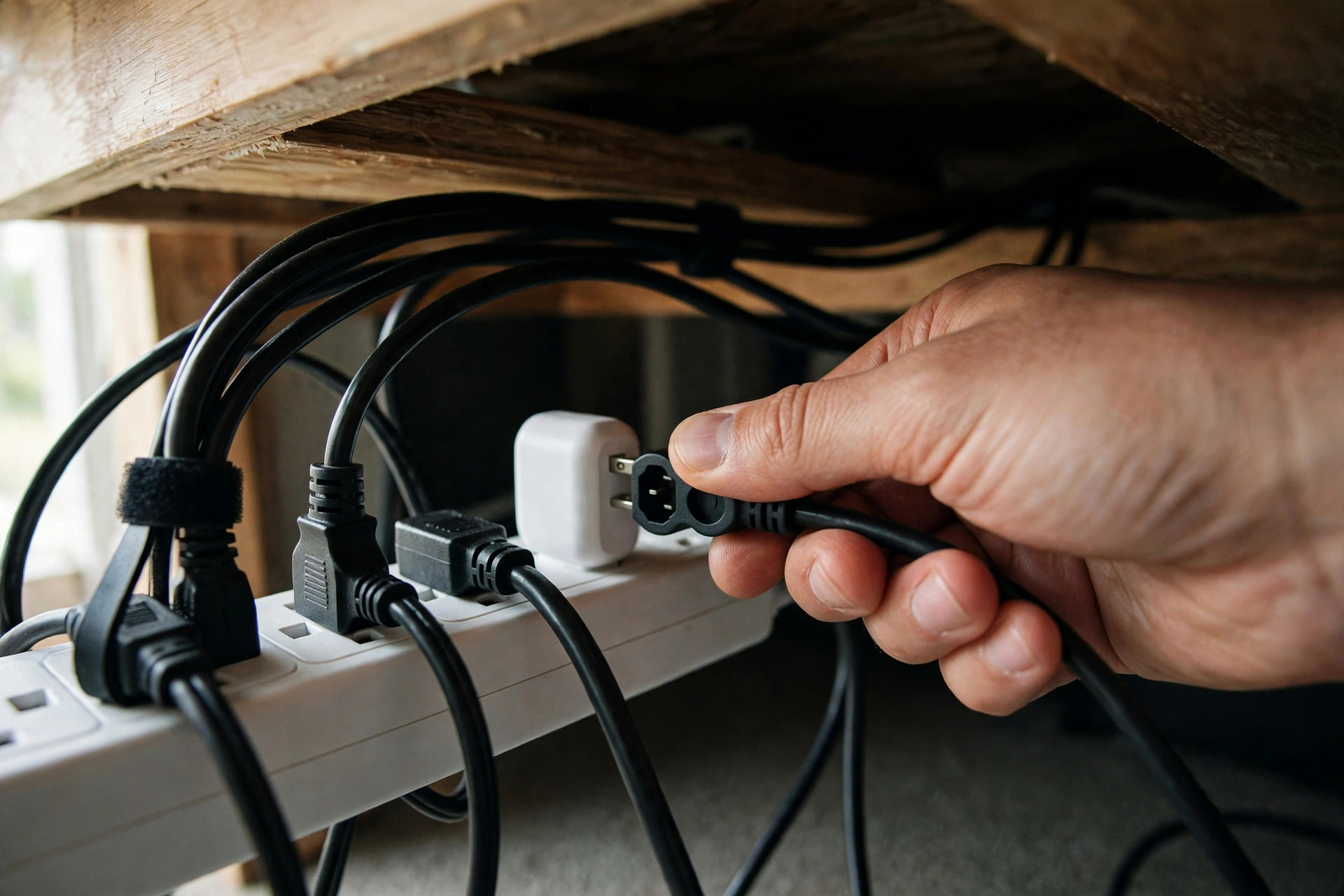
One more layout tax nobody photographs. The outlets on most strips and many duplex walls sit so close together that two bulky plugs cannot sit side by side, and a wide smart plug can block the second socket entirely. Mini-format models like the P115 exist for this reason. Measure the outlet before you order a four-pack, not after.

Where a smart plug is the wrong tool
Anything that must ride through an outage, protect data, or never lose power does not belong behind a $12 relay. A smart plug has no battery. When the grid drops, it drops. Gear that needs a bridge — a PC mid-save, a router you rely on during short outages — belongs on a battery backup, and how long a UPS actually runs once you know the real watts is the math that pairs with the measurements you just took. Fridges are a bad fit too: hard-switching a compressor on a schedule fights the thermostat, and the standby saving is near zero because a fridge is never really idle.
Three energy-monitoring plugs, matched to the job
Kasa KP125M (2-Pack)
15A / 1800W, energy monitoring with real-time and historical readings in its app, Matter support, compact body. The full-rating pick — the one cleared for heavier continuous loads.
Tapo P115 (4-Pack)
15A / 1800W, energy monitoring with bill estimation, mini format that leaves the second outlet usable, ETL certified. The multi-room standby hunt pick.
Emporia Smart Plug (4-Pack)
Energy monitoring down to 1-second data in the same app as the maker’s whole-home monitors, about 1W self-draw — but 10A continuous, 15A peak for one hour a day. Electronics only, never heaters.
Start with one plug, not a houseful. Park it on the entertainment strip for a week, read the idle number at 2 a.m., and let that single measurement decide whether the rest of the house deserves the same treatment. Most homes have two or three outlets doing nearly all of the standby damage.
FAQ
What is a smart plug used for?
A smart plug switches a plugged-in device on and off remotely or on a schedule, and energy-monitoring models also measure that device’s watt draw and total kilowatt-hours. The highest-value use is finding and cutting standby loads — entertainment gear, desk setups and chargers that draw power around the clock while idle.
Do smart plugs use a lot of electricity themselves?
No, but they are not free: a typical Wi-Fi smart plug draws about 1 watt to stay connected, roughly 8.8 kWh per year. That is why a plug only saves money on loads whose standby draw clearly exceeds about 1 watt — on a near-zero-draw charger, the plug can cost more than it saves.
How much can a smart plug actually save per year?
Cutting 30 watts of standby for 16 idle hours a day saves about 175 kWh a year, near $30 at average U.S. residential rates. The Department of Energy estimates standby power at 5 to 10 percent of household electricity use, so a few well-placed plugs on the worst strips capture most of what is realistically recoverable.
Can I plug a space heater or air conditioner into a smart plug?
Only into a plug rated for the full continuous load. A 1500W heater draws about 12.5A, which exceeds the 10A continuous rating of plugs like the Emporia model even though its headline says 15A peak. Use a true 15A / 1800W rated plug, check the continuous rating in the spec sheet, and never put motor-driven appliances on a scheduling plug.
Will a smart plug work during a power outage?
No. A smart plug has no battery and goes dark with the outlet. Devices that must stay up through short outages — a router, a PC, medical gear — need a UPS or a portable power station; a smart plug’s job is saving energy while the grid is up, not replacing it when it fails.