
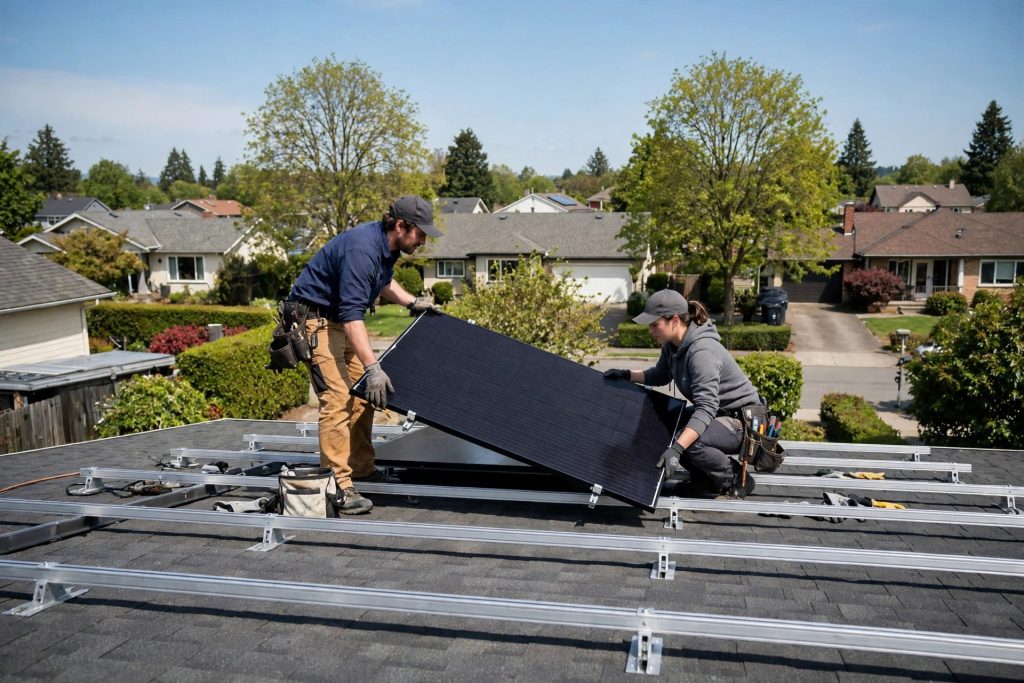
Expect to pay about $2.59 per watt on competitive marketplace quotes in 2026, which puts an 11 kW system at roughly $28,490 before incentives — and there is no federal tax credit left to subtract for a homeowner who buys in 2026. That figure comes from shopped, apples-to-apples quotes, not from the sticker on a door-knocker’s flyer. The catch: a second, broader dataset puts the median far higher, so the word “average” is hiding a spread wide enough to buy a car with.
How much does it cost to install solar panels in 2026?
Both averages are real. They measure different markets. EnergySage marketplace data updated June 2026 puts competitive, shopped quotes at $2.59/W — that’s total installed price divided by system size in watts — with an 11 kW system at $28,490, a 12 kW average of $31,135 and a range of $27,526 to $33,869. Their September 2026 summary reads $2.60/W: 5 kW at $13,900, 8 kW at $20,960, 10 kW at $25,800, batteries excluded. At the far low end of the same market sit plug in solar panels, the $400 to $2,000 no-install option now legal in 10 states, capped near 1,200W and sold with no installer at all. Berkeley Lab’s 2026 data update, covering systems actually installed in 2025, puts the US median at $3.60 per DC watt, with the 20th percentile near $2.70 and the 80th near $4.90. Run the same 11 kW roof through both: $28,490 at one number, $39,600 at the other. SolarReviews’ October 2026 figure of $3.03/W sits between them.
Where you shop moves the price more than which panel you pick. An older NREL study of online quote platforms found shoppers saved $0.20–$0.40/W, roughly $1,600–$3,200 on an 8 kW system. I’ve watched solar input swing from 40W to 180W every time a cloud passed on a partly cloudy day — production is weather, price per watt is the one number you control before signing.
Size comes before price, though. The kilowatts on the cover page start with the panel-count math that sets your system size in the first place, and every watt of oversizing carries the same soft-cost load as a watt you actually need.
Where does the money go if the panels are the cheap part?
On the national lab’s own ledger, the panels are about an eighth of the bill. NREL’s Q1 2024 benchmark, published January 2025, modelled $3.25/W — $26,000 for 8 kW. Modules: $0.40/W, about 12%. Inverter: $0.37/W. Balance of system, meaning racking and wiring: $0.62/W. Installation labor: $0.21/W. Soft costs: $1.64/W, or 50.5% of the total. Soft costs means customer acquisition, permitting, inspection, interconnection, overhead and profit — the paperwork and sales machine, not hardware.
Here’s the skill I actually use: the quote autopsy. Take any quote, strip out the battery and financing lines, divide the remaining total by the DC watts on the cover page. That single division is the only honest way to compare two installers. Then check the production estimate against the free PVWatts calculator from the national lab. If an installer’s promised kWh per year beats PVWatts for your roof by a wide margin, the payback math built on it is fiction.
Haggling over panel brand saves pennies per watt. The fight is over the soft half.

Why does the financed quote cost $9,000 more than the cash quote?
Because the loan itself is a product the installer sells, and its fee is rolled into your principal. The Consumer Financial Protection Bureau’s August 2024 report on residential solar lending found dealer fees — charges the lender takes for offering a low advertised rate, recovered by raising the price you finance — typically run 10 to 30 percent of the cash price and can exceed 50 percent, often built into the principal without showing in the stated APR. The Bureau’s own worked example: a $30,000 cash-price system carrying a $9,000 hidden fee becomes a $39,000 loan, and you pay interest on the fee for the full term. I’ve watched an MC4 connector that felt loose work itself halfway out over an hour in the wind — small hardware, real consequences. A loan fee is the financial version of that connector, invisible until it lets go. The fix is a skill, not a secret: ask for the cash price in writing, then compare it with the amount financed on the federal disclosure page. The gap is the fee, in dollars, no interpretation needed. A low monthly payment is the easiest number to stretch — longer term, fee folded in — which is why cost per DC watt on the cash price is the comparison that survives.

Three checks to run before you sign anything
One row, three cheap ways to make a quote prove itself. The monitor and the plug rebuild your real load profile, the kit prices the hardware floor. All three links are affiliate links.
Emporia Gen 3 Smart Home Energy Monitor
Measure the house before you size the array. Two 200A clamps on the mains plus 16 branch sensors at 50A give you whole-house and per-circuit kWh — the usage record that decides whether a quote is sized to your life or to a sales target.
Kasa KP125M Energy Monitoring Smart Plug
One outlet, exact watts and kWh, full 15A / 1800W rating. Run it on the fridge, the entertainment strip and the home-office corner for a week each. The loads that never sleep are the ones quietly setting your system size.
Renogy 400W Premium Solar Panel Kit
The hardware anchor. Start from the Renogy 400W Premium kit we reviewed — four 100W panels, a Rover 40A MPPT controller, Bluetooth module, brackets and cables in one box — then hold its per-watt hardware price next to any rooftop quote. The gap between the two numbers is the installed-cost machine this article just priced.
Can you still subtract 30% from a 2026 quote?
No — not if you buy and own the system. The IRS states the Residential Clean Energy Credit (Section 25D) is not available for property placed in service after December 31, 2025; paying a deposit or signing in 2025 does not rescue a system installed in 2026 — the completion date controls. On an 11 kW marketplace-average system, a quote that still subtracts 30% is inventing about $8,500 of discount ($28,490 x 0.30 = $8,547). Leases and power purchase agreements are the exception that proves the rule: the company that owns the system may claim a separate commercial credit and pass some value through pricing, but the homeowner claims nothing and owns nothing. What is left for buyers: state and local incentives, which vary too much to print as a national number — check the DSIRE database for your state before signing. A higher quote can still be the right one — steep or shaded roof work, a main-panel upgrade, premium modules with a longer warranty are real costs — but each must appear as its own line, priced, not dissolved into a higher per-watt fog; and if your electricity is cheap and your utility pays little for exported power, no discount on install cost fixes the payback, it only shrinks the loss.
Two quotes still sit side by side on my bench. The cheaper one is missing the fee line. The expensive one prices every line, down to the flashing. Still not decided — because the missing line is the one that matters.
Last updated: November 16, 2026. Prices are the marketplace and lab figures cited in the text, checked the same week.
FAQ
How much does it cost to install solar panels on a 2,000 square foot house?
House size is the wrong unit — cost follows the system size your electricity use demands. A household using about 10,000 kWh a year often lands near 8-9 kW in average sun; at the 2026 marketplace average of $2.60/W that is roughly $20,800-$23,400 before incentives, and at the Berkeley Lab median of $3.60/W it is $28,800-$32,400. Two identical houses can need different systems.
I signed in 2025 but the panels went on in 2026. Do I still get the credit?
No — the IRS ties the credit to when the property is placed in service, not when you signed or paid. Property placed in service after December 31, 2025 does not qualify for the homeowner credit. Unused credit from a qualifying 2025 system can be carried forward. This is general information, not tax advice.
Is a battery included in the cost per watt?
No — the benchmark prices quoted in this article exclude storage. A home battery is a separate five-figure line on most quotes. Folding it into the per-watt figure makes two quotes impossible to compare, so price the array and the battery as separate decisions.
This site contains affiliate links. We may earn a commission on qualifying purchases.