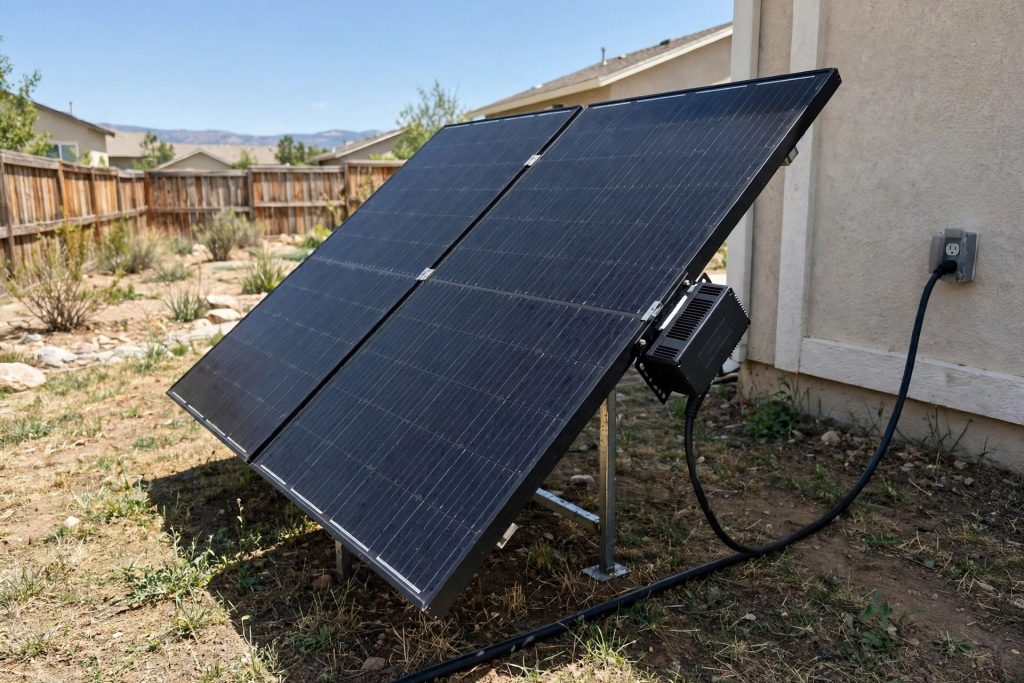
Plug in solar panels are legal in exactly 10 states as of October 2026, and Utah got there first with a 1,200W per-device cap. That is the whole answer. The rest is paperwork, and the paperwork has a hole in it big enough to drive a permit office through.
Six of those ten laws are live right now. Four are not. California and Virginia flip on January 1, 2027. New Jersey follows on March 1, 2027. New Hampshire lands somewhere in 2027, date pending. A law on the books and a law you can use are different things.
Are plug in solar panels legal in your state?
Ten states have passed plug-in solar laws, per Solar United Neighbors and the Bright Saver Plug-In Solar Consumer Guide released November 13, 2026: Utah, Maine, Vermont, Maryland, Connecticut, Colorado, California, New Hampshire, Virginia, New Jersey. That is the full list. No others.
Utah HB 340 was the first mover. Signed March 25, 2025. Effective May 7, 2025. Up to 1,200W per device, no utility approval, no fees. The device must carry certification from a nationally recognized testing lab and meet the National Electrical Code. Utah systems get no net metering, so surplus electrons go to the grid for free. Read that clause twice before you buy.
Check the connectors before you trust any kit. Plugging in the solar input, the MC4 connector felt loose. In wind, I watched it work itself halfway out over an hour. That is not a legal problem. That is a hardware problem, and the law does not screen for it.
Renters get a narrower version of the same deal, which is why how balcony solar works for renters who have no roof matters before any purchase: a railing mount and a landlord’s permission come before the outlet question.
The other nine states copied the shape of Utah’s law with local edits. Wattage caps vary. Utility notification rules vary. Effective dates vary. Check your state’s effective date before you check your panel angle.
The certification gap nobody puts on the box
No all-in-one plug in solar kit holds full system-level certification yet, per SUN and Bright Saver reporting from November 2026. Not one. The laws require it. The market does not have it.
Here is the mechanical difference. A UL 1741 sticker on the microinverter (turns panel DC into house AC) certifies that one component. Whole-system certification covers the panel, the inverter, the cord, the plug, and the anti-islanding logic (shuts output off when grid dies) as a single tested assembly. One sticker is a part. The other is the product. Buyers see the first and assume the second.
UL 3700 is UL’s plug-in PV standard. Outline published December 2025. Certification program running since January 2026. That timeline is fast for a safety standard and slow for a market that already sold you the box.
Honestly, the inverter sticker is doing marketing work it was never meant to do. A UL 1741 mark on a microinverter tells you the inverter passed grid-interconnection tests. It tells you nothing about whether that inverter, bolted to that panel, with that cord length, survives a fault. System-level testing exists because components interact. Skip it and you are the test lab.
Baseload (power a home draws around the clock) is what these kits actually offset. A 1,200W array covers a slice of it at noon and none of it at midnight.
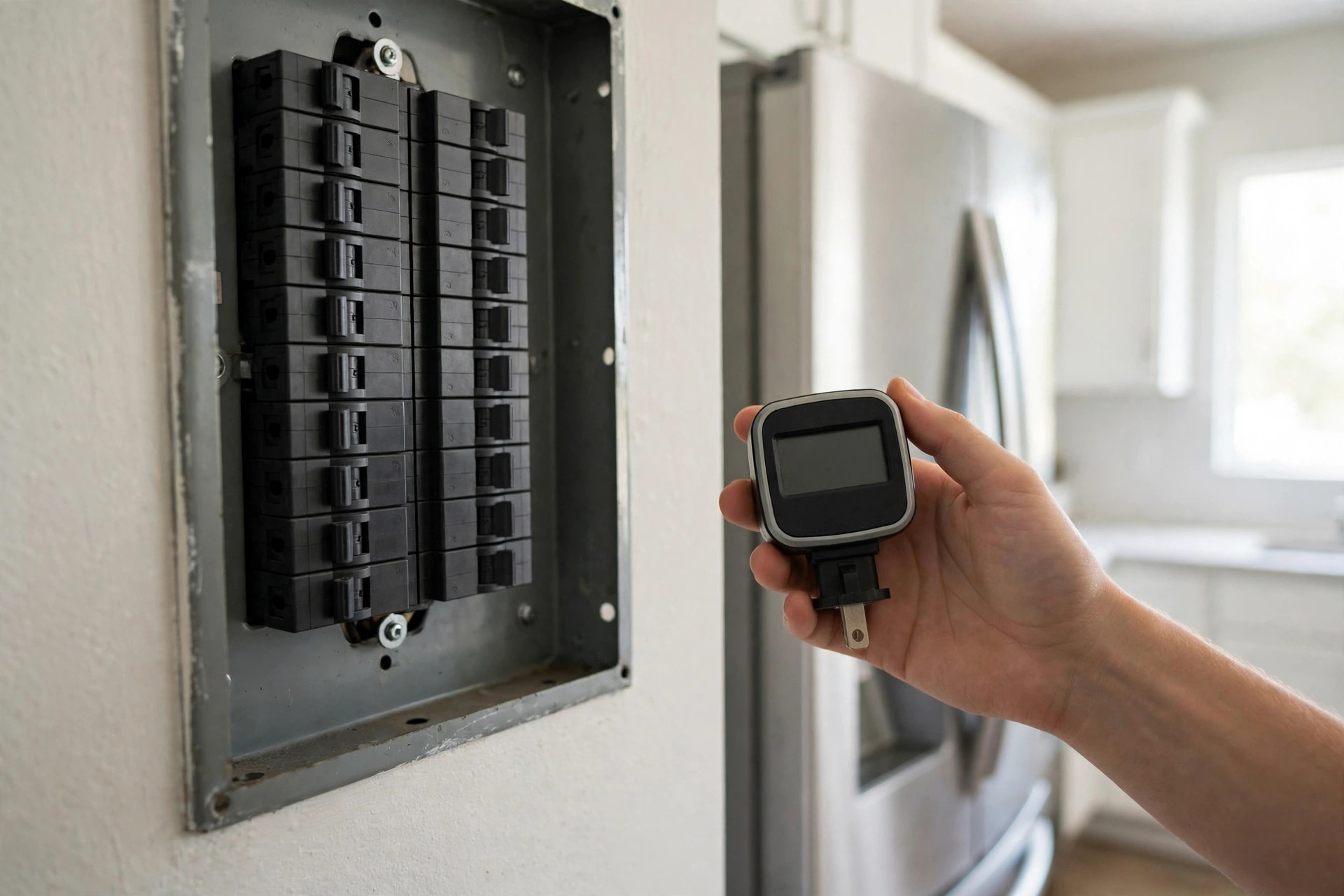
Why the breaker math is the real gate
A 15-amp branch circuit at 120V is rated 1,800W, and that number decides whether your plug-in kit is safe before any panel ever sees sunlight. Breakers trip on current through the breaker. Solar feeding in at the far end of a circuit adds current the breaker cannot see, so circuit wiring can carry solar watts plus grid watts at once. That is why electricians and kit teardowns keep landing on the same rule: use a dedicated circuit with nothing else on it.
Run the numbers yourself. A 1,800W circuit with a 1,440W load already on it has 360W of headroom. Plug an 800W inverter into that same run and the wire between the inverter and the panel board is now carrying load current plus backfeed current. The breaker sees the load. It does not see the solar contribution stacked on the far end. Wire overheats before the breaker ever thinks about tripping.
There is a second failure mode most buyers never hear about. UL Solutions has warned in a whitepaper that backfeeding can damage GFCI protection, leaving a wet-location circuit live but unprotected. Read that again. The outlet still works. The test button still clicks. The protection is gone. Kit vendors do not put that sentence on the box.
Here’s the thing: a dedicated circuit is not a suggestion. It is the gate. No spare breaker, no spare conduit run, no plug-in kit. Hire the electrician first, then buy hardware.
Measure your baseload before you size anything
Measure baseload for one week before buying, because a kit sized to your roof instead of your always-on load is money you will never recover. The meter costs less than a takeout dinner. The data changes what you buy.
Step one: buy a plug-level energy meter. Step two: put it on the fridge for a full week and log the kWh. Step three: move it to the router and the standby strip, one week each. Step four: add the always-on watts together. That total is your baseload. Step five: size the kit to that baseload, not to the roof. Any noon surplus above baseload leaves the house and, in Utah, earns nothing.
Panel hardware is the easy part to price. Renogy’s 400W Premium panel kit shows what 400W of panels plus a charge controller costs as off-grid hardware, which is a useful anchor before you pay a plug-in premium for the microinverter and the cord.
Expect the pattern, not a surprise. The fridge cycles. The router never sleeps. The standby strip pulls a constant trickle most owners have ignored for years. The always-on total is usually smaller than guessed and steadier than expected, and that total is the number a plug-in kit should chase.
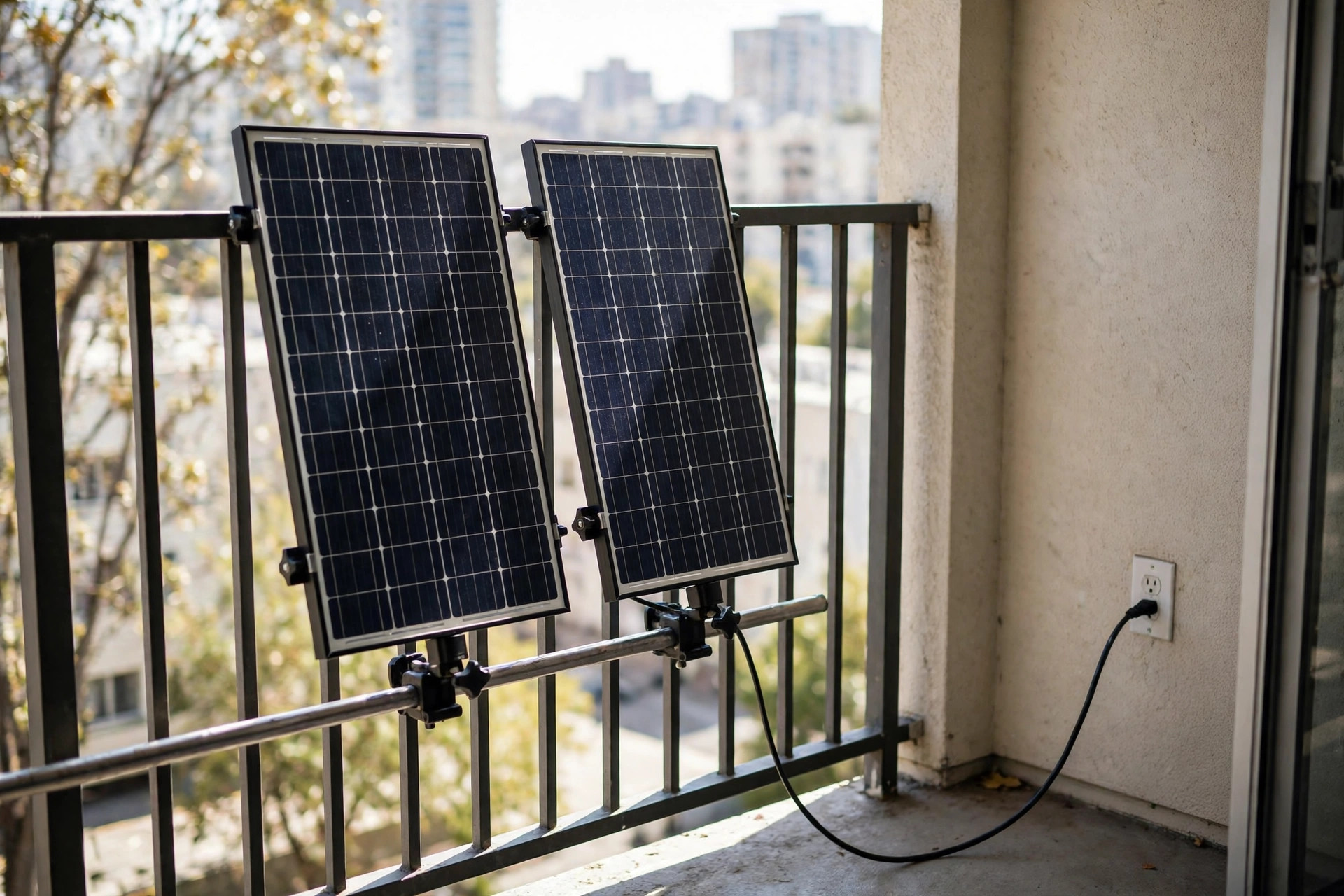
800W kit save how much? Run the yield math
An 800W kit saves about $106 a year in Salt Lake City and about $295 a year in Los Angeles, and the gap comes from your electric rate, not your sunshine. PlugSolar calculator figures, Global Solar Atlas yield minus 10 percent, 70 percent self-use assumed, EIA average residential rates January through August 2026, US average 18.19 cents per kWh.
Salt Lake City, tilted south: about 1,150 kWh a year, about $106 saved. Same kit upright on a railing: about 810 kWh, about $75 saved. Los Angeles, same kit: about 1,290 kWh, about $295 saved at 32.58 cents per kWh. Los Angeles makes only about 12 percent more power than Salt Lake City and saves almost three times the money. Your rate beats your sunshine.
Charging from solar on a partly cloudy day, I watched the input wattage swing from 40W to 180W every time a cloud passed. Output is not a flat line. Budget like it is not.
Hardware snapshot, October 2026: the EcoFlow STREAM microinverter runs $369 alone, $799 bundled with 400W of panels, 1,200W AC output. The maker states UL 1741 for the inverter, not whole-system UL 3700 certification. EcoFlow named Utah, Maryland, Connecticut and Colorado for plug-in installs on November 3, 2026.
If your state has no law in effect, or your only outlet is a shared kitchen circuit, do not buy a plug-in kit yet — a portable power station charged from a panel never backfeeds house wiring and is legal everywhere. If you have a dedicated circuit and a law on the books, buy the meter first, then the kit.
Renogy 400W Premium Solar Panel Kit – 4 x 100W panels plus Rover 40A MPPT controller. The hardware anchor: price panels before you pay a plug-in premium.
Kasa KP125M Energy Monitoring Smart Plug – 15A plug-level meter for watts and kWh. Run the baseload drill in this article with it.
EcoFlow RIVER 2 Pro – 768Wh portable power station. The no-law-needed route: charge it from a panel, never backfeed house wiring.
FAQ
Are plug in solar panels legal in all 50 states?
No. As of October 2026, 10 states have passed plug-in solar laws and six are in effect, per the Solar United Neighbors and Bright Saver guide. In a state with no law in effect, a grid-feeding kit plugged into an outlet has no simplified legal pathway, so check your state law and your utility rules before you buy.
How much can an 800W plug-in kit actually save?
About $106 a year in Salt Lake City and about $295 a year in Los Angeles for a tilted 800W kit, per PlugSolar calculator figures using EIA rates from January to August 2026. The Los Angeles kit makes only about 12 percent more power. The higher rate does the rest.
Do plug in solar panels work during a power outage?
No. A grid-tied plug-in kit must shut its output off when the grid dies, a protection called anti-islanding, so line workers are not exposed to live wires. If outage power is the goal, you need a battery system or a portable power station, not a plain plug-in kit.
Last updated: November 18, 2026. Prices and state effective dates were checked in November 2026 and change without notice.
This site contains affiliate links. We may earn a commission on qualifying purchases.