
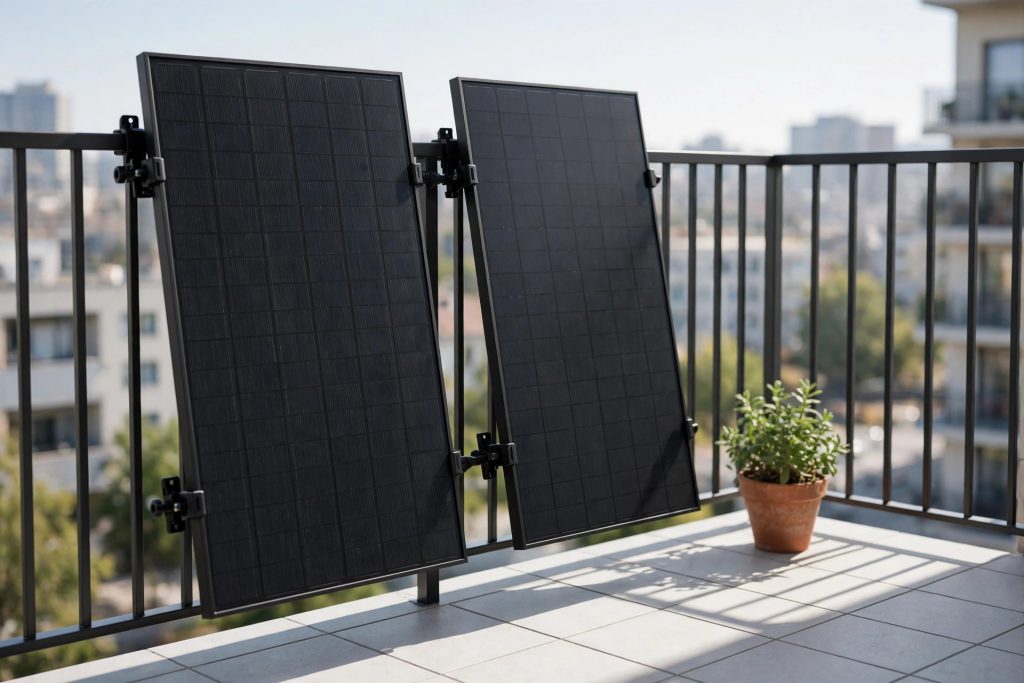
Short answer: Yes — renters can go solar without a roof. A plug-in balcony solar kit (400–800W) hangs on your railing, feeds power through a standard outlet via a microinverter, and typically offsets 10–25% of an apartment’s electricity use. Kits cost $300–$2,200, and as of October 2026, ten U.S. states — including California — have laws protecting plug-in solar. It supplements your bill rather than replacing the grid, and it’s not worth it on a north-facing balcony.
Solar used to be a homeowner’s game: a roof, a contractor, a five-figure budget. Then plug-in “balcony solar” — one or two panels clamped to a railing, feeding power through a regular wall outlet — quietly powered over a million German balconies. In 2026, the U.S. started catching up fast: California signed SB 868 in October 2026 (effective 2027) letting residents install plug-in solar up to 1,200 watts without utility approval, becoming the tenth state to legalize the category, and Britain legalized plug-in solar kits in August 2026. This guide covers how balcony solar works, what it realistically produces, what it costs, and the mistakes real buyers report.
How Balcony Solar Actually Works
Answer first: Panels on your railing make DC power; a small microinverter converts it to AC and feeds it into a wall outlet, where it instantly powers whatever your apartment is running.
Renters have three solar paths, and only one is true “balcony solar”:
- Plug-in balcony kit: 1–4 rigid panels on the railing or a stand, wired to a microinverter that plugs into a standard outlet. Power is consumed instantly by your fridge, router, laptop, and lights. No battery, no electrician. Certified kits include anti-islanding protection that shuts down export during grid outages.
- Portable power station + panels: Panels charge a battery box instead of feeding the outlet — nothing touches your home wiring, so there are no utility questions. You only benefit when you plug devices into the box. See our guide on what size portable power station you need for this route.
- Community solar: No hardware — you subscribe to a share of an off-site solar farm and get bill credits. Best for shaded or north-facing units.
For most renters with a sunny railing, the plug-in kit wins: set it up in an afternoon and take it with you when you move.
How Much Power Can Two Panels Really Make?
Answer first: A typical 400–800W balcony setup generates 1–3 kWh per day — enough to offset 10–25% of an average apartment’s use, worth roughly $15–$50 a month depending on your rates and sun exposure.
| Scenario (800W setup) | Daily output | Monthly offset* |
|---|---|---|
| South-facing, full sun | ~3–4 kWh | ~$18–$40 |
| East/west-facing | ~2–3 kWh | ~$12–$28 |
| Partial shade / winter | ~1–1.5 kWh | ~$6–$14 |
| North-facing (N. Hemisphere) | Minimal | Not worth it |
*At ~$0.20–0.30/kWh; your utility rate is the biggest variable.
Two caveats buyers underestimate: vertical mounting (panels hung flat on a railing produce less than tilted ones, especially in summer), and timing — a basic kit has no battery, so it only offsets what you consume while the sun shines. Daytime loads like a fridge, home office, and router benefit most. Our broader analysis of whether solar generators are worth the money found the same pattern: satisfaction tracks expectations, not hardware.
What It Costs (and How Fast It Pays Back)
Answer first: Complete plug-in kits run $300–$2,200; at typical savings of $180–$500 a year, most renters break even in 2–4 years, then the power is effectively free for the panels’ 20+ year life.
| Setup | Typical cost | Best for |
|---|---|---|
| Single 400W panel + microinverter | $300–$600 | Testing the waters, small balconies |
| 800W two-panel plug-in kit | $700–$1,400 | The renter sweet spot |
| 1,000–1,200W kit + battery station | $1,500–$2,200+ | Max offset + outage backup |
Since there’s no installer labor — you clamp, plug, and register — the cost is almost entirely hardware, which keeps payback far shorter than rooftop solar’s 7–10 years. The federal 30% Residential Clean Energy Credit can also apply to plug-in systems you buy outright.
What Real Buyers Complain About (Review Data)
Answer first: Most low ratings for balcony solar kits aren’t about the panels — they’re about delivery and setup logistics, not the hardware itself.
We pulled the numbers from customer reviews on a leading balcony-solar product page — EcoFlow’s STREAM Ultra X balcony power station kit (manufacturer site, 81 verified reviews, 4.56 stars). The distribution is telling: 74% five-star and 19% four-star, but 8% are 1–2 stars — and virtually every low rating is a logistics complaint, not a hardware failure. Half of those 1–2 star reviews cite incomplete or delayed shipments (panels arriving in separate untrackable parcels, one panel damaged in the box); the rest split between poor delivery-related customer service and a missing Smart Meter accessory that left the system running at “half its functionality.”
The mirror image holds for praise: the most repeated compliment across 4–5 star reviews is how easy installation and app setup were, followed by fast, well-packed delivery and stable, as-expected operation. The takeaway for buyers: balcony solar hardware is a solved problem — the risk is the seller’s fulfillment. Buy from an established brand with real logistics rather than the cheapest no-name kit, and budget an extra week of patience into your payback math, not an extra panel.
3 Renter-Friendly Setups That Make Sense in 2026
Answer first: Where plug-in solar is legal, buy a microinverter-based plug-in kit; where it isn’t (or your landlord says no), buy a portable power station with rigid panels and run daytime loads off it.
1. The plug-and-play offset: Two 400W panels on railing mounts with a microinverter, cabled to the nearest outlet. One job — shrinking daytime grid draw — with zero maintenance. Insist on recognized safety certification (UL-listed microinverter; UL 3700 is the 2026 benchmark for complete plug-in systems).
Balcony Solar Panel Kit — 800W Plug-In System with Microinverter
2. The flexible renter: A portable power station plus panels — no outlet injection, no utility paperwork, no landlord argument. An EcoFlow Delta 2 with 400W of rigid panels covers a home office plus fridge through the workday; a Jackery 1000 v2 kit does the same job for less. Our Jackery vs EcoFlow comparison breaks down which brand fits.
EcoFlow Delta 2 + 400W Solar Panels — Portable Solar Generator Bundle
3. The starter: One 200W panel with a compact station like the Anker SOLIX C1000 runs a laptop, phones, lights, and a router in good sun — and fits in a closet when you move. The lowest-risk way to find out whether your balcony’s sun is worth harvesting.
Anker SOLIX C1000 + 200W Solar Panel — Compact Balcony Bundle
Before You Buy: The Legal and Landlord Checklist
Answer first: Plug-in solar is now legal in at least ten U.S. states without permits — but your lease and landlord can still say no, so get written permission first.
- Check your state law. California (SB 868, effective 2027), Maryland (1,200W limit), Utah, Colorado, and others protect plug-in systems; caps and utility-notification rules differ.
- Read your lease. Most new laws are silent on landlords and HOAs, which can still restrict balcony installations. Written permission beats assumptions.
- Use no-drill mounting. Clamp-style railing brackets leave no marks — that’s what makes the system genuinely renter-portable.
- Buy certified hardware. UL-listed microinverter plus anti-islanding protection; UL 3700 (launched 2026) for complete kits. Uncertified gear is where the safety horror stories come from.
- Notify your utility if required. Some states ask for a simple notification with the system wattage — a formality, but skipping it can void your protections.
- Mind the railing load. A 400W rigid panel weighs ~45–50 lb. Two of them on a flimsy railing in a wind zone is an engineering question — use a floor stand on the balcony instead if unsure.
FAQ
Can renters legally install solar panels on a balcony?
In at least ten U.S. states as of late 2026, yes — plug-in balcony solar systems up to 800–1,200W (depending on the state) can be self-installed without permits or utility approval. However, your lease and landlord or HOA can still restrict installations, so always get written permission first. Portable power stations with panels need no permission at all since nothing connects to the building’s wiring.
How much can balcony solar panels save per month?
A typical 400–800W balcony setup generates 1–3 kWh per day, offsetting roughly 10–25% of an average apartment’s electricity use. At residential rates of $0.20–0.30/kWh, that’s about $15–$50 per month — or up to $500 a year for a small apartment in a sunny, high-rate state like California.
Do balcony solar panels work on north-facing balconies?
Poorly. In the Northern Hemisphere, north-facing panels get little direct sun and rarely justify the cost. East- or west-facing balconies still produce a respectable 60–80% of south-facing output. If your balcony faces north, a portable floor-standing panel you can reposition — or community solar — is the better option.
Do I need a battery with balcony solar?
Not for a basic plug-in kit: the microinverter feeds power straight into your home’s circuits for instant use. A battery (usually a portable power station) only becomes worthwhile if you’re away during peak sun hours and want to store that energy for the evening — or if you want backup during outages.
Are plug-in solar kits safe?
Certified ones are. Look for a UL-listed microinverter with anti-islanding protection (it shuts down if the grid goes out, protecting line workers), and complete kits carrying UL 3700 certification, the 2026 safety benchmark for plug-in solar. Avoid uncertified no-name kits — they’re the source of most safety incidents.

