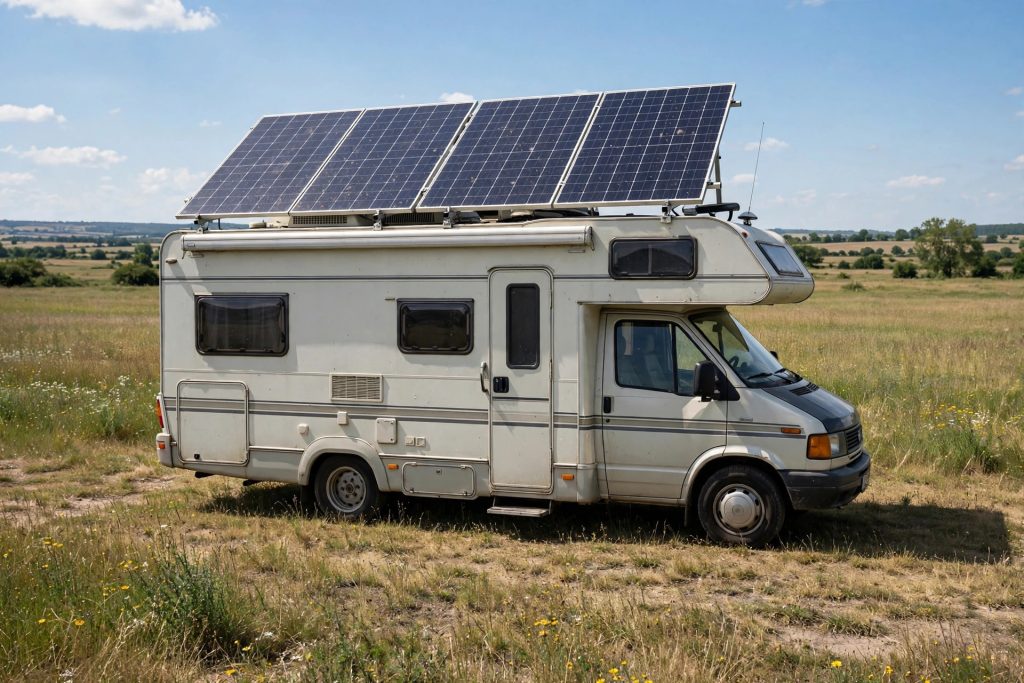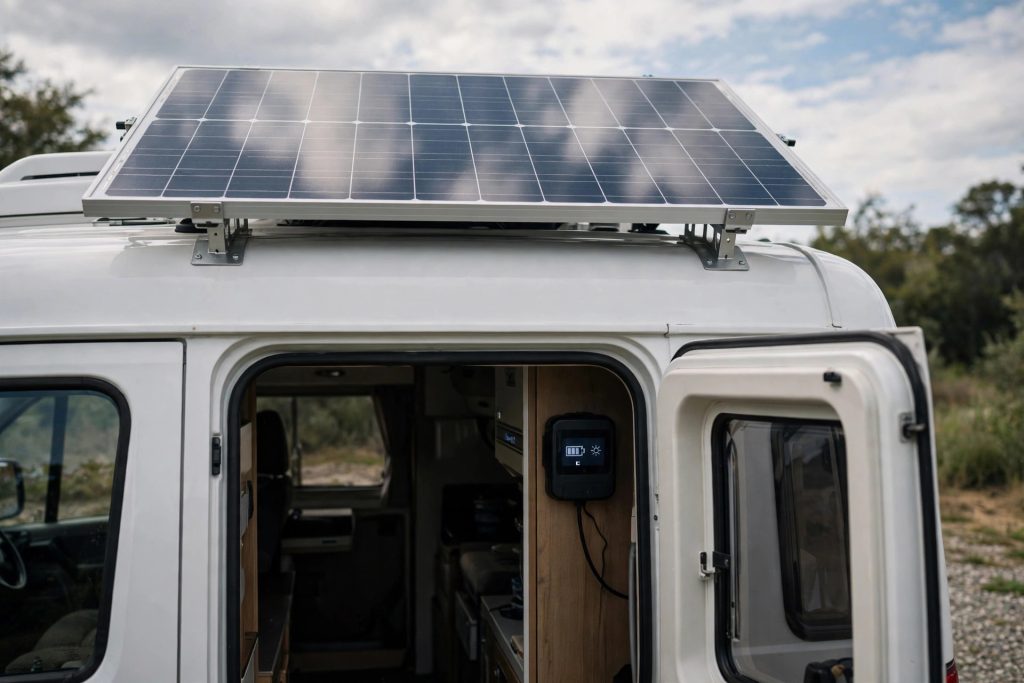

Most RVs that run a 12V fridge full time need 400W of roof solar. Run the math: 400W x 5 peak sun hours x 0.8 real-world derate (flat mounting, heat, wiring losses) lands near 1,600Wh on a clear summer day, and roughly half that in winter. Lights-and-phones rigs get away with 200W. Everything else is a storage conversation dressed up as a panel conversation.
Peak sun hours, if you’re new here, means the equivalent hours of full-strength noon sun your location gets per day — 5 is a fair national average, 3 is a bad winter day in the north, 6.5 is the desert in June. Recreational vehicle solar panels are rated at lab conditions you will never see on your roof. Size for the derate, not the sticker.
How much power does an RV use in a day?
Before you buy a single panel, tally the loads. Here’s what typical gear actually pulls at the battery. The marketing box rarely tells you this part.
| Load | Draw | Daily Wh |
|---|---|---|
| 12V compressor fridge (running) | 40-60W | 400-600Wh |
| LED lights | 10-30W total | ~120Wh |
| Water pump | intermittent | ~20Wh |
| Furnace fan (cold night) | 60-90W cycling | ~270Wh |
| Starlink dish, 8 hours | 40-75W | 320-600Wh |
| Laptop charging | ~65W | ~260Wh |
The fridge plus one always-on gadget eats a 200W array alive. A 200W panel makes maybe 800Wh on a good summer day and 400Wh in December. Add Starlink and you’re negative before the furnace ever kicks on. That’s the whole sizing problem in one sentence.
How many recreational vehicle solar panels fit on an RV roof?
A 100W panel is about 42 by 20 inches — roughly 7 square feet. Four of them need about 28 square feet before you account for gaps, mounting feet and walkable clearance. Sounds easy until you climb up and count obstructions.
Roof shape can overrule the wattage math entirely: on a curved shell or pop-top where rigid panels will not sit, our BougeRV Yuma 100W CIGS flexible solar panel review covers the thin-film option that bonds down instead — fewer watts per square foot, but it fits where nothing else does.
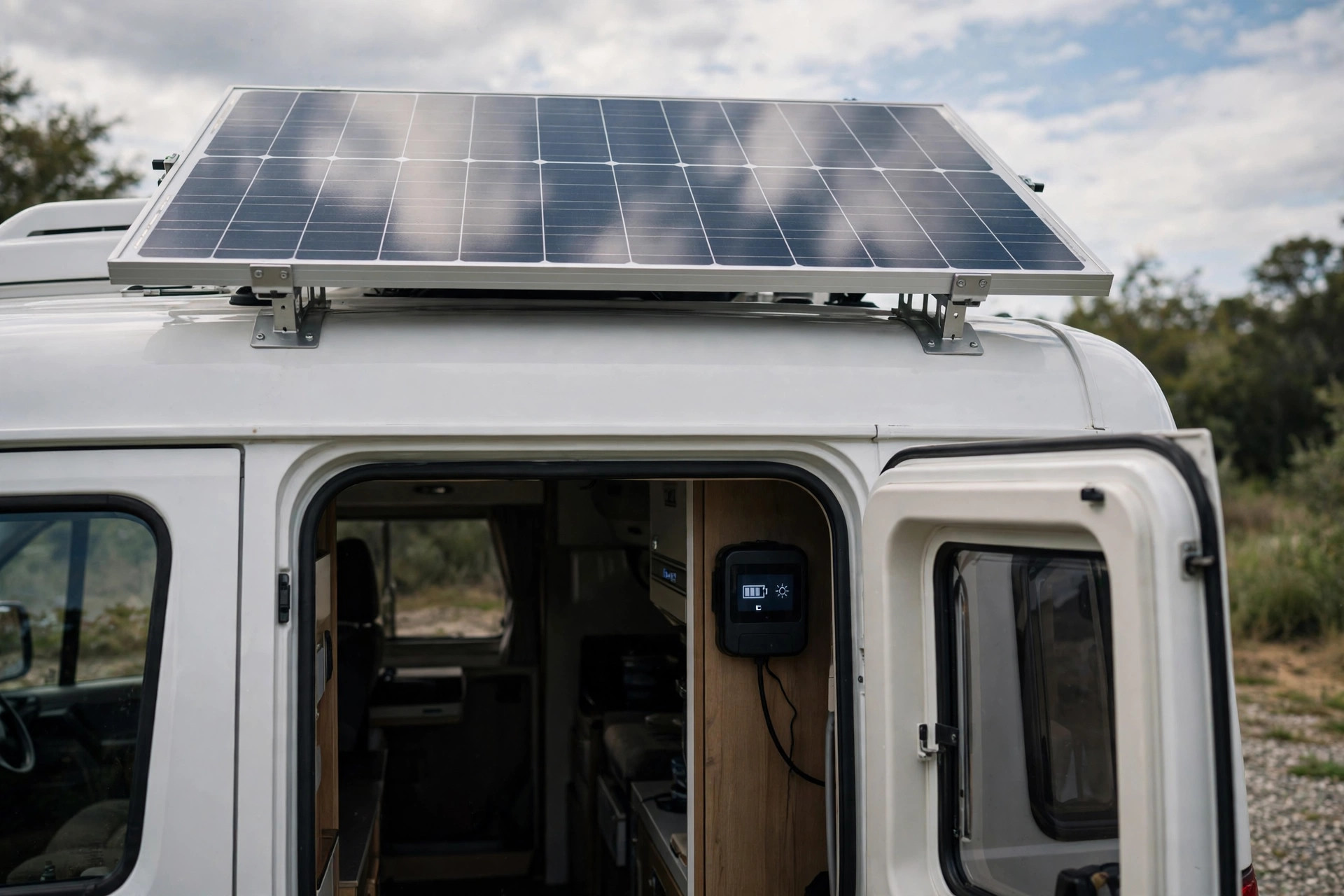
Roof AC units, vents, skylights and antennas steal the flat real estate. A 28-foot Class C often has less usable flat roof than a van conversion once the hardware is placed. Measure with a tape, not a brochure. And flat mounting costs you harvest versus tilted ground panels — expect 10-15% less in summer, more in winter when a low sun skims across a horizontal panel. Recreational vehicle solar panels mounted flat are a compromise you accept for the sake of not climbing up to re-angle them at every stop.
The controller decides more than the panel count
MPPT (maximum power point tracking) is a controller that actively converts the panel’s excess voltage into extra charging current. PWM (pulse width modulation) is a cheaper controller that clamps panel voltage down to battery voltage and throws the surplus away as heat.
Cold bright mornings raise panel voltage. MPPT converts that surplus; PWM clamps it away. On a 30°F morning your “12V” panel might sit at 18-20V open circuit — free watt-hours if the controller is smart enough to use them, wasted if it isn’t.
Owner reviews of 400W RV kits cluster their complaints on the charge controller and on parts missing at delivery, not on the panels. Trustpilot owner reviews checked in November 2026 back this up: one Florida owner reports pulling 370-420W from four 100W N-Type panels and warns buyers to get the MPPT version instead of the 30A PWM Adventurer package. That’s a real-world harvest number from a real roof, and it’s the controller doing the heavy lifting. If you want a known quantity in this class, Renogy’s 400W Premium kit with its 40A MPPT controller is the configuration worth comparing against.
Check any kit’s real output before you trust it
Here’s the formula I use on every install. Usable Wh = panel watts x peak sun hours x 0.75-0.85. The derate covers heat, flat-mount losses, wiring and controller efficiency. Use 0.75 for a hot roof in summer, 0.85 for a cool clear spring day.
Then pair it to storage. A 200Ah LiFePO4 bank is 2,560Wh nominal (12.8V x 200Ah) and about 2,300Wh usable — you can run lithium to roughly 90% depth of discharge, meaning how far you drain the bank. A 200Ah lead-acid bank gives you only about 1,280Wh usable at 50% depth of discharge, because lead doesn’t tolerate deep cycling. Same label, half the usable energy.
My routine: clamp a meter on the controller input at noon, watch the number for ten minutes, and compare it to the formula. I’ve stood on roofs watching solar input swing from 40W to 180W every time a cloud passed on a partly cloudy day — that swing is normal, and it’s why you size to the daily total, not the peak flash on the display. Speaking of displays: the controller LCD in direct noon sun is completely washed out, readable only when you shade it with a hand. Bring a hat.
A battery shunt monitor ends the guessing for about the price of a tank of fuel. Fit one, run your normal evening routine, and read the amp-hours consumed by morning. That single overnight number, multiplied out, tells you more about your real load than any sizing chart on the internet, this one included. Size the array to replace that number on a mediocre day, not a perfect one.
Can solar run the RV air conditioner?
No, not on panels alone. A 13,500 BTU roof AC draws roughly 1,300-1,600W running. Two hours of AC burns about 3kWh — more than a 400W array makes all day. Compressor startup surge is about 3x running watts, so you’re looking at 4,000W+ for a fraction of a second.
AC is a battery-plus-inverter problem. You need 3kWh+ of storage, a 2,000W+ inverter and a soft starter to tame the surge. Solar only refills that bank slowly — a 400W array puts back maybe 1,600Wh on a good day, which is half an afternoon of cooling. Plan on a generator or shore power for AC, full stop.
Sizing tiers: pick your number and stop shopping
- 200W: lights, phones, fan, and a fridge only if you drive most days to top up.
- 400W: the full-time fridge sweet spot. This is the default answer for most boondockers.
- 600-800W: fridge plus remote-work loads — laptop, Starlink, monitor.
- 1,000W+: rarely fits a real roof, and AC is still a storage problem no array solves.
Run the cost math the way an engineer would: not dollars per panel, dollars per harvested watt-hour. A cheap 200W PWM kit that delivers 400Wh on a December day costs you more per usable watt-hour than a 400W MPPT kit delivering 900Wh in the same weather, even though the sticker price is lower. The panel is a one-time purchase. The harvest repeats every day you own the rig. Buy the harvest, not the box.
One trade-off worth stating plainly: if you mostly stay on hookups or drive daily, 400W is money parked on the roof doing little. Skip to 200W and put the savings into a better controller or a second battery. If you’re planning long stationary stretches, read up on how to go off-grid with solar without oversizing the array before you max out the roof.
Three RV Solar Kits Matched to the Tiers Above
One kit per sizing tier — the right choice starts with your daily watt-hours and the charge controller, not with the biggest watt number on the box.
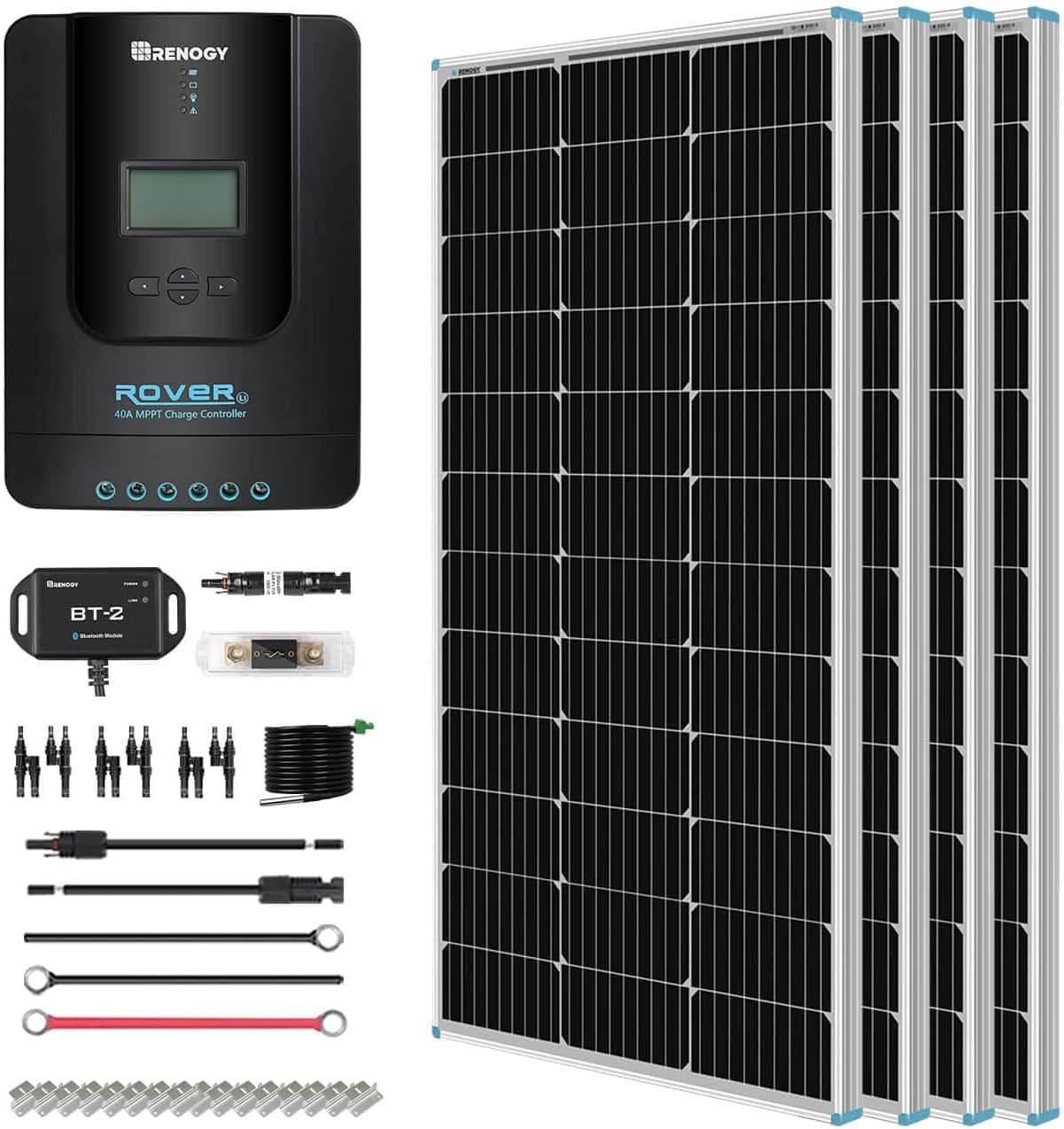
Renogy 400W Premium Kit
Four 100W panels with a Rover 40A MPPT controller and Bluetooth module — the most complete harvest in this group, but you still need your own battery and inverter
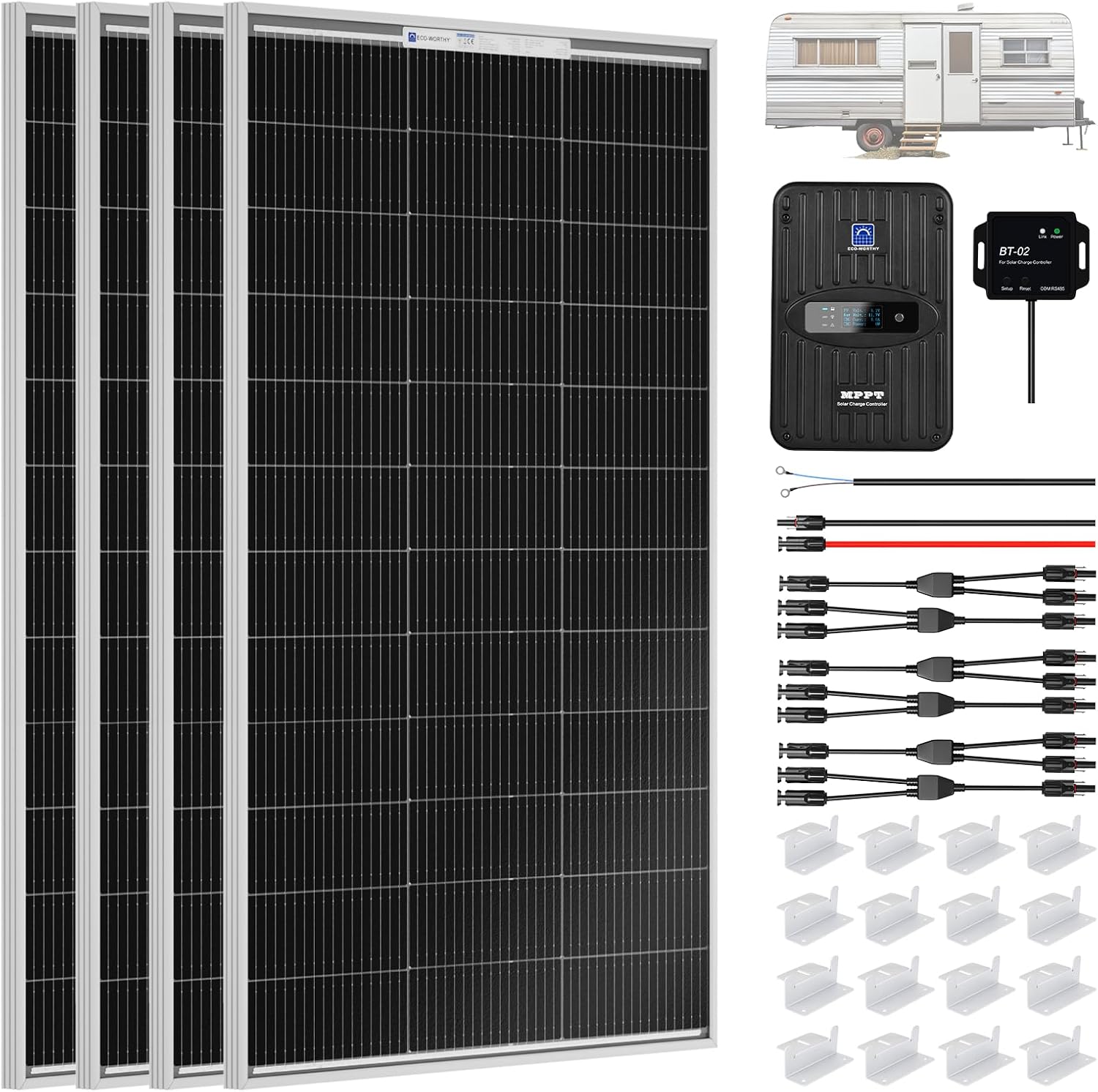
ECO-WORTHY 400W Kit
Same 400W class and a 40A MPPT controller for typically less money — the value route, with a smaller support network behind it
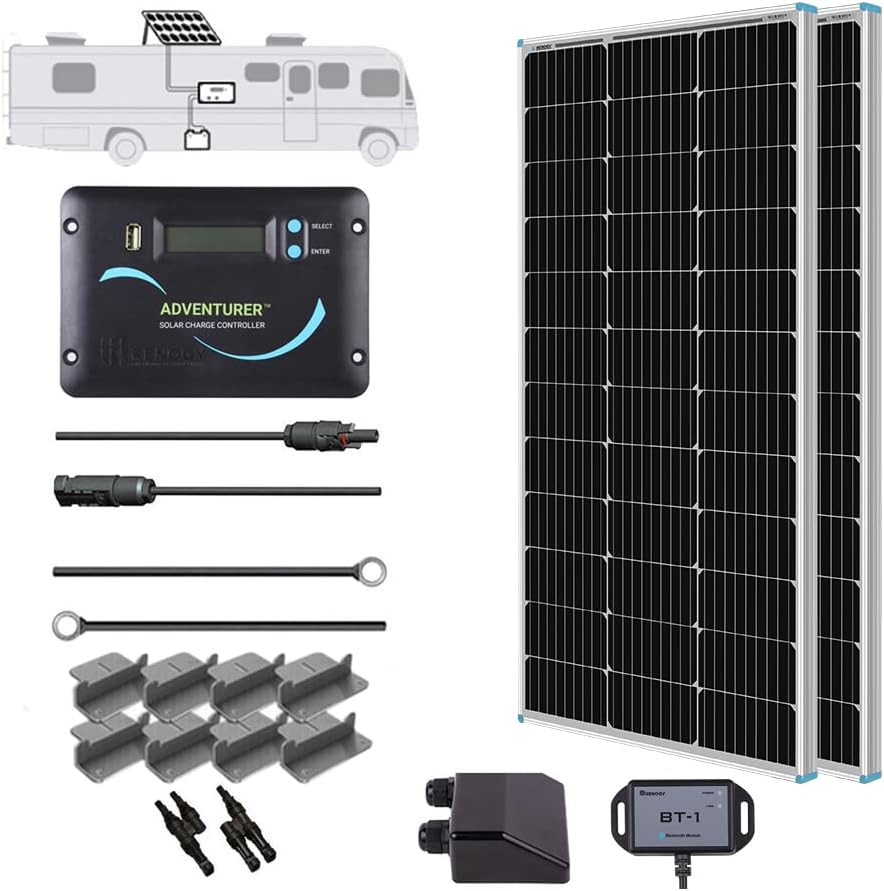
Renogy 200W RV Kit
Two 100W panels and a flush-mount Adventurer 30A PWM controller — half the harvest at a starter price, and PWM gives back less in poor light
Prices and availability may vary — tap any product to check the current listing.
FAQ
How many solar panels do I need to run an RV fridge?
400W for parked multi-day use. 200W only works in strong summer sun or with daily driving topping up the bank.
Can recreational vehicle solar panels run an air conditioner?
No — the math doesn’t close. A 13,500 BTU unit draws 1,300-1,600W, so two hours of cooling burns about 3kWh, more than a 400W array harvests in a full day.
Is 200W of solar enough for an RV?
Yes for lights, phones and a fan; no for a full-time fridge in winter. Winter harvest drops to roughly half of summer, which leaves a 200W array short.
MPPT or PWM for an RV?
MPPT once you pass 200W or camp in cold and shoulder seasons. PWM only makes sense for a small, cheap starter setup where the price gap matters more than the lost harvest.
Last updated: November 20, 2026
This site contains affiliate links. We may earn a commission on qualifying purchases.