This site contains affiliate links. We may earn a commission on qualifying purchases.
The third grey day is the one that tells the truth. Day one of a December storm, the bank sat at 91 percent and nobody in the house thought about electricity at all. Day two it was 58, and the array had put back less than the fridge and the water pump took out. By the morning of day three the display read 34 percent, the sky was the colour of wet concrete, and every decision made two years earlier, back when the system was lines in a notebook, was standing in the kitchen being graded.
That grading is the part the brochures skip. How to go off grid with solar is mostly not a shopping question. It is a sizing question, and the size is set by your worst month and your trimmed daily load, not by your annual average and not by the house you live in now, with every electric appliance still plugged in and running whenever it likes.
My bank survived that storm week, barely, on a system that looks undersized on paper in July and correctly sized in January. Getting there took a load audit I did not want to do, a battery formula I got wrong the first time, and a generator I had sworn, loudly, that a solar house would never need. Two of those three still annoy me. The generator least of all, as it turns out.
Cut the load first. Every kilowatt-hour you delete is one you never buy twice.
The average American home bought 10,791 kilowatt-hours from its utility in 2022, the federal energy statistics agency’s figure, which works out near 899 a month and roughly 30 a day. Hold that number up against off-grid quotes and the project dies right there, because a system sized to feed 30 kilowatt-hours a day through a northern December is a system with a very large battery, a very large array, and a price that belongs on a small commercial building. Nobody sizes for the average house. They size for the house after the audit.
The audit is unglamorous arithmetic. Write down everything that runs, its watts, and its honest hours. The loads that end off-grid projects are rarely the lights or the phones. They are the electric resistance heaters, the electric water heater, the electric dryer, and the electric range, four appliances that turn stored sunshine into heat at the worst exchange rate in the building. Move heat and cooking to propane or wood, keep the fridge, the well pump, the lights, the laptops and the washing machine on the battery, and a family house can land somewhere near 8 to 12 kilowatt-hours a day. A cabin lands lower. That trimmed figure, not the utility average, is the input to every calculation that follows, and the peak side of the same audit matters too, which is why our breakdown of how many watts it takes to run a house separates the watts that start motors from the watt-hours that empty tanks.
Savings hide in odd places during an audit. A second fridge in a garage, running empty eleven months a year. A desktop computer that idles at 60 watts around the clock, which is 1.4 kilowatt-hours a day spent on a screensaver. I found 2 kilowatt-hours a day in my own first audit that nobody in the house could attach to an actual activity. Gone before a single panel was priced. Cheapest storage I ever bought, that notebook page.
The battery is sized by a formula, and the formula has a winter clause
Here is the arithmetic that decides whether day three of the storm is a story or a blackout. Take the trimmed daily load and multiply by the grey days you intend to ride out, two is the common planning figure, three if your weather closes in for a week at a time. Divide by the share of the battery you are actually allowed to spend, then divide again by round-trip efficiency, because energy that goes into a bank and comes back out pays a toll both ways. Ten kilowatt-hours a day, two days of cover, lithium iron phosphate spent down to 20 percent remaining, efficiency at 90 percent. That is 10 times 2, divided by 0.8, divided by 0.9.
Roughly 28 kilowatt-hours of nameplate bank. For two days. In a trimmed house.
I said 20 the first time I ran it, in a notebook, with confidence. Actually, no. Twenty is what you get when the efficiency toll gets quietly forgotten, and forgetting it is how banks end up a fifth smaller than the weather requires. Run the same house on lead-acid and the picture worsens, because that chemistry only lets you spend about half the bank if you want it to live, so the nameplate figure climbs past 40 kilowatt-hours for the same two days. The bank is the budget. Everything else in an off-grid quote is commentary, and the replacement cycle belongs in the same notebook page, which is why the lifespan figures in our guide to how long solar batteries last should be read before the bank is sized, not after it is ordered.
Cold writes its own clause into the formula. On a winter trip with a smaller portable bank, at about minus 8, the display showed 62 percent in the morning and the unit still shut down the moment a real load leaned on it. The percentage was a voltage guess wearing a costume. Lithium cells sag under load when they are cold, the management system protects them by cutting output, and charging below freezing is off the table entirely unless the battery heats itself or lives somewhere warm. A bank in an unheated shed in January is a smaller bank than the label claims. Put it in the insulated corner. Budget the heating pads. Winter is not a footnote in this design, it is the design.
The building-block math explains why serious banks skip the 12-volt shelf. One 12-volt 100 amp-hour lithium battery holds 1.28 kilowatt-hours on paper and gives back roughly 1.1 in honest service, so a 20 kilowatt-hour working bank means wiring together something like sixteen of them, with sixteen sets of terminals to torque and check. On the maker’s own store page, checked November 4, the Group 24 version of that battery sat at 4.96 stars across 127 reviews, a near-perfect score on a small sample, and I read that the way I read all battery reviews now. Owners review batteries in month two. Banks fail in year three. Buy the block for its management system, its low-temperature protection and its warranty paperwork, and let the stars be the last thing on the page you look at.
Size the array for December, then look at what the panels actually cost
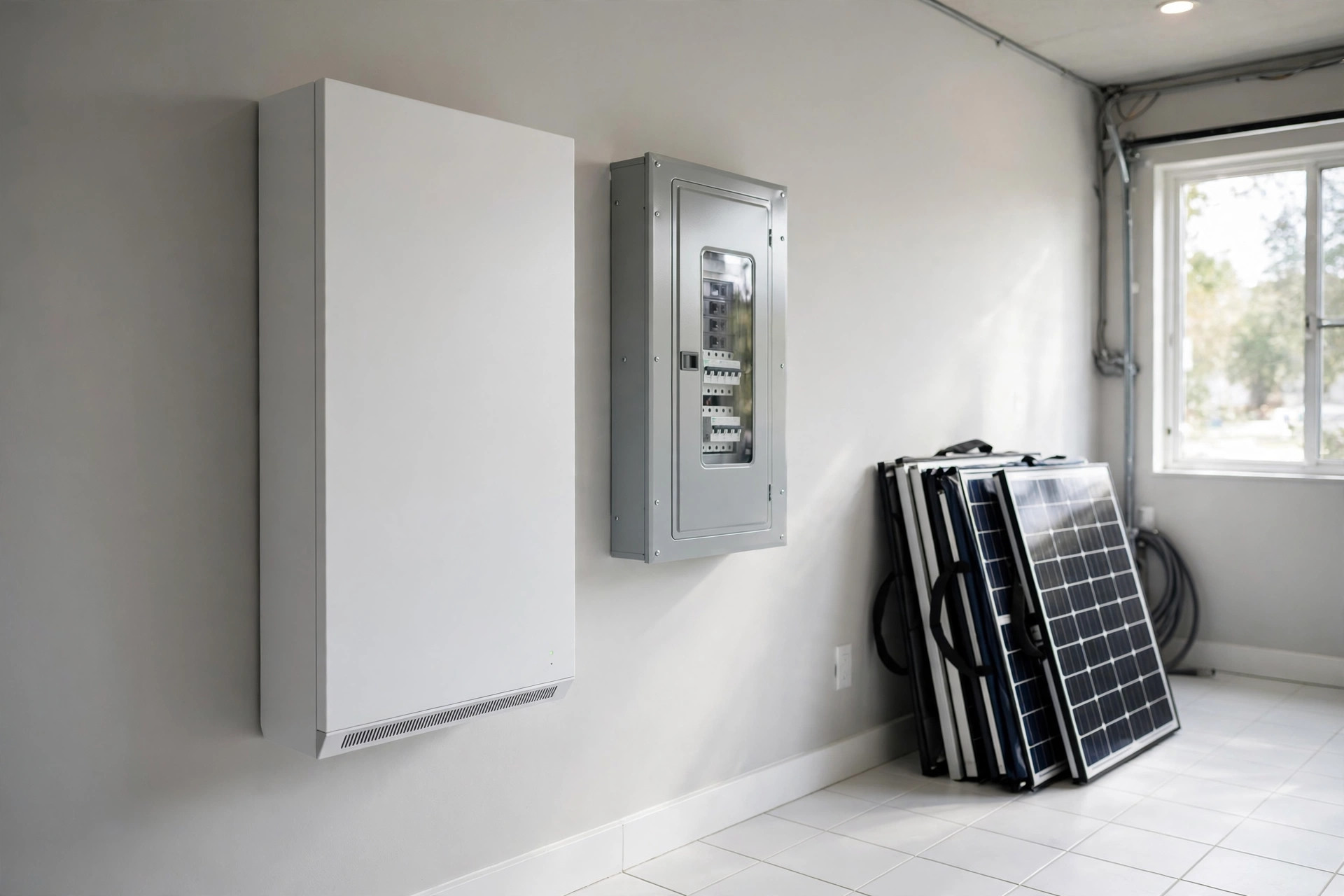
Array sizing runs the same winter-first logic in the other direction. Take the trimmed daily load and divide by your worst month’s peak sun hours, then divide by a derating factor near 0.7 for temperature, dirt, wiring and conversion losses. Ten kilowatt-hours a day against two and a half December sun hours gives an array near 5.7 kilowatts before any margin, so most designers land between 6 and 8 and let a generator carry the ugliest weeks. The same house in a mild climate with four winter sun hours needs far less glass. Geography is a component. It just does not come in a box, which is also why the starter-kit arithmetic in our guide to what size solar panel kit you need is worth doing on a small system first, where a sizing mistake costs a weekend instead of a mortgage payment.
Now the money, because this is where off-grid quotes confuse everyone who has been reading grid-tied prices. A 2026 national price report on off-grid systems put a cabin build, 3 kilowatts of array over 10 kilowatt-hours of battery, at $28,000 to $46,000 installed. A mid-size home at 8 kilowatts and 20 kilowatt-hours ran $47,100 to $75,300. A large high-demand home reached $80,000 to $122,000. Spread across the array, that is roughly $5.30 to $15.30 per watt, against a marketplace average near $2.60 per watt for an ordinary grid-tied rooftop the same year. The report’s own explanation is the one that matters. Panels and racking are only a fifth to a third of an off-grid bill. The battery bank, the off-grid inverter, the generator inlet, the wiring, the permits and the labour are the rest of it, and a grid-tied house skips most of that list because the utility is its battery.
After thirty minutes at a heavy load one afternoon I pressed the back of my hand against the inverter’s side vent, the hand-back test, more sensitive than a palm. Hot air, steady, the thermal design working hard and coping. That heat is the conversion toll made physical, and it runs all day in an off-grid house, on every load, in both directions. A grid-tied neighbour never pays it on power that goes straight from roof to kettle at noon. You pay it on nearly everything. Another few percent, gone as warm air in a utility room, already counted in the derating if the designer was honest and a slow leak in the budget if he was not.
The generator is a system component. Budget it like one.
Look, the purist version of this project has no engine in it. The purist version also has a battery bank sized for the worst week of the worst winter on record, and that bank costs more than the array, the inverter and the generator combined. Nearly every working off-grid house I know of, and every installer guide I trust, lands in the same place. A modest backup generator sits in the design from the start, sized to charge the bank at a good rate and carry the house while it does, and it runs a handful of hours across a bad December instead of a handful of minutes every evening. One installer guide priced the generator as roughly an $8,000 addition and used the word non-negotiable, which sounded like salesmanship until my first three-day storm repriced the word for me.
The generator also changes the battery maths in your favour. With an engine as the third day, the bank only has to be honest for two, and the 28 kilowatt-hour figure from the formula can shrink toward 20 without the house going dark when the weather misbehaves. Fuel for those hours is a rounding error next to a battery upgrade. What the generator cannot do is rescue a system whose daily load was never audited. It will happily charge a bank all winter so an electric dryer can empty it again by Thursday. The audit is still the project. The engine just keeps the project forgiving.
I have not lived the suburban version of this, where the house sits on a street with a live utility pole at the kerb and disconnecting is a paperwork fight as much as an electrical one. That scenario I have not priced, and the permit side of it varies enough by town that my cabin numbers should not be carried across. The electrical maths travels fine. The permission maths is local, and anyone who quotes you a whole project without asking which side of that line your house sits on is guessing with your money.
The Three Boxes Every Off-Grid Build Starts With
Storage, charge control and inversion. Buy these three right and the array is just glass on a frame.
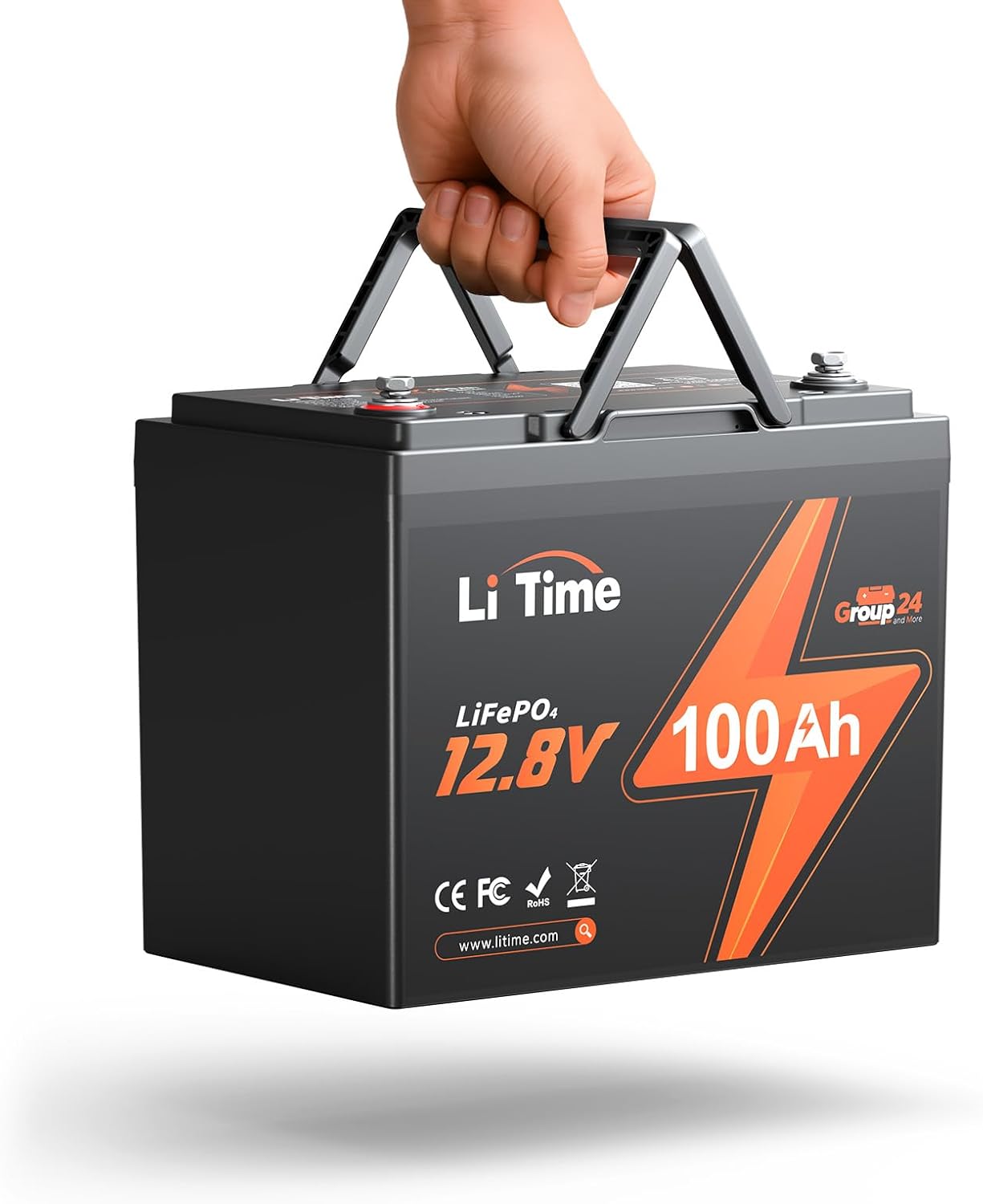
LiTime 12V 100Ah LiFePO4 Battery (Group 24)
12.8V times 100Ah is 1,280Wh of nameplate storage with a built-in 100A management system; on the maker’s own store page the Group 24 version held 4.96 stars across 127 reviews, checked November 4
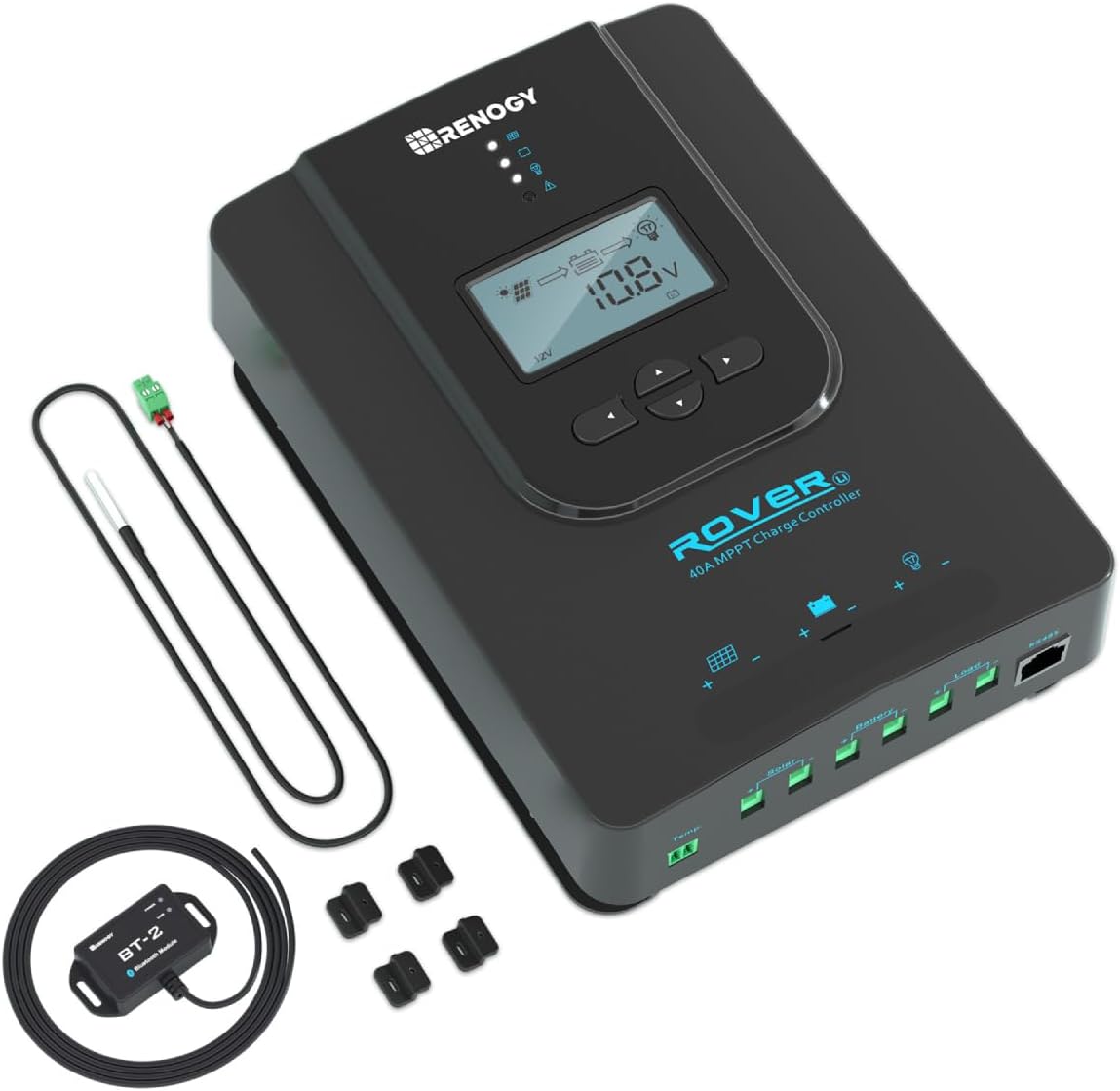
Renogy Rover 40A MPPT Charge Controller
A 40A MPPT controller for 12/24V banks that tracks the array’s real power point instead of clamping it to battery voltage, the difference between the watts on the panel label and the watts that reach storage on a grey morning
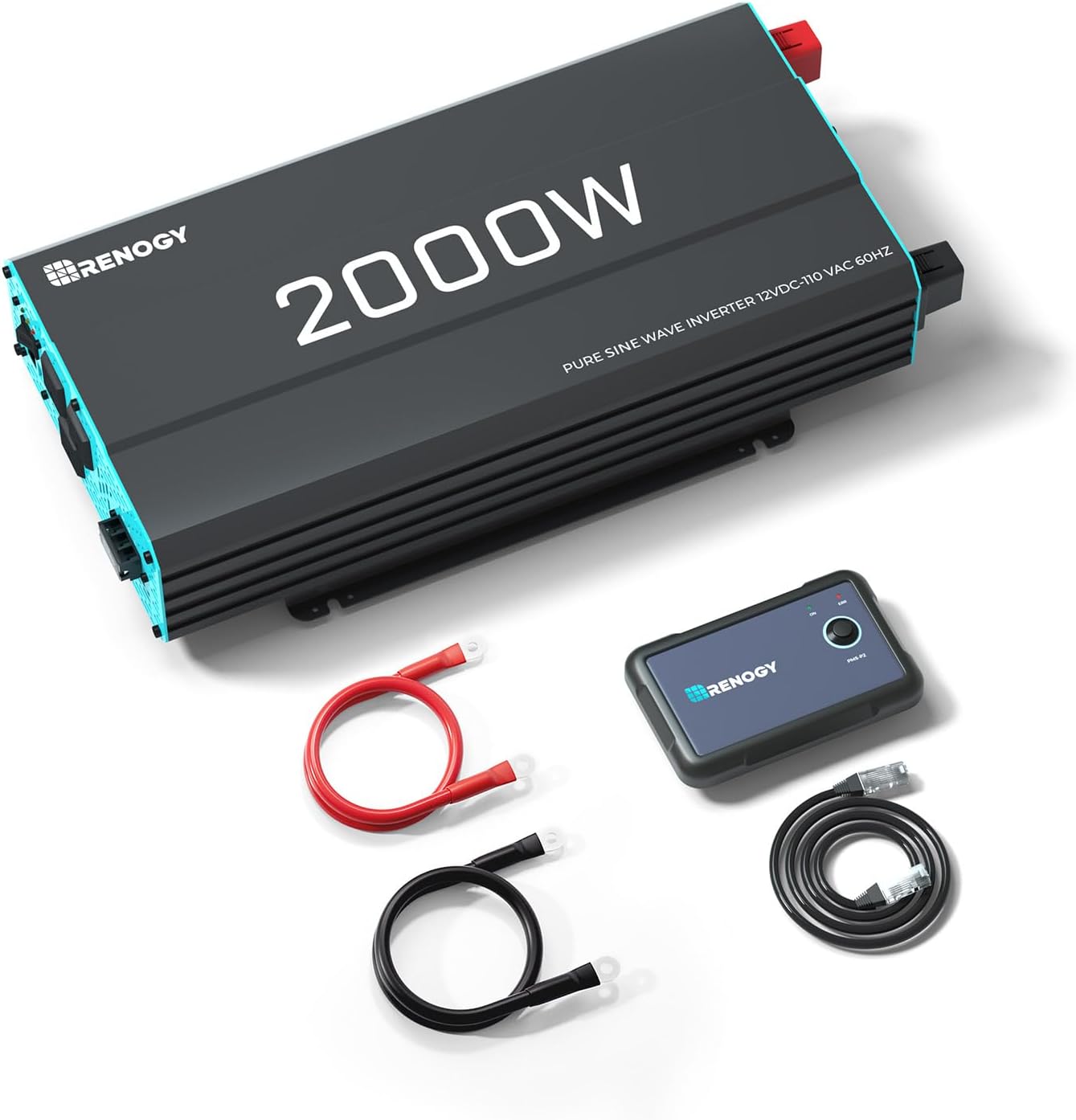
Renogy 2000W Pure Sine Wave Inverter
2000W of continuous pure sine output for the fridge, the pump and the electronics that complain about stepped waveforms; size the inverter for motor starts, not running watts, and let the bank sizing formula do the rest
This site contains affiliate links. We may earn a commission on qualifying purchases.
Frequently asked questions
How many batteries do I need to go off grid with solar?
For a trimmed house using 10 kilowatt-hours a day, plan on roughly 20 to 28 kilowatt-hours of lithium storage for two days of cover, the low end if a generator backs the third day and the high end if it does not. The formula is daily use multiplied by days of cover, divided by the share of the bank you can spend, divided by round-trip efficiency. Lead-acid roughly doubles the nameplate figure, because only about half of that bank can be spent without shortening its life. Count in kilowatt-hours, never in amp-hours alone, because an amp-hour at 12 volts and an amp-hour at 48 are different amounts of energy wearing the same label.
Can a normal suburban house go fully off grid, or is this only for cabins?
The electrical side works in a suburb exactly the way it works at a cabin, and the practical side is harder in almost every way that has nothing to do with panels. Many towns expect a grid connection to exist for occupancy, utilities have their own disconnection rules, and a suburban house usually carries the full unaudited load, air conditioning included, which pushes the system toward the top of the price ranges in this article. Most suburban owners who run the numbers honestly end at a hybrid system instead, grid attached, battery backed, no permission fight. I have not done the suburban disconnect myself. The maths above is the part I can vouch for.
Do I still need a generator if my solar array is big enough?
Big enough exists, and almost nobody buys it, because the last week of December cover is the most expensive electricity in the whole design. A bank and array sized to sail through the worst storm week of a decade sit two-thirds idle for the other fifty weeks of the year. A generator that runs twenty or thirty hours across a winter buys that same cover for a small fraction of the battery money, which is why installers treat it as part of the system rather than an admission of defeat. Size it to charge the bank hard while it runs. An engine loafing at a trickle is just noise with a fuel bill.
Is going off grid with solar cheaper than staying on the grid?
No, not against an ordinary residential bill, and anyone whose spreadsheet says otherwise has usually priced the panels and forgotten the bank, the replacement bank, or the winter. At roughly $2.60 per watt grid-tied against $5.30 to $15.30 per watt off-grid, the off-grid premium buys independence, not savings, and it buys it at properties where the alternative is a five-figure line extension quote or a feeder that fails every storm season anyway. My own payback column has a coffee stain where the generator fund jar sits on the shelf above it, about a third full, for the engine I priced in October and still have not ordered. December is circled on the calendar next to it. We will see who blinks first, me or the sky.