
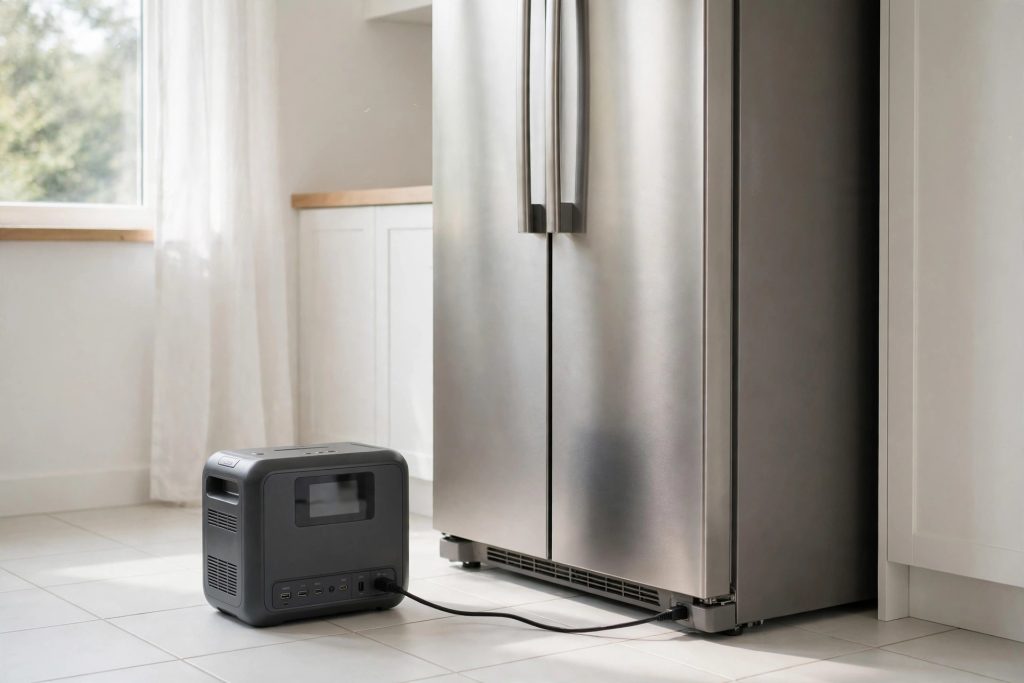
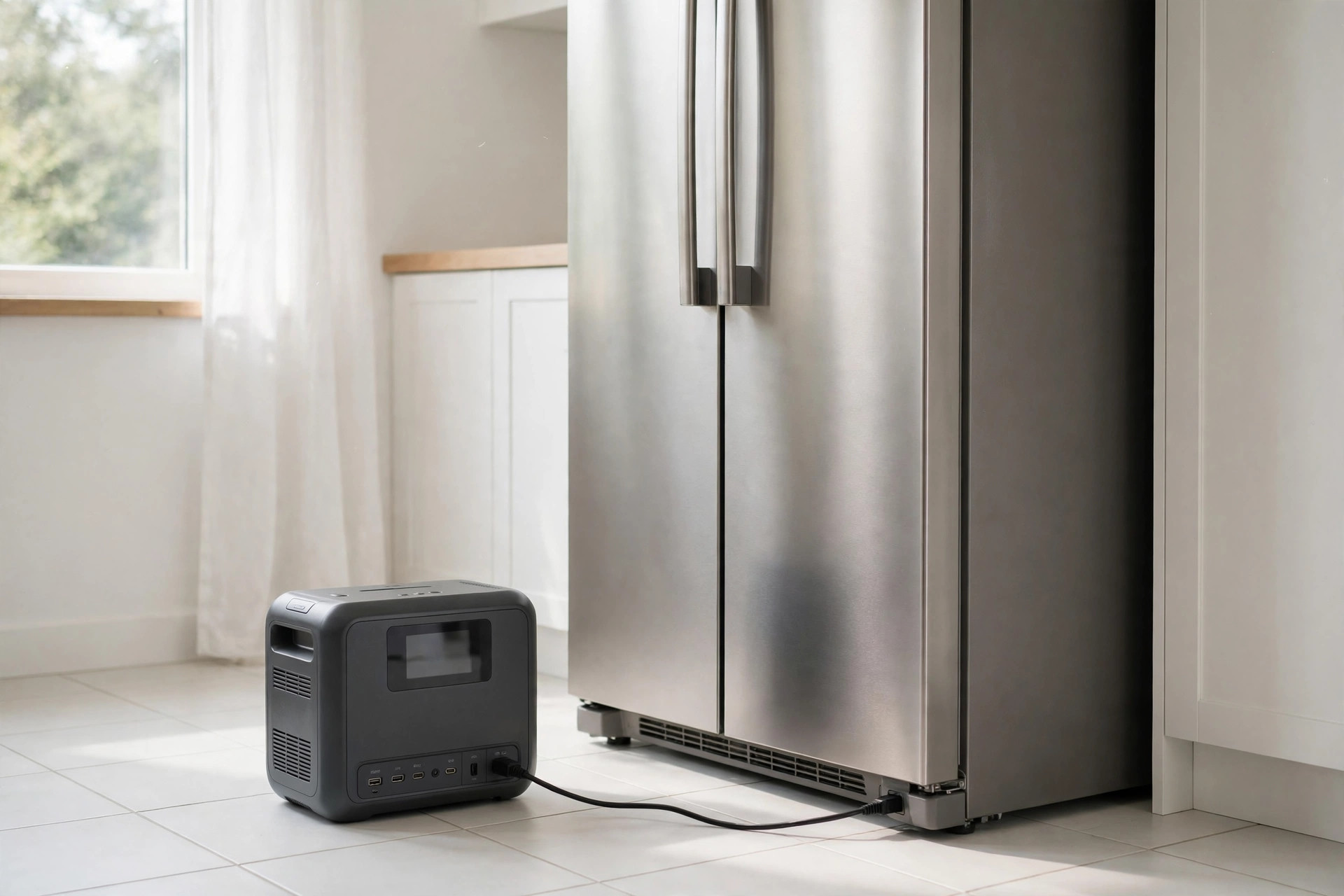
Yes — most solar generators can power a refrigerator, as long as the unit’s inverter is strong enough to handle the fridge’s startup surge and the battery is big enough for the runtime you need. A standard full-size refrigerator draws roughly 100–250 watts while the compressor is running, but it briefly pulls 2–3 times that when the compressor kicks on. A 1000Wh-class solar generator with at least 1000W of continuous output will run a typical full-size fridge for about 9–17 hours; a mini fridge can stretch the same battery to a full day or more.
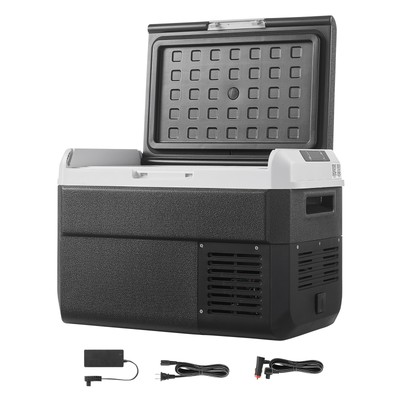
This guide breaks down exactly how much power a refrigerator needs, how long different battery sizes last, how to size a solar generator for your fridge, and whether solar panels can keep it running during a long outage.
The Short Answer
If you just need the numbers:
- Running watts: most full-size fridges draw 100–250W; mini fridges draw 50–100W.
- Startup surge: 2–3x the running watts (typically 600–1,200W for a full-size fridge), lasting a fraction of a second each time the compressor starts.
- Minimum inverter size: 1000W continuous for a full-size fridge, 300W for a mini fridge.
- Typical runtime from a 1000Wh battery: 9–17 hours for a full-size fridge; 24+ hours for a mini fridge.
- Daily energy use: about 1–2 kWh per day for a full-size fridge, 0.4–0.8 kWh for a mini fridge.
Everything below explains where these numbers come from and how to apply them to your own fridge.
What Does a Refrigerator Actually Need From a Solar Generator?
A refrigerator needs two things from backup power: enough instantaneous watts to start the compressor, and enough stored energy (watt-hours) to keep it cold for hours. These are separate requirements — a small battery with a strong inverter can start a fridge but won’t run it for long, while a big battery with a weak inverter may not start it at all.
Running watts is what the fridge draws while the compressor is actively cooling. Startup (surge) watts is the brief spike — usually 2–3 times the running watts — each time the compressor kicks on. Your solar generator’s continuous inverter rating must clear the surge number, not just the running number.
| Fridge type | Running watts | Startup surge | Daily energy |
|---|---|---|---|
| Mini fridge | 50–100W | 150–300W | 0.3–0.7 kWh |
| Standard top/bottom mount | 150–400W | 600–1,800W | 0.8–1.8 kWh |
| Large French door | 250–700W | 900–2,200W | 1.2–2.8 kWh |
| Side-by-side with dispenser | 300–900W | 1,000–2,500W | 1.5–3.5 kWh |
The surest way to get your numbers: check the yellow EnergyGuide label or the rating plate inside the fridge door, or plug in a $15–20 plug-in power meter for a day. Newer ENERGY STAR models typically use 30–50% less energy than equivalent fridges from 15+ years ago, so age matters a lot.
How Long Will a Solar Generator Run a Refrigerator?
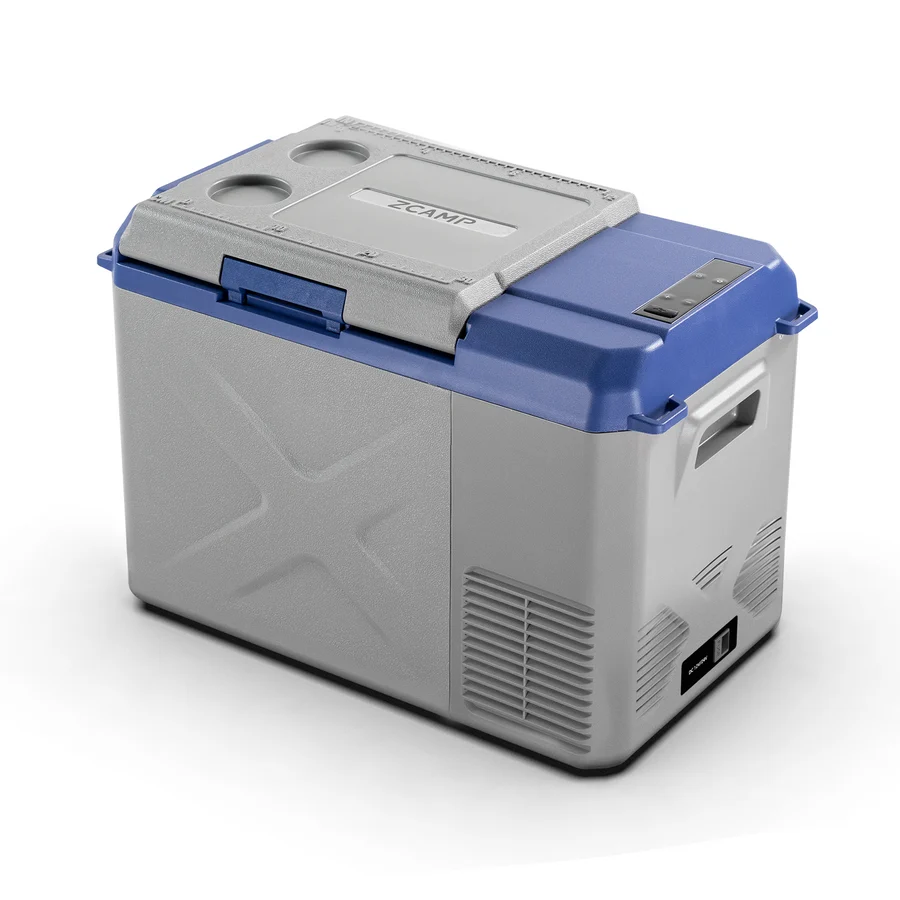
A 1000Wh-class solar generator will typically run a standard full-size refrigerator for 9–17 hours; a 500Wh unit manages roughly 5–9 hours, and a 2000Wh unit can go 18–30+ hours. The wide ranges exist because a fridge is not a steady load — the compressor cycles on and off, usually totaling 8–10 hours of actual run time per day.
The math is straightforward: take the battery’s usable capacity (about 85% of the rated Wh after inverter losses), and divide by the fridge’s average hourly draw (running watts × roughly one-third, accounting for the compressor’s off cycles).
Worked example: a 150W fridge with the compressor cycling about 8 hours a day averages ~50W per hour and uses ~1.2 kWh per day. A 1000Wh station delivers about 850Wh usable → 850 ÷ 50 ≈ 17 hours. An older 250W fridge in a hot kitchen averages ~83W per hour → about 10 hours from the same battery.
| Battery capacity | Efficient fridge (~150W) | Average fridge (~200W) | Older/large fridge (~300W) |
|---|---|---|---|
| 500Wh | ~8–9 hours | ~6–7 hours | ~4–5 hours |
| 1000Wh | ~14–17 hours | ~10–13 hours | ~7–9 hours |
| 2000Wh | ~28–34 hours | ~20–26 hours | ~14–18 hours |
Estimates assume ~85% inverter efficiency and normal cycling. Hot rooms, frequent door openings, and warm food shorten runtime; a pre-cooled, full, unopened fridge stretches it.
Wondering what size fits your broader backup plan? Our portable power station sizing guide walks through the full calculation for fridges plus other essentials.
What Size Solar Generator Do You Need for a Fridge?
For a standard full-size refrigerator, choose a solar generator with at least 1000W of continuous inverter output and 1000Wh+ of battery if you want overnight coverage. For a mini fridge, 300W / 500Wh is a reasonable minimum. Use this checklist before you buy:
- Continuous inverter watts ≥ the fridge’s startup surge. For most full-size fridges that’s 1000W+; large French-door or side-by-side models may need 1800W–2000W.
- Surge rating ≥ the startup spike. Most quality stations list a surge rating roughly 1.5–2x the continuous rating — confirm it clears your fridge’s number.
- Battery watt-hours matched to your target runtime. Use the table above: roughly 1 kWh of battery per 9–17 hours of full-size fridge time.
- Pure sine wave output. Virtually all modern portable power stations provide this; compressor motors run smoother and cooler on it than on modified sine wave.
- LiFePO4 battery chemistry. It typically lasts 3,000–4,000 cycles to 80% capacity — several times longer than older lithium-ion packs — which matters if the unit sits in emergency storage for years.
Shopping for a fridge-ready power station? Look for 1000W+ continuous output, 1000Wh+ LiFePO4 battery, and a surge rating above 1500W. Compare current models and prices:
If you’re still deciding whether this kind of backup is worth the investment, see our breakdown of whether solar generators are worth it for home backup.
Can Solar Panels Keep the Fridge Running During a Long Outage?
Yes — with enough panels, a solar generator can keep a refrigerator running indefinitely during daytime, and a right-sized battery carries it through the night. A 200W panel in decent sun produces roughly 0.8–1 kWh per day, while a full-size fridge consumes 1–2 kWh per day — so 300–400W of panels roughly offsets the fridge’s daily use, with the battery covering cloudy stretches and nighttime.
Two things make this work in practice. First, most solar generators support pass-through charging: they can run the fridge from the AC outlets while solar panels recharge the battery at the same time. Second, you don’t have to fully recharge every day — even partial solar top-ups meaningfully extend runtime. In our solar generator charging guide, a 1000Wh station refills in about 5–8 hours from 200W of panels in good sun.
Panel placement matters as much as wattage: keep panels angled toward the sun, unshaded, and reposition them midday if you can. For help sizing the array itself, see how many solar panels you need.
Building a fridge backup kit? Pair a 1000Wh+ station with 200–400W of portable panels for outage-ready coverage. Browse current panel and bundle options:
5 Tips to Make a Fridge Last Longer on a Solar Generator
The cheapest way to double your runtime is to reduce what the fridge has to do. These habits matter more than buying a slightly bigger battery:
- Pre-cool before the outage. Turn the fridge to its coldest safe setting (below 40°F / 4°C) while grid power is still on, so the battery starts from a cold baseline.
- Keep the fridge full. Cold food and water jugs hold temperature far better than empty air, so the compressor cycles less after each door opening.
- Minimize door openings. Decide what you need before opening the door. A fridge kept closed holds safe temperatures for about 4 hours with no power at all.
- Disable extras. Turn off ice makers, water dispensers, and quick-freeze modes — each adds load you don’t need in an emergency.
- Give the power station airflow. Keep the station ventilated and out of direct sun; heat increases inverter losses and shortens effective runtime.
FAQ
Can a solar generator run a refrigerator overnight?
Yes. A 1000Wh-class station typically runs a standard full-size fridge for 9–17 hours — enough for most nights — while a mini fridge can easily go 24+ hours. Keep the door closed overnight and the compressor cycles less.
Can a solar generator run a mini fridge?
Easily. Mini fridges draw only 50–100W running with a 150–300W startup surge, so even a 300W / 500Wh station handles them, often for a full day or more per charge.
Can a solar generator run a freezer too?
Chest freezers are similar to fridges in power draw (100–200W running) and work fine on the same sizing rules. Running a fridge and a freezer together doubles the load, so size the battery for the combined daily kWh.
Will a solar generator damage my refrigerator?
No, as long as the inverter is pure sine wave (standard on modern stations) and its continuous rating clears the fridge’s startup surge. An undersized inverter that trips repeatedly is the main risk — size it with margin.
Can I charge the solar generator while it’s running the fridge?
Yes — this is called pass-through charging, and most modern stations support it. You can run the fridge from the AC outlets while solar panels (or a wall outlet) recharge the battery simultaneously.
How do I find my fridge’s exact wattage?
Check the yellow EnergyGuide label for annual kWh (divide by 365 for daily use), read the rating plate inside the door, or use a plug-in power meter for a day of real measurements. For sizing, always plan around the startup surge, not just the running watts.
Affiliate disclosure: This article contains affiliate links. If you purchase through them, we may earn a commission at no extra cost to you — it helps us keep our guides free and independent.
Common Questions About Solar Generator
Quick Answers
Straight answers to the questions people ask most about this topic.
Solar Generator — what should I know?
The short answer is yes — with the right expectations. Worked example: a 150W fridge with the compressor cycling about 8 hours a day averages ~50W per hour and uses ~1.2 kWh per day.
Worked example: a 150W fridge with the compressor cycling about 8 hours a day averages ~50W per hour and uses ~1.2 kWh per day.
How much should I expect to spend on solar generator?
Costs vary widely by capacity and brand, but the sweet spot for most buyers is a mid-range option that covers essential needs without overpaying for capacity you'll never use.
Use the table above: roughly 1 kWh of battery per 9–17 hours of full-size fridge time.
What should I look for when choosing solar generator?
Focus on capacity, charging speed, and build quality first — those determine everyday satisfaction far more than bonus features.
Read the specifications carefully and compare at least two or three options before deciding. Real user reviews reveal issues spec sheets hide.
What mistakes do people make with solar generator?
The most common mistake is buying too much or too little capacity — either wasting money or ending up short when it matters.
Measure your actual needs first. A little research up front prevents the two biggest regrets: overpaying and underpowering.
How do I get the most out of solar generator?
Follow the manufacturer's charging guidelines and store it properly between uses — that alone extends useful life significantly.
Typical runtime from a 1000Wh battery: 9–17 hours for a full-size fridge; 24+ hours for a mini fridge.
Common Questions About Solar Generator
Quick Answers
Straight answers to the questions people ask most about this topic.
Solar Generator — what should I know?
The short answer is yes — with the right expectations. Worked example: a 150W fridge with the compressor cycling about 8 hours a day averages ~50W per hour and uses ~1.2 kWh per day.
Worked example: a 150W fridge with the compressor cycling about 8 hours a day averages ~50W per hour and uses ~1.2 kWh per day.
How much should I expect to spend on solar generator?
Costs vary widely by capacity and brand, but the sweet spot for most buyers is a mid-range option that covers essential needs without overpaying for capacity you'll never use.
Use the table above: roughly 1 kWh of battery per 9–17 hours of full-size fridge time.
What should I look for when choosing solar generator?
Focus on capacity, charging speed, and build quality first — those determine everyday satisfaction far more than bonus features.
Read the specifications carefully and compare at least two or three options before deciding. Real user reviews reveal issues spec sheets hide.
What mistakes do people make with solar generator?
The most common mistake is buying too much or too little capacity — either wasting money or ending up short when it matters.
Measure your actual needs first. A little research up front prevents the two biggest regrets: overpaying and underpowering.
How do I get the most out of solar generator?
Follow the manufacturer's charging guidelines and store it properly between uses — that alone extends useful life significantly.
Typical runtime from a 1000Wh battery: 9–17 hours for a full-size fridge; 24+ hours for a mini fridge.


