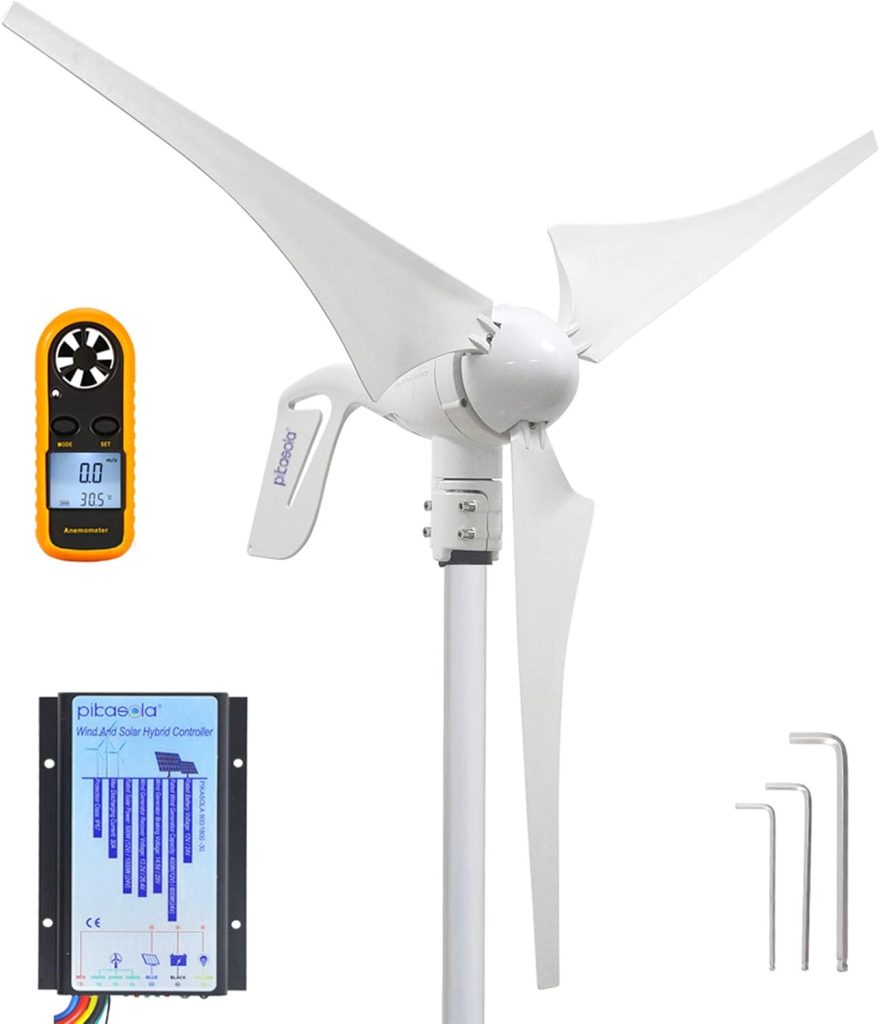
One point five kilowatts. That’s the headline on the Automaxx 1500W, and it’s the number I want to dismantle first, because “1.5kW” in small wind means “1.5kW at a wind speed you will almost never see.” The rated wind speed for turbines this size is typically 12 to 14 meters per second — that’s a near-gale, the kind of wind that makes walking difficult. At that wind speed, yes, the turbine makes 1,500W. At 6 m/s — a strong, noticeable breeze, the kind you’d call “windy” — the cubic law says it makes one-eighth of rated. One-eighth of 1,500 is 187W. Your 1.5kW turbine is a 187W turbine on a windy day. This isn’t a defect. It’s physics. But the box says 1.5kW, and the box is what you paid for.
Actually, 187W might be generous — that’s steady wind, not gusting. In gusty 6 m/s wind, the average is lower. The cubic law is unkind, and then some.
I want to be fair to small wind, because I actually like small wind. A well-sited turbine on a tall tower, in a genuinely windy location, makes real power — hundreds of watts, day and night, complementing solar beautifully. The problem is never the turbine. It’s the siting. And the siting is where every residential wind dream goes to die, because the wind at rooftop height in a suburban neighborhood is nothing like the wind in the brochure. Trees, houses, fences — they all create turbulence, and turbulence is the enemy. A turbine in turbulent air doesn’t just make less power; it shakes itself to death. Vibration kills bearings, bearings kill turbines, and the whole expensive assembly becomes a very tall lawn ornament.
Tower height is the variable that matters more than turbine size, and it’s the one buyers resist most. Wind speed increases with height — the difference between 30 feet and 60 feet can double your average wind speed, which cubes your power. Doubles the wind, eight times the power. But a 60-foot tower is a construction project: permits, concrete, guy wires, neighbors. So people mount the 1.5kW turbine on a 20-foot pole on the roof, in turbulent air, and wonder why it makes 100W. The turbine is fine. The air is bad. Nobody wants to hear that the $1,500 turbine needs a $2,000 tower to work. But it does. That’s the real price of small wind, and it’s never on the box.
The 24V system voltage on the Automaxx is the right call for this size — at 1,500W, a 12V system would be pushing 125A, which needs absurdly thick wire. 24V halves the current. This is basic electrical design, and it’s correct here. The 60A rating in the review title is the charge current at 24V — 60A × 24V = 1,440W, consistent with the 1.5kW headline. The numbers cohere, which is more than I can say for some listings. But coherent numbers at unachievable wind speeds are still unachievable. I’d rather see the power curve — watts at 4, 6, 8, 10, 12 m/s — than the single headline number. The power curve is the truth. The headline is the advertisement. Show me the curve.
Realistic output for a 1.5kW turbine in a decent (not great) location: 100-300W average, which is 2.4-7.2kWh per day. That’s real energy — enough to matter, enough to offset a meaningful chunk of a cabin’s usage. In a great location — a ridge, a coast, the plains — it can be much more. In a suburban backyard, it can be nearly nothing. The spread between “great location” and “backyard” is an order of magnitude, which is why small wind advice always starts with: measure your wind first. An anemometer on a pole for a year, logging data. A year of patience before spending a dollar. Nobody does this. Everyone should.
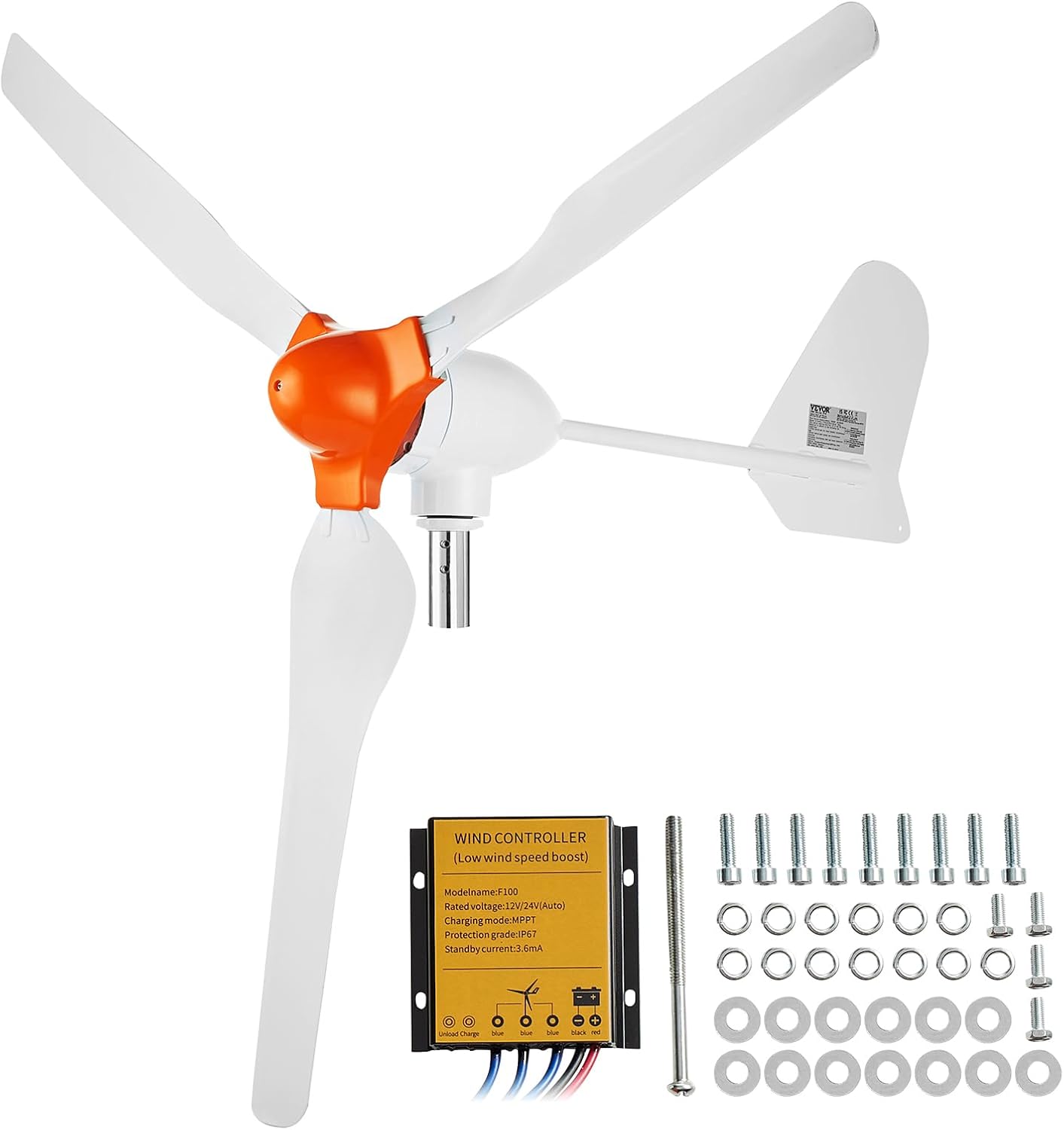
The honest alternatives, for context: VEVOR’s 500W turbine is the smaller, cheaper entry — same physics, smaller numbers, and honestly a saner first turbine because the tower and installation cost less. The 800W VEVOR splits the difference. A 400W 24V five-blade kit with hybrid solar input is the beginner-friendly shape — wind plus solar into one controller, hedging both weathers. The pattern: start smaller than you think, on a tower taller than you want, and let the anemometer data decide whether to scale up. The people who love small wind all started small. The people who hate it bought 1.5kW for a rooftop.
I haven’t installed an Automaxx. My wind experience is a smaller turbine, a borrowed anemometer, and a year of data that told me my site wasn’t good enough — which was the most valuable result, because it saved me thousands. The data said: average 4 m/s at 30 feet, turbulent, not viable. I believed the data. The turbine I almost bought is still in someone’s warehouse, and my money is still mine. Measure first. The anemometer is the cheapest part of a wind system and the most important. It’s also the part nobody buys, because it delays gratification by a year. A year of data versus a decade of regret. The data wins.
Small wind, honestly sized
Start smaller than you think, on a taller tower than you want. These are the sane entry points.
VEVOR 800W 12V Wind Turbine Generator
800W 12V three-blade turbine with MPPT controller; the step up for windy sites.
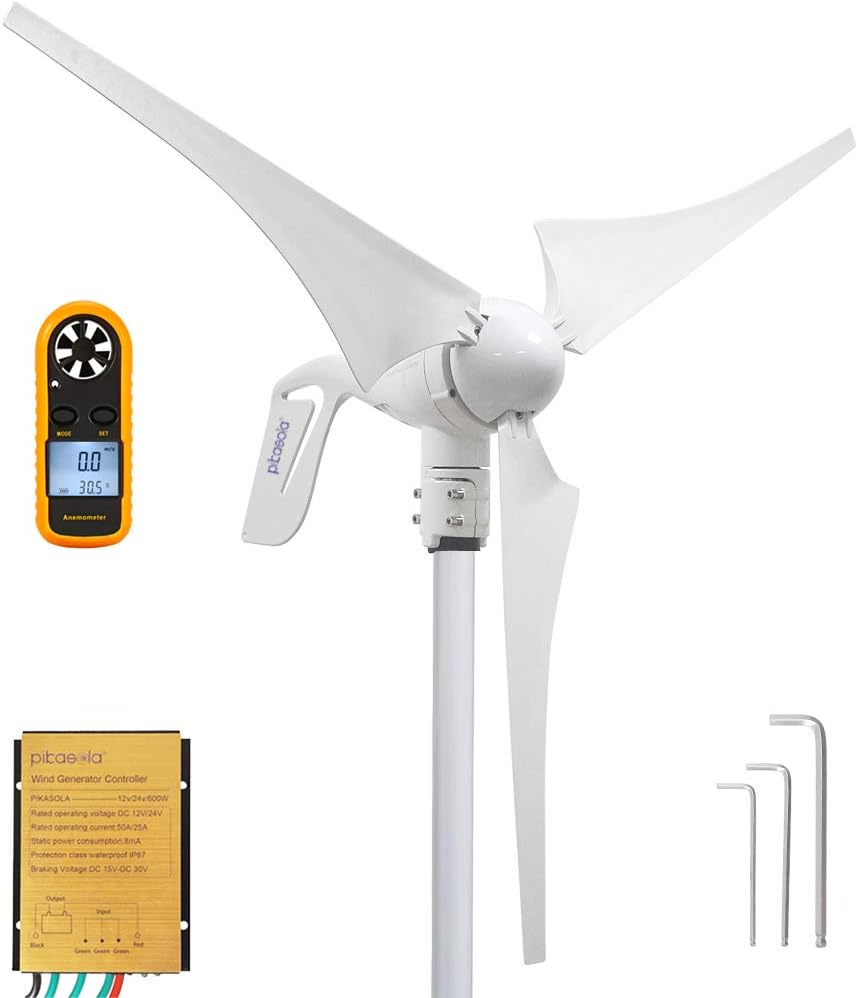
Pikasola 400W 24V Wind Turbine Generator
400W 24V three-blade turbine with charge controller; 24V keeps current (and wire size) sane.
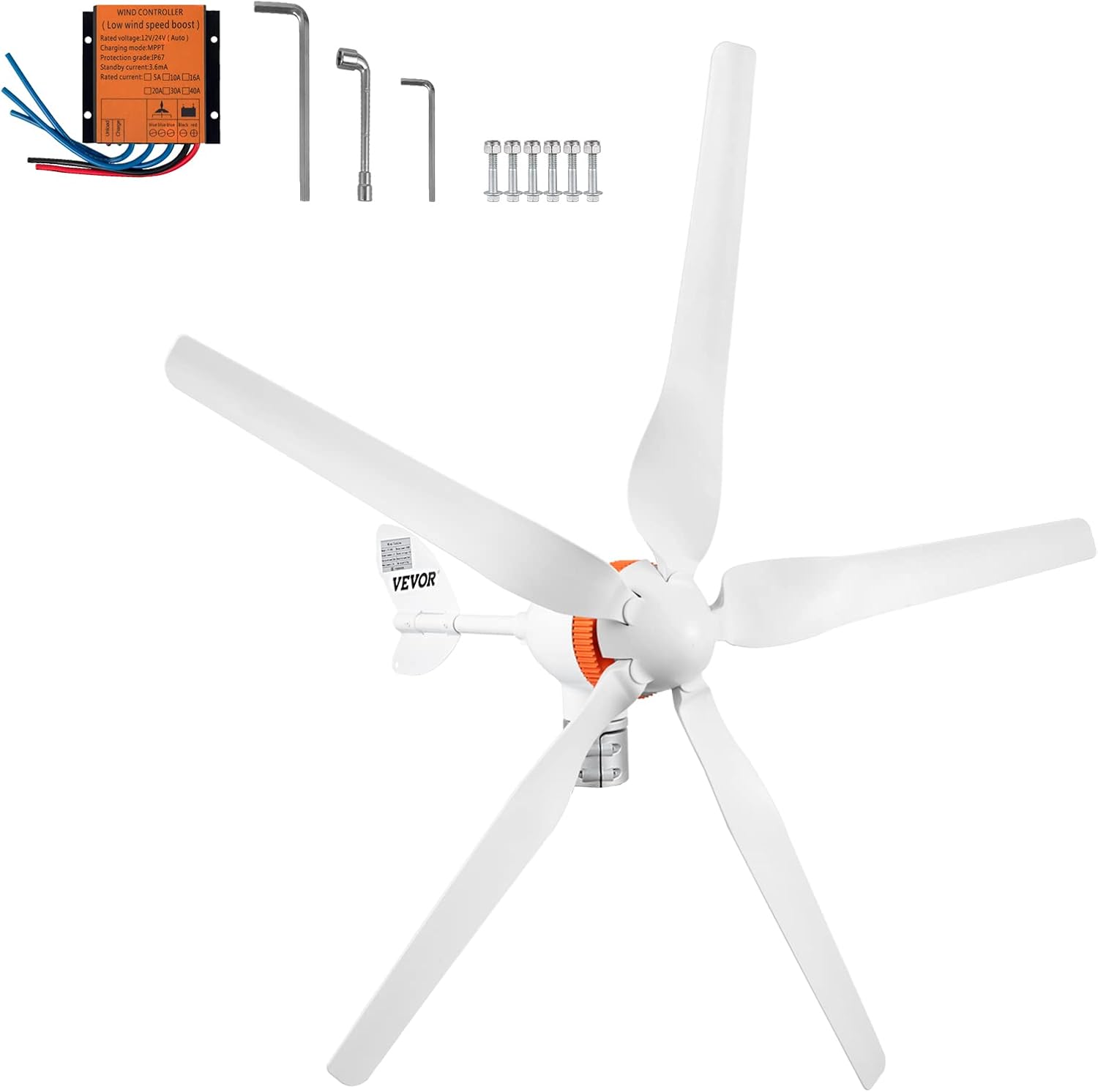
VEVOR 500W 12V Wind Turbine Kit
500W 12V five-blade kit with MPPT controller included; a complete small-wind starter.
The category’s original sin is the rated-power headline, and I want to name it clearly: small wind turbines are rated at wind speeds that occur a few percent of the time, while solar panels are rated at irradiance that occurs daily. The two “rated” numbers mean completely different things, but buyers compare them as if they’re equivalent. A 1,500W turbine and 1,500W of solar are not the same purchase. The solar makes its rated power most sunny middays. The turbine makes its rated power during storms. The honest metric is annual energy — kWh per year at your site — and no listing provides it, because it requires knowing your site, and the listing doesn’t know your site. Only the anemometer knows.
Noise is the neighbor variable. A 1.5kW turbine at speed makes noise — a whoosh, a hum, blade-pass frequency. In a rural setting, nobody cares. In a suburb, it’s a dispute waiting to happen. Check local regulations before buying, not after. Some jurisdictions restrict turbine height, some restrict noise, some restrict both. The permit office is the least exciting part of wind power and the most consequential. I know someone who installed first and asked later. The turbine came down. The money didn’t come back.
My anemometer year taught me the central lesson of small wind: the resource is everything, the turbine is secondary. A mediocre turbine in great wind outperforms a great turbine in mediocre wind, every time, by multiples. The Automaxx 1500W is — on paper — a capable machine: 24V, proper current ratings, the right voltage for the power class. Whether it’s a good purchase depends entirely on the air above your property, which you can’t see, can’t guess, and can only measure. So measure. Put up the pole. Log the year. Then buy the turbine the data says you need — which might be smaller than 1.5kW, on a taller tower than you planned, making more power than the big turbine on the short pole ever would. The wind doesn’t read the box. It just blows, or it doesn’t, and the anemometer is the only one telling the truth.