
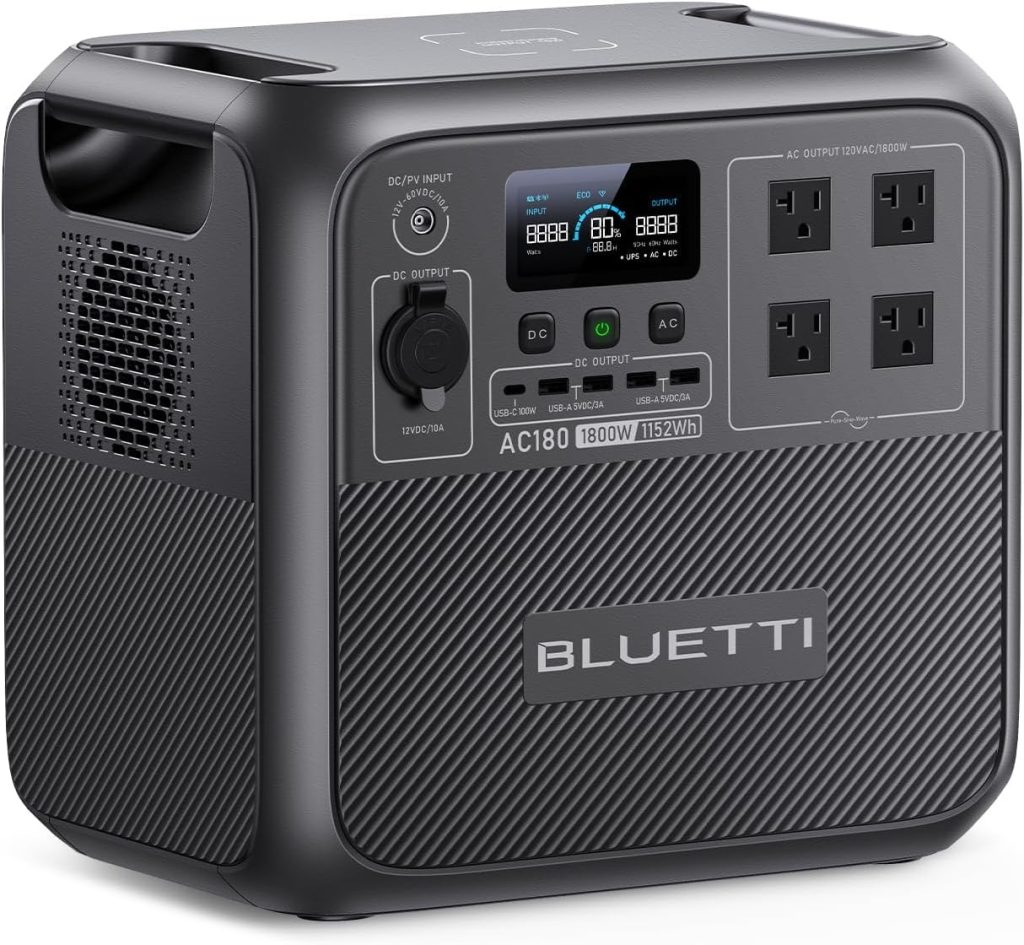
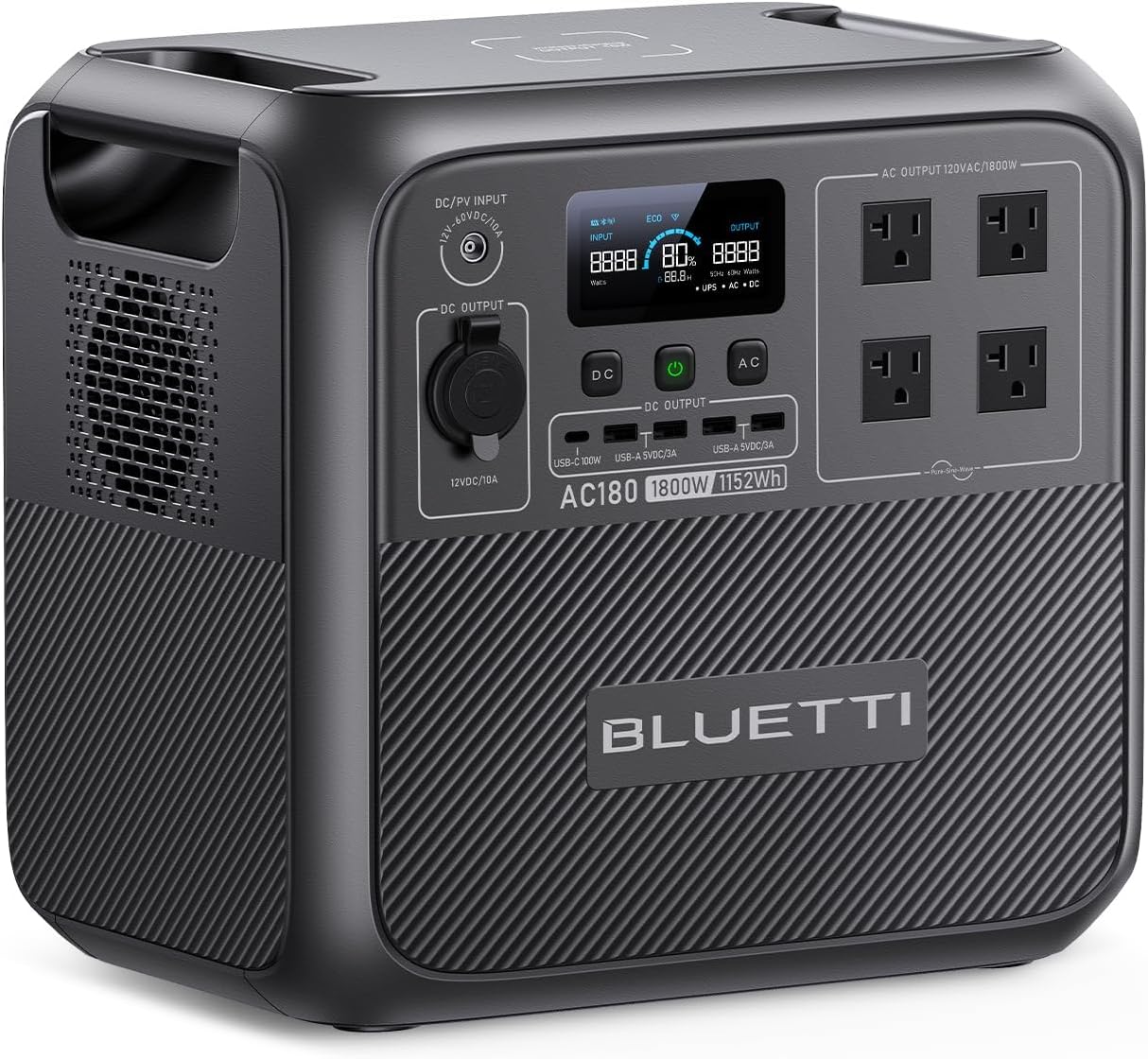
BLUETTI AC180 Review: A 1152Wh LiFePO4 Portable Power Station That Gets Camping Right
The BLUETTI AC180 sits in the sweet spot of the portable power station market: bigger than the grab-and-go models, smaller than the back-breakers. This guide walks through what that actually means for your campsite. You’ll learn who the AC180 fits best, how it stacks up against two well-known rivals, and what mistakes to avoid before you buy.
Quick Answer
The BLUETTI AC180 is a mid-range LiFePO4 portable power station aimed squarely at campers who want to run a car fridge, charge phones and laptops, and power camp lighting for a long weekend without lugging a generator. If that sounds like your trips, it deserves a spot on your shortlist. If you only camp one night at a time or need to run a full RV, a smaller or larger unit fits better.
Compare Top Mid-Range Portable Power Stations
Three proven picks side by side — choose the one that fits your needs.
BLUETTI AC180 Portable Power Station (1152Wh LiFePO4)
Our pick for campers: generous capacity, fast recharge, and app-enabled boost for surge-hungry appliances.
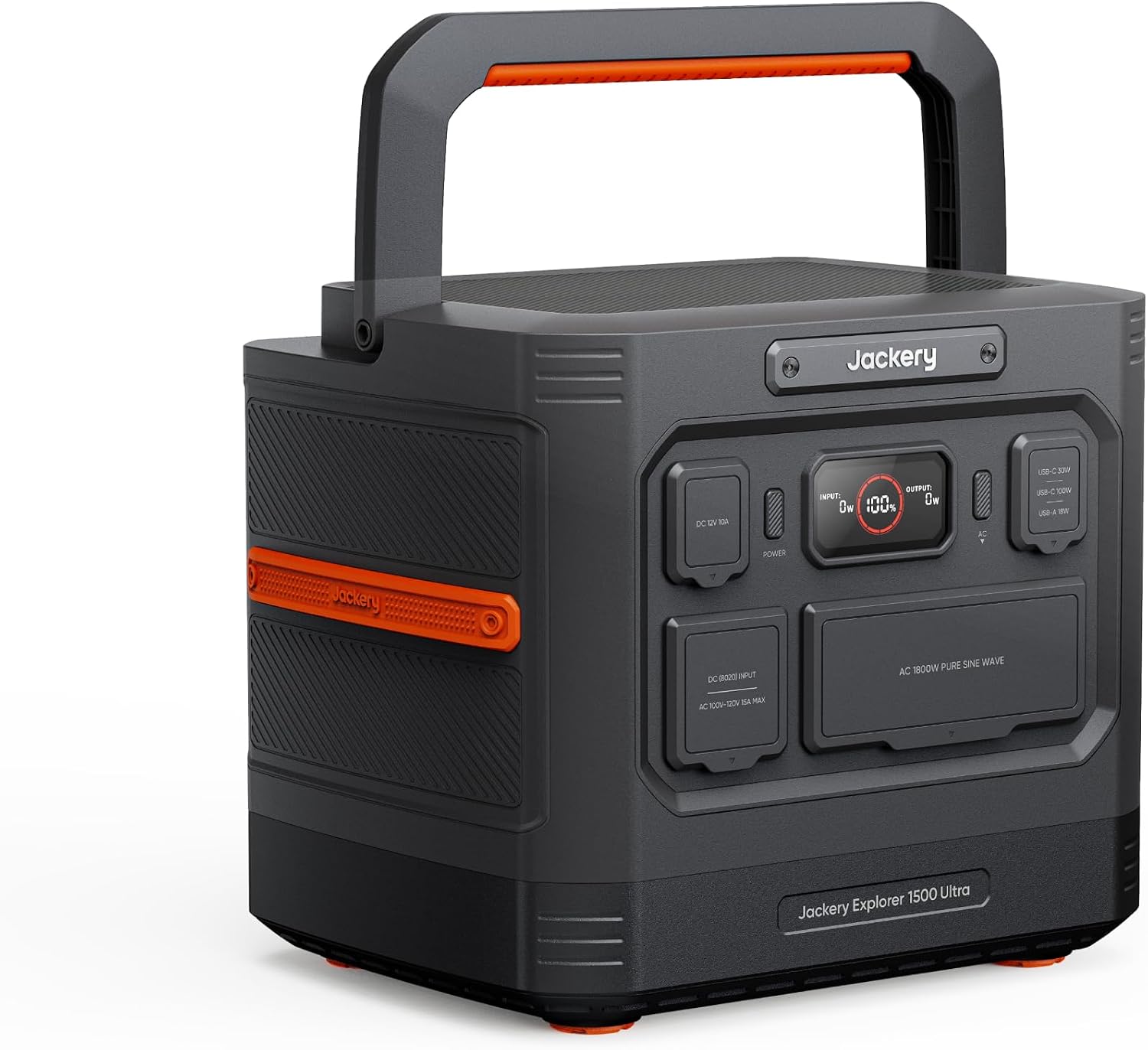
Jackery Explorer 1500 Portable Power Station (1534Wh)
About a third more capacity than the AC180, so it feeds more high-draw appliances — but it’s noticeably bigger, heavier, and slower to recharge.
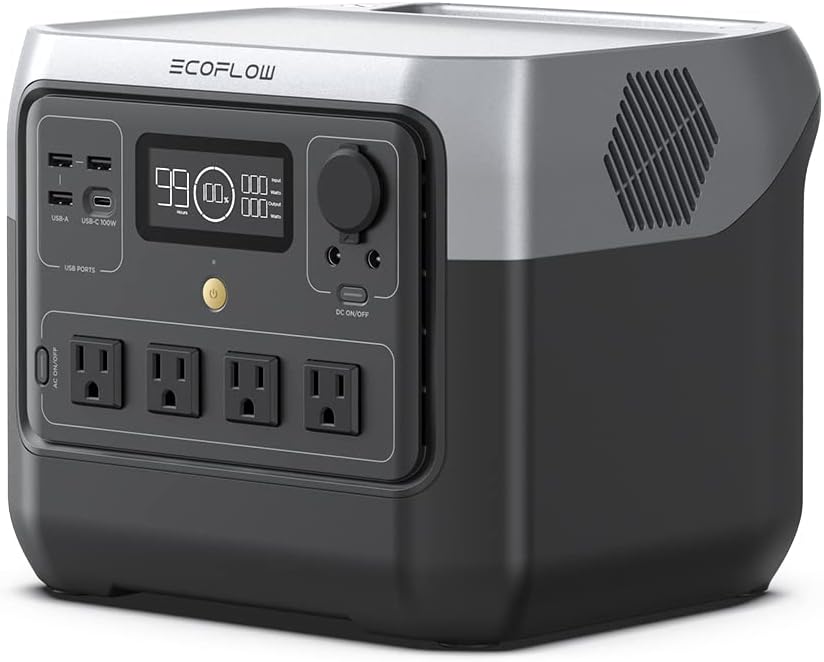
EcoFlow RIVER 2 Pro Portable Power Station (768Wh)
Smaller and lighter at around 17 pounds — handy for short trips and keeping in the car, though its output is roughly half the AC180’s.
Prices and availability may vary — tap any product to check the current listing.
Still comparing? Our reviews of the Anker SOLIX C1000 Gen 2 and the EcoFlow RIVER 2 Max cover the two closest rivals in this class.
What to Look For in a Mid-Range Portable Power Station
Capacity gets all the attention. It’s the number everyone quotes, and honestly it’s the number most buyers overthink. A roughly 1.1 kWh unit like the AC180 isn’t twice as useful as a 600 Wh model for every camper — it depends entirely on what you plug in. Start by listing your actual loads: a 12V car fridge, two phones, a laptop, a lantern. Then think about how long each one runs. Most people skip that second step. That’s where regret comes from.
Battery chemistry matters more than marketing lets on. Lithium iron phosphate (LiFePO4) cells generally hold up better over thousands of charge cycles than older lithium-ion formulations. Translation: a LiFePO4 station is more likely to still be healthy five camping seasons from now. The AC180 uses LiFePO4, as do its two rivals here. Older or budget chemistry in this class is the corner-cutting to watch for — a lower sticker price can quietly cost you half the lifespan.
Output rating decides which appliances are even allowed at the party. Heating devices — kettles, hair dryers, electric stoves — are the killers: they pull far more watts than anything else you’d bring camping, and most mid-range stations simply say no. The AC180’s app-controlled boost mode coaxes compatibility out of some higher-wattage resistive loads that would otherwise trip a standard outlet. Handy? Sometimes. Magic? No. Treat boost as a convenience for edge cases, not a promise that any appliance works.
Recharge speed shapes your whole trip rhythm. An older-generation station might need most of a day on the wall to refill, which means planning your charging around nights at a powered site. Newer units in this class refill in a fraction of that time. Faster charging means you can top up during a lunch stop or a single evening at a friend’s house and be ready for another weekend. If you camp back-to-back weekends, this is the spec — sorry, the trait — that keeps you sane.
Solar input is the other half of the independence story. The AC180 accepts a generous amount of panel power for its class, so more of your afternoon sunlight becomes stored energy instead of wasted potential. But that only helps if you buy enough panel wattage to feed it. A single 100W panel won’t impress anyone. Match panel capacity to the station.
Weight and portability are where spec sheets lie to you. The AC180 sits in the mid-30s pound range — one strong person can manage it, nobody will call it light. The Jackery Explorer 1500 is heftier still; the EcoFlow RIVER 2 Pro is dramatically lighter, and you feel that difference every time you move it. If you’re loading gear solo, weight deserves equal billing with capacity.
Matching the BLUETTI AC180 to Your Camping Style
Let’s talk personas. Not the marketing kind — the three campers who actually show up at campgrounds.
The long-weekend family camper. Two adults, a couple of kids, a minivan full of gear. The car fridge runs all weekend, phones charge overnight, a laptop streams movies after dark. This is the AC180’s home turf: its capacity covers a three-day weekend of these loads, and with a solar panel or two you stretch that further. Going smaller would mean rationing; going bigger, weight and money you don’t need.
The van lifer / overlander. You live out of the vehicle for weeks. Every day needs power for the fridge, camera batteries, a laptop for editing, maybe a drone. For you, the AC180 is a secondary power source — solid, reliable, easy to move between the van and the tent — but probably not your primary system if you’re running heavier loads. Pair it with rooftop solar and it earns its keep as the flexible backup that never asks for attention.
The prepared homeowner. This one’s not camping at all. Storm season knocks out power for a day or two, and the fridge, the router, a few lights, and phone chargers keep life bearable. The AC180’s capacity handles the essentials through an outage without the noise and fumes of a gas generator. It’s not a whole-home solution — don’t even think about the AC unit — but for keeping the important stuff alive, it quietly does the job.
And who’s it not for? The solo backpacker, obviously — this much battery in a backpack is a non-starter. The RVer with a rooftop air conditioner, also no. If your heaviest load is a phone and a lantern, save your money and go smaller. Simple as that.
Mid-Range Portable Power Stations: Tier Comparison
The market roughly splits into four tiers. Each has a job. None is “better” in the abstract — they’re better at specific things.
| Type / Tier | Best For | Price Tier | Key Feature | Watch-Out |
|---|---|---|---|---|
| Compact (<600 Wh) | Day trips, solo campers | Budget-friendly | Light enough to carry one-handed | Won’t run a fridge for a full weekend |
| Mid-range (~1–1.2 kWh) | Family camping, outages | Mid-range | Balanced capacity and portability | Weight creeping into two-person-carry territory |
| Large (~1.5 kWh) | Van life, group trips | Upper mid-range | Runs bigger appliances longer | Heavy; slower recharge per kWh |
| Home backup (2 kWh+) | Extended outages | Premium | Expandable, near-generator replacement | Overkill and overweight for most campsites |
Compact units are the minimalist’s answer: cheap, cheerful, and gone by Saturday afternoon if you push them.
The mid-range tier — where the AC180 and the EcoFlow RIVER 2 Pro both live — is where most campers land after their first season of borrowing a friend’s gas generator. It’s the “enough for a real trip” zone.
Large units like the Jackery Explorer 1500 step up when you stop asking “will it last the weekend?” and start asking “can it run the electric kettle?” More capacity, more weight, more everything.
Home backup behemoths are a different purchase entirely. If you’re comparing them with camping units, you’ve probably overscoped — unless your camping is really just “the power went out again.”
Three Camping Scenarios, Worked Through
Weekend at a State Park
You arrive Friday evening. The car fridge gets plugged in before the tent goes up — priorities. Saturday, phones and a speaker charge while you hike. Evening: lantern, string lights, a laptop for a movie. Sunday morning, the fridge hums along while you pack.
This exact load pattern is what the AC180 was designed around: steady low-draw devices plus one medium-draw appliance, refilled by solar during Saturday’s sunshine. A smaller unit would force you to unplug the fridge Saturday night “just in case.” With the AC180, you don’t think about it. That mental freedom is the product’s main selling point.
The EcoFlow RIVER 2 Pro handles the same weekend, just with less margin — you’ll be topping up Saturday afternoon, and if clouds roll in, Sunday gets tense. The Jackery Explorer 1500, meanwhile, yawns through the whole thing and asks for more. Which brings us to…
Boondocking for a Week
No hookups. Seven days. This is the endurance event, and endurance events are won with solar, not battery.
Any of these stations can do a week off-grid if solar input keeps pace with daily consumption. The AC180’s edge here is its higher solar charging ceiling — with enough panel wattage, a sunny day replenishes a day’s usage. But people buy a mid-range station, pair it with one small panel, and wonder why day four feels thin. The panel is the engine; the battery is just the fuel tank.
For a full week, the larger Jackery actually has a case: its bigger tank smooths over cloudy days. The smaller EcoFlow lives panel-to-panel — fine in the desert Southwest, stressful anywhere else.
The Storm-Season Backup
Different math entirely. No solar coming (the panels are in the garage, it’s raining, you’re not setting them up in a storm). You’re running down the stored charge, full stop.
The AC180 covers the essentials — fridge, router, lights, phones — through a day or two of outage. Its fast wall recharge matters most after the outage: when power flickers back for a few hours, you refill before it drops again. Recharge speed is the most underrated trait in this category. Everyone shops capacity. Nobody shops the refill.
Common Mistakes First-Time Buyers Make
Mistake one: shopping capacity without listing loads. Before you buy any station, write down what you’ll actually run and for how long. The math takes five minutes and saves buyer’s remorse. Every. Single. Time.
Mistake two: forgetting the recharge side. A power station is a battery, not a generator — it doesn’t make energy, it stores it. If your trip is longer than one full charge, you need a recharge plan: solar panels, a car alternator connection, or a stop at a powered site. Buying the station without the refill strategy is buying half a solution.
Mistake three: treating boost modes as a free lunch. Boost can make some higher-wattage appliances work — genuinely useful in a pinch. But it comes with trade-offs: lower efficiency, faster drain. Use it for the kettle once, not as a daily driver. Need high wattage regularly? Buy a bigger station.
Mistake four: ignoring the weight until it’s in the car. Mid-30s pounds sounds manageable on a product page. At the trailhead, after you’ve already carried the tent, the cooler, and the camp chairs, it feels like an anchor. If you’re a solo camper or have any mobility limits, handle a station in person before buying — or go one tier smaller.
Why, How, and What: The Three Questions Everyone Asks
Why do so many campers pick a mid-range station over a bigger one? Because camping has a weight budget, not just a money budget. A ~1 kWh unit like the AC180 covers the realistic load list — fridge, lights, devices — while staying carryable by one person. Go bigger and every trip involves a dolly conversation. Go smaller and you’re doing energy math at midnight. The middle is popular because it’s the least annoying choice, and there’s real wisdom in that.
How should you size a station for your trips? List your devices, note each one’s rough draw, and multiply by hours of use. Add a cushion for the fridge compressor cycling more in heat. If your total lands well under a mid-range station’s storage, you’re in the right tier; if it barely fits, step up. This back-of-envelope math beats reading twenty reviews. Seriously.
What actually separates the BLUETTI AC180 from its rivals? Honestly? Less than the marketing suggests, more than nothing. Against the Jackery Explorer 1500, the AC180 trades capacity for portability and faster recharge — you’ll carry it more, you’ll wait less. Against the EcoFlow RIVER 2 Pro, it trades lightness for breathing room — more storage, heavier to move. The app-controlled boost mode and the fast refill are the AC180’s genuine differentiators. Everything else is preference and price tier.
Questions People Ask Before Buying
Straight answers, no fluff
Is the BLUETTI AC180 worth it compared to cheaper portable power stations?
Yes, if you camp more than a few nights a year and run a 12V fridge — the combination of LiFePO4 longevity, fast recharging, and enough capacity for a long weekend justifies the mid-range price over budget models that die young or can’t keep a fridge cold overnight. Cheaper models tend to cut corners: older battery chemistry, slower charging, or inflated capacity claims. If your trips are single overnights and your heaviest load is a phone, a smaller unit is the smarter buy — you’re not using what you’d pay for.
BLUETTI AC180 vs EcoFlow RIVER 2 Pro: which one should I get?
Get the AC180 if you want more energy storage for running a fridge through a long weekend without recharging mid-trip; get the RIVER 2 Pro if you prioritize light weight for easy solo carrying and the fastest possible recharge between frequent short trips. The RIVER 2 Pro is the grab-and-go athlete — around 17 pounds, quick to refill, built for car camping and short hops. The AC180 is the endurance pick — more storage, heavier to carry, with a boost mode for edge-case appliances. Choose by how you travel, not by the spec sheet.
How big of a power station do I need for a weekend camping trip?
For a typical family weekend with a 12V car fridge, phones, a laptop, and camp lighting, a mid-range station in the ~1 kWh class — like the AC180 — is the right size, giving you a comfortable margin without excess weight. The fridge is the anchor load: it sips power but runs constantly, defining your baseline. Everything else is rounding error by comparison. Solo campers can go smaller; groups running electric cooking gear should go bigger. Size up one tier from your bare minimum — heat makes every compressor work harder than the brochure assumed.
Can the AC180 keep a full-size refrigerator running during a power outage?
It can keep a full-size home fridge running for a meaningful stretch of an outage — typically through a day — but it’s designed around camping loads, not whole-home backup, so don’t expect multi-day coverage without solar or another recharge source. Home fridges cycle on and off, drawing less on average than their startup surge suggests — which is why a mid-range station handles them better than expected. Plug in the fridge, the router, and a couple of lights; leave the rest unplugged. For longer outages, pair it with solar panels — even partial sun extends your runway.
Is the boost mode on the AC180 actually useful, or is it just marketing?
It’s genuinely useful for occasional resistive loads like a kettle or a small heater, letting the station run appliances that would normally trip it — but it comes with lower efficiency and shorter runtime, so it’s an emergency tool, not a daily habit. Think of boost as the station borrowing against itself: more watts now, faster drain and more heat. Boiling water for coffee, warming the tent for ten minutes — genuinely useful. Using it as a strategy for every meal? You’ll be recharging constantly. Respect the trade-off and it earns its place.
Frequently Asked Questions
How long does the BLUETTI AC180 take to recharge with solar panels?
It depends on your panels and the sun. With a solid 400–500W of panels in good light, a full recharge typically takes a few hours; with one small panel, think a full sunny day. Size your panels to your trip, not to the minimum.
Can I bring the BLUETTI AC180 on a plane?
No. Portable power stations in this capacity class far exceed airline lithium battery limits, and they can’t go in checked luggage or carry-ons. Plan for road trips and car camping — that’s what it’s built for.
Does the AC180 work as a UPS for my computer?
It offers a pass-through UPS-style function that switches connected devices to battery when wall power drops, with switching fast enough for most computers. It’s a convenience for brief outages, though — not a replacement for a dedicated UPS if you run sensitive equipment around the clock.
How noisy is the AC180 when charging or running?
Quiet enough for a campsite. The fans stay low during normal loads and ramp up during fast charging. You won’t hear it from the next tent over. Comparable to or quieter than most in its class.
Can I charge the AC180 while using it at the same time?
Yes — pass-through charging lets it accept solar or wall input while powering your devices. It’s one of the genuinely practical features for long trips: set up the panels in the morning and keep living your day. Just know that simultaneous charge and discharge generates more heat, so the fans work harder.
Will the AC180 run my CPAP machine overnight?
In most cases, yes, comfortably. A CPAP without its heated humidifier draws modest power, and a station in this capacity class typically covers a full night’s sleep with room to spare. Skip the humidifier heat function if you want maximum runtime — heating elements are always the biggest drain.
How should I store the AC180 between camping seasons?
Store it at roughly half to three-quarters charge in a cool, dry place, and top it up every few months. LiFePO4 chemistry is forgiving, but batteries left at zero or 100% for a year don’t age gracefully. A quick calendar reminder does the job. Your future self says thanks.
Not sure what fits your setup? Our portable power station sizing guide walks through the real-world math.
Final Recommendation
The BLUETTI AC180 is the pick for campers who want to stop thinking about power. It covers the real weekend load list — fridge, devices, lights — recharges fast when you get wall or sun time, and its LiFePO4 battery should outlast your camping ambitions. If you travel solo and light, save money and weight with a compact unit. If you run hungry appliances regularly, step up to a larger station.
For everyone in between — which is most campers, honestly — the AC180 lands right in the pocket. Few purchases make a campsite feel this civilized.
Pair it with enough solar to cover your daily draw, size your loads honestly, and it will quietly handle season after season. That’s the whole pitch — no drama, just power where you want it.
OUR TOP PICK
BLUETTI AC180 Portable Power Station (1152Wh LiFePO4)
Our pick for campers: generous capacity, fast recharge, and app-enabled boost for surge-hungry appliances.

