This site contains affiliate links. We may earn a commission on qualifying purchases.
The first quote said $13,900. The second one, for the same 22kW machine, same house, same panel, said $10,400. Nothing about my house changed between those two visits. What changed was what each installer decided to put on the paper, and what each one quietly left off it.
So here is the short answer people actually want. A Generac home standby generator, the permanently installed kind, runs about $8,000 to $16,000 all-in for a typical U.S. project, and that range comes from Generac itself, not from a dealer brochure. The generator is roughly a third of that money. One third. The other two thirds are the switch, the wire, the gas line, the pad, the permits and the labor, which is why two honest quotes can sit $3,500 apart and both be telling a version of the truth.
Portables live in a different universe, and I will get to them, because plenty of people asking this question do not need a standby unit at all. A Generac portable big enough to matter costs hundreds, not thousands, and installs with your own two hands and an extension cord budget. Mixing those two categories in one search is how people end up comparing a $900 machine against a $13,900 project and concluding that somebody is robbing them. Nobody is. They are different products that happen to share a logo.
The number on the box is the propane number
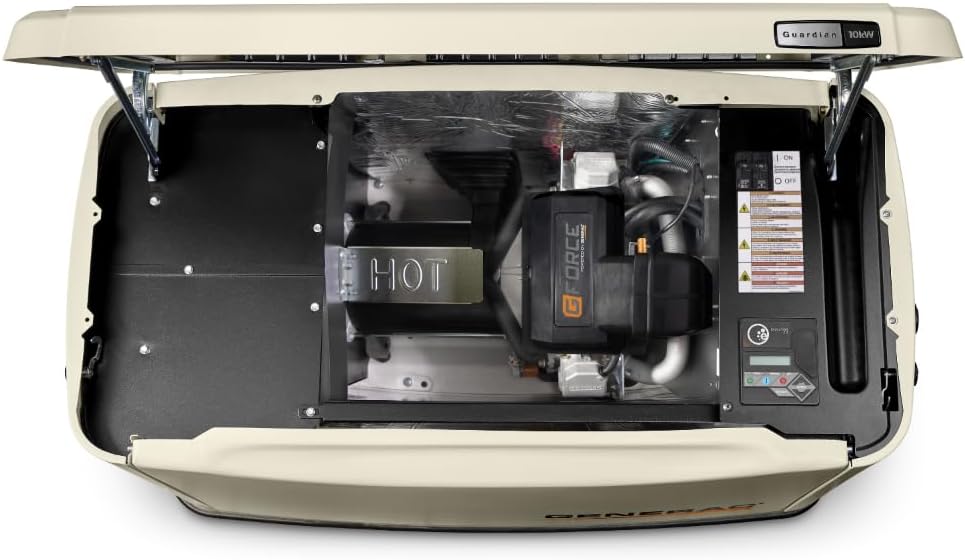
Start with the rating, because the rating quietly inflates everything downstream. The 22kW Guardian package, model 7043 with the 200-amp whole-house transfer switch in the box, lists at $6,979 to start, and retail listings have shown it around $6,839. That 22kW figure is the output on liquid propane. Feed the same machine natural gas, which is what most suburban installs actually do, and the spec sheet says about 19.5kW.
Still a lot of power. Not the point.
The point is that every cost-per-kilowatt calculation you do in your head, every comparison against a 20kW quote from another brand, every argument about whether you need the 22 or could live with the 18, should run on 19.5 if a gas line is feeding it. At $6,979 for the package, that is roughly $358 per usable kilowatt on natural gas against roughly $317 on the propane number. Same machine. Same check. The denominator moved, and nobody at the sales table volunteers the smaller one. Actually, no. One of my three installers did, unprompted, and he is the one whose quote I kept.
That same trick runs down the whole range. The 10kW Guardian package with a 100-amp, 16-circuit switch, model 7294, is the entry point of the standby line, and its rating carries the same fuel split in miniature. When I priced the spread between standby models, the honest way to compare was dollars per natural-gas kilowatt, switch included, because the switch is not optional equipment. It is the thing that makes the machine legal to connect. A quote that prices the generator alone and discovers the switch later is not cheaper. It is unfinished.
Where the other two thirds go
The pad first, because it is the line item people laugh at until they price concrete. A precast or poured pad for a standby unit runs around $1,000 for a pad of roughly eighteen square feet in the estimates I collected, depending on frost depth and local code. Some installs sit the unit on gravel and skip most of that. Some towns will not. The difference between those two answers is a few hundred dollars and it lives entirely in your local inspector’s habits, which no national price guide can see.
Electrical work is the fattest variable. The 7043 package includes the 200-amp switch as hardware. Mounting it, wiring it into your service and getting it inspected is separate money, and transfer switch installation commonly lands around $1,200 to $1,600 before anything goes wrong. Things go wrong in specific, billable ways. A full panel that needs replacing. A service entrance on the opposite side of the house from where the generator can sit, which turns a short conduit run into a long one. A subpanel because the circuits you want backed up are not where the switch wants them. My second quote carried a panel line the first quote never mentioned, and when I asked the first installer about it he went quiet in the way that means the number would have appeared later, as a change order, at change-order prices.
Gas is the sleeper. A short run from an existing meter with capacity to spare is a modest line item. A long run is pipe, trenching and labor by the foot. And if the meter and regulator cannot feed a generator on top of a furnace and a water heater, the utility gets involved, and utility timelines do not care about your outage anxiety. Propane houses skip the meter question and buy a tank question instead. I have not priced a propane tank install at my own place, so I am not going to invent a number for one. Ask locally. That answer changes by county, never mind by state.
Labor for the installation portion, across the national cost data I went through, sits somewhere around $1,500 to $5,000 for standby work, with permits, placement and wiring folded into the broader averages at roughly $4,500. Wide range. Useless range, almost, except for one thing it teaches: the install is a construction project with a generator in the middle of it, and construction projects are priced by the house, not by the catalog.
The portable door out of this price range
Here is the thing: a standby quote is an answer to a specific question, which is whether the power should come on by itself, at 3 a.m., with nobody home. If your actual question is keeping the fridge cold and the furnace blower turning during the outages you get, a portable and a legal inlet hookup answer it for a tenth of the money, and you give up the automation, not the heat.
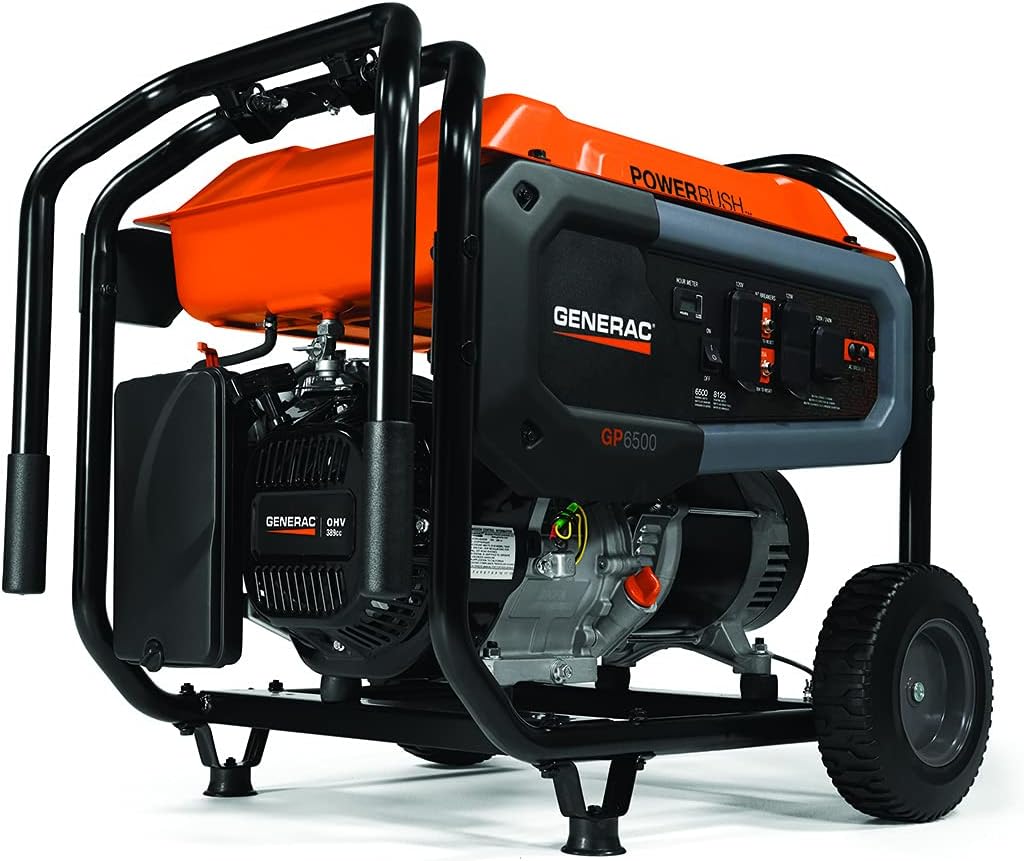
The GP6500 is the portable I keep coming back to in this range, 6,500 running watts and 8,125 starting watts with the COsense shutoff, at $799 to $899 across the tool retailers I checked the week this was written. The GP8000E steps up to 8,000 running watts and electric start, and gives up nothing on the COsense front. Neither one needs a pad, a permit for the machine itself, or a gas line. Both need you home, awake and willing to wheel 172 to 214 pounds of generator out into the weather, because that is the trade, stated plainly. The standby premium is not buying watts. Watts are cheap. The premium buys the machine starting without you.
When the GP8000E ran a neighbor’s house through the tail of an outage last winter, the exhaust note carried two doors down and stayed there, a mower that never finishes the lawn. That is Site reality for every open-frame portable in this class, Generac included, and it is the complaint that follows these machines around. Standby units are not quiet either, they are just enclosed, set on a pad, and far enough from your bedroom window that the weekly exercise run becomes a background fact instead of an event.
Three Rungs of the Generac Ladder
One standby package that starts itself, and the two portables people buy when the standby quote lands too high.
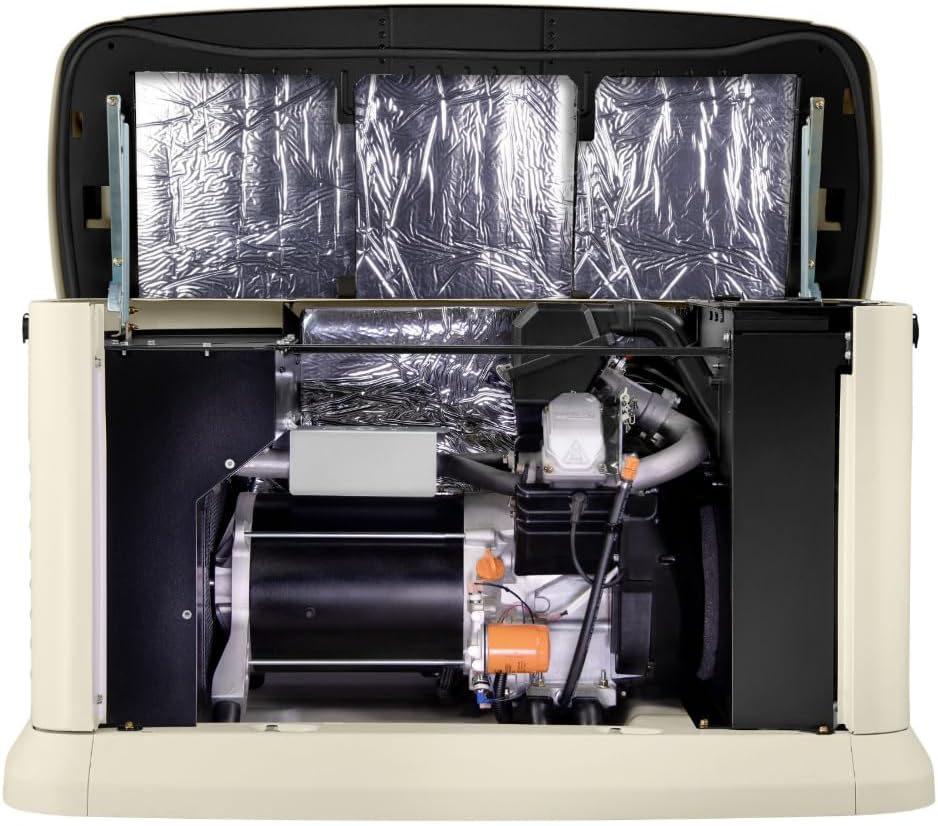
Generac Guardian 10kW Standby Generator (7172)
10kW on propane and 9kW on natural gas with a 100-amp, 16-circuit transfer switch, listed at $4,189 at one tool retailer and rated 4.9 stars across 81 ratings there; the starting battery is not in the box, and neither is the install
Generac GP6500 Portable Generator
6,500 running watts and 8,125 starting watts with COsense shutoff and a 20-foot cord in the box, rated 4.7 stars across 660 reviews at the big home-improvement chain; no pad, no permit for the machine, no gas line — and no starting itself at 3 a.m. either
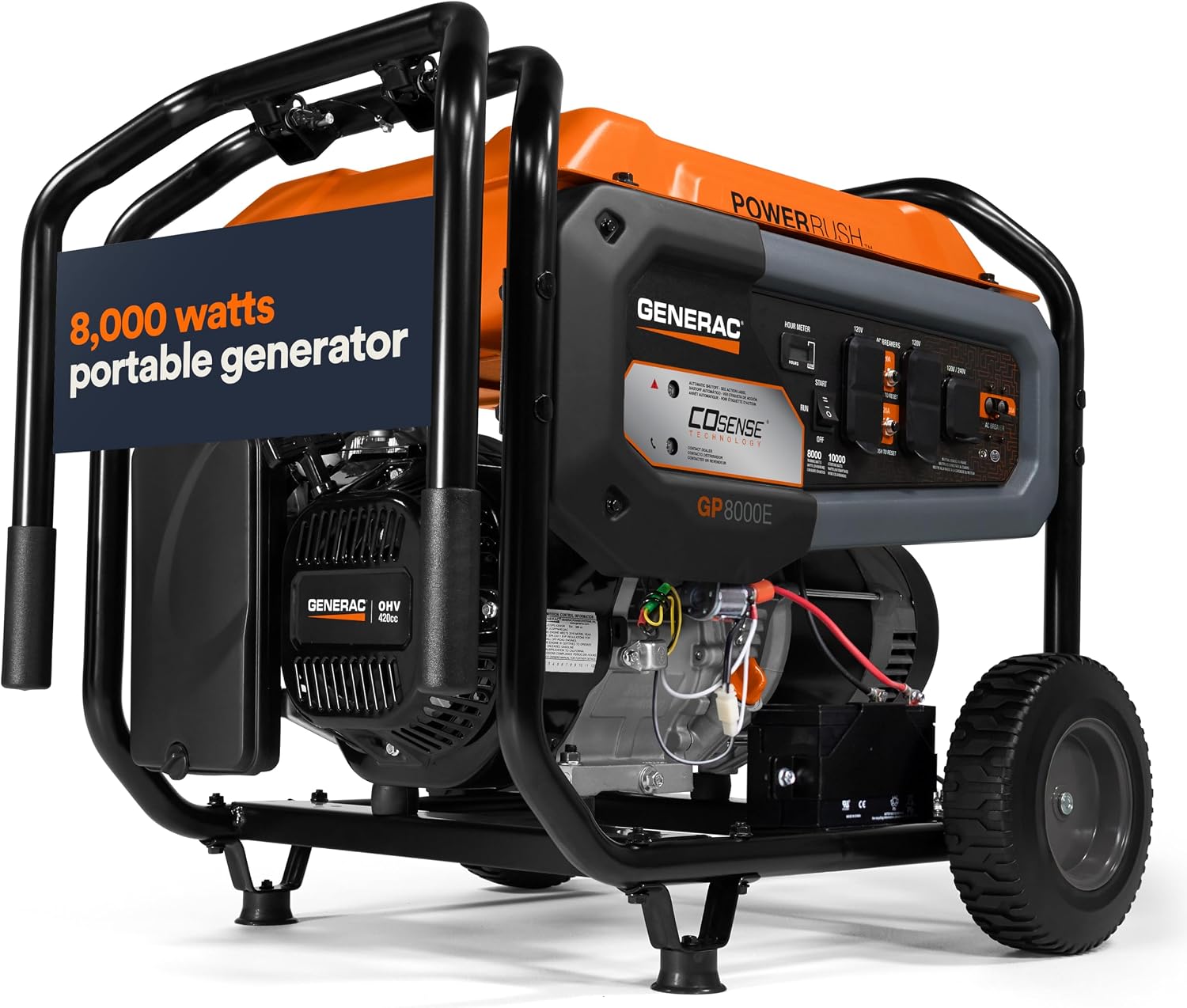
Generac GP8000E Portable Generator
8,000 running watts and 10,000 starting watts with electric start and COsense, on a 7.9-gallon tank; the extra watts are the cheap part — the 214 pounds and the exhaust note are what nobody puts in the headline
This site contains affiliate links. We may earn a commission on qualifying purchases.
Look at the review pattern across this range, because it is the most useful data on this page and it is not hiding in the averages. I pulled the Generac review pages at the big home-improvement chain on October 28, 2026. The 10kW standby package sits at 4.7 stars across 4,084 reviews, with 120 of those reviews at one star, about 3 percent. The gasoline GP6500 sits at 4.7 across 660 reviews, 16 of them one-star, about 2 percent. Then the dual-fuel version of that same GP6500, the GP6500E DF, drops to 4.2 stars across 142 reviews, and 26 of the 142 are one-star. Better than eighteen percent. Read those twenty-six and the same sentence keeps forming: fuel leaking from the carburetor or the shutoff valve on a brand-new machine, in two cases on the replacement unit as well. Same platform, same 6,500 watts, two completely different ownership stories, and the difference is a fuel valve. It also reframes the standby premium in a way I did not expect. The permanently installed machine, the one that costs five figures to put in, carries the thinnest angry tail of the three relative to its price, because a dealer commissions it and somebody checks the fuel connections before it ever has to work. The portable asks you to be that somebody. If a dual-fuel GP6500 is the one in your cart, the first fill happens in the driveway, nose working, not in a dark garage during an outage.
What does the yearly exercise cycle actually burn?
A running standby generator costs fuel every week whether the power fails or not, and the 22kW burns roughly 228 cubic feet of natural gas per hour at half load. That half-load figure comes off the manufacturer spec sheet, along with about 327 cubic feet per hour at full load and roughly 2.5 gallons of propane per hour at half load. The weekly self-test runs at low speed for a few minutes, so the test itself is pocket change. During the commissioning run on the install I sat in on, after about thirty minutes under load I put the back of my hand near the enclosure vent and got a steady push of hot air, not a leak, just the thermal design working exactly as hard as the spec sheet quietly admits it has to. A two-day outage at half load is not. Run the 22kW through 48 hours of half-load natural gas and you are looking at something near 10,900 cubic feet, which lands on the same gas bill as the furnace it kept alive. Nobody quotes you the outage itself as a line item. It is one.
Ownership keeps billing after that. Oil, filter and plugs on the service interval, a few hundred dollars a year if a dealer does it on a maintenance plan, less if your own hands do it with the manufacturer’s kit. A starting battery that is a separate purchase on many standby quotes and a replacement every three to four years after that. An extended warranty that stretches the standard five-year limited coverage toward seven or ten, priced as an add-on at signing, cheaper then than later. Add a decade of it up and the standby machine’s second price, the quiet one, lands somewhere in the low thousands on top of the project. I keep a spreadsheet. Of course I keep a spreadsheet. The column that surprised me was not fuel. It was the battery, twice in ten years, plus the one service visit that found a rodent nest in the enclosure, which is a cost category no brochure has ever printed.
Is a smaller Generac with load management cheaper than a 22kW?
Yes, often by thousands, because load management modules let a 14kW or 18kW unit carry an air conditioner it could not start unaided. The modules watch the big loads and stage them, so the AC, the dryer and the oven stop demanding their surges in the same second. That is the honest alternative to buying the biggest air-cooled box Generac sells. It is also the line item that separates a sizing conversation from a sales conversation. An installer who walks your panel, asks about the AC tonnage and talks about managed loads is selling you a system. An installer who quotes the 22 before asking a single load question is selling you a 22. The watts-to-run-a-house math matters here, and I have worked through how many watts a house actually draws in a separate piece, peak against average, because that gap is where the money hides.
For the standby hardware itself, including what the 14kW class does and does not cover, the Generac 14kW home generator review on this site is the deeper read. And if the portable route is the one that survives your budget, the connection still has to be legal, which is why I wrote up how to hook a generator up to a house through a switch or an interlock rather than a cord with two plug ends and a prayer.
Frequently asked questions
My quote says 22kW but the house runs on natural gas. How many kilowatts am I actually buying?
About 19.5kW. The headline rating on the Guardian air-cooled range is the propane figure, and natural gas delivers less energy per cubic foot through the same engine, so the same unit makes roughly two and a half kilowatts less on it. That is still enough for most houses with managed loads, and it does not make the quote dishonest on its own. It makes any dollars-per-kilowatt comparison dishonest if you run it on the bigger number. Ask the installer to write the natural gas output on the quote itself. The good ones already do.
Two installers quoted the same generator $3,500 apart. Which one is lying?
Probably neither, and that is exactly what makes standby quotes so hard to compare. Lay the two side by side and the gap usually turns out to be scope wearing a price tag: one included the pad and the other planned gravel, one priced a panel replacement the other never mentioned, one bundled the extended warranty and a year of maintenance while the other left both for later. Ask both for the same itemized list, equipment, switch, gas run in feet, electrical work, permits, pad, battery, warranty years, in writing. The quotes that survive that request are the ones worth arguing about. The one that gets vaguer under it has told you what you needed.
Is the starting battery really not included in a five-figure project?
On many standby installs, correct, the battery is a separate line, and it catches people off guard precisely because everything else about the project feels so complete. The generator cannot crank itself without one, so it is not an optional extra in any practical sense, it is just billed like one. Check your quote for it before signing, along with who owns the first-year service visit. Neither item is expensive next to the project total. Both are annoying in direct proportion to how late you find out about them, and the battery will want replacing every three to four years for as long as you own the machine, long after the installer has stopped returning your calls about anything else.