
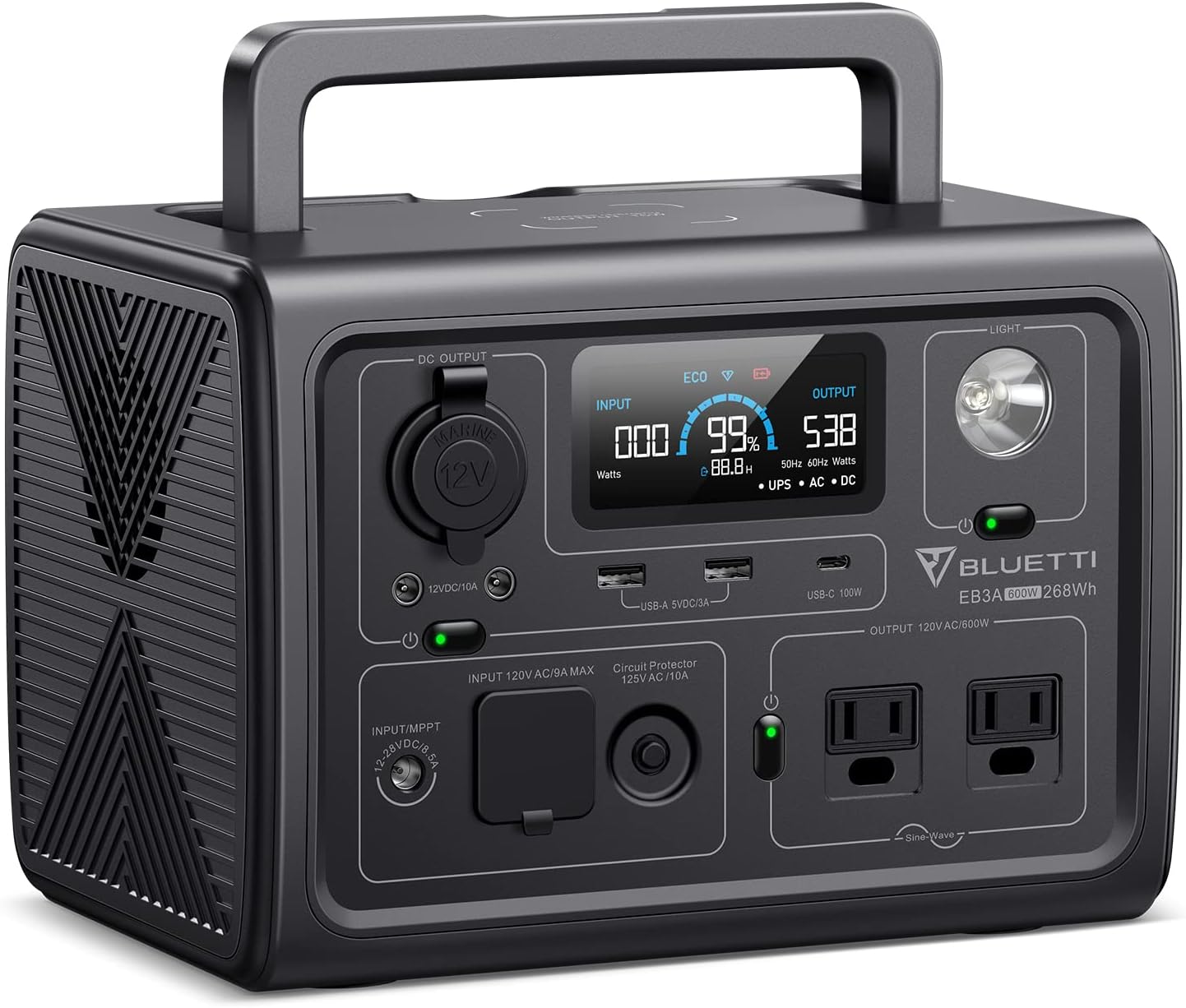
BLUETTI EB3A Review: 268Wh, 600W AC, 30-Minute Fast Charging
The BLUETTI EB3A looks like every other small gray box in the portable power station aisle — until you read the output number. 600W of AC power in a 268Wh station is unusual, and it changes the list of things you can plug in. Add a UPS mode and famously quick charging, and the EB3A becomes the small station for people with slightly bigger ambitions. This guide covers what those numbers mean in real life, who the EB3A fits, and where a lighter, slower rival might serve you better.
Quick Answer
The BLUETTI EB3A is the small station for buyers who need more muscle: 600W of AC output handles appliances that stop rival stations cold, and the UPS mode keeps a desktop setup alive through power flickers. Charging is blisteringly fast. The trade-offs: it’s heavier than the ultralight class, and 268Wh still drains quickly under a 600W load — power and endurance are different things.
Compare Top Portable Power Stations
Three proven picks side by side — choose the one that fits your needs.
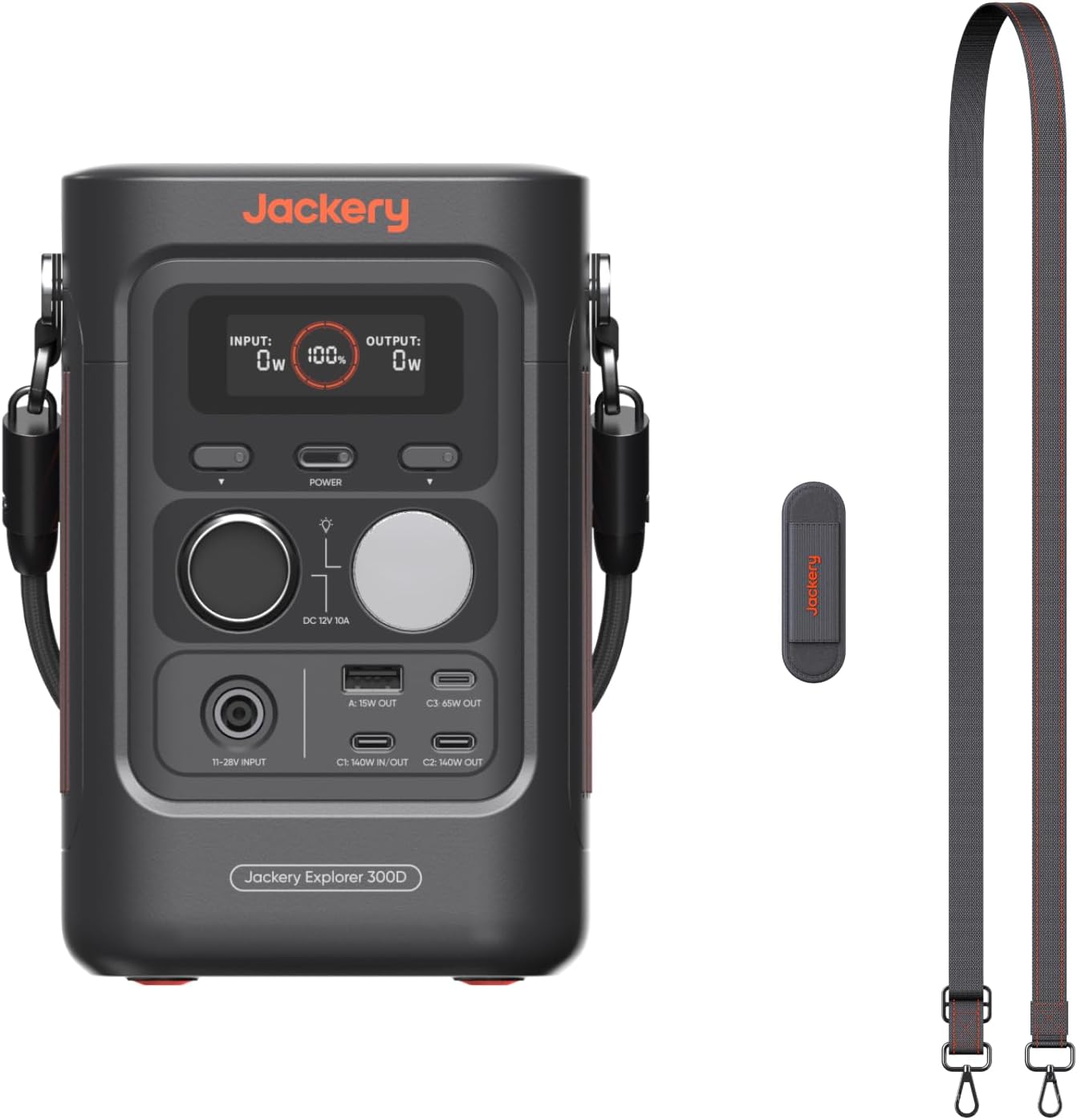
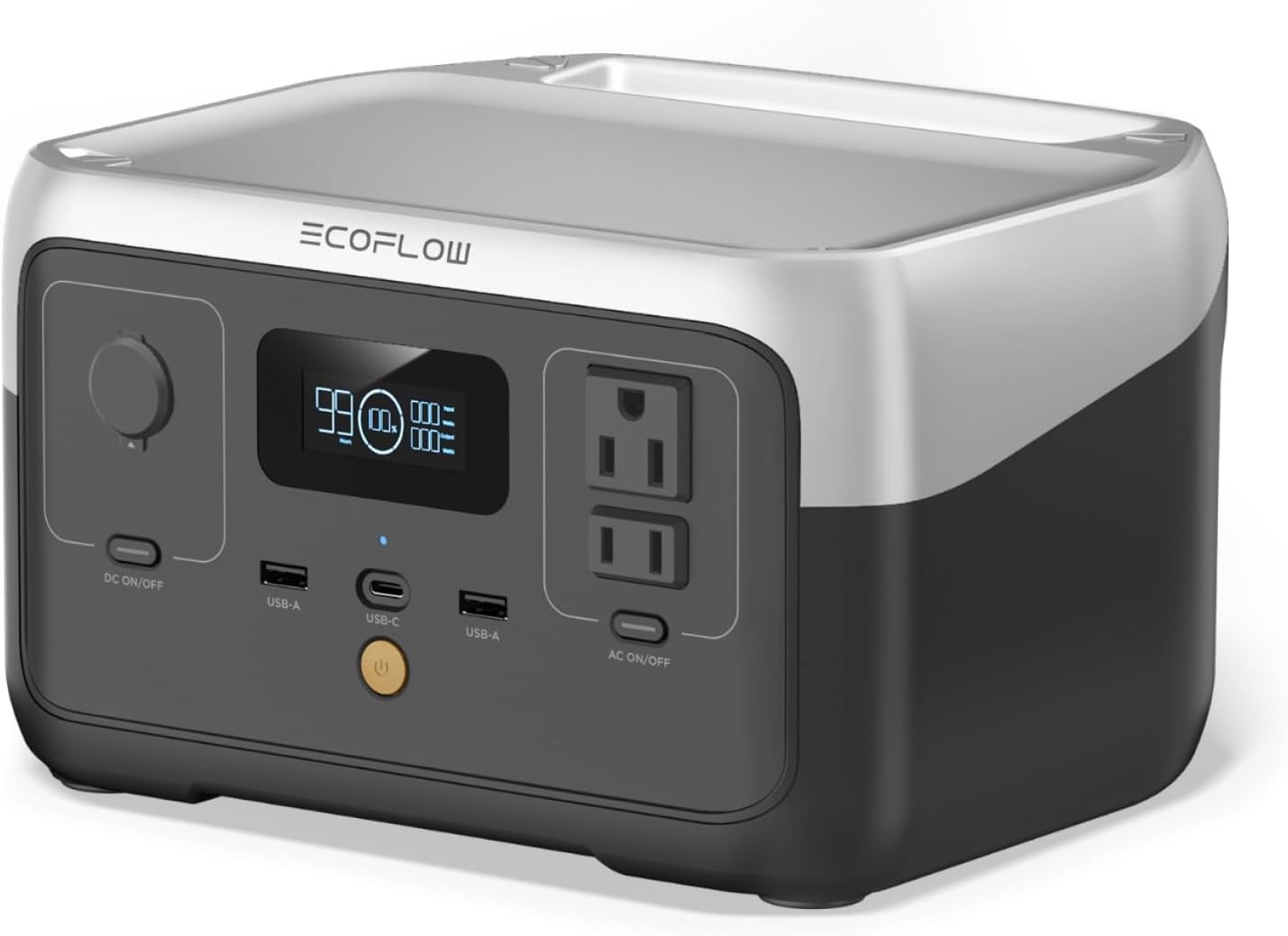
Prices and availability may vary — tap any product to check the current listing.
Still comparing? Our reviews of the Jackery Explorer 300 Plus and the EcoFlow RIVER 2 cover the two closest rivals in this class.
What to Look For in a Portable Power Station
The EB3A’s spec sheet reads like a dare: small battery, big inverter. Here’s how to read the numbers that actually matter — for this station and any rival.
AC output: why 600W is the headline
Most 268Wh-class stations top out around 300W. The EB3A doubles that. In practice, 600W is the line between “electronics only” and “small appliances welcome”: a mini rice cooker, a small kettle, a blender, or a compact power tool — loads that trip a 300W inverter.
Here’s the part people miss: 600W of output with 268Wh of capacity means roughly half an hour at full tilt. The inverter is a sprinter’s legs on a middle-distance runner’s lungs — not a flaw, a design choice. Run bigger things briefly: boil water, blend a smoothie, top up a tool battery. Just don’t plan 600W all afternoon. Respect the tank.
Battery chemistry: the LiFePO4 question
The EB3A uses LiFePO4 cells — the chemistry that has quietly taken over the serious end of this category. Translation: thousands of cycles before meaningful degradation, better thermal stability, and a station that survives years of weekend abuse instead of fading after a couple of seasons.
For a station cycled hard — monthly camping, a few outages a year, maybe daily as a UPS — chemistry is the difference between a three-year purchase and a decade-long one. It’s what separates the EB3A from bargain stations that look similar in photos and die young. Check chemistry before price. Always.
Charging speed: 30 minutes changes the routine
The EB3A’s fast wall charging refills its battery in well under an hour — roughly half an hour from empty at full speed. Even in a category where fast charging has become a selling point, that’s startling.
The effect: you stop planning around charging. Dead at 6pm, guests at 7 — plug in while you cook and it’s ready. A 45-minute outage window? Actually captured. The caveat: all that current generates heat, and the fan will tell you. Normal. Topping up overnight with no deadline, the slower modes are gentler — free longevity.
UPS mode: the feature nobody else in this class brags about
Here’s the EB3A’s quiet superpower. In UPS mode, it sits between the wall and your devices and switches to battery fast enough that a desktop PC or router doesn’t notice the flicker. For remote workers in areas with flaky power, that’s the difference between a saved document and a corrupted one.
A warning: it’s a UPS for small loads, not a whole home. Desktop, monitor, router — perfect. Add a laser printer and a space heater and you’ll meet the overload protection. And 268Wh covers flickers and short drops, not a six-hour blackout. Different tool, different job.
Ports and display: the everyday interface
The EB3A carries the standard spread — AC outlets, USB-C, USB-A, 12V car socket — plus a clear display showing input, output, and remaining runtime estimates. The display matters more than it sounds: a station that tells you “37 minutes at this load” prevents the dead-battery surprise that ruins evenings.
With 600W available, it’s tempting to plug in everything at once. Glance at the real-time wattage readout before adding the fourth device — tripping overload protection mid-blend is annoying, and a two-second glance prevents it.
Weight and size: ten pounds of intent
At roughly ten pounds, the EB3A is noticeably heftier than the ultralight 256Wh rivals. It’s still very much portable — one hand, no strain — but it’s a “carry deliberately” weight rather than a “toss in the bag” weight.
Worth it? Depends on your answer to the 600W question. Use the bigger inverter and UPS mode, and ten pounds is a bargain. Never exceed 300W, and you’re carrying pounds for capability you’ll never touch. Be honest about your device list.
Match the EB3A to Your Life
The remote worker with flaky power
Your power doesn’t go out for days — it flickers. Three-second drops, brownouts, the occasional twenty-minute outage right in the middle of a video call. A gas generator is absurd overkill; what you need is a silent box that catches the flickers and bridges the short gaps.
In UPS mode it’s purpose-built for this life: grid hiccups, nothing reboots, the call continues. Fast recharge means it’s ready again quickly after each event. If your work depends on uptime and your grid is unreliable, this is the most cost-effective insurance in the category.
The car camper who cooks electrically
You’ve upgraded from granola bars to actual camp cooking, and you’d love to leave the gas canister at home sometimes. A small electric kettle for morning coffee, a mini rice cooker for dinner, a blender for the campsite smoothies that make everyone jealous — all of these live in the 300–600W band that stops most small stations cold.
The EB3A handles them one at a time, with power to spare for phones and lights. The 268Wh tank means you cook efficiently and move on — boil, blend, done. Pair it with a solar panel for daytime top-ups and a long weekend works. At ten pounds it’s car-camping gear, not backpacking gear.
How the Tiers Compare
Same four tiers as always — but the EB3A’s 600W output blurs the line between the second and third. Here’s where each tier actually sits.
| Tier | Best For | Price Tier | Key Feature | Watch Out |
|---|---|---|---|---|
| Mini stations (under 100Wh) | Day hikes, phone top-ups | Budget | Featherweight | No AC muscle at all |
| 268–300Wh class (EB3A’s home) | Camping, short outages, desk backup | Mid-range | EB3A brings 600W to this tier | Small tank drains fast at high watts |
| 500–1000Wh class | Multi-day trips, serious backup | Upper mid-range | Endurance to match the output | Heavy enough to live in the trunk |
| 1500Wh and up | Home backup, RV, off-grid | Premium | Runs nearly everything, silently | Price and weight of furniture |
Minis are for trails, not campsites. The EB3A’s tier is the value sweet spot — and the EB3A stretches it upward with its 600W inverter, borrowing capability from the class above without the weight penalty. The 500–1000Wh tier adds endurance to match. The big boxes impress right up until moving day.
Home Office Backup: The UPS Scenario
Let’s walk through the remote-worker’s Tuesday. The EB3A sits under the desk in UPS mode, silently passing wall power to a desktop (150W), a monitor (30W), and a router (10W) — roughly 190W total. At 2:14pm the grid drops for eleven minutes. Nothing happens. The monitor doesn’t blink, the call doesn’t drop, the document doesn’t corrupt. The station drained maybe 35Wh. By 2:40 it’s recharged.
The honest limits: a two-hour outage is fine if you dim the monitor and skip the printer. A full workday blackout gives you a few productive hours, then it’s laptop-on-battery time. And a laser printer’s startup surge will humble the 600W inverter — print before the storm.
For flickers and short outages — the most common grid annoyance by far — it’s close to ideal. For all-day blackouts, it’s a bridge, and you should know that going in.
Car Camping: What 600W Unlocks
Friday evening: lights on, two phones charging, dinner cooking — a mini rice cooker pulling 350W for 25 minutes (about 145Wh). After dinner, a small 600W kettle boils water in four minutes (roughly 40Wh). Total evening: under 200Wh, with room for a fan overnight.
Saturday, a 100W solar panel leans against the car and quietly replaces most of what the evening took. That’s the rhythm the EB3A enables: cook electrically, recharge passively, repeat. No fuel, no fumes, no 6am gas-station run.
The boundary: one appliance at a time. Rice cooker AND kettle together trips the inverter — sequence your cooking like the tiny kitchen it is. A full-size grill or 1500W kettle stays out of bounds. 600W is generous, not magic.
Common Mistakes Buyers Make
1. Confusing watts with watt-hours
Watts are the engine; watt-hours are the fuel tank. The EB3A has a big engine (600W) and a modest tank (268Wh) — impressive things, briefly. Expecting 600W all afternoon disappoints through no fault of the station. Read both numbers. Respect both numbers.
2. Buying the UPS feature and never using it
Plenty of owners bought the UPS mode, then parked the station in a closet “for emergencies” where it protects nothing. A UPS only works plugged in between wall and gear, all the time. Commit: station under the desk, always on, devices routed through it. Otherwise you paid for a feature that lives in a box.
3. Running high-wattage loads without watching the tank
The 600W inverter invites ambition, and ambition drains 268Wh fast. Kettle, blender, rice cooker back-to-back without glancing at the display is how you hit zero at the worst moment. Sequence big loads, recharge between them, and the small tank goes surprisingly far.
4. Expecting generator-grade endurance
A 268Wh station is not a gas generator, and 600W doesn’t change that. No three-day fridge backup, no power tools all afternoon. What it does — silent, indoor-safe, instant power in short bursts — generators do terribly. Buy it for its strengths.
Questions People Ask Before Buying
These are the questions shoppers actually type into search and AI assistants when they’re close to buying. Straight answers, no fluff.
Is the BLUETTI EB3A good for home backup?
For short outages and flickers, yes — especially in UPS mode, where it keeps a desktop, monitor, and router alive through drops that would otherwise reboot everything. It bridges gaps of minutes to a few hours. It is not whole-home backup: 268Wh won’t carry a household through a multi-day blackout. Think premium protection for your desk, not a generator replacement.
Does the BLUETTI EB3A really have a UPS mode?
Yes — it switches to battery fast enough to keep computers and routers running through flickers without interruption. The standout feature in its size class; most rivals this small don’t offer it. Setup is simple: station into the wall, devices into the station, leave it. It’s a UPS for a desk’s worth of gear, not a house — 268Wh covers short events, not long ones.
BLUETTI EB3A vs EcoFlow RIVER 2 — which should I buy?
Buy the EB3A for more AC muscle or a UPS: 600W runs small appliances the RIVER 2 can’t touch, and UPS mode protects desktop setups. Buy the RIVER 2 for the lightest carry and fastest recharge — a touch lighter, slightly quicker refill. Both use long-lasting LiFePO4 cells. Appliances and desk backup point to the EB3A; ultralight camping points to the RIVER 2.
Can the BLUETTI EB3A run a refrigerator?
A portable 12V car fridge, yes — easily, for a night or more. A full-size household fridge is a stretch: running wattage might fit under 600W, but the compressor’s startup surge can trip the inverter, and 268Wh drains in hours. Camp fridges: strong fit. Multi-day home fridge backup: much larger station needed.
How fast does the BLUETTI EB3A charge?
From a wall outlet at full speed, roughly half an hour — among the fastest in its class, dramatically quicker than the three-to-five-hour norm. Solar and car charging take longer, as with every station. Dead at 6pm, ready before dinner, quick to recover between outages. Fan noise during max-speed charging is normal.
Why, How, What: Quick Answers
Why does 600W matter if the battery is only 268Wh?
Because capability and endurance answer different questions. 600W decides WHAT you can run; 268Wh decides HOW LONG — minutes for big loads, hours for small ones. A 300W station with the same battery can’t run those appliances at all. Brief access to real appliance power is exactly the right trade for camp cooking and short outage tasks.
How do you set up the EB3A as a UPS?
Station into the wall, enable UPS mode, devices into the station instead of the wall. Leave it connected permanently — it passes wall power through, keeps the battery topped up, and switches automatically when the grid fails. Keep total load comfortably under 600W, skip the laser printer, and check every few months that it’s still plugged in.
What can’t the BLUETTI EB3A run?
Anything over 600W sustained: full-size kettles, microwaves, space heaters, hair dryers, large power tools. Also several medium loads at once — rice cooker plus kettle trips the overload protection, so sequence big appliances one at a time. And anything needing hundreds of watt-hours continuously: a full-size fridge for days, a heater all night. Generous within its lane. The lane has edges.
Frequently Asked Questions
Can I use the EB3A while it’s charging?
Yes — devices can run while it refills. In UPS mode this is the normal state: wall power flows through while the battery stays topped up. Simultaneous heavy charging and discharging creates more heat and slows net recharge, so for the quickest refill let it charge unloaded.
Can I charge the EB3A with solar panels?
Yes — a 100–200W panel makes a solid weekend pairing. A full solar recharge takes several hours of good sun; treat solar as a daytime top-up, not a replacement for the blistering wall speed. Home outage prep: wall charger. Campsite: the panel earns its keep.
Is the BLUETTI EB3A safe to use indoors?
Yes — no fumes, no fuel, no carbon monoxide. Quiet enough for a bedroom or office; the fan only spins up under heavy load or max-speed charging. Keep vents clear, don’t stack things on top, don’t charge it on a bed or couch.
How heavy is the BLUETTI EB3A?
Roughly ten pounds — heftier than the ultralight seven-pounders, thanks to the bigger inverter and sturdy build. Still a genuine one-hand carry, but you’ll feel it on a long walk from the parking lot. If your loads justify 600W and UPS mode, the weight is well spent.
Can the EB3A run a CPAP machine overnight?
Usually yes — without the heated humidifier a CPAP draws modest power, and 268Wh covers a full night with margin. With the heater on, consumption climbs a lot; check your machine’s draw and consider turning the heat down. Test your specific setup at home first.
Does the EB3A work with a phone app?
Yes — it monitors input/output and runtime and adjusts settings like charging speed. Useful for dialing the rate down for gentler overnight top-ups. But every core function works from the buttons and display; the app is a convenience, not a requirement.
Not sure what fits your setup? Our what size power station you need walks through the real-world math.
Final Recommendation
Buy the BLUETTI EB3A if your load list includes anything a 300W station can’t handle — small kitchen appliances, a compact power tool, a desktop worth protecting with UPS mode. The 600W inverter is why this station exists; if you need it, nothing else this size does the job.
Skip it if your loads are all small electronics and you value the lightest carry — a lighter station saves pounds and money for zero practical loss. Need multi-day endurance over burst power? Step up a tier. But for the remote worker with flickery power and the camper who wants real cooking, the EB3A solves a real annoyance.
Decision Tree: Should You Buy It?
→ Need to run 300–600W appliances (kettle, rice cooker, blender)? Yes → this is your station.
→ Want UPS protection for a desktop/monitor/router? Yes → the EB3A is the pick in this class.
→ Loads are all phones, laptop, lights — nothing over 300W? A lighter station saves weight and money.
→ Need multi-day fridge backup or whole-home coverage? Step up to a much larger tier.
→ Fastest possible recharge above everything? Compare the EcoFlow RIVER 2’s one-hour charging.
Key Takeaways
• 600W AC output is the headline — small appliances that stop rival stations cold.
• UPS mode protects desktops and routers through flickers; set it up permanently or don’t bother.
• ~30-minute wall charging means the station is rarely the thing you’re waiting on.
• 268Wh drains fast at 600W — sequence big loads, watch the display, respect the tank.

