
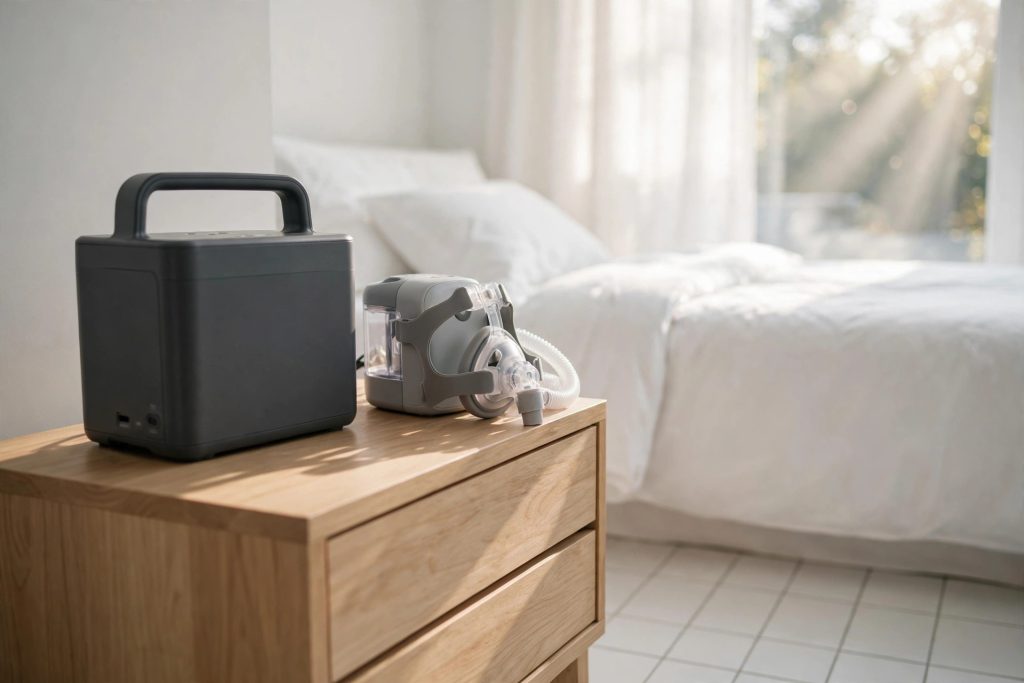
Quick answer: Most CPAP users need a 300–500Wh power station for camping without a humidifier, or 1,000Wh+ if they run a heated humidifier or want multi-night backup. Size it with a simple formula: usable hours ≈ capacity (Wh) × 0.85 ÷ your CPAP’s wattage. Pick a station with a pure sine wave inverter, quiet fan, and no low-load auto-shutoff — then run a full test night at home before you rely on it.
A CPAP machine is the one device you don’t want to lose at 3 a.m. — camping off-grid, flying, or riding out a blackout. A portable power station can keep therapy running all night, but only if it’s sized right and doesn’t shut itself off under low loads. This guide shows you how to size one, which features matter, and which models make sense — based on manufacturer-published specs and independent review data, not lab tests we didn’t run.
Power note, not medical advice: this guide is about batteries and watts. Never skip, shorten, or change your sleep therapy without talking to your doctor first.
How Many Watts Does a CPAP Machine Use?
The short answer: usually 10–90W, and the humidifier decides where you land. ResMed’s published specs for the popular AirSense 10 list 53W typical and 104W peak. Real-world draw, per CPAP retailer data:
| Setup | Typical draw | Notes |
|---|---|---|
| Blower only (no humidifier) | 10–17W | Just the motor and electronics |
| Heated humidifier, moderate setting | 30–60W | Varies with heat level and room temperature |
| Humidifier + heated tube, high setting | 50–80W | Approaches 90W at maximum settings |
The takeaway for sizing: turning the humidifier off can cut your power needs by two-thirds or more. For an 8-hour night, that’s the difference between roughly 130Wh and roughly 500Wh. Size for your typical draw with margin, not the absolute peak on the power brick label.
The Simple Runtime Formula
The formula: usable hours ≈ capacity (Wh) × 0.85 ÷ your CPAP’s wattage. The 0.85 factor accounts for inverter losses — converting DC battery power to AC wastes roughly 10–15% as heat. Worked examples:
- 292Wh station ÷ 15W (no humidifier): 292 × 0.85 ÷ 15 ≈ 16.5 hours — about two full nights.
- 292Wh station ÷ 53W (with humidifier): 292 × 0.85 ÷ 53 ≈ 4.7 hours — not enough for one full night. This is the sizing mistake to avoid.
- 1,070Wh station ÷ 53W (with humidifier): 1,070 × 0.85 ÷ 53 ≈ 17 hours — two comfortable nights with reserve.
With a 12V DC converter cord (below), skip the inverter loss and multiply by ~0.95 instead.
What Size Power Station Do You Need?
Match capacity to your use case: 300–500Wh for humidifier-free camping, 1,000Wh+ for humidified sleep or multi-night trips, and 100–160Wh for air travel.
| Use case | Recommended capacity | Why |
|---|---|---|
| Weekend camping, no humidifier | 300–500Wh | ~15W draw = 2–3 nights per charge |
| Camping with heated humidifier | 1,000Wh+ | ~53W draw = ~2 nights with margin |
| Home power outage backup | 1,000–1,500Wh+ | Multi-night reserve plus phone/lights; expandable models help |
| Air travel | ≤100Wh (carry-on), up to 160Wh with airline approval | Airline lithium battery limits — check with your carrier first |
When in doubt, round up a class. A station that dies at 4 a.m. is worse than one that’s slightly heavier to carry. For the same math applied to any device, see our portable power station sizing guide.
5 Features That Matter for CPAP Use
1. Pure sine wave output
CPAP machines are sensitive medical electronics. Pure sine wave AC mimics grid power; modified sine wave can cause motor hum, error codes, or overheating. Verify pure sine wave in the specs before you buy.
2. No low-load auto-shutoff
A CPAP drawing 10–15W looks like “nothing plugged in” to some stations, which then auto-sleep to save power — potentially mid-night. Check reviews for low-load behavior; models with an “always-on” option are the safe choice.
3. Quiet fan
The station may sit on your nightstand. Look for ~30 dB or below in quiet mode — about a soft whisper — so the cooling fan doesn’t ruin your sleep.
4. LiFePO4 battery chemistry
Lithium iron phosphate cells typically last 3,000–4,000+ charge cycles — roughly a decade of regular use — versus a few hundred for older lithium chemistries. See how long solar generators last for the full comparison.
5. Pass-through charging and DC output
Pass-through charging lets you run the CPAP while the station recharges — handy for daytime top-ups. A 12V DC output enables a DC converter cord, which skips inverter losses entirely.
Our Top Picks for CPAP Users
Spec-based shortlist from manufacturer data and independent 2026 reviews — not our own lab tests. All four output pure sine wave.
Best for camping and travel: Jackery Explorer 300
292Wh at about 7 lb, with LiFePO4 cells rated for 4,000+ cycles — the lightest way to cover two humidifier-free nights (~16 hours at 15W). Independent reviewers consistently call it the safest default for travel CPAP.
Best all-around: Jackery Explorer 1000 v2
1,070Wh and a 1,500W inverter cover roughly two full humidified nights (~17 hours at 53W) plus a phone and a lamp. The “one station for everything” pick — see our Jackery vs EcoFlow comparison for how the two ecosystems differ.
Best for home outage backup: BLUETTI AC180
1,152Wh with a 20ms UPS switchover — your CPAP barely notices a blackout. Less packable, but the right call for uninterrupted therapy at home. Our EcoFlow Delta 2 review covers a close alternative in the same class.
Best for fast turnaround: Anker SOLIX C1000
1,056Wh that recharges to 80% in about 43 minutes from a wall outlet. If your pattern is “drain it overnight, top it up during the day,” fast charging matters more than raw capacity.
Use a DC Converter Cord to Stretch Runtime
A manufacturer DC cord for your specific CPAP model can add 10–15% more runtime for free. DC-to-DC skips the inverter, so you keep the ~15% that would have become heat. Buy the official cord made for your machine (ResMed, Philips, and others each sell one) — voltage and connector must match. This is the trick that makes small 300Wh stations viable for multi-night trips.
Always Run a Test Night at Home First
Never trust a new setup on the first night you actually need it. Run one full 8-hour night at home on the station with your normal settings, then check the remaining percentage in the morning. That single test reveals your real-world runtime — your humidifier setting, your pressure, any auto-shutoff quirks — better than any spec sheet.
If you’re weighing whether a power station is worth the investment, our guide on whether solar generators are worth the money breaks down the cost-per-use math.
Frequently Asked Questions
How long will a 500Wh power station run a CPAP?
About 28 hours without a humidifier (500 × 0.85 ÷ 15W) — roughly three nights. With a heated humidifier at 53W, about 8 hours — one night with little margin. Your settings change the real number.
Can I run a heated humidifier on a portable power station?
Yes, with enough capacity. A heated humidifier roughly triples draw (from ~15W to ~53W on a ResMed AirSense 10), so use at least 1,000Wh for a full humidified night with reserve.
Is it safe to run a CPAP on a portable power station all night?
Yes, if the station outputs pure sine wave AC — standard on reputable 2026 models. Avoid modified sine wave inverters, which can make CPAP motors hum or throw error codes. Keep following your prescribed therapy.
Can I take a portable power station on a plane for my CPAP?
Generally up to 100Wh in carry-on, up to 160Wh with airline approval — always in the cabin, never checked. Most full-size stations exceed this; frequent flyers should use sub-160Wh models and confirm with their airline.
Should I use the AC outlet or a DC cord for my CPAP?
A DC cord is more efficient: skipping the inverter returns roughly 10–15% more runtime. Use the official cord for your CPAP model. The AC outlet works fine as a plug-and-play fallback if you have spare capacity.
What happens if the power station runs out in the middle of the night?
Your CPAP stops — which is why a home test night matters. Plan to use no more than ~80% of capacity, and keep a backup plan for outages.

