
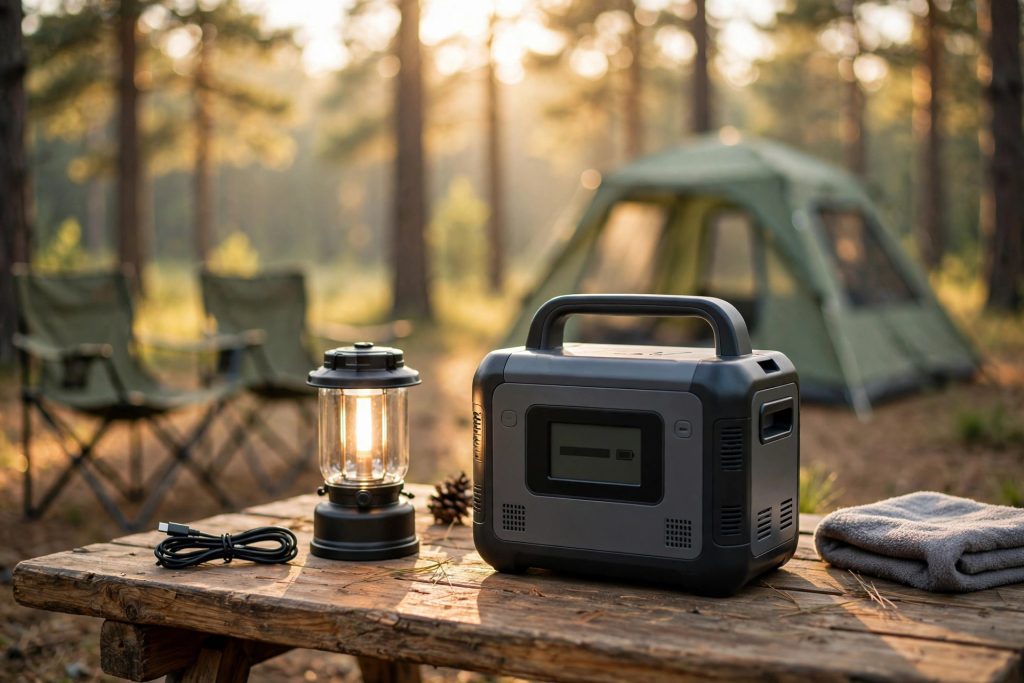
Short answer: For most campers, a 1,000Wh-class portable power station (1,500–1,800W AC output) is the sweet spot for a weekend trip — it covers lights, phones, a mini fridge, and laptop charging for 2–3 days, and recharges fast enough off a 200W solar panel to keep going indefinitely. If you only charge phones and a lantern, a 300–500Wh unit is plenty and much easier to carry.
Camping used to mean leaving everything powered behind. Not anymore. A modern portable power station gives you a silent, fume-free “wall outlet” that fits behind the back seat — no gasoline, no noise, no extension cords from the campground bathroom. But the range is confusing: 300Wh to 2,000Wh+, prices from a hundred dollars to well over a thousand, and brand names that all start to blur together.
This guide cuts through that. You’ll learn exactly how much capacity you actually need for camping, which features matter in the woods (and which don’t), and our picks for the best portable power station for camping in five common scenarios — from ultralight car camping to running a 12V fridge through a heat wave.
How Much Power Do You Really Need While Camping?
Answer first: Most campers use 200–800Wh per day, so a 1,000Wh-class station covers a 2–3 day trip with margin.
Don’t buy by brand first — buy by math. Add up the watt-hours of what you’ll actually run. A phone holds about 15Wh, a laptop battery 60–100Wh, an LED lantern maybe 5Wh for a whole evening. The big one is a portable 12V fridge (like a compressor cooler), which draws 40–60W but cycles on and off, typically consuming 300–600Wh over 24 hours.
| Typical camping load | Power draw | Hours on a 1,000Wh station* |
|---|---|---|
| Smartphone (full charge) | ~15Wh | ~55 charges |
| LED lantern (evening use) | ~5W | ~170 hours |
| Laptop (one full charge) | ~80Wh | ~10 charges |
| 12V compressor cooler | ~45W (cycling) | ~18 hours |
| CPAP machine (no humidifier) | ~40–60W | ~14–20 hours |
| Electric kettle (1200W) | 1200W | Needs 1,500W+ output |
*Rough estimate: usable capacity ≈ nameplate Wh × 0.85 (inverter and conversion losses). See our full sizing walkthrough in what size portable power station do I need.
Best Portable Power Station for Camping: Our 5 Picks
The honest headline: there is no single “best” — the best portable power station for camping depends on your trip style. Below are five spec-based picks (we did not lab-test these units; specs are from manufacturer data sheets) covering the scenarios campers actually ask about.
| Model | Capacity | AC output | Battery | Best for |
|---|---|---|---|---|
| Jackery Explorer 1000 v2 | 1,070Wh | 1,500W | LiFePO4, 4,000 cycles | All-round weekend camping |
| EcoFlow DELTA 2 | 1,024Wh | 1,800W | LiFePO4, 3,000 cycles | Fast charging, heavier loads |
| BLUETTI AC180 | 1,152Wh | 1,800W | LiFePO4, 3,500 cycles | Best value per Wh |
| Anker SOLIX C1000 | 1,056Wh | 1,050W | LiFePO4, 3,000 cycles | Compact, lightning recharge |
| EcoFlow RIVER 2 Pro | 768Wh | 800W | LiFePO4, 3,000 cycles | Lightweight, budget car camping |
1. Jackery Explorer 1000 v2 — Best all-round for weekend camping
Why it wins: 1,070Wh of capacity with 1,500W of AC output covers virtually everything a camper runs — 12V fridge, string lights, phones, laptop, even a small air pump — in one box.
Jackery practically invented this product category, and the v2 fixes the original Explorer 1000’s biggest weakness: the switch from lithium-ion to LiFePO4 chemistry means roughly 4,000 charge cycles before capacity drops to 80%, versus about 800 on the older model. In real terms, that means a decade of camping seasons instead of a few. It also recharges fast — under two hours from a wall outlet, and around the same with two 200W solar panels in good sun.
If you only buy one and want the least decision-making, this is it. Check Price Now
2. EcoFlow DELTA 2 — Best for fast charging and heavier appliances
Why it wins: 1,800W of output and one of the fastest recharge times in the class — about 80 minutes from empty on a wall outlet.
The extra 300W of headroom over the Jackery matters more than it looks on paper: it’s the difference between running a 1,200W electric kettle and not. The DELTA 2 also handles a 500W solar input (about 11–60V), so it fills up quicker off panels during short daylight. It’s slightly heavier than some rivals, but if your camping style includes a drip coffee maker, an electric griddle, or a fan running all night in summer, this is the one. Check Price Now
3. BLUETTI AC180 — Best value per watt-hour
Why it wins: 1,152Wh — the most capacity of our five picks — with 1,800W output, frequently priced below comparable rivals.
The AC180 is the pick for campers who run a compressor fridge around the clock and don’t want to think about state of charge. Its 11 outlets cover a busy family campsite, and 20ms UPS switchover is a nice bonus at home (it can back up a Wi-Fi router or a fish tank during short outages). The app control for charging schedules is genuinely useful for solar: set it to only charge above a certain input so weak morning sun doesn’t waste cycles. Check Price Now
4. Anker SOLIX C1000 — Best compact 1,000Wh-class option
Why it wins: full 1,056Wh capacity in a noticeably smaller, lighter body, with HyperFlash charging that can hit 80% in about 43 minutes on AC.
For campers who haul gear a long way from the car, size matters as much as capacity. The C1000’s standout trick is recharge speed — a quick stop at a campsite hookup or a gas-station outlet and you’re nearly full. The 1,050W output won’t run a kettle, but it handles every other typical camping load. If you value portability and fast top-ups over maximum AC muscle, this is the sweet spot.
5. EcoFlow RIVER 2 Pro — Best lightweight and budget pick
Why it wins: 768Wh and 800W output in a genuinely portable package — enough for phones, lights, a laptop, and a CPAP night or two.
Honest caveat: this is not a fridge-through-the-weekend unit. But if your camping means a tent, a cooler full of ice, and keeping devices alive, the RIVER 2 Pro does it at a fraction of the weight and cost of the 1,000Wh class. It’s also the pick for backpackers-style car camping and as a “second unit” for couples who camp separately within one site. See our CPAP power sizing guide if overnight medical devices are the reason you’re reading this.
What to Compare: The 6 Features That Actually Matter at a Campsite
capacity, AC output wattage, and recharge speed decide 90% of camping satisfaction — everything else is a tiebreaker.
- Capacity (Wh): your “fuel tank.” Size it to your daily use with margin, not your dreams. Our sizing guide walks through the formula with real device examples.
- AC output (W): your “engine size.” Check the highest-wattage thing you’ll ever plug in (kettle, hair dryer, air pump) and leave 20% headroom. Underpowered inverters shut down or, worse, brown out.
- Pure sine wave inverter: non-negotiable. All five picks above have one. Modified sine wave can damage laptop chargers and CPAP machines.
- Solar input: the bigger the MPPT input (in watts), the faster free daytime recharging. 200W+ input lets a 100W panel meaningfully refill a unit over a sunny day. More on timing in how long it takes to charge a solar generator.
- Battery chemistry: LiFePO4 (lithium iron phosphate) lasts 3,000–4,000 cycles vs. ~500–800 for standard lithium-ion, handles heat better, and is less fire-prone — worth prioritizing.
- Weight and noise: fans kick in under heavy load; 1,000Wh units are typically 25–40 lbs. If you’re carrying it more than 50 yards, weight deserves a real vote. All are whisper-quiet compared to gas generators — which is the whole point. Wondering whether solar generators are worth the money at all? We did the math.
How to Stretch Battery Life at Camp: 5 Practical Tips
The big one: run DC loads (USB, 12V) directly instead of through the AC inverter — it avoids ~10–15% conversion loss and adds real hours.
- Go DC-first: charge phones and laptops over USB-C PD, and run a 12V fridge from the DC port rather than an AC brick. Same battery, noticeably more runtime.
- Pair it with solar: a single 200W panel in decent sun adds roughly 150–180Wh per hour to your station — enough to run a fridge indefinitely on sunny days. Angle the panel at the sun midday; flat on the ground costs you 20–30%.
- Pre-cool the fridge at home: running the compressor’s hardest work (first cooldown) on wall power saves a big chunk of battery on day one.
- Keep the battery warm-ish: LiFePO4 charges poorly below freezing and loses apparent capacity in the cold. Sleep it inside the tent, not in the trunk.
- Use eco/app modes: most of these units have a sleep or low-load shutoff timer so the inverter doesn’t sip power all night on standby.
FAQ: Best Portable Power Station for Camping
What size portable power station do I need for camping?
For a weekend trip with lights, phones, and laptop charging, 300–500Wh is enough. Add a 12V fridge and you want 1,000Wh or more. The rule of thumb: estimate daily use in Wh, multiply by trip days, and add 25% margin. (Multiply watts × hours for each device.)
How long will a 1,000Wh power station last while camping?
It depends on your load. Roughly: 2–3 days for typical light camping (lights, phones, laptop), or about 24–36 hours running a 12V compressor fridge plus devices. Pair it with a 200W solar panel and sunny days can make it indefinite.
Can a portable power station run a camping fridge?
Yes — this is one of the most common camping uses. A 45W compressor cooler uses about 300–600Wh per day because the compressor cycles. A 1,000Wh station handles that comfortably; run it from the 12V DC port to avoid inverter losses.
Do I need solar panels with my portable power station for camping?
Not strictly — you can charge fully at home and a 1,000Wh unit covers most weekend trips. But a 100–200W solar panel turns a weekend trip into an open-ended one, and it’s the only way to recharge far from outlets. Buy panels that fit your station’s MPPT voltage range.
Are portable power stations allowed in national parks and campgrounds?
Generally yes — they’re silent and emission-free, which is exactly why campers prefer them over gas generators. Gas generators face strict quiet hours (often 8pm–8am) in many campgrounds; battery stations have no such restriction. Always check specific campground rules.
Jackery vs EcoFlow vs BLUETTI — which brand is best for camping?
All three make solid camping units. Roughly: Jackery for the broadest model range and beginner-friendliness, EcoFlow for the fastest charging tech, BLUETTI for value per watt-hour. We compared the two biggest head-to-head in our Jackery vs EcoFlow guide — pick by your priority, not the logo.

