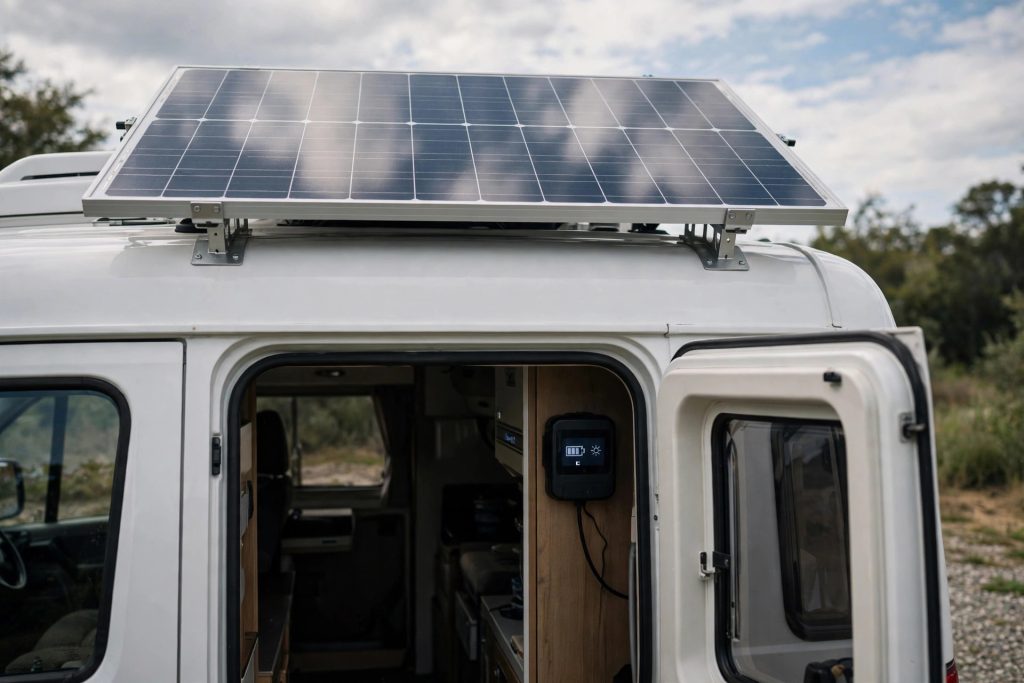
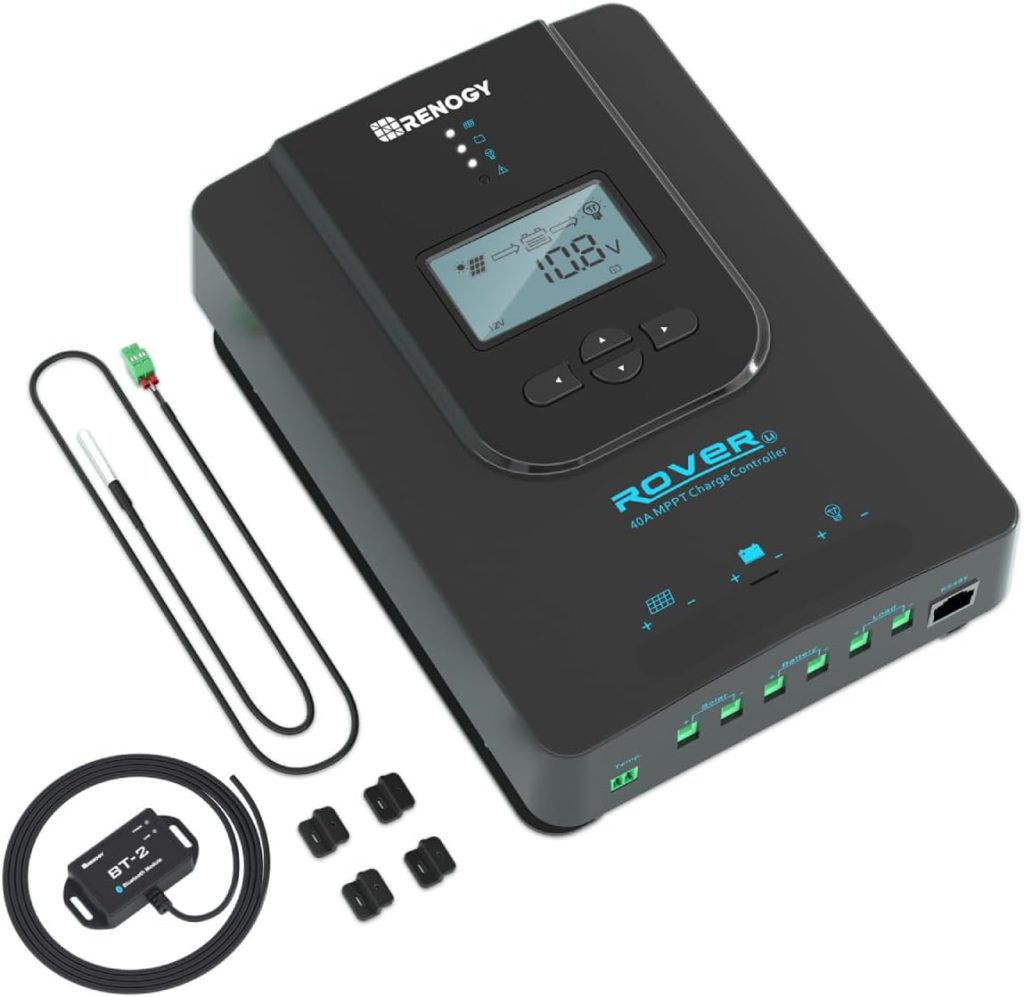
An MPPT solar charge controller is easy to ignore until a cheap one cooks a battery or wastes half your panels. This guide puts the Renogy Rover 40A forward as the main pick for camping, RV, and small off-grid builds, then stacks it against the Victron SmartSolar 100/30 and the EPEVER 40A Tracer.
Quick Answer
Buy the Renogy Rover 40A if you want a screen on the unit, Bluetooth through the included BT-2 module, and headroom for a 400W array on 12V without paying a premium. Pick the Victron SmartSolar 100/30 if app logging matters more than a display and your array fits the 30A class. Choose the EPEVER 40A if budget comes first and you can accept a bulkier box plus a remote meter that costs extra.
The same Rover 40A also ships inside the Renogy 400W Premium kit if you would rather buy the panels and controller as one matched set.
Top 3 MPPT Solar Charge Controllers
Same job, three philosophies — screen plus Bluetooth, app-only premium, and budget hardware.
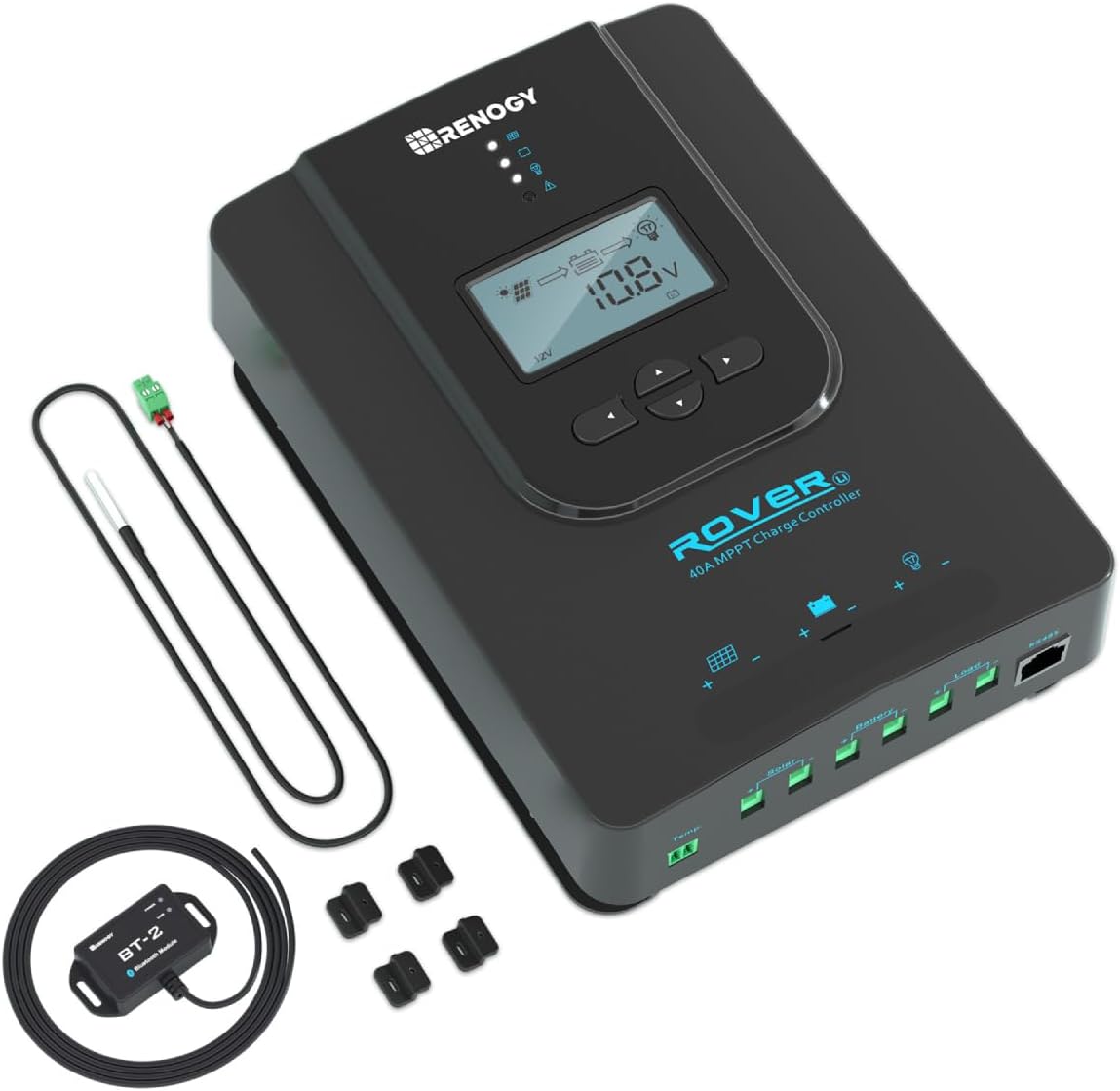
Renogy Rover 40A MPPT
Backlit LCD on the unit + Bluetooth module in the box — the balanced default for RV and van builds
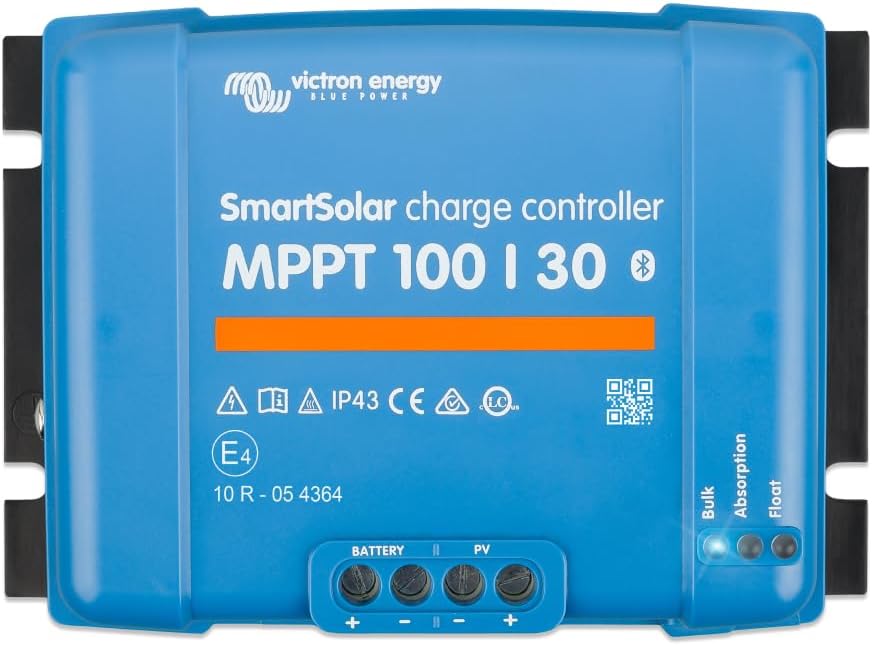
Victron SmartSolar MPPT 100/30
Built-in Bluetooth and deep app history, no screen on the unit — for data lovers who live on their phone
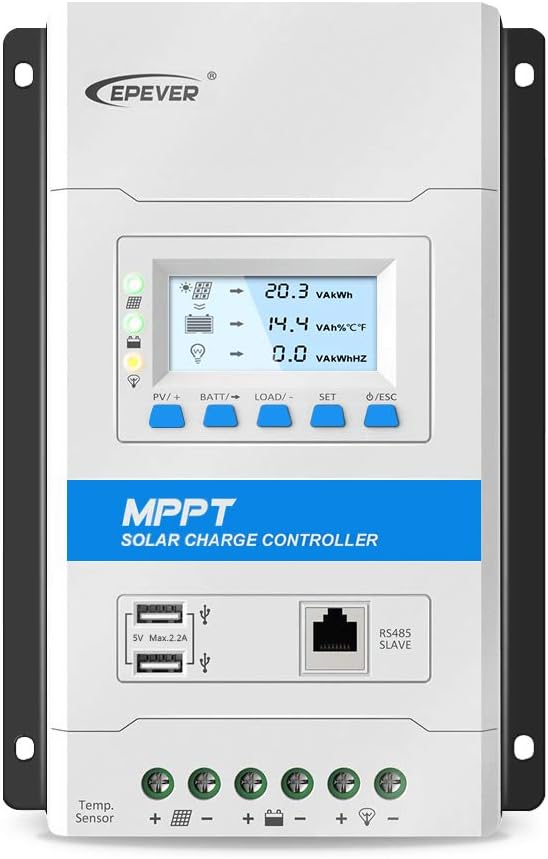
EPEVER 40A MPPT Tracer
LCD plus dual USB ports at a budget tier — remote meter is an add-on, case runs bulkier
Prices and availability may vary — tap any product to check the current listing.
What to Look For in an MPPT Solar Charge Controller
MPPT versus PWM is not a small upgrade on most arrays. PWM drags panel voltage down to battery voltage and throws the difference away. MPPT tracks the panel’s sweet spot and converts extra voltage into extra charging amps, with gains of roughly 10 to 30 percent showing up on cold mornings, cloudy days, and higher-voltage strings. Past 200W, MPPT usually pays for itself; on one small panel matched to a 12V battery, the gap shrinks to almost nothing.
Sizing amps to array watts decides whether 40A is generous or tight. Divide array watts by battery charging voltage to get the amps a controller must handle. A 400W array charging a 12V bank at around 14.4V can push close to 28A in strong sun, leaving a 30A unit near its ceiling with little room for a cold, bright day or a future panel. On a 24V bank that same array needs about half the amps. Going bigger costs money and wall space.
Maximum PV input voltage catches people out more than current does. Series wiring raises voltage, cuts cable losses, and lets thinner wire work, but panel voltage climbs as temperature drops. A string that looks safe on a summer spec sheet can spike past a 100V-class input limit on a frosty morning and damage the controller. Leave a margin of at least 15 to 20 percent below the rated maximum, using open-circuit voltage corrected for your coldest expected weather.
Panel voltage is also why the newest flexible panels belong on an MPPT unit rather than a bargain PWM controller: the BougeRV Yuma 100W CIGS flexible panel we reviewed runs an open-circuit voltage in the 31.5V class, and an MPPT controller is what turns that extra voltage into charging current instead of waste.
Battery chemistry profiles, especially for lithium, need hands-on checking. Controllers in this class carry presets for sealed, gel, flooded, and lithium, plus a user mode. For LiFePO4, set the absorption voltage your battery maker specifies and switch equalization fully off — equalization is a deliberate overcharge routine for flooded lead-acid and has no place on lithium. Renogy’s lithium mode also includes a recovery feature meant to wake a battery whose protection circuit has shut down. Temperature cuts the other way: compensation suits lead-acid, while most LiFePO4 batteries should not charge below freezing unless they have heating or a low-temperature cut-off.
The same lithium profile question shows up on the AC side of the system: when the bank refills from a hookup instead of the roof, a dedicated lithium battery charger for shore-power refills applies the 14.6V profile without a solar controller in the loop at all.
A display on the unit versus app-only monitoring is a daily-life trade-off. The Rover puts a backlit LCD on the box and adds Bluetooth through its included BT-2 dongle, so you can read amps and battery state at the battery bay, phone in pocket. EPEVER fits a backlit LCD and dual USB ports, handy for a phone top-up at camp. Victron takes the opposite bet: no screen, built-in Bluetooth, and an app logging history in far more depth. Superb if you like data — a nuisance the day your phone dies, when the blue box tells you nothing at a glance.
Protections and wiring order sound boring until something pops. Look for reverse-polarity, overcharge, short-circuit, and over-temperature protection. Order matters just as much: connect the battery first so the controller senses system voltage, then the panels. Reverse that and a unit can misread the system or take a spike it was never meant to handle. Simple rule, expensive lesson.
How to Match a Solar Charge Controller to Your Situation
The RV or van builder with about 400W on the roof and a 100Ah lithium battery. This is the Rover 40A’s home turf: 400W sits comfortably inside 40A on 12V, the screen helps in a cramped locker, and room remains for one more panel. Pair it with the right solar batteries and storage becomes the limit, not charging.
The tent camper or DIY solar-box builder running about 200W of portable panels. Honestly? A 30A controller is plenty here, and the Victron 100/30 makes sense. Portable output rarely holds at peak because angles change every time you move camp, so the smaller unit seldom bottlenecks you. Many weigh a solar panel kit as a matched set, and Victron’s compact size and logging suit a box build — though premium pricing stings for six weekends a year.
The cabin or off-grid user who plans to expand later. Buy amps you will grow into. Anyone starting at 300W who expects 600W within two years should start at 40A — Rover or EPEVER — and wire for the bigger system from day one. Campers going light with foldable solar panels rarely need that headroom; a cabin roof is different.
How the Main Options Compare
| Type/Tier | Best For | Price Tier | Key Feature | Watch-Out |
|---|---|---|---|---|
| 40A MPPT with display + Bluetooth (Rover class) | RV and van builds around 400W | Mid-range | Backlit LCD plus Bluetooth via included module | Lithium defaults need manual checking |
| 30A premium app-first MPPT (Victron class) | Solar-box and data-driven users | Premium | Built-in Bluetooth with deep app history | No display — phone required for any reading |
| 40A budget MPPT (EPEVER class) | Cost-first 40A builds and cabins | Budget-friendly | Backlit LCD plus dual USB ports | Remote meter costs extra; case is bulky |
| Cheap PWM controller | One small panel, lead-acid, tight budgets | Lowest | Simple, tiny, little to configure | Wastes higher-voltage output; poor fit for lithium growth |
The Rover-class row wins on balance: screen, Bluetooth, and 40A headroom in one mid-range box. Victron’s row trades the screen for software polish at a premium. EPEVER’s row delivers genuine 40A charging for the least money, minus the add-on meter cost. PWM only makes sense at the smallest scale.
Questions People Ask Before Buying
Real buyer questions, straight answers
Is an MPPT controller worth it over a cheap PWM one?
Yes, for most arrays over 200W, and the gap grows with higher-voltage panels and changeable weather. MPPT recovers energy PWM discards — often a full battery by early afternoon instead of limping into evening. Below 200W with a panel closely matched to a 12V battery, the answer flips — PWM savings can buy a second panel instead.
Is 40A enough for 400W of solar panels?
Yes, 40A is enough for 400W on a 12V system, with headroom to spare. Peak output runs in the high-20-amp range under strong sun, leaving room for cold-day spikes and a modest addition later. On 24V, that current roughly halves. Trouble starts well past 500W on 12V, where a bigger controller or 24V belongs in the conversation.
Can I use the Rover 40A with a LiFePO4 battery?
Yes, the Rover 40A supports LiFePO4 through its lithium profile, including a recovery function for a battery that has shut itself down. Select lithium mode, verify voltages against your battery maker’s spec sheet, and turn equalization off completely. Also confirm low-temperature protection — the controller alone will not protect lithium cells from a freezing charge.
Do I need Bluetooth on a solar charge controller?
No, Bluetooth is a convenience, not a requirement for charging. Your battery fills the same whether you watch or not. Wireless monitoring earns its keep in troubleshooting — spotting a shaded panel days before it dies at camp. A physical screen gives most of that visibility with no pairing at all.
Should I buy the Victron 100/30 or the Renogy Rover 40A?
Buy the Rover 40A if you want 40A of headroom and a screen readable without a phone. Buy the Victron 100/30 if your array fits 30A and detailed app history is something you will actually open. Its software is the stronger experience, full stop. Renogy’s package fits a growing RV system better, at a lower price tier.
Partial Shade and Cloudy Days: Where Tracking Earns Its Money
Shade is where the MPPT argument stops being theoretical. A tree shadow, a cloud bank, a panel angled wrong after lunch — output does not dip politely, it falls off a cliff, and ideal voltage shifts with it. MPPT keeps hunting for that moving target many times per second. PWM cannot hunt at all.
Does that rescue a badly shaded install? No. Nothing electronic fixes panels parked under a tree all day. Tracking squeezes charge from the messy middle — broken cloud, low angles, half-shaded hours. Across a week of mixed weather, that is often the difference between running the fridge confidently and rationing lights by day three.
Winter Charging and Lithium: The Cold Problem
Cold weather flatters panels and punishes lithium batteries. Panel voltage rises as temperature falls, meaning free extra harvest — provided your string voltage, recalculated for the coldest morning you will see, stays safely under the maximum input. Skip that step and a January cold snap can kill the unit.
Batteries face the opposite risk. Charging a standard LiFePO4 cell below freezing can cause permanent internal damage, and it stays silent. Use a battery with a low-temperature cut-off or internal heating. Lead-acid users dodge this but pay in reduced winter capacity.
Common Mistakes When Buying a Solar Charge Controller
Connecting the panels before the battery. Tempting, because the panels are on the roof and the wires are right there. Still wrong. A controller must sense battery voltage first to know whether it runs 12V or 24V. Battery first, panels second, every time.
Oversizing the array past the maximum PV voltage in cold weather. Shoppers count amps carefully, then wire three panels in series because the summer math looked fine. Winter arrives, open-circuit voltage climbs, and the limit gets crossed on the first frosty morning. Calculate with cold-corrected datasheet figures.
Leaving lead-acid equalization switched on for a lithium bank. Equalization is a controlled overcharge meant to balance flooded lead-acid cells. Applied to lithium, it stresses cells and can trip battery protection or worse. The mistake usually follows a controller swap or factory reset. Change anything, then re-confirm the profile from scratch.
Buying a 20A controller to save money, then outgrowing it in one season. I’ve seen people spend the savings twice — once on the small controller, again on its replacement — after adding a second panel the next spring. Systems grow. If your array could pass 300W on 12V, starting at 40A is cheaper over two years.
Why, How, What: Charge Controller Basics
Why does a solar system need a charge controller at all?
Panels do not naturally deliver battery-friendly power. Their voltage swings with light and temperature, running well above what a 12V battery should absorb, and they keep pushing current into a full battery if nothing intervenes. A controller regulates that flow — fast when the battery is hungry, gentle when nearly full. Skip it and battery life shortens, sometimes dramatically.
How does MPPT actually squeeze out more power?
A panel produces maximum power at one pairing of voltage and current, and that pairing moves constantly. MPPT samples output, adjusts its load, and converts the result down to battery voltage at higher current — a gearbox for electricity. PWM locks panel voltage to battery voltage and accepts whatever power that leaves behind.
What should you check before ordering any controller?
Start with three numbers: total array watts, cold-corrected open-circuit voltage for your wiring layout, and battery voltage and chemistry. Those decide amp rating, input-voltage class, and profiles. Next, choose your monitoring — screen, app, or both — and confirm settings can match your battery maker’s figures. Fail any check and it is the wrong controller.
Key Takeaways
MPPT beats PWM by a meaningful margin above roughly 200W, in changeable weather, and with higher-voltage strings — and by very little on a tiny, well-matched single panel.
A 400W array on a 12V bank peaks in the high-20-amp range, so 40A gives expansion room while 30A runs close to its ceiling.
The Renogy Rover 40A balances a backlit screen, Bluetooth via its included BT-2 module, and 40A headroom at a mid-range tier.
Victron’s SmartSolar 100/30 has no display; its strength is built-in Bluetooth and detailed app history, at a premium tier.
EPEVER’s 40A Tracer keeps costs down with a screen and dual USB ports, but its remote meter costs extra and its case is bulky.
Lithium charging demands three checks: correct profile voltages, equalization fully off, and protection against charging below freezing.
Connect the battery before the panels, always, and size string voltage for the coldest morning rather than the average day.
Decision Tree: Which Controller Fits You?
Want a screen on the unit and room to grow past 400W on 12V? → Choose the Renogy Rover 40A.
Want the deepest app logging, with an array in the 30A class? → Choose the Victron SmartSolar 100/30.
Want genuine 40A MPPT charging at the lowest price tier? → Choose the EPEVER 40A Tracer.
Want Bluetooth checks from inside the van on a rainy night? → Choose the Renogy Rover 40A or the Victron SmartSolar 100/30.
Want a remote wall-mounted meter across the cabin? → Choose the EPEVER 40A Tracer and budget for its meter, or the Renogy Rover 40A and use its screen instead.
Want the most compact unit for a tight solar box? → Choose the Victron SmartSolar 100/30.
Want dual USB ports on the controller itself? → Choose the EPEVER 40A Tracer.
Frequently Asked Questions
How long does a solar charge controller usually last?
A decent MPPT unit commonly serves for many years, often outlasting the first battery bank it charges. Heat is the main enemy; fanless designs rely on heatsinks and need airflow, not burial under insulation. Mount it ventilated, keep connections tight, and longevity rarely becomes the weak point.
Can a solar charge controller also charge from a vehicle alternator?
No, a solar charge controller only manages panel input and cannot take alternator power. Engine charging requires a separate DC-DC charger, though combined units handle both sources. Drivers often fit both — solar at camp, alternator on the road. Feeding alternator output into a solar input can damage both.
Does an MPPT controller work with any brand of solar panel?
Yes, controllers and panels mix across brands freely as long as electrical limits line up. Array voltage and current must stay within the rated input range. No lock-in exists and no penalty applies for mixing brands — just do the cold-voltage math for your panels.
Can two charge controllers charge the same battery bank?
Yes, two controllers can charge one bank in parallel, and larger off-grid systems do this with separate arrays. Each unit manages its own array while the battery accepts current from both, and settings should match closely. For most RV builds, though, one correctly sized controller is simpler and cheaper.
What size wire should run between the controller and the battery?
Keep that run short and use wire thick enough to keep voltage drop minimal — for a 40A controller near the battery, a noticeably heavier gauge than the panel leads, sized from an ampacity and voltage-drop chart for your exact length. Add a fuse or breaker on the positive lead, close to the battery.
Do I need a separate controller if I use a portable power station?
No, portable power stations have a solar charge controller built in, so panels connect directly within the station’s stated input limits. Standalone controllers serve systems built around separate batteries — RV house banks, cabins, DIY boxes. Never route one through the other.
Final Recommendation
For most RV, van, and camping builds assembled today, the Renogy Rover 40A is the controller to buy. It covers the 400W class with room left over, its screen-plus-Bluetooth mix suits real troubleshooting, the fanless heatsink keeps nights quiet, and the mid-range tier leaves money for battery capacity. Check current availability at major retailers, and confirm lithium settings against your battery manual on install day.
Exceptions are clear-cut. Data-focused users with 30A-class arrays should pay the premium for the Victron SmartSolar 100/30 and its app logging, accepting the phone-only interface. Budget-first builders needing 40A should take the EPEVER Tracer and put savings into panels. Nobody building a lithium system should save a small sum on cheap PWM and call it done.
Top 3 MPPT Solar Charge Controllers
Same job, three philosophies — screen plus Bluetooth, app-only premium, and budget hardware.
Renogy Rover 40A MPPT
Backlit LCD on the unit + Bluetooth module in the box — the balanced default for RV and van builds
Victron SmartSolar MPPT 100/30
Built-in Bluetooth and deep app history, no screen on the unit — for data lovers who live on their phone
EPEVER 40A MPPT Tracer
LCD plus dual USB ports at a budget tier — remote meter is an add-on, case runs bulkier
Prices and availability may vary — tap any product to check the current listing.
Affiliate Disclosure: This article contains affiliate links. If you buy through one of these links, we may earn a commission at no extra cost to you.