Most people shopping for a portable power station in the 1kWh class expect a compromise, and this portable power station category usually delivers one. You get enough capacity for a fridge and some lights, but output tops out well before a microwave or a power tool enters the picture. The OUPES Mega 1 breaks that pattern. It pairs roughly 1024Wh of LiFePO4 capacity with 2000W of continuous AC output, a figure you’d normally associate with a larger, heavier box.
Quick Answer
The Mega 1 is worth considering if you camp or travel in an RV and regularly need 2000W-class output without hauling a 2kWh unit, because it delivers that output at about 27.8 lb and can grow later with expansion batteries. If you only charge phones and run lights, it’s more station than you need, and if service depth matters more than output per pound, the bigger brands still hold an edge.
Drivers who want the opposite trade in this class — less output, but a kit that can also rescue the vehicle itself — should look at the VTOMAN Jump 1500X with its jump-start port, which pairs a smaller 828Wh station with an included solar panel.
Compare Top Portable Power Stations for Camping
Three roughly 1024Wh stations side by side — one pushes 2000W and expands toward 5kWh, one bundles a 200W panel into the kit, one brings the deepest accessory ecosystem. The right pick depends on the loads you actually run.
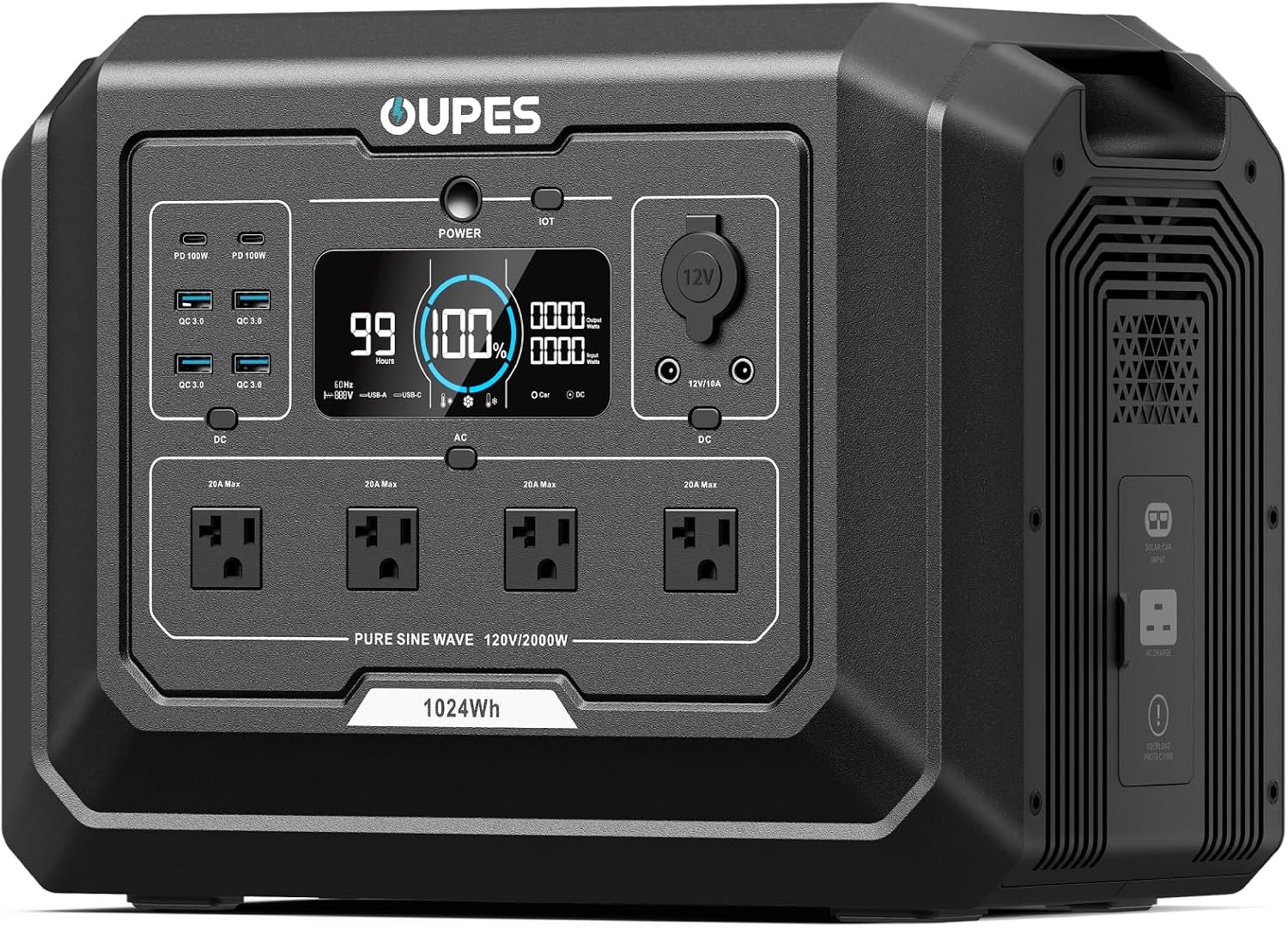
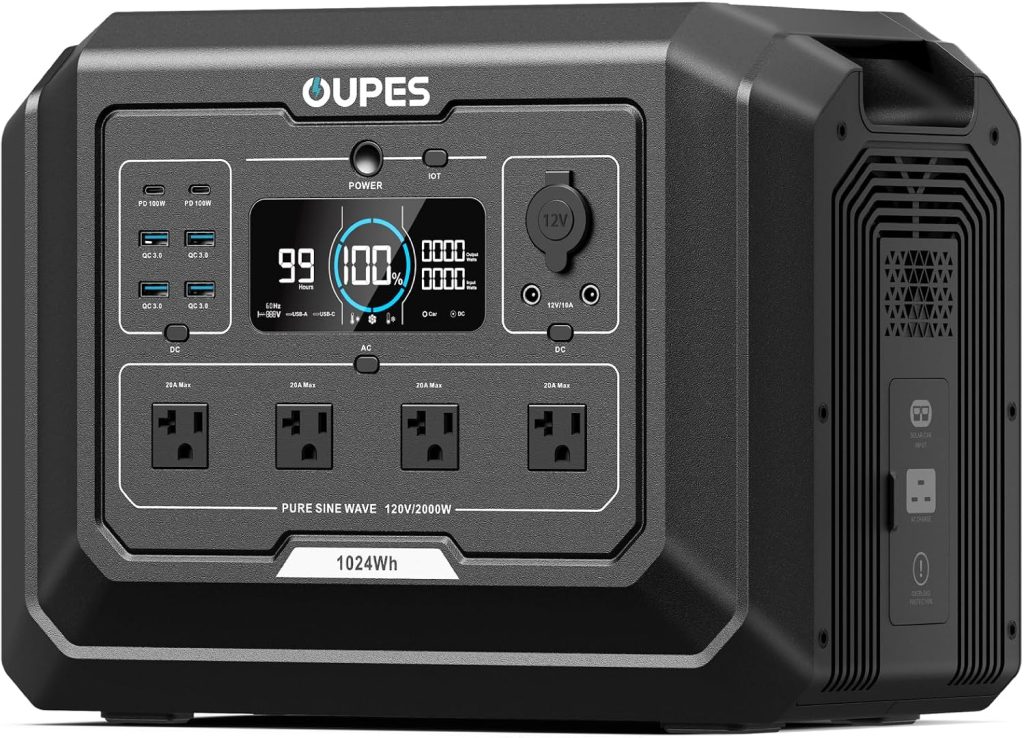
OUPES Mega 1
1024Wh with 2000W output at roughly 28 lb, expandable to about 5120Wh with extra batteries — the most output per pound here, from a newer brand
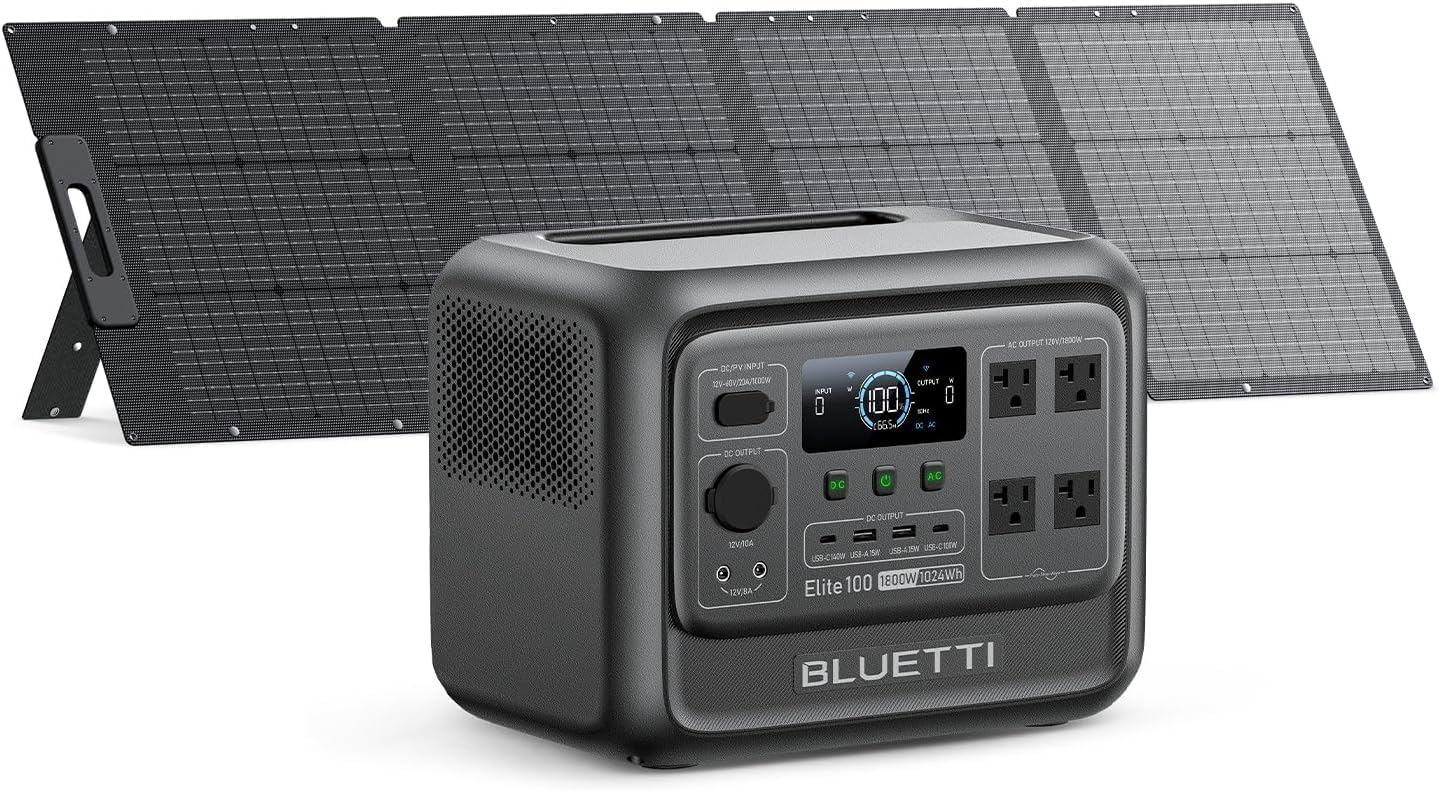
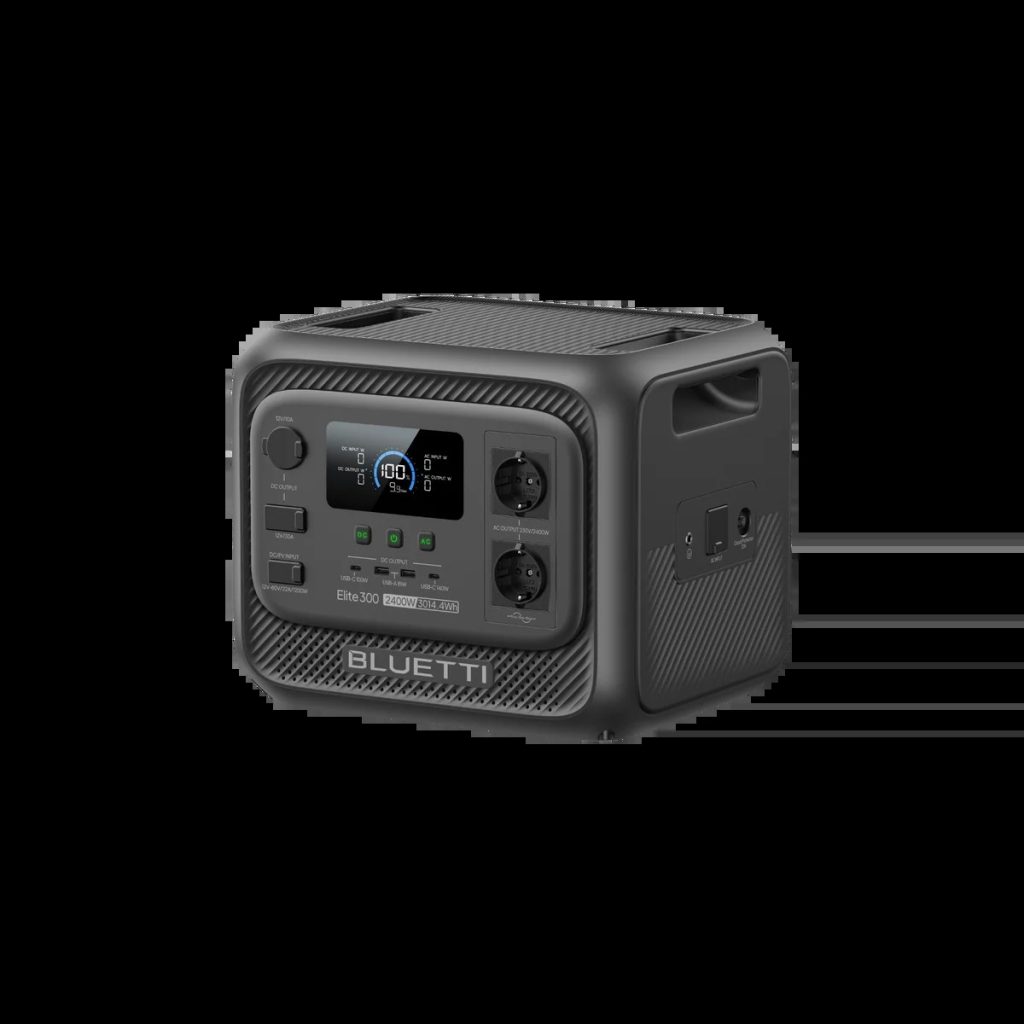
BLUETTI Elite 100 V2
1024Wh and 1800W in a compact body, sold here as a kit with a 200W panel included — strong solar value, but the capacity stays fixed
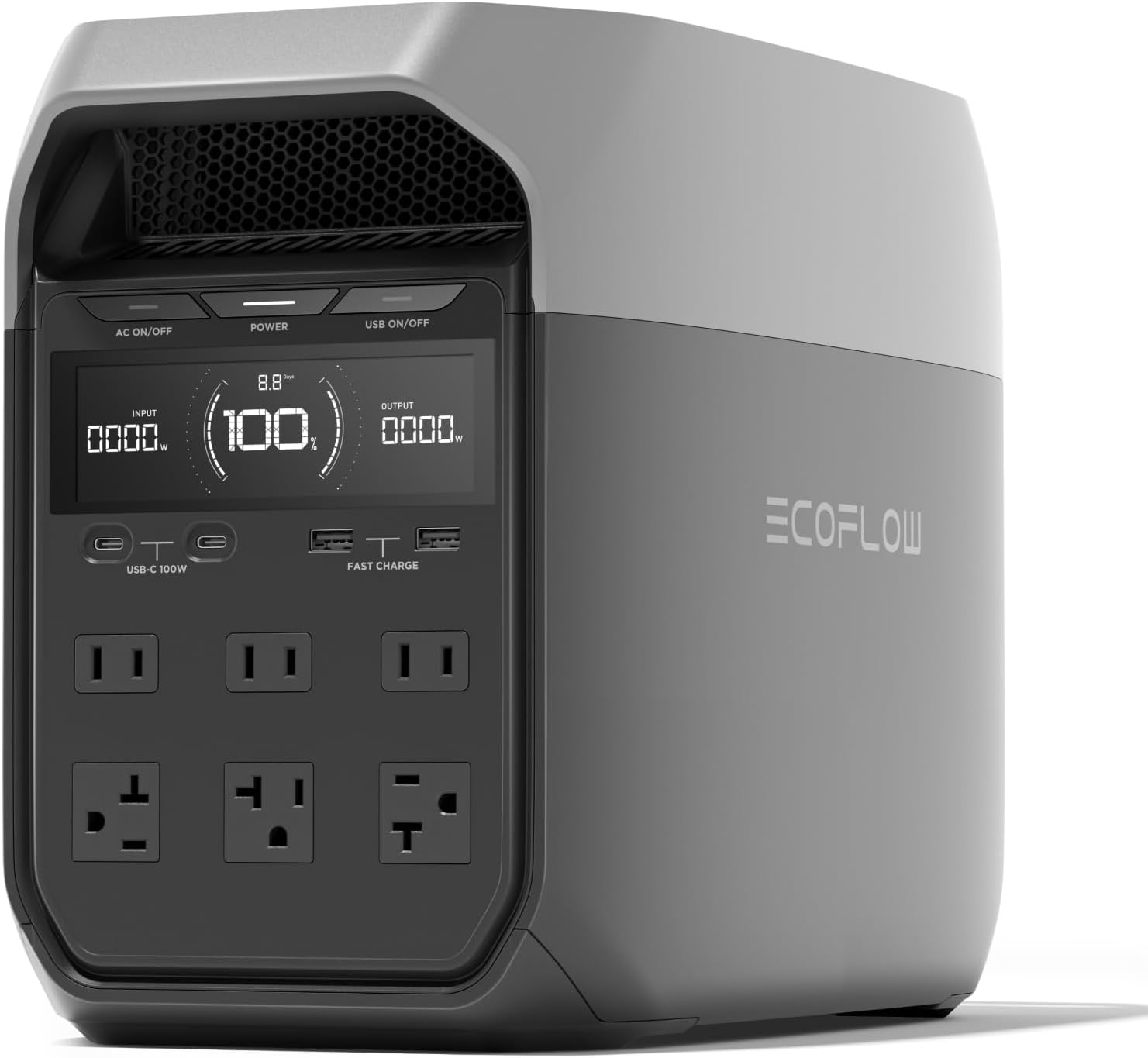
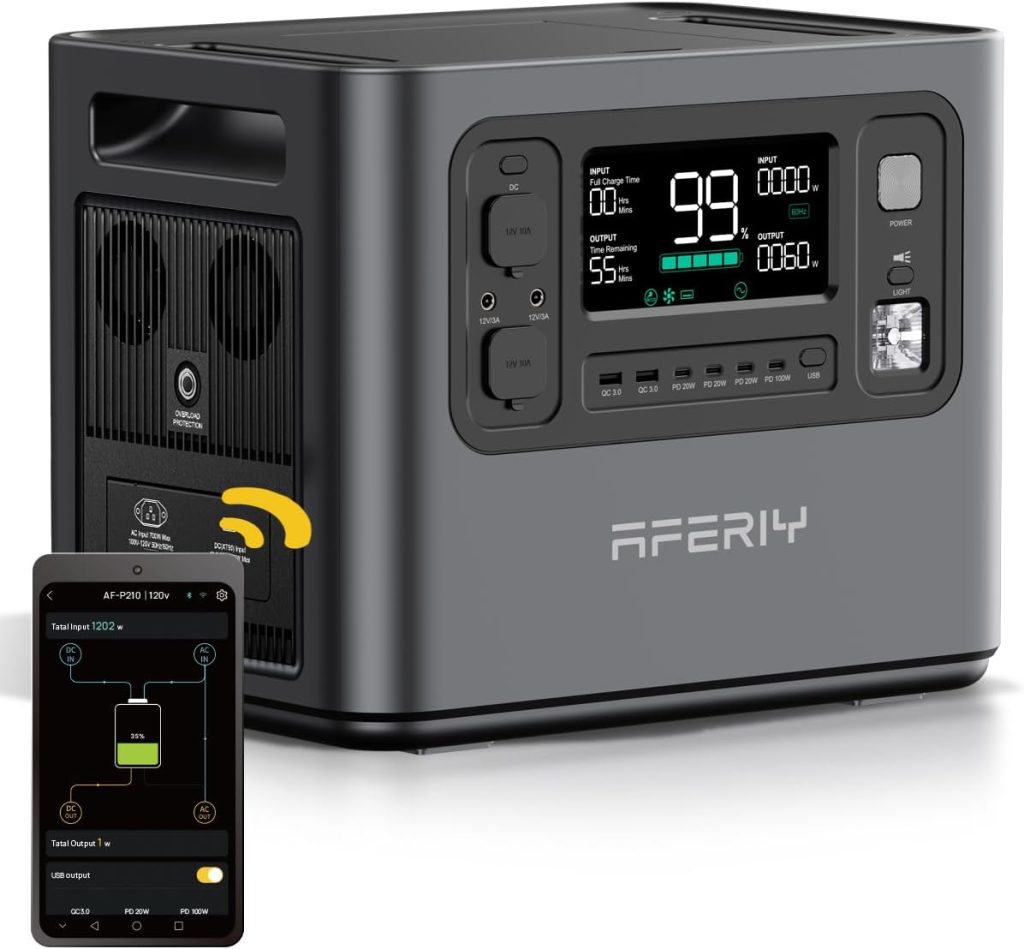
EcoFlow DELTA 3
1024Wh and 1800W with very fast charging and the widest accessory range — the safe ecosystem pick, though output sits below the Mega 1 and extras add up
Prices and availability may vary — tap any product to check the current listing.
What to Check Before You Buy a Portable Power Station
Capacity gets the headline in this category. Output decides what actually happens at camp. A station can hold a full charge and still refuse the one appliance you bought it for. Start with output, then work backwards.
Capacity and output math, done honestly
Run the numbers before you fall for a form factor. A 12V fridge cycling through a warm day might draw a few hundred watt-hours over 24 hours, while lights and phones barely register. Add your loads across two nights and 1024Wh becomes a real budget, especially once conversion losses take their cut. The energy store is mid-sized. The door it opens is not. You can start loads that lower-output rivals can’t, but you can’t run them forever. Treat a portable power station as an energy budget with an output ceiling, not a wall outlet that happens to move.
And here’s the part that stings. 1024Wh still cannot run heating or cooking loads for long. A microwave is fine for reheating a meal, not for cooking one. The Mega 1 lets you use those appliances briefly. It doesn’t give you the energy to live on them.
Continuous output versus surge, and why the gap matters
Manufacturers love the surge number because it’s the bigger one. The Mega 1 is rated at 2000W continuous with surge headroom up to about 4500W, and that distinction matters every time a motor starts. A fridge compressor or small power tool asks for a brief spike before settling down, and a station that absorbs it without tripping is far more useful. Independent lab coverage in 2026 rated the Mega 1 among the most efficient small stations in the roughly 600 to 1100Wh range and noted it’s one of the few 1kWh units under 30 lb that can surge like a much larger model. Efficiency doesn’t cook dinner, though — it just means less stored energy wasted as heat. The trade-off cuts the other way too. A station that starts everything can still leave you dark by midnight if you treat starting power as running power.
Recharge speed and solar input
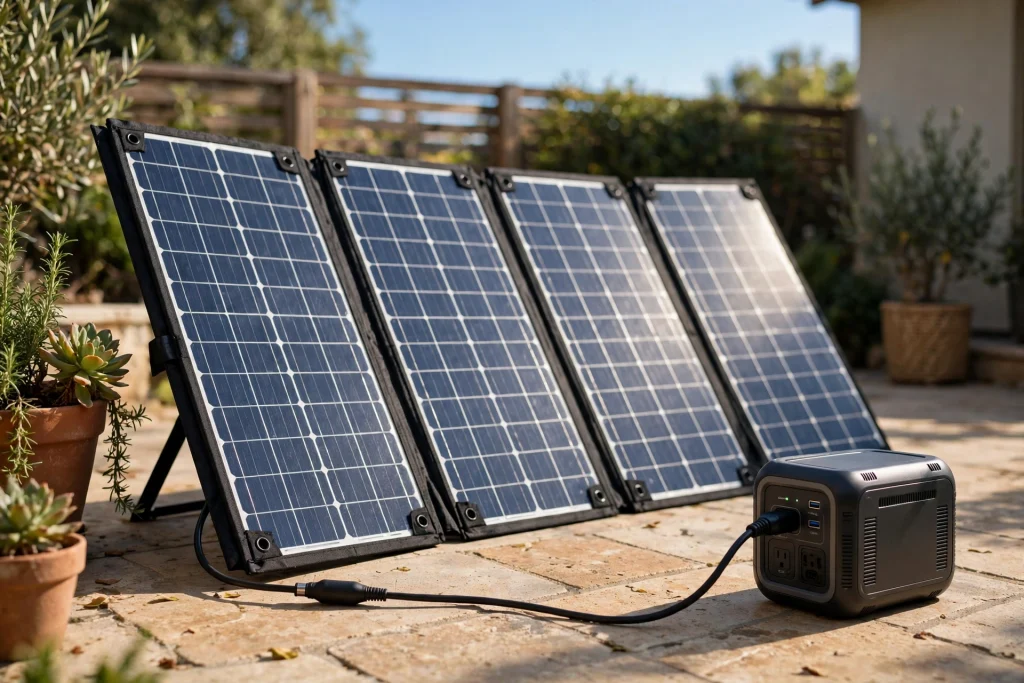
Dead stations don’t care how strong their inverters are. The Mega 1 refills from AC quickly, reaching about 80% in roughly 36 minutes. It also accepts up to about 800W of solar input, a high ceiling for this size. Pairing it with foldable solar panels suits campers who stay put for a few days. But solar math is weather math. Clouds, shade, and a low winter sun can cut the harvest to a fraction of the panel rating. The BLUETTI Elite 100 V2 also offers strong solar input for its size, so the Mega 1 doesn’t own this argument — it just accepts more of it.
Expandability and what growing actually costs
A fixed 1024Wh is a decision you live with. The Mega 1 softens it by expanding to roughly 5120Wh with up to two B2 extra batteries, moving it from weekend duty into longer RV stays and more serious home backup. The Elite 100 V2 doesn’t offer growth in the same way. Some buyers compare this route against separate solar batteries in a DIY setup, which stores a lot for the money but asks far more of you in wiring and troubleshooting. Expansion batteries, though, add real cost. Price the full system before committing, because a Mega 1 plus two extra batteries lands in a different spending tier than the base unit suggests. The trade-off is timing — you delay the extra spend until your trips prove you need it.
Weight, handles, and the brand support trade-off
At about 27.8 lb, the Mega 1 is light for what it outputs, and among this trio it feels like the lightest carry relative to the output you get. Distance changes the verdict. The handles aren’t the most comfortable for long carries, so a walk-in site will remind you that 27.8 lb is still 27.8 lb. Then there’s the honest brand question. OUPES is a newer, smaller name than BLUETTI or EcoFlow, which means a thinner service network and a shorter track record if something goes wrong in year three. The LiFePO4 pack is rated around 3500 cycles or more, so the chemistry probably isn’t the weak point. Support infrastructure might be.
Matching the Station to Your Kind of Camping
Spec sheets don’t sleep in tents. The right answer depends on what your trips look like across a season, not on the single most demanding weekend you can imagine.
Take the weekend camper running a 12V fridge, a couple of lights, and phones for two people. For that kit the Mega 1 is almost overbuilt on output and about right on capacity. The fridge cycles, the lights sip, and 1024Wh covers two nights without anxious rationing in most conditions. You’d buy it not because the weekend demands 2000W, but because the occasional heavier load stops being a negotiation.
Now picture the RV or van traveler who stays out for a week and already suspects one battery won’t cut it. This is the buyer the expansion path was built for. Start with the base unit, add a B2 battery when longer trips become routine, and the system grows toward roughly 5120Wh without a second inverter. The trade-off shows up in budget and storage, since each extra battery is another heavy block to stow.
A third buyer barely camps at all. They want the station at home as backup — router, laptop, maybe a fridge through an outage — with camping as the occasional second job. The Mega 1 fits that double life well, partly because its UPS switchover happens in under 20ms, fast enough that electronics ride through a flicker without rebooting. Just keep the scale honest. It’ll carry essentials through a night, not a whole house through a weekend.
And then there’s the cook. If your camp kitchen centers on electric cooking — an induction hob, repeated kettle boils, a heater when the temperature drops — skip this class entirely, Mega 1 included. The output can start those loads. The capacity can’t feed them for long, and no surge figure changes that arithmetic. Buy a much larger station, or cook with fuel.
Side-by-Side Mega 1 vs Elite 100 V2 vs DELTA 3
All three sit near 1024Wh with LiFePO4 packs, so the argument isn’t the size of the tank. It’s output, charging character, and what each brand asks you to give up.
| Type/Tier | Best For | Price Tier | Key Feature | Watch-Out |
|---|---|---|---|---|
| OUPES Mega 1, high-output expandable tier | Campers and RV users needing 2000W-class output in a 1kWh body | Mid-range | 2000W continuous output, expandable to about 5120Wh, fast AC recharge | Newer brand with a thinner service network, expansion batteries add real cost |
| BLUETTI Elite 100 V2, compact tier | Space-conscious campers with moderate loads | Mid-range | Notably compact for its capacity, strong solar input for its size, about 1800W output | Slightly lower output than the Mega 1, not expandable the same way |
| EcoFlow DELTA 3, mature ecosystem tier | Buyers who value app polish and accessories | Premium | Very fast AC charging, mature app and wide accessory range, about 1800W output | Ecosystem extras cost more, output still sits below the Mega 1 |
So which way does the decision fall? Pick the Mega 1 when output per pound is the thing you can’t get elsewhere, because neither rival reaches 2000W in this weight class and neither expands the way it does. Pick the Elite 100 V2 when space is tight and loads stay moderate. Pick the DELTA 3 when the ecosystem matters most — the app, the accessories, the established support. Notice what isn’t on this list. A winner for electric cooking. That station doesn’t exist at 1024Wh.
Three Trips, Three Different Answers
A two-night tent weekend
Phones, lights, a 12V fridge, maybe a small fan on a warm night. The Mega 1 handles this without drama and without needing its headline output. Honestly, the weekend is comfortable and the fridge stays cold. If every trip looked exactly like this, forever, a smaller and cheaper station would do.
A week-long RV base camp with an expansion battery
Stretch the stay to a week and base capacity stops being enough, especially with a fridge running around the clock and work gear in the mix. Adding a B2 battery earns its keep here, pushing the system well beyond 1024Wh and turning daily solar input into a genuine refill strategy. The DELTA 3 and Elite 100 V2 can’t follow the same way, since their capacity is the capacity you bought. An expanded system competes on price with larger fixed stations, so this route suits varied stays — short trips on the base unit, long ones with the extra block along.
An overnight outage at home
The power drops at dinner and returns after breakfast. In that window, the Mega 1’s UPS switchover under 20ms keeps the router and a laptop alive through the transition, and capacity carries lights, phones, and a fridge through the night in most households. It won’t run a heater, and it won’t cook breakfast on an induction hob without eating the reserve everything else needs. Treat it as a bridge for essentials and it’s a calm night.
Common Mistakes Buyers Make With 1kWh Stations
The classic mistake is reading the surge figure as the running figure. A station that surges to about 4500W cannot run a 4500W load, full stop, and buyers who plan around the big number trip the inverter with the first ambitious appliance. Plan around continuous output. Treat surge as insurance for motor starts, nothing more.
Another one is assuming 1024Wh means 1024Wh of usable energy at the plug. Conversion losses and the station’s own electronics take a share, so real runtime lands below the napkin math almost every time. A plan that only works at full theoretical capacity isn’t a plan.
Plenty of buyers also treat expandability as a free option, without checking what the expansion batteries cost or whether they’ll still be easy to find in two years. If growing the system is central to your plan, price the whole system now.
The last mistake is subtler. People buy output for a load they use twice a year and sacrifice things they’d notice weekly — carry comfort, app quality, support they can actually reach. The twice-a-year appliance shouldn’t get the only vote.
Why Output Leads, How Expansion Works, and What It Costs You
Why does continuous output matter more than capacity in this class? Because capacity only decides how long a load runs, while output decides whether it runs at all. The Mega 1’s 2000W rating removes that wall for many appliances and tools. It doesn’t remove the energy wall behind it, so output and capacity still have to be judged together.
How does the expansion path actually change daily use? You start with a single roughly 1024Wh unit that one person can carry without thinking about it. When a longer trip or heavier home backup role shows up, you add a B2 battery and the same station takes on the bigger job, up to about 5120Wh with two of them. What changes is the energy on hand and, unavoidably, the weight and money in the system.
What should you honestly expect from 1024Wh at camp? Expect a fridge, lights, phones, and a laptop to coexist comfortably across a weekend, with solar stretching things in good weather. Expect brief use of heavier appliances to be possible and genuinely handy. Don’t expect sustained electric cooking, heating, or air conditioning, because the energy simply isn’t there.
Questions People Ask Before Buying
Real buyer questions, straight answers
Can the Mega 1 run a microwave at camp?
Yes, it can run many typical microwaves because its 2000W continuous output covers the demand of most mid-sized models. Runtime is the limit, not starting power, since a microwave drains a 1024Wh pack quickly. Reheat a meal or two and you’re fine. Cook dinner for six from scratch and the battery will make its feelings known.
How long will 1024Wh run a camping fridge?
An efficient 12V fridge can typically run for well over a day on this capacity, and often across a full weekend when it cycles modestly in mild weather. Heat is the enemy, since a fridge working against a hot vehicle interior draws far more than the same fridge on a cool night. Exact hours vary too much by model and weather for an honest single number, so treat estimates as ranges.
Is the Mega 1 worth it over the DELTA 3 or Elite 100 V2?
It is worth it when 2000W-class output or later expansion sits at the center of your plan, because neither rival matches that combination at this weight. The DELTA 3 answers with a mature app, fast charging, and a broad accessory range. The Elite 100 V2 answers with compactness. If your loads never pass about 1800W and you never plan to expand, the Mega 1’s headline advantage never gets used, and the rivals become the more sensible spend.
Can it work as home backup during an outage?
Yes, for essentials, and the UPS switchover under 20ms makes it genuinely suited to keeping a router and computer running through the switch. A fridge, lights, and phones through an overnight outage sit within its capacity in most homes. Whole-home ambitions don’t. Heating, cooking, and air conditioning loads drain it fast, so decide in advance which devices matter.
How fast does the Mega 1 recharge before a trip?
It recharges quickly, reaching about 80% from AC in roughly 36 minutes, so a same-morning top-up is realistic rather than aspirational. A full charge takes longer, since the last portion of a lithium pack fills more slowly by design. Solar input up to about 800W gives a second refill route at camp.
Key Takeaways
1024Wh with 2000W continuous output is an unusual pairing, and output is the half of it you’ll feel first.
Surge headroom near 4500W helps motors start, but it doesn’t extend how long heavy loads can run.
Expansion to about 5120Wh is real flexibility — the full system costs more than the base unit implies.
Fast AC recharge to about 80% in roughly 36 minutes and up to 800W of solar input make refilling the easy part.
At about 27.8 lb it’s an easy short carry, though the handles make long carries less pleasant.
Heating and cooking loads remain out of reach for sustained use at this capacity, whichever brand you pick.
The newer brand’s thinner service network is the honest price of the spec sheet. Decision tree, in plain arrows:
Your heaviest regular load needs 2000W-class output and you want to stay near 1kWh → OUPES Mega 1
Your trips will grow longer and you want capacity that can grow with them → OUPES Mega 1, with expansion batteries priced in from the start
Space is tight, loads stay moderate, and compactness matters daily → BLUETTI Elite 100 V2
App polish, accessories, and established support matter more than peak output → EcoFlow DELTA 3
You only run phones, lights, and a camera charger → skip all three and buy a roughly 300Wh station instead
Electric cooking or heating is the center of your plan → skip this class and look at much larger stations
Frequently Asked Questions
How long does the Mega 1 battery last before it wears out?
The LiFePO4 pack is rated around 3500 cycles or more, which means years of regular use before capacity fade becomes a serious concern. Calendar aging still applies, so a station stored fully charged in a hot garage ages faster than the cycle count suggests. Store it partially charged in a cool place.
Can the Mega 1 charge while powering other devices?
Yes, pass-through use is part of how stations in this class are expected to work, including riding through an outage in UPS mode. Running heavy loads while fast charging makes the fans work harder and can slow the net refill. For overnight backup that’s a fair trade.
Is the Mega 1 loud under load?
Fan noise rises when the inverter works hard or the unit charges fast, which is normal across this category. Light loads like a fridge and lights are a much quieter proposition than a sustained draw near the output ceiling. If you sleep next to the station in a van, schedule heavy loads for waking hours.
Does the Mega 1 work with any solar panel?
It accepts solar input up to about 800W, and panels need to fall within the station’s accepted voltage range to charge safely and efficiently. Same-brand panels are the simplest match, while third-party panels often work if their electrical specs line up. Check the voltage figures before buying a panel, not after.
How heavy is the Mega 1 with an expansion battery?
The base unit is about 27.8 lb, and each B2 expansion battery adds substantial weight on top of that. The expanded system suits vehicle-based camping and home backup far better than anything involving a long carry. Two blocks in an RV are easy. Two blocks on a trail are a workout you didn’t sign up for.
What does app control actually add?
App control lets you check charge level, watch input and output, and adjust settings without walking to the station, which sounds minor until the unit lives in a van cabinet or behind a desk. The counterpoint is dependence on a smaller brand’s software support over time. The physical controls still cover the essentials if the app becomes the weak link.
Final Recommendation
Buy the OUPES Mega 1 if your camping or RV life includes loads that embarrass ordinary 1kWh stations — a microwave for real meals, a tool that needs a hard start, a bigger fridge — and you want that output in a box one person can still move without planning the carry. Go in clear-eyed about the other side, though. You’re choosing a newer brand with a thinner support network, handles that won’t charm you on a long walk, and expansion batteries that push total spend into larger-station territory.
Skip it if your kit is phones, lights, and little else, because a roughly 300Wh station does that job for less money and less weight. Skip it too if dealer support and a long track record matter more than output per pound — the DELTA 3 and Elite 100 V2 are calmer purchases for that buyer. And whatever badge is on the front, don’t buy any 1024Wh station expecting to cook and heat with electricity for long. The Mega 1’s real achievement is narrower and more useful than the hype version. It lets a mid-sized station say yes to heavier loads, briefly and honestly, without asking you to haul the heavyweight class around all season.
Compare Top Portable Power Stations for Camping
Three roughly 1024Wh stations side by side — one pushes 2000W and expands toward 5kWh, one bundles a 200W panel into the kit, one brings the deepest accessory ecosystem. The right pick depends on the loads you actually run.
OUPES Mega 1
1024Wh with 2000W output at roughly 28 lb, expandable to about 5120Wh with extra batteries — the most output per pound here, from a newer brand
BLUETTI Elite 100 V2
1024Wh and 1800W in a compact body, sold here as a kit with a 200W panel included — strong solar value, but the capacity stays fixed
EcoFlow DELTA 3
1024Wh and 1800W with very fast charging and the widest accessory range — the safe ecosystem pick, though output sits below the Mega 1 and extras add up
Prices and availability may vary — tap any product to check the current listing.
Affiliate Disclosure: This article contains affiliate links. If you buy through one of these links, we may earn a commission at no extra cost to you.